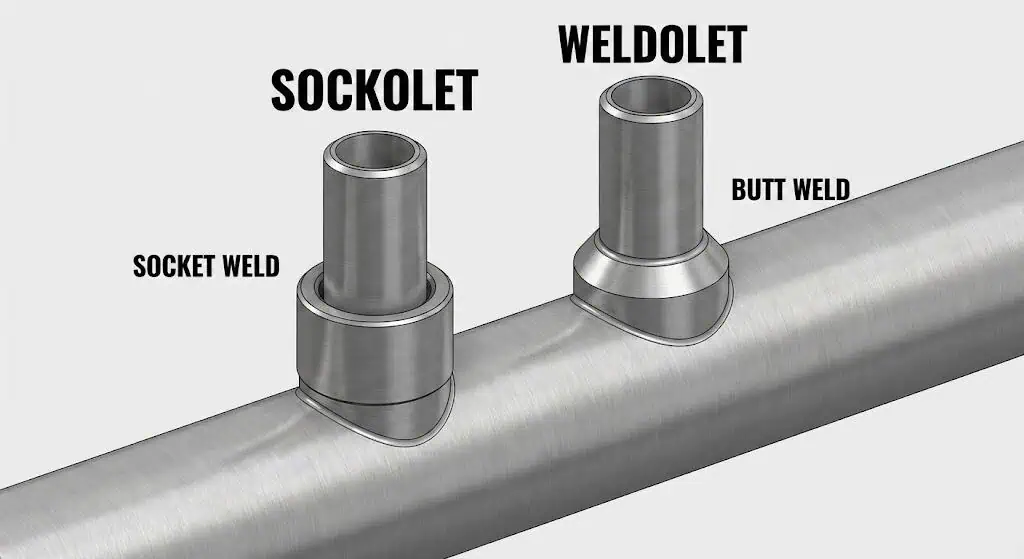
When I compare sockolet vs weldolet, the difference that actually matters on site is how the branch end is prepared and welded—not whether the fitting “slides over” the pipe. Both are forged, integrally reinforced branch outlet fittings that are fillet-welded to the outside of the run pipe. The split is at the branch end: a sockolet has a socket-weld end for small-bore branch pipe, while a weldolet has a butt-weld (beveled) end for a full-penetration groove weld. If you’re building a branch off a line that terminates at a flange, I usually check the flange standard first (ASME B16.5 / B16.47, facing type, bolt pattern) and then work backward to the branch outlet selection—especially if the branch ties into stainless steel flanges or other forged fittings.
Quick selection rule I use in the field: If the branch needs a full-penetration butt weld, better NDE access, or higher fatigue tolerance, I lean weldolet. If it’s a small branch where a socket weld is allowed by spec and installation time matters, I lean sockolet. If the spec calls for a threaded branch, that’s threadolet—but I keep it out of high-cycle vibration service unless the design explicitly allows it.
Moderate (hole cut, socket gap control, fillet weld quality)
Typical use
Critical / cyclic / higher consequence branches
Small-bore branches where socket welding is acceptable
What Is an Olet?
An olet is a reinforced branch connection fitting used to create a controlled outlet from a larger run pipe to a smaller branch pipe. The engineering value is that it provides local reinforcement around the branch opening, so I can meet branch connection design requirements without installing a full tee in many layouts. In process piping, that usually means fewer welds and less disruption to the run line—while still keeping stress and leak risk under control. Common olet types include weldolet, sockolet, threadolet, elbolet, latrolet, and more. If you need product-side selection ranges (sizes/classes/materials), I reference the forged branch outlets category here: Branch Outlets (Olets).
Field example (failure mode → cause → fix): I’ve seen “mystery seepage” around a branch that was traced to poor hole fit-up: the fitter left excessive mismatch between the outlet base and the run pipe curvature, then tried to fill it with weld metal. The weld passed a quick visual check, but micro-leaks showed up after heat cycling. The fix was to re-cut the hole, re-fit the outlet to sit flush, and weld to procedure with proper inspection hold points.
Sockolet Definition
A sockolet is a socket-weld branch outlet used to join a small branch pipe to a larger run pipe. In practice, the sockolet body sits on the outside of the run pipe like a saddle, and I insert the branch pipe into the socket. The joint is completed with a fillet weld at the socket end and a fillet weld around the outlet-to-run interface.
Socket detail that prevents real failures: For socket-weld branches, I do not bottom the pipe out in the socket. I leave a small expansion gap (typical practice is about 1/16 in / 1.6 mm, subject to spec and size) before welding. Bottoming out is a classic way to introduce high restraint and crack initiation under thermal cycling.
Sockolets are commonly used in high-pressure small-diameter piping where socket welding is permitted by the project specification (common “class” designations for socket-weld ends are tied to forged fitting standards). Typical uses: instrumentation lines, high-pressure utility branches, chemical process sample lines, and general industrial piping where socket welding is acceptable.
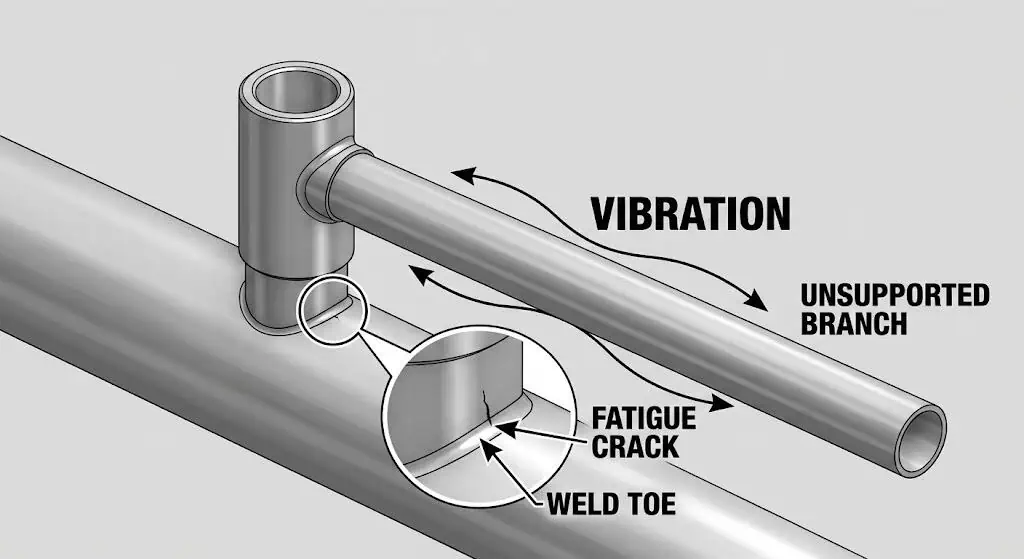
Field example (failure mode → cause → fix): A recurring issue on vibrating skid piping is fatigue cracking at the socket weld toe. Root causes are usually a combination of high vibration, short branch stubs acting like cantilevers, and inconsistent fillet size. The fix is rarely “more weld.” I shorten unsupported branch length, add support, control fillet size to WPS, and verify the socket gap practice was followed.
Weldolet Definition
A weldolet is a butt-weld branch outlet designed to create a reinforced branch connection between a run pipe and a branch pipe. It has a contoured base to match the run pipe curvature and a beveled branch end for a full-penetration groove weld. That groove weld is the key difference: it improves joint continuity, makes volumetric NDE more practical in many projects, and generally behaves better in cyclic service when designed and supported correctly.
Weldolets are preferred in higher consequence or higher temperature service where the piping code and project spec require butt-weld branch construction (for example, many B31.3 process piping projects treat butt-weld branches as the default unless specifically allowed otherwise).
Common Olet Applications
Olet fittings are used wherever a strong, leak-free branch connection is required in industrial piping. Typical applications include:
Application Type
Description
Oil and gas pipelines
Branch take-offs for instrumentation, sampling, drains, vents (spec-driven)
Power plants
High-temperature auxiliary branches and utility tie-ins
Chemical processing
Corrosive media branches where metallurgy and inspection matter
Petrochemical
Process branches with strict leak tolerance and shutdown cost
Power generation
Cooling/steam auxiliaries where cyclic loading is common
Shipbuilding
Compact branches where layout space is limited
Offshore platforms
Vibration + corrosion exposure; branch support and material choice are critical
I use olet fittings like sockolet, weldolet, and threadolet in these places. The key is to match the outlet type to the service: pressure/temperature, vibration, inspection requirement, and corrosion mechanism. If you need compatibility with flanged connections, I align the branch plan with the flange facing/standard used in the line (see stainless steel flanges and socket weld flanges where small-bore high-pressure designs are common).
Sockolet vs Weldolet Design
Structure and Connection
Sockolet and weldolet differ at the branch end (socket vs bevel) and that drives welding method, inspection, and fatigue behavior.
Sockolet uses a socket-weld branch end (fillet weld). Weldolet uses a beveled butt-weld branch end (groove weld). Both typically sit on the run pipe with a contoured base and are welded around the outlet-to-run interface to secure the saddle and seal the opening.
Here’s a table that shows the practical differences I check before approving a branch outlet choice:
Feature
Sockolet
Weldolet
Branch weld type
Fillet weld (socket-weld end)
Full-penetration groove weld (butt-weld end)
Typical branch size
Small bore branches (spec-dependent)
Small to large branches (spec-dependent)
Inspection practicality
Mostly VT/PT/MT; volumetric NDE is limited
Volumetric NDE often feasible per project spec
Cyclic/vibration service
Acceptable when supported and detailed correctly; watch weld toe fatigue
Typically preferred for cyclic/consequence service when designed correctly
Field example (failure mode → cause → fix): On a hot line with frequent thermal cycles, I’ve seen sockolet branches develop toe cracks. The immediate cause was a stiff branch with no flexibility plus an over-sized fillet with poor profile (high stress concentration). The corrective action was adding support/flexibility, re-profiling weld per WPS, and verifying the socket gap practice.
If I want to connect to a flange system, both types can be designed to work. The difference is whether the branch needs a butt-weld end or socket-weld end and whether the project spec allows it. For flange selection and facing compatibility, I cross-check the line’s flange standard: Sunhy stainless steel flanges.
Size and Pressure Range
Size and pressure capability are specification-driven; I treat catalog ranges as “typical engineering range” and confirm against the line class and piping code. Instead of quoting a single “9000#” headline rating, I verify: run pipe schedule, branch schedule, design pressure/temperature, and the outlet end type. In many projects, socket-weld outlet classes (e.g., 3000 / 6000) are referenced for the branch end, while the outlet-to-run reinforcement and weld details are governed by the piping code and project specification.
Here’s a practical “what I see most often” range (typical engineering range, affected by schedule, material grade, design temperature, and project spec):
Type
Common branch end form
Common size window (typical)
How I validate suitability
Weldolet
Butt-weld
Small to large branches (project-dependent)
Branch calc / reinforcement check + groove weld WPS + NDE plan
Sockolet
Socket-weld
Small-bore branches (project-dependent)
Socket-weld allowance in spec + gap control + vibration/support check
Confirm the piping code branch reinforcement requirement and any client addenda.
Confirm branch end type is allowed (socket weld vs butt weld vs threaded) for the service category.
Confirm design temperature/pressure derating and material grade.
Material Compatibility
Material choice is not just corrosion resistance—it’s weldability, toughness, and service mechanism compatibility. Most sockolets and weldolets are supplied in forged grades. Typical specifications I see on drawings include carbon steel (e.g., A105), low-temperature carbon steel (e.g., A350 grades), and stainless/alloy forgings (e.g., ASTM A182 families). Stainless steel outlets are common where chloride exposure, washdown, or chemical media raise corrosion risk, and they pair naturally with stainless steel flanges. Carbon steel is widely used but often needs coating/CP strategy and careful water chemistry control if corrosion is a concern.
Here’s a quick compatibility checklist I use:
Metallurgy match: outlet grade compatible with run pipe and branch pipe (weld procedure and filler selection).
Bevel end preparation requirements for butt-weld ends
Tip: I do not pick an outlet material in isolation. I check the line class, welding procedure, and the corrosion/toughness mechanism that actually governs life.
Installation
Installing a Sockolet
Installing a sockolet is efficient, but it still needs qualified welding practice and gap control. My sequence is consistent:
Mark and cut the run pipe opening to the required branch size and orientation.
Fit the sockolet base to sit flush on the run pipe curvature (no “bridge gaps” with weld metal).
Insert the branch pipe into the socket and leave the expansion gap (typical practice ~1/16 in, spec-controlled).
Tack and weld to WPS: outlet-to-run weld and the socket end fillet weld, with controlled fillet profile.
Inspect per project plan (VT, and PT/MT as required; hold points are common on critical lines).
Tip: The two biggest leak drivers I see are (1) poor outlet-to-run fit-up and (2) sloppy socket weld profile. Fix those, and a lot of “mystery leaks” disappear.
Installing a Weldolet
Installing a weldolet is slower because it’s a groove-weld branch end and usually carries a tighter inspection expectation. My typical sequence:
Cut/cope the run pipe opening with correct orientation and edge preparation.
Fit the weldolet base to match the run pipe curvature; minimize mismatch before welding.
Fit the branch pipe to the bevel and set the groove weld geometry per WPS.
Weld full penetration (root, fill, cap) per qualified WPS; control heat input where metallurgy demands it.
NDE per spec (VT plus PT/MT; RT/UT where required/feasible).
Here’s a table showing common installation risks I plan around for sockolet vs weldolet:
Challenge Type
Description
Fit-up control
Misfit at outlet base or groove geometry increases defect risk and leak probability after cycling.
WPS/Welder qualification
Groove welds typically demand stricter qualification and inspection hold points.
Inspection access
Weldolet branches often require a clearer NDE plan; geometry and location can constrain UT/RT.
Tools and Skills Needed
I need the right tools and the right level of welding control for a safe installation. For both sockolet and weldolet, I use pipe cutting tools, grinders, alignment aids, and welding equipment. The real “skill divider” is quality control: fit-up, weld profile, and inspection discipline.
Here’s a quick checklist:
Pipe cutter / hole saw / boring tools (depending on wall thickness and access)
Grinder for fit-up and prep
Welding equipment matched to material and procedure
Measuring tools (square, level, calipers) + thread tools if a threadolet is involved
Safety gloves, face shield, and hot-work controls
Note: I don’t treat socket welds as “beginner welds.” On pressure piping, I still require qualified practice and inspection discipline.
I apply the same discipline to all outlet types, including threadolet. Picking the right outlet and executing fit-up + welding correctly is what keeps the branch from becoming the weak link.
Performance
Load and Pressure Handling
In real service, performance is driven by branch detail, support, and cyclic loading—not just the outlet nameplate. Weldolet branches typically perform better when the branch is stressed by vibration, thermal cycling, or bending because the groove-welded branch end provides a more continuous load path (when designed and executed correctly). Sockolet branches can perform well in many services, but I watch for fatigue at the fillet weld toe and I avoid long unsupported branch stubs.
Here’s a practical comparison view (typical engineering guidance; final selection must match piping code + line class + project spec):
Fitting
Load Capacity (typical behavior)
Where it shines
Primary watch-outs
Weldolet
High (good for cyclic/consequence when detailed correctly)
Critical service, higher fatigue demand, NDE expectations
Fit-up and penetration quality; heat input control
Sockolet
Moderate to high (service-dependent)
Small-bore branches, quicker installs when socket weld allowed
Socket gap practice; weld toe fatigue; crevice/corrosion in deposits
Tip: If the branch sees vibration, I decide support first. Outlet type alone won’t save an unsupported cantilever.
Durability and Maintenance
Weldolet joints are often easier to manage in long-life service because groove-weld branches can align with stricter inspection programs. Sockolet durability is very service-dependent. If the branch traps deposits or sees frequent thermal cycles, I inspect more often and pay attention to weld toe indications. In corrosive services, stainless helps, but geometry still matters—crevice and under-deposit corrosion risk does not vanish just because the alloy is “better.”
Here’s what I do to keep branch outlets working:
Inspect welds for cracking indications (especially at fillet weld toes)
Check branch supports and vibration sources after commissioning changes
Confirm material traceability (MTR) on critical lines
Keep deposits under control where under-deposit corrosion is a known risk
Note: Regular inspection works best when the branch detail is consistent and documented—outlet type, welding procedure, and inspection method should be traceable.
Pros and Cons
Sockolet Advantages and Disadvantages
Sockolet installs efficiently for small branches, but it is sensitive to socket detail, vibration, and deposit-related corrosion mechanisms. When I use a sockolet, the work can move fast if fit-up and gap practice are controlled. Where people get burned is assuming “socket weld = easy.” On pressure piping, poor profile, poor gap control, and poor support show up later as seepage or toe cracking.
Here’s a table that shows the main pros/cons in engineering terms:
Advantages of Sockolets
Disadvantages of Sockolets
Compact branch detail for small bore take-offs
Socket weld toe is a common fatigue initiation point in vibration service
Efficient installation when socket welding is allowed by spec
Socket gap and fillet profile must be controlled; poor practice causes cracking
Useful on instrumentation and utility branches
Inspection options can be more limited vs groove-weld branch ends
I pick sockolet when the service and spec allow socket welding and the branch loads are controlled. For threaded branches, I use threadolet only where the design permits and the consequences are acceptable.
Tip: If you choose sockolet on a vibrating skid, budget time for support and inspection planning—don’t treat it as a “quick fitting.”
Weldolet Advantages and Disadvantages
Weldolet is the branch outlet I rely on for higher consequence, cyclic service, and projects that demand stronger inspection alignment. A properly executed full-penetration branch weld provides a robust load path and can be integrated into stricter NDE programs when required by the client or code. Material-wise, weldolets are commonly specified in forged grades aligned with the line material strategy, and they integrate well in systems that also use forged flanges (see stainless steel flanges).
Here’s a realistic pros/cons table (not a marketing list):
Advantages of Weldolets
Disadvantages of Weldolets
Groove-weld branch end supports full-penetration welding practice
Higher installation time and stricter WPS/WPQ expectations
Often preferred for cyclic / critical service when designed correctly
Fit-up and penetration quality are non-negotiable; defects are costly to repair
Better alignment with volumetric NDE programs (project-dependent)
Heat input control can be critical on certain alloys and wall thicknesses
Good stress distribution with contoured base when fitted correctly
Branch location geometry can constrain NDE access
Weldolet is rarely the “wrong” technical choice. It becomes the wrong choice only when the project cannot support the welding/inspection discipline it requires.
Note: For branches that matter—high consequence media, cycling, or shutdown cost—weldolet is usually where I start the discussion.
How to Choose
Application Scenarios
I match the outlet type to the service category, not the installer preference. If the branch is small and the spec allows socket welding, sockolet can be a clean solution. If the branch is in a location with vibration, thermal cycling, or strict inspection requirements, weldolet is usually the safer engineering option. If the line is dominated by forged flanges and small-bore high pressure details, I also cross-check related components like socket weld flanges so the assembly strategy stays consistent.
Here’s a table that helps me decide quickly:
Type
Application Scenario
Sockolet
Small-bore branch where socket welding is allowed, loads are controlled, and fast installation is valuable
Field example (failure mode → cause → fix): A weldolet branch leaked only after hydrotest temperature swings. The groove weld looked fine visually; PT later showed a linear indication tied to poor root control. Repair required excavation and re-weld to qualified WPS, then re-test. The lesson: groove welds “look fine” until you inspect them properly.
Key Selection Factors
I focus on three things: service severity, branch loads, and specification constraints. When I select an outlet, I check the branch end type allowed by spec (socket vs butt vs threaded), the pressure/temperature line class, and whether the branch is likely to see vibration or thermal cycling. Material compatibility matters too. If I’m unsure, I align with the manufacturer’s dimensional and material guidance for branch outlets: Sunhy branch outlets (olets).
Here’s a table that shows what I consider:
Fitting Type
Connection Type
Typical selection driver
Pipe Size Suitability
Welding Required
Weldolet
Butt-weld branch end + fillet to run
Cyclic / critical / NDE-driven branch detail
Small to large (project-dependent)
Yes (groove + fillet)
Sockolet
Socket-weld branch end + fillet to run
Small-bore branch where socket welding is allowed
Small-bore (project-dependent)
Yes (fillet)
I also use this checklist:
Confirm end type allowed by spec and service category
Plan branch support (especially on vibrating systems)
Confirm material grade + traceability requirements
Confirm inspection method and access before fabrication
If I feel unsure, I reach out to a manufacturer with a clear product spec and engineering support. I want documented ranges, material traceability, and dimensional consistency so the branch isn’t built on guesswork.
Tip: The right outlet choice is the one that survives your real loads and your real inspection plan—not the one that looks fastest on paper.
When I compare sockolet and weldolet, I treat them as two different branch-end welding strategies. The table below makes the core difference easy to see:
Feature
Sockolet
Weldolet
Branch end weld
Socket-weld (fillet)
Butt-weld (full-penetration groove)
Best-fit service pattern
Small-bore branches where socket weld is allowed
Cyclic / critical / inspection-driven branches
Typical risk focus
Gap control + weld toe fatigue + deposits
Fit-up + penetration quality + NDE access
Installation effort
Moderate
Higher
I always look at pressure, pipe size, vibration/cycling, and metallurgy before picking an outlet. If I am not sure, I check the project spec and confirm with engineering support. Choosing the right outlet keeps the branch from becoming the first failure point.
FAQ
What is the main difference between a sockolet and a weldolet?
A sockolet has a socket-weld branch end; a weldolet has a butt-weld (beveled) branch end. Both are welded to the outside of the run pipe, but the branch end detail drives welding method, inspection approach, and fatigue behavior.
Fitting
Branch End Connection Type
Sockolet
Socket Weld
Weldolet
Butt Weld
Can I use both sockolet and weldolet with stainless steel flanges?
Yes—both can be used in systems that connect to stainless steel flanges, as long as the material grade and welding procedure are compatible. I verify metallurgy (run/branch/outlet), welding procedure, and flange standard/facing. For flange selection references, see stainless steel flanges.
Which fitting is easier to install?
Sockolet is usually faster in small-bore work when socket welding is allowed, but it still needs gap control and qualified welding practice. Weldolet generally takes longer because it involves a groove weld branch end and often tighter inspection expectations.
When should I choose a weldolet over a sockolet?
I choose weldolet for cyclic/vibration service, higher consequence branches, or when the specification prefers butt-weld branch construction. If inspection requirements are strict or fatigue risk is high, weldolet is typically the more conservative engineering choice.
Do I need special tools for installing these fittings?
I need standard fabrication and welding tools for both, but weldolet usually demands tighter fit-up control and a groove-weld procedure. Here’s my checklist:
Pipe cutting / hole making tools
Grinder for prep and fit-up
Welding equipment matched to material and WPS
Measuring tools for alignment control
Safety gear and hot-work controls
Sockolet installation is typically simpler. Weldolet requires more fit-up control and inspection planning.