To measure hex bolt dimensions, use exact tools to check bolt length, bolt diameter, and thread pitch. Measuring hex bolts the right way helps you pick the correct fastener and makes sure it fits. Sunhy gives traceable, high-quality industrial fasteners in many materials, so measuring right is important. Many mistakes happen when people measure hex bolt length over the head or mix up bolt diameter with wrench size. The table below shows common mistakes when measuring a bolt:
| Common Measurement Errors in Ordering Hex Bolts |
|---|
| Measuring over dirt, debris, or burrs. |
| Using too much force with calipers. |
| Holding calipers at the wrong angle. |
| Not checking more than once. |
Use easy tools to measure hex bolt dimensions, like digital calipers and thread gauges, to stop mistakes when measuring hex bolts and bolt dimensions.
Essential Metrology Tools for Fasteners
Why Digital Calipers are Mandatory for Diameter (vs. Tape Measures)
Digital calipers are mandatory for measuring hex bolt diameter because they provide precise and repeatable results.
A digital caliper shows the number right away. This makes it easy to read and helps stop mistakes. Tape measures and rulers are not as exact, especially for small or important sizes.
- Calipers check the diameter across the shank of a hex bolt with great accuracy.
- They also help you measure hex bolt length and thread details.
- Bolt gauges and rulers can be used, but only calipers give the accuracy needed for big jobs.
For important or heavy-duty projects, being exact is very important. Calipers and a thread gauge help you get the right measurement every time.
The table below shows how digital calipers and analog tools are different:
| Feature | Digital Calipers | Analog Tools |
|---|---|---|
| Readout Type | Direct numerical readouts | Manual interpretation |
| Parallax Error | Eliminated | Present |
| Measurement Speed | Improved | Slower |
| Data Output Capabilities | Yes (USB/Bluetooth) | No |
| User Error Susceptibility | Lower | Higher |
Using Thread Pitch Gauges (Metric and Imperial Leaves)
Thread pitch gauges are essential for identifying the thread type and pitch on a hex bolt.
A thread pitch gauge has many leaves. Each leaf has teeth that match certain thread shapes. This tool helps you find out if a hex bolt has metric or imperial threads and if the thread is coarse or fine.
- Calipers and thread pitch gauges are the main tools for measuring hex bolt dimensions in factories.
- Calibration is very important for thread pitch gauges. If a gauge is worn out or not checked, it can give wrong results. This can make you use the wrong hex bolt for your job.
- You should match the gauge leaf to the threads on the hex bolt, make sure it fits just right, and check calibration often.
Tip: Always check the gauge’s calibration before you use it to measure hex bolt pitch. This helps you get good and steady results.
A thread pitch gauge that is checked and working well, along with a digital caliper, lets anyone measure hex bolt dimensions the right way and with confidence.
Measuring Length: The “Under-the-Head” Standard
The Bearing Surface Rule: Why Including the Head is a Critical Error
Always measure hex bolt length from under the head, not over it.
Including the head in the measurement gives a false length. The correct length starts at the bearing surface, which is the flat part under the head that touches the material. Measuring over the head can cause the bolt to be too long or too short for the job. This mistake often leads to unstable assemblies or fitting issues.
Tip: The bearing surface is the only part that matters for length because it sits flush against the material.

Step-by-Step Measurement Guide (From Under Head to Blunt End)
Follow these steps to measure hex bolt length correctly:
- Place the hex bolt on a flat surface.
- Align a digital caliper or ruler at the bearing surface under the head.
- Extend the tool to the blunt end of the bolt (not the tip of the head).
- Read the measurement in millimeters or inches.
Common errors in the field include:
- Missing size, which can cause fitting problems and reduce strength.
- Using the wrong thread type, which may strip or jam threads.
- Choosing the wrong length, which can lead to weak clamping and shifting parts.
Note: Correct bolt size ensures assembly efficiency and prevents stripped threads.
Exception Handling: Countersunk Screws (Total Length) vs. Hex Bolts
Measure the total length for countersunk screws, but use the under-the-head rule for hex bolts.
Countersunk screws sit flush with the surface, so their full length counts. Hex bolts have a head that stays above the surface, so only the shank length matters.
| Fastener Type | Where to Measure Length |
|---|---|
| Hex Bolt | Under the head to blunt end |
| Countersunk Screw | Entire length, including the head |
Manufacturers use ISO standards to keep hex bolt length consistent across batches. These standards set clear rules for size and shape, which is crucial for industries like construction and automotive. Production follows strict controls, so each hex bolt meets the right specifications and performs under stress. Traceability ensures every fastener can be tracked from raw material to finished product.
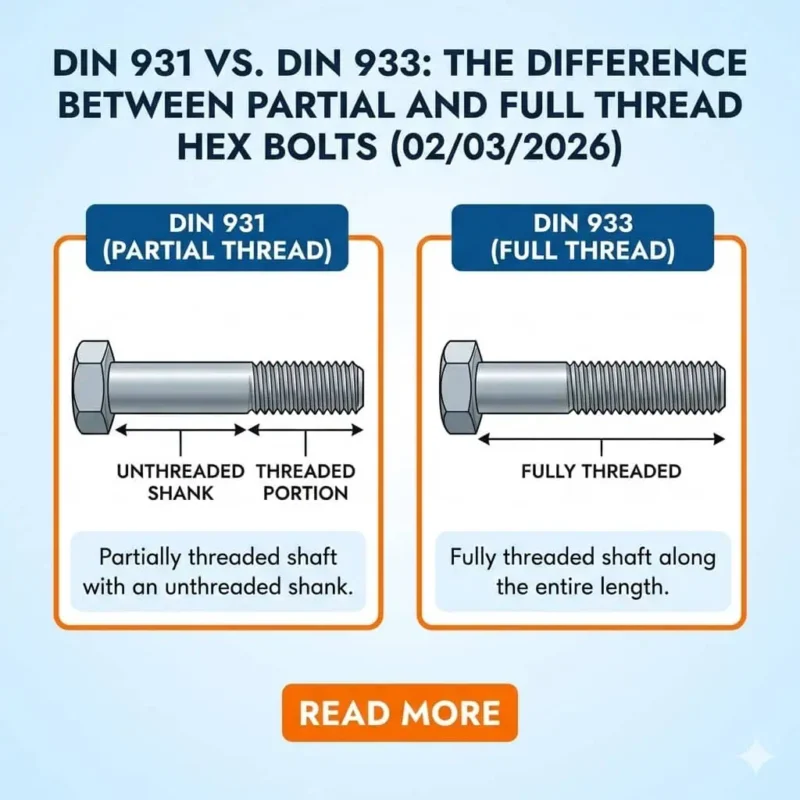
Measuring Diameter vs. Width Across Flats (WAF)
The Common Mistake: Confusing Wrench Size (WAF) with Thread Diameter
The most common mistake is confusing the wrench size (WAF) with the thread diameter of a hex bolt.
A lot of people think the wrench size for the hex bolt head is the same as the thread diameter. This mix-up can cause big problems when putting things together or fixing them.
- If you pick the wrong bolt size, things might break.
- Safety problems can happen, like a wrench slipping and hurting someone.
- Bolts can get damaged and be hard to take out. You might need special tools.
To pick the right hex bolt, you need to know the difference between thread diameter and width across flats. Thread diameter tells you if the bolt will fit in a hole or nut. Width across flats tells you what size wrench you need.
Measuring Major Diameter (OD) on the Threads
Measure the major diameter (OD) of a hex bolt by using a digital caliper across the outermost threads.
The major diameter is the thickest part of the threads. This number shows the real size of the bolt’s shank. It helps you find the right nut or hole for the bolt.
Tip: Always check a few spots along the threads to see if they are worn or damaged.
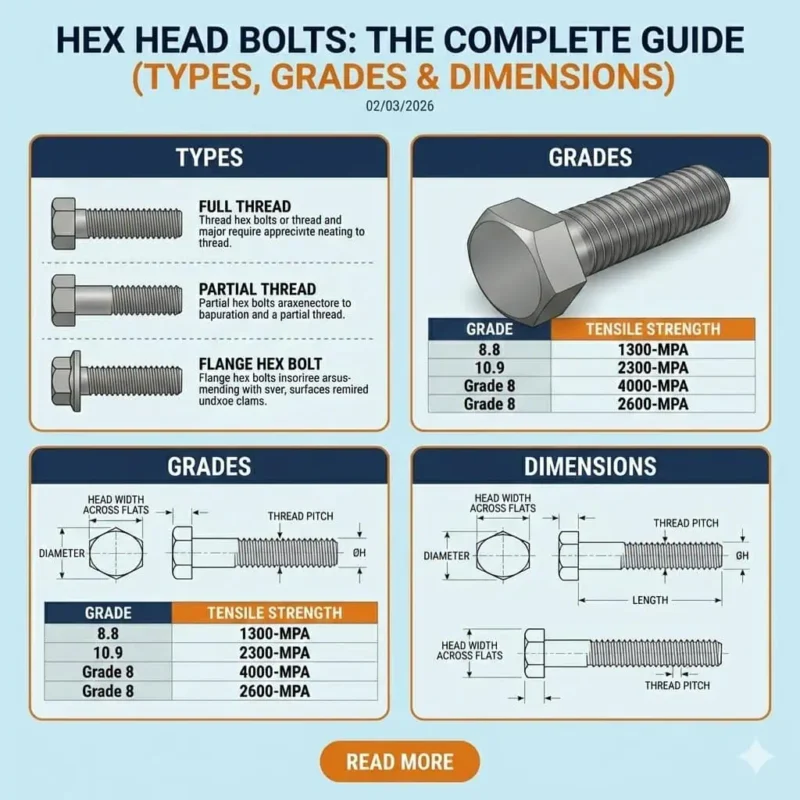
The table below explains the main ways to measure hex bolts:
| Measurement Type | Description |
|---|---|
| Body Diameter | Actual diameter range of the bolt shank, shows permissible sizes. |
| Width Across Flats | Distance between flat sides of the hex head, important for wrench fit. |
| Width Across Corners | Diagonal distance across the hex head, needed for clearance in tight spaces. |
| Head Height | Height from base to top of the bolt head, ensures enough clearance for installation. |
| Thread Length | Standard lengths for screws, varies by application. |
| Max & Min | Range of measurements for industry specifications, ensures compatibility. |
| Ref | Reference dimension for information, not subject to strict tolerances. |
Standard Reference Table: ISO Head Sizes vs. Nominal Diameters
ISO standards set the relationship between hex bolt head sizes and nominal diameters.
Manufacturers use these rules to make sure fasteners work the same way everywhere. The table below shows some common ISO head sizes for hex bolts:
| Nominal Size (Inches) | Full-Size Body Diameter (E) | Width Across Flats (F) | Width Across Corners (G) | Head Height (H) | Radius of Fillet (R) | Thread Length (LT) |
|---|---|---|---|---|---|---|
| 1/4″ | 0.260 | 0.237 | 7/16″ | 0.438 | 0.425 | 0.505 |
| 5/16″ | 0.324 | 0.298 | 1/2″ | 0.500 | 0.484 | 0.577 |
| 3/8″ | 0.388 | 0.360 | 9/16″ | 0.562 | 0.544 | 0.650 |
| 1/2″ | 0.515 | 0.482 | 3/4″ | 0.750 | 0.725 | 0.866 |
| 1″ | 1.022 | 0.976 | 1-1/2″ | 1.500 | 1.450 | 1.732 |
| 2″ | 2.039 | 1.964 | 3″ | 3.000 | 2.9000 | 3.464 |

Note: Always check both the thread diameter and the width across flats before picking a hex bolt for your project. This makes sure the bolt fits the hole and the wrench fits the head.
Determining Thread Pitch and Count (TPI)
Metric Pitch (Distance in mm) vs. Imperial TPI (Threads Per Inch)
Metric pitch measures the distance between threads in millimeters, while imperial TPI counts the number of threads per inch.
Metric hex bolt threads use a number that shows the space between each thread. For example, a metric pitch of 1.5 means there is 1.5 mm between each thread. Imperial hex bolt threads use TPI, which stands for threads per inch. A TPI of 13 means there are 13 threads in one inch.
The table below shows common thread pitch values for hex bolts used in construction and manufacturing:
| Nominal Size and Threads Per In. | Basic Pitch Dia. | Section at Minor Dia. | Tensile Stress Area |
|---|---|---|---|
| 3⁄8 – 16 | 0.3344 | 0.0678 | 0.0775 |
| 7⁄16 – 14 | 0.3911 | 0.0933 | 0.1063 |
| 1⁄2 – 13 | 0.4500 | 0.1257 | 0.1419 |
| 9⁄16 – 12 | 0.5084 | 0.162 | 0.182 |
| 5⁄8 – 11 | 0.5660 | 0.202 | 0.226 |
| 3⁄4 – 10 | 0.6850 | 0.302 | 0.334 |
| 7⁄8 – 9 | 0.8028 | 0.419 | 0.462 |
| 1 – 8 | 0.9188 | 0.551 | 0.606 |
| 11⁄4 – 7 | 1.1572 | 0.890 | 0.969 |

Tip: Metric bolts are common in Europe and Asia. Imperial bolts are often used in the United States.
How to Use a Thread Gauge to Identify Coarse vs. Fine Threads
A thread gauge helps match the threads on a hex bolt to the correct pitch or TPI.
A thread gauge has many blades, each with teeth for a different pitch. To use it, match the gauge teeth with the hex bolt threads until you find a perfect fit. This method gives the most accurate result for both metric and imperial bolts.
Steps to measure thread pitch or TPI on a hex bolt:
- Select a thread gauge blade and place it against the bolt’s threads.
- Check if the teeth fit perfectly into the threads.
- If the gauge is not available, mark a one-inch section on the bolt and count the number of thread peaks. This number is the TPI.
Thread gauges help users tell if a hex bolt has coarse or fine threads. Coarse-thread bolts have fewer, deeper threads. They work well in construction. Fine-thread bolts have more threads per inch. They give a tighter hold, which is good for machinery.
Note: Using a thread gauge ensures the right match. Even a small error can lead to the wrong hex bolt choice.
Threads fall into groups like coarse (UNC) and fine (UNF). Knowing the group helps pick the right hex bolt for the job. Always check the diameter, pitch, and thread system for the best fit.
Summary: The 3-Step Verification Protocol
Always follow a 3-step protocol to verify hex bolt measurements before ordering.
This process makes sure every hex bolt fits and works the way you want.
- Measure the Length:
Put the hex bolt flat or stand it up. Place the caliper or ruler right under the head, not on top. Measure straight to the end of the threads or point. Write down the number in millimeters or inches. Round it to the closest standard size.Only measure from the bearing surface under the head to the end. - Check the Diameter:
Use a digital caliper to measure across the outside threads. This gives you the major diameter. The major diameter tells you how much weight the bolt can hold and if it will fit.Do not mix up diameter with the wrench size. - Identify the Thread Pitch:
Use a thread pitch gauge to match the threads. For metric bolts, measure the space between threads in millimeters. For imperial bolts, count the number of threads in one inch.The pitch must match the nut or tapped hole for proper assembly.
Quick Reference Table: Where to Measure (Length, Dia, Pitch)
| Parameter | Common Range | Where to Measure | Purpose |
|---|---|---|---|
| Length | 12–200 mm | Under the head to the end of threads | Makes sure the bolt fits right |
| Diameter | 6–50 mm | Across the outermost threads | Shows how much weight the bolt can hold |
| Thread Pitch | 1–6 mm | Between adjacent threads (or TPI) | Must match nut or tapped hole |
| Head Width | 10–80 mm | Across flats of the hex head | Tells you what size wrench to use |
Always check your measurements twice before you order. This protocol helps stop mistakes and makes sure the hex bolt is right for the job.
Measuring a hex bolt the right way helps keep things safe and strong for a long time.
People in factories use three main steps:
- Measure diameter by putting a caliper on the threads.
- Measure length starting under the head and going to the end.
- Measure pitch with a thread gauge or by counting the threads.
Check your measurements twice and use the correct tool each time. Sunhy checks every order for size and keeps track of each batch.
Look at the summary table before you buy bolts. If you need special or regular fasteners, ask Sunhy for a price.
FAQ
How does someone measure hex bolt length correctly?
Measure from under the head to the end of the bolt.
Start at the flat part under the head. Do not include the head in your measurement. This way, the bolt will fit the job the right way.
What tool gives the most accurate bolt diameter measurement?
A digital caliper provides the most accurate measurement.
Digital calipers check the diameter across the threads. They give exact and repeatable numbers. Tape measures and rulers are not as good for small bolts.
How can a person tell if a hex bolt has coarse or fine threads?
Use a thread pitch gauge to check the thread type.
Pick a gauge leaf and match it to the bolt’s threads. Coarse threads have fewer, deeper lines. Fine threads have more, shallow lines. The gauge tells you the exact pitch or TPI.
Why is it important not to confuse wrench size with bolt diameter?
Wrench size (WAF) and bolt diameter are different measurements.
Wrench size is the distance across the flat sides of the head. Bolt diameter is the width of the threaded part. Mixing them up can make you order the wrong bolt.
What should someone do before ordering hex bolts?
Double-check all measurements and use the correct tools.
Check the length, diameter, and pitch again. Use digital calipers and thread gauges for best results. Look at standard tables to make sure. This helps you avoid mistakes and get the right bolt.