DIN 931 hex bolts are typically supplied with a partially threaded shaft (unthreaded shank + threaded end), while DIN 933 hex bolts are fully threaded. In real projects, this is not a “small” difference. It affects where the shear plane lands, how well parts align during assembly, how much thread engagement you can achieve, and how easy it is to control preload without damaging threads or driving galling. If you care about joint reliability, think in load paths: shear stress at the bearing zone, thread engagement at the nut/tapped hole, and friction (K-factor) during tightening.
Direct field rule: Choose DIN 931 when the joint is shear-sensitive and you want the unthreaded shank to sit in the shear plane (when possible). Choose DIN 933 when you need full thread engagement (thin materials, tapped holes, variable thickness stack-ups), and when shear is not governed by threads in the joint.
Partially threaded bolts are often preferred in structural and machinery joints because the unthreaded shank can provide a smoother bearing surface and reduce notch sensitivity when the design places the shear plane in the shank area. Fully threaded bolts are often preferred when you need maximum thread engagement or adjustability. The mistake I see most often is choosing “full thread vs partial thread” by habit, then discovering at assembly that threads are sitting in the bearing zone, or that engagement is short once you account for washers, chamfer, and thread runout.
Sunhy supplies industrial hex fasteners engineered for demanding environments, supporting both DIN and ISO standards (ISO 4014 and ISO 4017) with inspection records and traceable batches when required.
- Partially threaded bolts can improve shear performance when the shear plane passes through the unthreaded shank.
- Structural joints and machinery assemblies often benefit from the unthreaded shank for alignment and bearing.
- Fully threaded bolts simplify procurement for thin parts, tapped holes, and variable stack-ups where thread engagement is the main constraint.
DIN 931 and DIN 933 Overview
What Is DIN 931?
DIN 931 hex bolts are commonly supplied as partially threaded fasteners intended for joints where alignment and shear transfer matter.
DIN 931 bolts typically include an unthreaded shank between the head and the threaded portion. If your design places the shear plane in the unthreaded shank, you reduce the chance of threads carrying shear or getting damaged by bearing contact. This is one reason DIN 931 (or its common ISO counterpart ISO 4014) is widely used in structural frames, machinery bases, and general engineering assemblies.
Engineering note: “partially threaded” does not guarantee threads will never enter the joint. The unthreaded shank length depends on bolt length per the applicable standard. Always check the grip length vs. thread length on the drawing.
| Feature | What to Verify on the Drawing / Spec |
|---|---|
| Nominal size range | Diameter, length, and pitch (coarse vs fine) required by the joint |
| Thread length vs. grip length | Confirm the unthreaded shank covers the shear plane where intended; account for washers and stack-up |
| Underhead geometry | Check underhead fillet, chamfer, and whether the bearing surface matches your washer/plate contact |
| Product grade / tolerances | Confirm product grade (A/B), tolerance class, and any customer-specific dimensional constraints |
What Is DIN 933?
DIN 933 hex bolts are fully threaded fasteners typically used where full thread engagement or adjustability is the controlling requirement.
DIN 933 bolts have threads running from the tip up to the underside of the hex head. This is practical for thin parts, variable thickness stack-ups, and applications using tapped holes. DIN 933 is also commonly paired with ISO 4017 in international procurement, but interchangeability must be checked against the drawing because some sizes may differ in wrench size (WAF) and supply conventions.
- DIN 933 suits assemblies requiring maximum thread engagement, especially in thin or tapped-hole applications.
- Fully threaded bolts simplify inventory when many lengths are needed but thread engagement must remain consistent.
Key Differences in Threading
The main difference between DIN 931 and DIN 933 is whether the joint includes an unthreaded shank section.
That difference affects shear transfer, bearing behavior, alignment, and how tolerant the joint is to minor fit-up variations. It also affects preload control: if threads are bearing or damaged, your torque-to-preload relationship becomes unstable and clamp load scatter increases.
| Bolt Type | Threading Type | Where It Usually Fits Best |
|---|---|---|
| DIN 933 | Fully threaded | Clamping/tension-driven joints, tapped holes, thin or variable stack-ups |
| DIN 931 | Partially threaded | Shear-sensitive joints where the design places the shear plane in the shank; alignment-sensitive assemblies |
Selection reminder: The “best” bolt is the one that matches how the joint carries load. If the joint is governed by shear/bearing, prioritize where the shear plane lands. If the joint is governed by thread engagement, prioritize full engagement and correct bolt length.
Hex Bolt Dimensions Guide: DIN 931 vs. DIN 933
DIN 931 and DIN 933 differ in thread coverage and standard thread length rules, which can change how much unthreaded shank sits inside your joint.
This section focuses on what engineers and buyers should actually check: diameter/length availability, shank vs thread length, and practical fit constraints (tool clearance, WAF, and stack-up).
Standard Dimensions and Ranges
Both DIN and ISO families cover broad diameter and length ranges. In procurement, you’ll often see “DIN 931 / ISO 4014” and “DIN 933 / ISO 4017” listings. For project control, always reference the governing standard and the drawing dimensions as the acceptance basis.
| Diameter Range | Length Range |
|---|---|
| M3 to M64 (varies by standard/vendor) | Commonly 25 mm to 200+ mm depending on size and product grade |
Sunhy aligns its offering with industry standards, supporting catalog-standard and custom sizes where engineering drawings define the acceptance criteria.
Shank Length vs. Full Thread Length
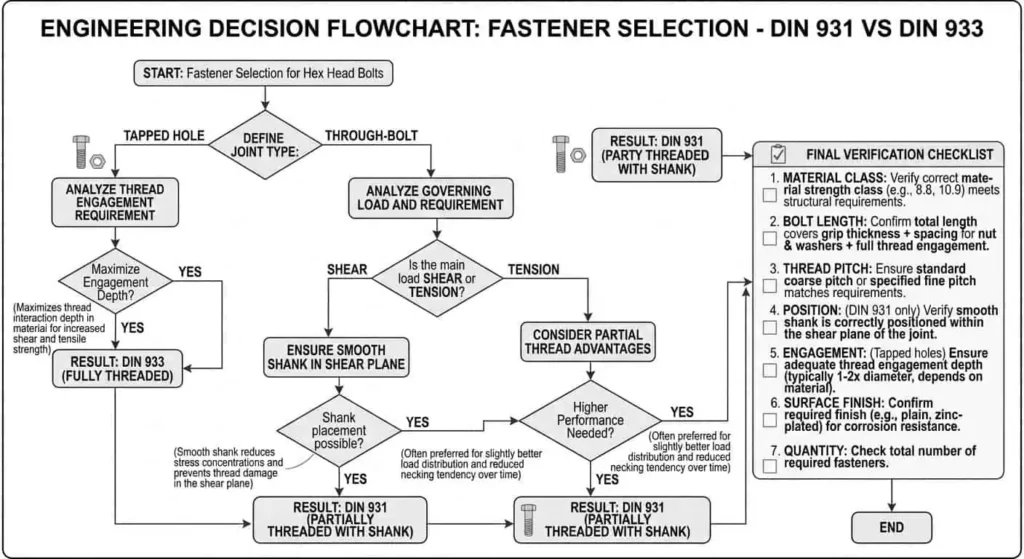
The difference in shank and thread length drives real joint behavior. Use this checklist logic rather than relying on “partial thread = stronger” as a blanket rule:
- Step 1 (joint type): Is it a through-bolt joint with clearance holes, or a tapped-hole joint?
- Step 2 (governing load): Is the joint governed by shear/bearing, or mainly by axial clamp/tension?
- Step 3 (shear plane location): If shear is critical, can the design place the shear plane in the unthreaded shank?
- Step 4 (thread engagement): If thread engagement is critical, do you have enough full threads through the nut/tapped depth after accounting for washers and runout?
- DIN 931 bolts can provide a smooth bearing surface in the joint and reduce the chance of threads being damaged by shear/bearing contact.
- DIN 933 bolts maximize thread engagement and simplify selection when thickness varies.
- For short lengths, a “partially threaded” standard may still result in threads entering the joint. Always check the thread-length rules for the specific size/length.
Practical check: If your drawing intends the unthreaded shank to sit in the shear plane, verify the grip length (total clamped thickness) against the bolt’s standard thread length. If the grip is longer than the unthreaded shank, threads may end up in the joint.
Thread engagement guidance (field-typical, project-dependent): For steel nuts in steel joints, many engineers target about 1.0D–1.5D effective engagement (D = nominal diameter). If you are in soft materials, thin plates, or critical fatigue service, treat engagement as a designed parameter and validate by drawing/spec rather than rules of thumb.
Typical Diameter and Length Options
Both DIN 931 and DIN 933 are offered in common diameters and lengths, but availability varies by market. For controlled projects, specify diameter, length, thread pitch, strength class, coating, and the governing standard on the PO.
| Bolt Type | Diameter Range | Typical Use Note |
|---|---|---|
| DIN 931 | M4 to M48 (commonly stocked ranges vary) | Common for structural and machinery through-bolt joints where shear/bearing may matter |
| DIN 933 | M3 to M42 (commonly stocked ranges vary) | Common for clamping/tapped-hole joints and variable thickness assemblies |
Sunhy offers hex bolts in sizes from M3 to M64, supporting various materials, coatings, and strength classes where specifications require them.
| Feature | Details |
|---|---|
| Size Range | M3 to M64 |
| Customization Options | Materials, coatings, strength classes per drawing/spec |
| Industry Standard Alignment | DIN / ISO per procurement requirements |
Procurement note: If tools or sockets are standardized on-site, include WAF/tool clearance as a controlled requirement, especially for sizes where DIN and ISO can differ.
Structural Integrity and Shear Strength
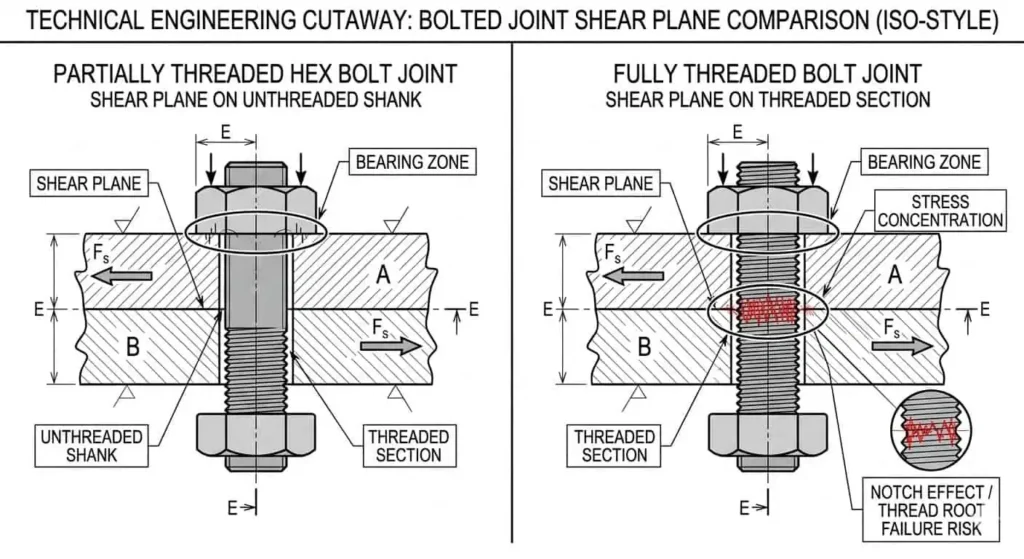
Shear Applications and Unthreaded Shank
DIN 931 partially threaded bolts can be advantageous in shear-driven joints when the joint design places the shear plane in the unthreaded shank.
Threads reduce the effective cross-section and introduce notch effects. If a joint allows the smooth shank to carry shear/bearing, you typically reduce local stress concentration and thread damage risk. This is a common reason engineers prefer partially threaded bolts for structural joints, machinery frames, and alignment-sensitive assemblies.
Design reality: If the bolt is too short (or grip length too large), threads may still sit in the shear plane. The fix is not “DIN 931 by name” but correct bolt length selection and checking thread-length rules.
Risks of Full Thread Engagement
Fully threaded bolts (DIN 933) are not “wrong,” but they can create avoidable issues when shear/bearing happens on the threaded portion.
Typical risks to manage in structural or shear-sensitive joints include:
- Threads in the shear/bearing zone can accelerate local wear and reduce effective shear area.
- Higher chance of thread damage during assembly if parts are misaligned or holes are tight.
- For stainless bolts, higher galling risk during installation if speed and lubrication are uncontrolled (see the standard test method framework for galling resistance: ASTM G98).
These are design-and-assembly issues, not a universal condemnation of DIN 933. If your joint is tension-dominant or uses tapped holes, DIN 933 is often the practical choice.
Tension vs. Shear Loads
Match bolt type to the governing load path—tension or shear.
DIN 931 is commonly selected when the design intends a smooth shank through the shear plane. DIN 933 is commonly selected where full thread engagement is needed and axial clamping is dominant.
| Load Type | Common Choice | What to Verify |
|---|---|---|
| Shear / bearing governs | DIN 931 (part thread) | Grip length vs. thread length; ensure shank covers shear plane where intended |
| Tension / clamp governs | DIN 933 (full thread) | Thread engagement in nut/tapped hole; correct length after washers/runout |
Mini case (RCA format):
What happened: A machinery base joint loosened after commissioning.
Immediate cause: Threads were bearing in the shear plane and fretted under vibration.
System cause: Bolt length selection placed threads in the joint; no verification step on grip vs thread length.
Corrective action: Re-selected bolt length so shank covered the shear plane; added washer and preload procedure control.
Prevention action: Add a receiving check: measure grip length, confirm thread length rule, verify preload method and lubrication on the work instruction.
DIN Standards and ISO Equivalents
DIN 931 and ISO 4014 Comparison
DIN 931 is commonly paired with ISO 4014 in international procurement as the “partial thread hex bolt” family.
In practice, catalogs often list “DIN 931 / ISO 4014” because the products are broadly equivalent in function. For controlled projects, treat ISO 4014 (and DIN 931 where specified) as the governing acceptance basis by drawing, and verify any project-specific dimensional constraints.
- ISO 4014 is the ISO family for hexagon head bolts (partial thread variants by length rules).
- DIN 931 remains widely referenced in supply chains; substitution should be controlled by drawing/spec.
- Always verify key dimensions that affect assembly tooling and fit, not just the name of the standard.
DIN 933 and ISO 4017 Comparison
DIN 933 is commonly paired with ISO 4017 as the “full thread hex bolt” family.
ISO 4017 covers hexagon head screws threaded up to the head. Many vendors list “DIN 933 / ISO 4017,” but interchangeability still requires checking sizes where wrench dimensions can differ and confirming the drawing’s requirement for WAF and head geometry.
- DIN 933 bolts are fully threaded; ISO 4017 is the ISO full-thread family.
- Both are widely used; buyers often specify whichever aligns with the project standard set.
- Verify WAF and tool clearance where site tooling is standardized.
Interchangeability in Practice
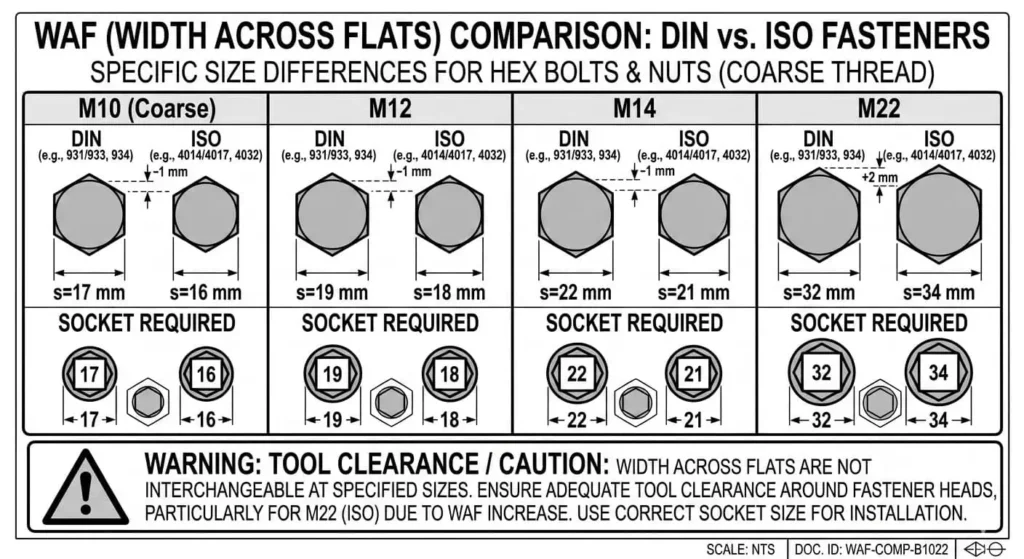
DIN and ISO hex bolts often interchange in practice, but there are known exceptions that can affect fit and procurement.
One common exception is width across flats (WAF). If your project controls tool clearance, treat WAF as a controlled requirement and verify against the drawing and the applicable standard family (see ISO guidance for hexagon products: ISO 272).
| Example Size (Common Market Case) | DIN Typical WAF | ISO Typical WAF |
|---|---|---|
| M10 | 17 mm | 16 mm |
| M12 | 19 mm | 18 mm |
| M14 | 22 mm | 21 mm |
| M22 | Verify by drawing/spec | Verify by drawing/spec |
- Despite formal standard evolution, DIN 931 and DIN 933 bolts remain widely stocked and specified.
- Some suppliers ship “ISO-marked” parts that follow legacy wrench sizes, especially in mixed DIN/ISO supply chains.
- For critical assemblies, include WAF/tool clearance on the drawing or PO and verify during incoming inspection.
Mini case (RCA format):
What happened: Offshore maintenance stopped because the socket set did not fit the delivered bolts.
Immediate cause: WAF mismatch between the specified standard family and the supplied bolts.
System cause: PO controlled diameter/length/pitch but did not control WAF; receiving inspection checked threads but not tooling dimensions.
Corrective action: Re-issue PO with WAF controlled; segregate stock; verify per drawing and ISO guidance.
Prevention action: Add WAF/tool clearance to the inspection checklist for sizes known to vary in mixed DIN/ISO supply chains.
Application Guide: Choosing the Right Hex Bolt
When to Use DIN 931
Engineers typically select DIN 931 hex bolts for joints where alignment and shear/bearing behavior are important.
Use DIN 931 when the design intends the smooth shank to sit in the joint’s shear plane and when you want better bearing behavior in clearance holes. This is common in structural frames, machinery bases, brackets, and assemblies where misalignment can damage threads or reduce reliability.
| Application Criteria | DIN 931 Suitability |
|---|---|
| Shear/bearing sensitivity | High (verify shank covers shear plane by length selection) |
| Alignment critical | High |
| Through-bolt structural joints | Common choice |
When to Use DIN 933
DIN 933 hex bolts are often preferred for clamping, tensioning, and assemblies requiring full thread engagement.
Choose DIN 933 when you need reliable engagement in thin parts, tapped holes, or variable thickness stack-ups. DIN 933 also simplifies selection when you cannot control where the shear plane falls, and the joint is primarily tension/clamp governed. For nut compatibility and common dimensions, reference the fastener set (bolt + nut) as a system (see hex nut standards).
Tip: Use DIN 933 when the controlling requirement is thread engagement and preload control. If the joint is shear-governed, confirm whether threads will sit in the shear plane and whether that is acceptable by design.
Common Industrial Use Cases
DIN and ISO hex bolts are used across industrial sectors where load paths and environment vary.
Instead of listing industries only, match bolt choice to joint behavior:
- Steel structures and frames: often DIN 931 when shear/bearing and alignment dominate.
- Equipment mounting and panel assemblies: often DIN 933 when thread engagement dominates.
- Pressure and rotating equipment skids: selection depends on vibration, preload control, and inspection requirements.
Engineers rely on consistent dimensions, correct strength class, and traceable documentation more than marketing descriptions. If the joint is regulated (pressure equipment / lifting / structural), specify inspection scope and traceability on the PO.
Procurement and Quality Considerations
Material and Strength Classes
DIN 931 and DIN 933 hex bolts are supplied in different materials and strength classes. Buyers should treat the strength class as a controlled requirement and verify incoming documentation.
For carbon/alloy steel metric fasteners, strength classes such as 8.8 and 10.9 are commonly specified (see mechanical property framework: ISO 898-1). For stainless steel fasteners, classes such as A2-70 and A4-70 are commonly specified (see stainless fastener framework: ISO 3506-1). Final selection depends on load, environment, and any regulatory code requirements.
For practical selection by grade/marking, use a controlled internal reference for project teams (see bolt grades and markings).
| Strength Class (Steel) | Min Tensile Strength (MPa) | Min Yield Strength (MPa) | Typical Elongation A (%) |
|---|---|---|---|
| 8.8 | 800 | 640 | 12 |
| 10.9 | 1000 | 900 | 9 |
Preload control note (field-typical, project-dependent): Torque is only a proxy for preload. Friction scatter (threads + bearing surface + lubricant) drives clamp load scatter. Many teams treat a nut factor (K) around 0.12–0.25 as a typical engineering range depending on lubrication and surface condition, then validate on critical joints using controlled tightening methods and documented procedures (see ISO fastener test framework listing for torque/clamp force testing: ISO fasteners standards index).
Engineering warning (coatings & hydrogen embrittlement): If you specify high-strength steel bolts (commonly 10.9/12.9 families) with electroplated coatings, control hydrogen embrittlement risk by procedure and by specification. Coating requirements for threaded fasteners are defined by standards such as ISO 4042 (electroplated coatings) and ISO 10683 (zinc flake coatings). Do not swap coating systems on-site without engineering review.
Stainless steel bolts are typically selected for corrosion exposure, but they require proper assembly control to reduce galling risk. If stainless is specified for marine or chemical environments, control lubrication and installation speed and consider anti-galling measures where the procedure allows.

Sunhy Industrial Fasteners Advantages
For regulated or audit-driven projects, the practical advantage is not “more SKUs,” but controlled documentation and predictable compliance.
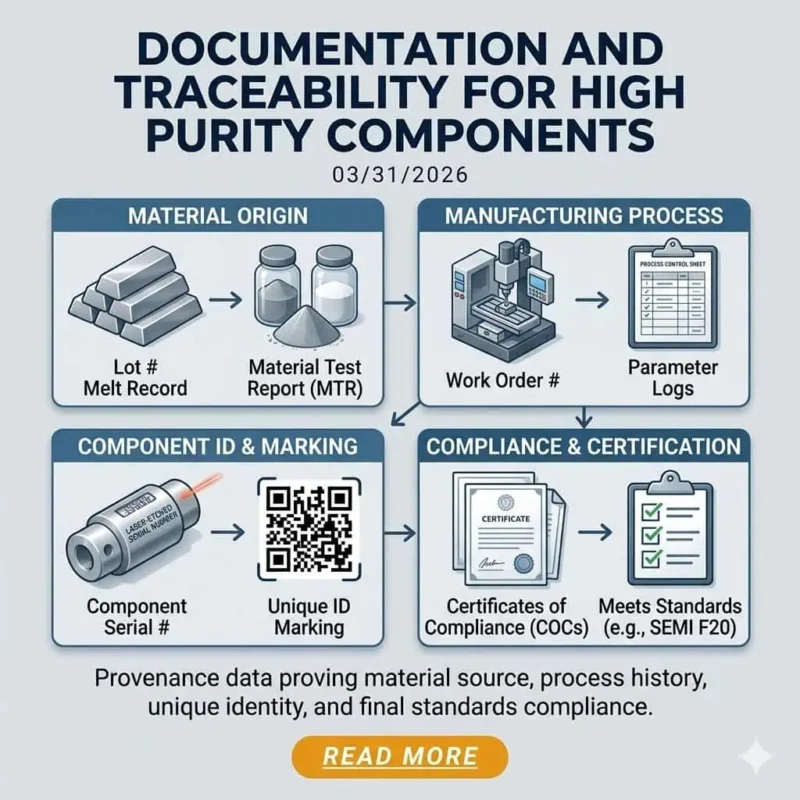
Sunhy supports fasteners in sizes from M3 to M64 with material options and coatings defined by drawing/spec. Where required, buyers can request batch traceability and inspection records (dimensional checks, marking verification, and documentation packages aligned with the project requirement).
- Steel and stainless fasteners with controlled strength class selection
- Lot traceability and inspection records when required by project QA
- Custom and OEM fasteners made-to-print for specialized needs
- Catalog availability for common DIN/ISO items
Ordering and Compliance Tips
Procurement teams should verify material, strength class, coating, and documentation scope when ordering hex bolts for critical projects.
For controlled projects, specify: standard (DIN 931/933 or ISO 4014/4017), size, pitch, strength class (ISO 898-1) or stainless class (ISO 3506-1), coating, WAF/tool clearance if relevant, and acceptance documentation (inspection record, batch ID, traceability).
| PO Line Item Control (Recommended) | Why It Matters |
|---|---|
| Standard + size + pitch (e.g., M12×1.75) | Prevents wrong-thread deliveries and cross-threading failures |
| Length + intended grip length | Controls whether threads land in the bearing/shear zone |
| Property class (8.8/10.9 or A2-70/A4-70) | Controls yield strength and allowable preload ceiling |
| Coating system (per ISO 4042 / ISO 10683 if used) | Controls corrosion performance and embrittlement risk |
| WAF/tool clearance (where relevant) | Prevents installation stoppage due to socket mismatch |
| Documentation scope (traceability, inspection record) | Supports audits and reduces wrong-grade risk |
Tip: Always request inspection records and lot traceability for fasteners used in pressure equipment, lifting, or structural assemblies. Incoming inspection should include marking check, dimension spot-check, and documentation completeness.
DIN 931 bolts feature a partial thread for shear-sensitive and alignment-sensitive joints (when length selection places shank in the joint), while DIN 933 bolts offer full threading for maximum engagement and adjustability. Selecting the correct hex bolt improves reliability and reduces rework in industrial settings.
- DIN 931 is commonly selected for structural and machinery joints where shear/bearing and alignment govern.
- DIN 933 is commonly selected for clamping/tapped-hole assemblies where engagement governs.
- Materials include carbon steel, alloy steel, and stainless steel with finishes defined by environment and specification.
If your joint is critical and you do not know your friction condition (K-factor) under your lubricant/coating, treat torque values as provisional and run a controlled verification or consult an application engineer for a joint-specific tightening method and recordable torque plan.
FAQ
What is the main difference between DIN 931 and DIN 933 hex bolts?
DIN 931 bolts are typically supplied as partially threaded; DIN 933 bolts are fully threaded.
DIN 931 can be advantageous when the joint design places the shear plane in the unthreaded shank. DIN 933 is advantageous when thread engagement and adjustability are the main requirements (thin parts, tapped holes, variable stack-ups).
Can DIN 931 and DIN 933 bolts be used interchangeably?
Not automatically.
Even when diameter and pitch match, interchangeability depends on the joint’s load path (shear vs tension), required thread engagement, bolt length (grip vs thread length), and tooling constraints (WAF). For controlled projects, treat the drawing/spec as the acceptance basis and verify key dimensions before substitution.
What materials are available for DIN 931 and DIN 933 bolts?
Common options include carbon steel, alloy steel, and stainless steel.
Steel bolts are often specified by strength class (e.g., 8.8, 10.9). Stainless bolts are often specified by ISO 3506-1 classes (e.g., A2-70, A4-70). Final choice depends on load, corrosion exposure, and any code requirements.
Are DIN and ISO hex bolts compatible?
Often, but not always.
Many catalogs list “DIN 931 / ISO 4014” and “DIN 933 / ISO 4017,” but some sizes can differ in wrench size (WAF) and supply conventions. Always verify the exact size on the drawing and confirm WAF/tool clearance if installation tooling is fixed.
How can buyers ensure fastener quality and compliance?
Control documentation and incoming inspection.
For critical projects, request inspection records and lot traceability, verify markings, spot-check key dimensions (including WAF where relevant), and confirm strength class/material class matches the PO and specification. Use suppliers who can provide consistent documentation packages for audits.
How do I choose bolt length so threads don’t sit in the shear plane?
Compare joint grip length to the bolt’s standard thread length rule for the exact size/length.
If your design intends the unthreaded shank to carry shear, select a bolt length where the unthreaded shank covers the shear plane. If that is not possible, treat the joint as “threads may carry shear” and verify acceptability by design and inspection controls.
How do you reduce galling risk for stainless steel hex bolts?
Use controlled lubrication and installation practice.
Stainless fasteners can gall under high friction. Use an approved lubricant/anti-seize where the procedure allows, avoid high-speed dry installation, and apply controlled tightening to reduce heat and metal transfer (see the galling resistance framework: ASTM G98). For repeat issues, review stainless grade/class selection and assembly procedure together.
What coating standards should be referenced on a purchase order for critical bolts?
Use coating standards that define requirements for threaded fasteners and control process risk.
For electroplated coatings, reference ISO 4042. For zinc flake coating systems used on fasteners, reference ISO 10683. Do not allow unreviewed substitutions on-site for high-strength bolts.