
Threaded Couplings & Sockets | Full / Half / Reducing (Class 150)
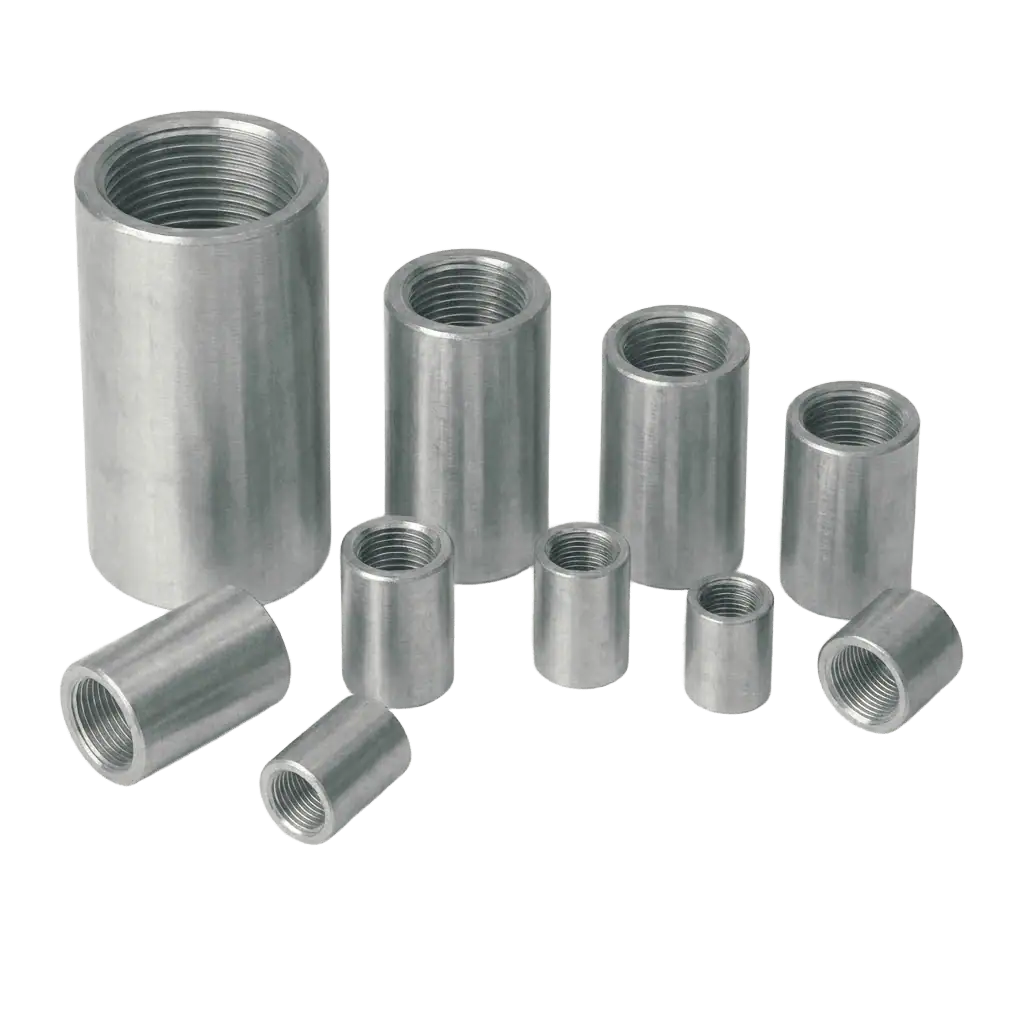
SUNHY supplies threaded couplings and sockets for joining and extending pipes in serviceable piping systems. These fittings are commonly selected for utility and general industrial lines where fast installation, alignment flexibility, and straightforward maintenance are required.
Available as full coupling, half coupling, and reducing coupling, with NPT or BSP/BSPT threads. Standard supply focuses on stainless steel (SS304 / SS316) for corrosion control, with cast iron or brass options on request. Documentation and inspection level can be provided per project specification.
- Fast pipe joining, simple install
- Serviceable connection, easy maintenance
- Full/half/reducing types, BOM match
- Standard threads, reliable make-up
- Clear traceability, heat ID
- Docs available, per project spec
Specification & Standard
Nominal Size
Commonly 1/8″ – 4″ (DN6 – DN100); other sizes on request
Type
Full Coupling / Half Coupling / Reducing Coupling
Thread Standard
NPT (ASME B1.20.1) / BSP / BSPT (ISO 7-1) as specified
Standards
ISO 4144 (as applicable) / project specification
Product
Threaded Couplings / Threaded Sockets
Pressure Rating
Class 150 (150 lbs)
Materials
Stainless Steel SS304 / SS316 common; cast iron / brass available on request
Documentation & Inspection
MTC (EN 10204 3.1), dimensional inspection; PMI for stainless upon request; inspection level as specified
Threaded Couplings & Sockets for Fast, Serviceable Pipe Connections
Threaded couplings (also called threaded sockets) are used to join two pipes in-line without welding. They are commonly specified for utility and general industrial piping where fast assembly and future maintenance access are prioritized.
Product Range
- Full Coupling — standard in-line connection for pipe extension and repairs.
- Half Coupling — compact connection often used on outlets, manifolds, and equipment tie-ins.
- Reducing Coupling — size transition between different NPS/DN as specified on the BOM.
Key Advantages (B2B)
- No hot work — supports simplified site execution and controlled installation.
- Service-friendly — easier disassembly for flushing, replacement, and line modifications.
- Thread compatibility — NPT or BSP/BSPT options to match regional practice and mating pipe.
- Corrosion control — SS304/SS316 stainless options for humid, chemical, or coastal environments.
- Documentation ready — MTC and inspection level available per project requirement.
Dimension & Ordering Table (Full / Half / Reducing Coupling)
For site fit and procurement accuracy, specify the coupling type, size, thread standard, and material grade directly on your BOM. This checklist helps avoid mismatched threads and unnecessary rework during installation.
| Item | What to Specify | Typical Options |
|---|---|---|
| Type | Coupling configuration | Full / Half / Reducing |
| Size | NPS/DN and (for reducing) both ends | e.g., 1"×1" (full), 2"×1" (reducing) |
| Thread | Thread standard to match mating pipe | NPT / BSP / BSPT |
| Pressure | Required rating | Class 150 (150 lbs) |
| Material | Grade based on corrosion and service fluid | SS304 / SS316 (common); cast iron / brass on request |
| Inspection | Acceptance scope for site receiving | Dimensional check / thread gauging / PMI (stainless) as specified |
| Documents | Handover package | MTC (EN 10204 3.1) + marking/traceability support |
Selection tip: For reducing couplings, always specify both end sizes (run size and reduced size) on the BOM. For international projects, confirm NPT vs BSP/BSPT before ordering.
Product Assembly | How to Install Threaded Couplings & Sockets
Threaded couplings and sockets are assembled by engaging pipe threads to create a sealed joint. Final procedures should follow your project specification and be performed by qualified personnel.
Recommended Assembly Steps
- Verify BOM match — confirm type (full/half/reducing), size(s), thread standard (NPT/BSP/BSPT), and material grade.
- Check thread condition — ensure threads are clean and undamaged; avoid cross-threading.
- Apply sealing method per spec — use approved PTFE tape or thread sealant compatible with the service fluid.
- Align and tighten — keep pipe alignment to reduce stress on the joint; avoid over-torque.
- Leak test — perform system test per project requirement after assembly and support installation.
Practical note: If the line requires frequent maintenance access, specify stainless couplings with documentation scope (MTC + inspection) to match the receiving checklist.
Related Products
Butt Weld Tee (Equal / Reducing)
For branch connections in welded piping spools.
Concentric Reducer
Smooth centerline transition for vertical lines and pumps.
Eccentric Reducer
Flat side design to reduce air pockets in horizontal piping.
Butt Weld End Cap
Clean closure for pipe ends—ideal for test spools and headers.
Stub End (Lap Joint)
Common with lap joint flanges for frequent disassembly service.
FAQ
What is the difference between a threaded coupling and a threaded socket?
The main difference lies in their manufacturing standard and pressure rating. A Threaded Coupling refers to a high-pressure, forged fitting manufactured to ASME B16.11, designed for industrial systems (Class 3000/6000). A Threaded Socket (or Merchant Coupling) is a low-pressure fitting manufactured to ASTM A865 from seamless or welded pipe, intended for standard plumbing applications.
Comparison Table:
| Feature | Forged Coupling (ASME B16.11) | Merchant Socket (ASTM A865) |
| Process | Forged (High Strength) | Machined from Pipe |
| Pressure | High (Class 3000 / 6000) | Low (Standard / Extra Strong) |
| Use Case | Oil, Gas, High-Pressure Steam | Low-Pressure Water, Plumbing |
Full coupling vs half coupling how do l choose?
Choose a Full Coupling when you need to join two lengths of pipe together in a straight line. Choose a Half Coupling when you need to create a branch connection or a threaded port on a pressure vessel or header pipe.
Full Coupling: Double-ended thread. Used for pipe extension.
Half Coupling: Single-ended thread. One end is threaded for connection, while the flat/beveled end is welded directly onto a tank wall or run pipe (acting as a branch outlet).
When should l use a reducing coupling?
You should use a Reducing Coupling when connecting two pipes of different diameters in a straight line where maintaining structural integrity is critical. Unlike Hex Bushings, which create a sharp “step” that causes turbulence and pressure drop, a Reducing Coupling offers a smoother transition and superior strength, making it the preferred choice for high-pressure industrial lines.
Do you offer NPT and BSP/BSPT threaded couplings?
Yes, we supply couplings with both NPT (National Pipe Taper) and BSPT (British Standard Pipe Taper) threads. It is crucial not to mix them as they have different thread angles and are not compatible.
NPT: 60° thread angle, flattened peaks/valleys (Standard in USA/Canada).
BSPT: 55° thread angle, rounded peaks/valleys (Standard in Europe/Asia).
Warning: For 1/2″ and 3/4″ sizes, both NPT and BSPT share the same pitch (14 TPI), allowing them to screw together, but they will leak due to the angle mismatch.
What materials and documents are available for project receiving?
We provide forged couplings in standard materials including Carbon Steel (ASTM A105), Low-Temp Steel (ASTM A350 LF2), and Stainless Steel (ASTM A182 F304/F316).
For project compliance, all shipments can be accompanied by:
EN 10204 3.1 Material Test Certificates (MTC) (verifying chemical/mechanical properties).
NACE MR0175 / ISO 15156 compliance statements (for Sour Service environments, confirming hardness limits like ≤ 22 HRC for carbon steel).