
Class 3000 Socket Weld Fittings | ANSI/ASME B16.11 / BS 3799 | 304L / 316L | Small-Bore High-Pressure
SUNHY supplies Class 3000 socket weld fittings for compact, high-integrity connections in small-bore piping systems. Typical applications include instrument tie-ins, utility lines, and high-pressure service where consistent fit-up and weld quality matter.
Our range covers common socket weld geometries—elbows, tees, crosses, couplings, caps, and unions—with project-ready documentation options. Dimensions can be specified to ANSI/ASME B16.11 and BS 3799 as required.
- Compact joint, space-saving design
- Strong connection, stable welds
- Clean fit-up, consistent alignment
- Wide product range, ready selection
- Clear traceability, heat ID
- Docs available, per spec

Specification & Standard
Nominal Diameter (DN)
Commonly 1/4″ – 2″ (larger sizes on request)
Connection
Socket Weld (SW); OD socket weld ends available
Manufacturing & QC
Hot forged; heat number traceability; dimensional inspection available (per project requirement)
Standards
ANSI/ASME B16.11 / BS 3799 (per project spec)
Pressure Class
Class 3000 (Class 6000 available by request)
Product Range
SW 90° Elbow / SW 45° Elbow / Equal Tee / Reducing Tee / Equal Cross / Full Coupling / Half Coupling / Reducing Coupling / Round Cap / Conical Seat Union / SW×NPT & SW×BSPT Coupling
Materials
304L / 316L stainless options (other grades on request)
Documentation & Inspection
EN 10204 3.1 MTC available; inspection options per project requirement
Class 3000 Socket Weld Fittings | Small-Bore High-Pressure Connections
SUNHY supplies Class 3000 socket weld fittings for compact, high-integrity connections in small-bore piping. Socket weld ends support stable fit-up and consistent welding when executed to the project WPS and inspection requirements.
Product Range
- Elbows: 90° Elbow, 45° Elbow
- Tees: Equal Tee, Reducing Tee
- Crosses: Equal Cross
- Couplings: Full Coupling, Half Coupling, Reducing Coupling
- Caps: Round Cap
- Unions: Conical Seat Union
- Transition Options: SW × NPT coupling, SW × BSPT coupling
Why Choose Socket Weld (SW)
- Compact layout — preferred where space is limited in small-bore runs.
- Consistent fit-up — socket design supports repeatable alignment in fabrication.
- Project-ready deliverables — documentation and inspection level available to match QA and handover needs.
Quality & Documentation
- MTC (EN 10204 3.1) available
- Heat number traceability and marking support
- PMI / NDT available as specified
Ordering Guide | Class 3000 Socket Weld Fittings (ASME B16.11 / BS 3799)
To avoid mismatches, specify the fitting by type, size, pressure class, material, and documentation. Dimensions are supplied to the applicable standard or project specification.
Recommended RFQ Format
| Item | Specify |
|---|---|
| Fitting Type | 90° Elbow / 45° Elbow / Equal Tee / Reducing Tee / Equal Cross / Coupling / Cap / Union |
| Size | NPS/DN (for reducing tee/coupling: Run × Branch/Outlet) |
| Pressure Class | Class 3000 (Class 6000 if required) |
| Material | 304L / 316L (other grades on request) |
| Standard | ANSI/ASME B16.11 / BS 3799 (per project spec) |
| Documentation | EN 10204 3.1 MTC; PMI/NDT if specified |
If you share a BOM or line class note, we can help verify the correct configuration (equal vs reducing) and documentation level.
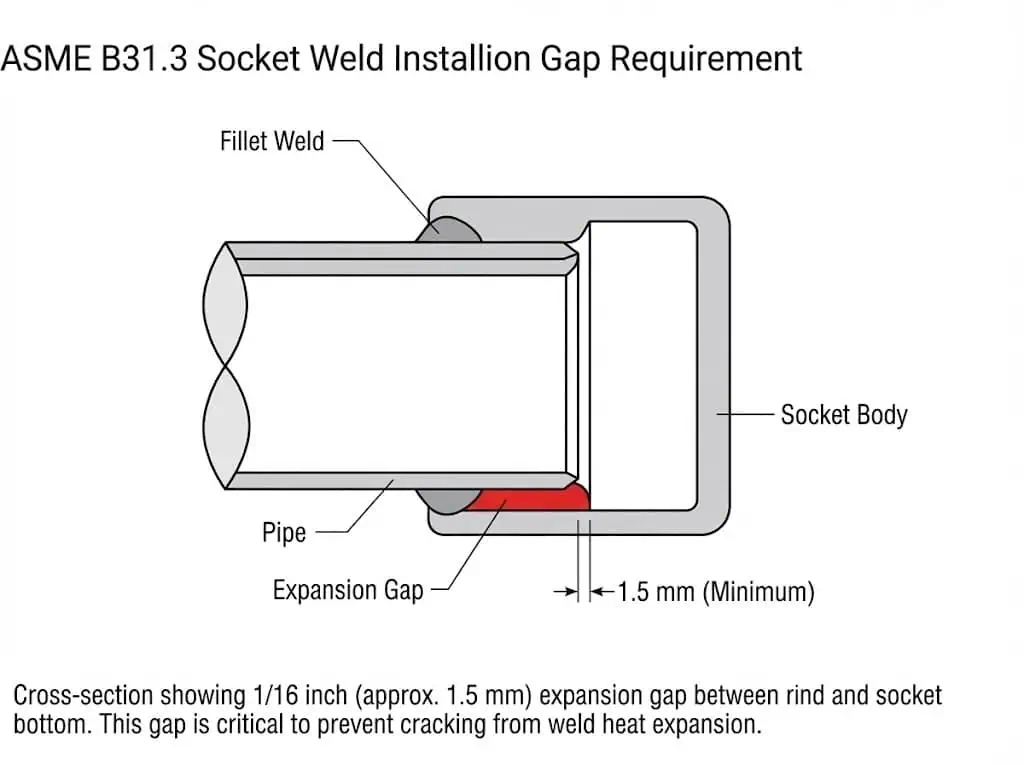
Installation Notes | Socket Weld Fittings
Socket weld fittings are installed by inserting the pipe into the socket and welding per the qualified WPS. Final welding, inspection, and acceptance criteria should follow your project specification and applicable code.
Typical Fabrication Steps
- Verify the fitting — confirm type, size, class, and material match the BOM.
- Clean and prepare — remove oil, debris, and oxidation from pipe OD and socket area.
- Fit-up control — insert, align, and follow project fit-up rules before tacking.
- Weld per WPS — use the qualified procedure and required heat-input control.
- Inspection — visual and dimensional checks; PMI/NDT as specified; keep records for handover.
Tip: For Class 3000 service, consistent fit-up and disciplined welding control are key drivers of repeatable quality.
Related Products
Butt Weld Tee (Equal / Reducing)
For branch connections in welded piping spools.
Concentric Reducer
Smooth centerline transition for vertical lines and pumps.
Eccentric Reducer
Flat side design to reduce air pockets in horizontal piping.
Butt Weld End Cap
Clean closure for pipe ends—ideal for test spools and headers.
Stub End (Lap Joint)
Common with lap joint flanges for frequent disassembly service.
FAQ
What is a socket weld fitting?
A Socket Weld Fitting is a high-pressure pipe connection detail where the pipe is inserted into a recessed area (socket) of a valve, fitting, or flange and secured with a fillet weld. Designed primarily for small-bore piping (NPS 2 and smaller), these fittings are manufactured in accordance with ASME B16.11 standards. They are available in pressure ratings of Class 3000, 6000, and 9000, offering superior leakage integrity compared to threaded fittings and easier alignment than butt weld fittings.
What are socket weld fittings used for?
Socket Weld Fittings are forged steel pipe connectors used primarily to create permanent, leak-proof joints in small-bore piping systems (NPS 2 and below). They are essential in high-pressure steam, chemical, and toxic fluid lines where threaded connections may leak and butt welds are difficult to align.
Key Advantages & Installation Requirements:
Leak Prevention: The fillet weld provides a tighter seal than threaded fittings, making them ideal for hazardous media.
Self-Alignment: The pipe inserts into the recessed socket, eliminating the need for tack welding during fit-up.
Critical Installation Step: According to ASME B31.3, a 1/16-inch (1.5mm) expansion gap must be left between the pipe end and the socket bottom to prevent thermal cracking.
What does “Class 3000” mean for socket weld fittings?
Class 3000 is a pressure-temperature rating designation defined by the ASME B16.11 standard; it does not mean the fitting is limited to a maximum pressure of 3000 psi. Instead, it indicates that the fitting is designed to have the same burst strength as a seamless pipe of a specific wall thickness (Schedule).
Correlation of Class 3000 to Pipe Schedules:
| Connection Type | Pressure Class | Corresponding Pipe Schedule |
| Socket Weld | Class 3000 | Schedule 80 (XS) |
| Threaded | Class 3000 | Schedule 160 |
| Socket Weld | Class 6000 | Schedule 160 |
| Threaded | Class 6000 | Double Extra Strong (XXS) |
What types of threads are available for socket weld fittings?
While standard socket weld fittings are joined via welding, transition fittings (such as Socket Weld x Threaded adapters) are available to connect different systems. The two most common thread standards for these fittings are:
NPT (National Pipe Taper): The U.S. standard defined by ASME B1.20.1, featuring a 60° thread angle. It is the dominant standard for oil and gas applications in North America.
BSP (British Standard Pipe): The international standard (including BSPT and BSPP) defined by ISO 7 or BS 21, featuring a 55° thread angle.
Note: Always check the specification (e.g., Class 3000 NPT) as NPT and BSP threads are not compatible.
How do l choose the right socket weld fitting?
To choose the right fitting, compare your system’s pressure, vibration, and maintenance requirements against the capabilities of Socket Weld versus Threaded fittings:
| Feature | Socket Weld Fittings | Threaded Fittings |
| Best Application | High-pressure, toxic, or flammable fluids | Low-pressure water, air, or non-critical lines |
| Leakage Risk | Zero (Permanent welded joint) | Moderate (Can loosen with vibration) |
| Pressure Class | High (Class 3000, 6000, 9000) | Lower to Medium (Class 2000, 3000, 6000) |
| Installation | Requires skilled welder & 1/16″ gap | Simple assembly with thread sealant |
What quality control options are available for socket weld fittings?
Socket Weld Fittings are forged steel pipe connectors used primarily to create permanent, leak-proof joints in small-bore piping systems (NPS 2 and below). They are essential in high-pressure steam, chemical, and toxic fluid lines where threaded connections may leak and butt welds are difficult to align.
Key Advantages & Installation Requirements:
Leak Prevention: The fillet weld provides a tighter seal than threaded fittings, making them ideal for hazardous media.
Self-Alignment: The pipe inserts into the recessed socket, eliminating the need for tack welding during fit-up.
Critical Installation Step: According to ASME B31.3, a 1/16-inch (1.5mm) expansion gap must be left between the pipe end and the socket bottom to prevent thermal cracking.