








Sélection du revêtement pour écrous automobiles
Guide de sélection des revêtements automobiles : Écrous zingués, zingage lamellaire et zinc-nickel
Choisir le bon revêtement pour les écrous automobiles n'est pas seulement une décision anticorrosion. Les écrous zingués, à flocons de zinc et au zinc-nickel peuvent se comporter différemment après le revêtement, le contrôle du filetage, le couple de serrage, les vibrations, l'exposition au sel et l'approbation de production.
Ce guide compare les trois options de revêtement en fonction de l'exposition à la corrosion, de l'ajustement du filetage intérieur, du risque de fragilisation par l'hydrogène, du contrôle du frottement, de la couche de finition, des données RFQ et des exigences documentaires automobiles.
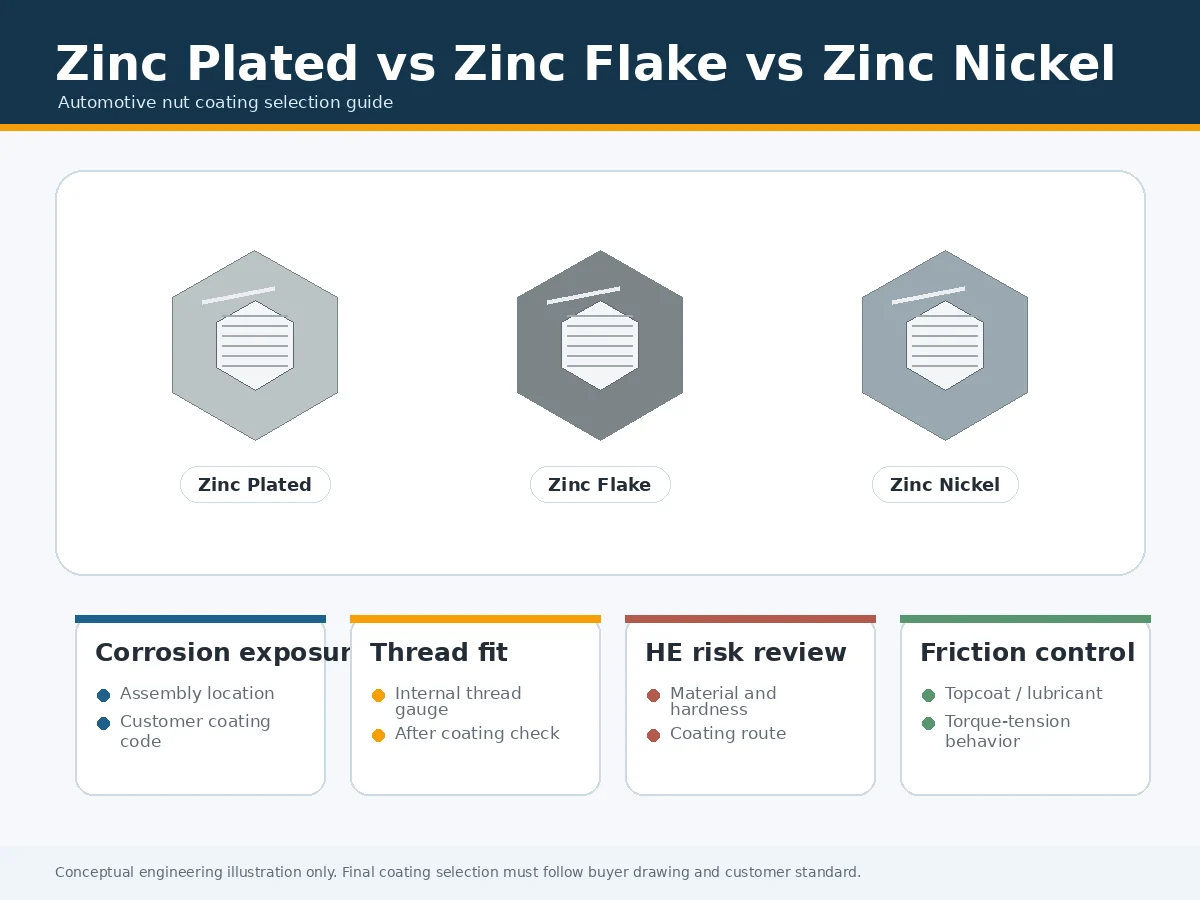
Comparaison conceptuelle des revêtements uniquement ; la sélection finale du revêtement doit suivre le dessin de l'acheteur et la norme du client.
Réponse rapide : Quel revêtement les acheteurs automobiles doivent-ils choisir ?
Il n'existe pas de revêtement universellement idéal pour chaque écrou automobile. Le choix correct dépend de l'environnement d'application, de la résistance du matériau, du traitement thermique, des exigences d'ajustement du filetage, du code de revêtement client, de la couche de finition, du lubrifiant, de la plage de friction, de la méthode d'inspection et de l'étendue des documents d'approbation.
Les écrous zingués sont souvent choisis pour les applications sensibles aux coûts, une exposition à la corrosion moindre ou des projets où le dessin client spécifie déjà une finition électrozinguée. Ils peuvent être pratiques et largement disponibles, mais les pièces à haute résistance ou trempées nécessitent une évaluation du risque de fragilisation par l'hydrogène lors de l'électrozinguage.
Les écrous au zinc lamellaire sont souvent considérés pour des exigences de corrosion plus élevées, des fixations automobiles exposées à l'extérieur ou des projets où une voie de revêtement non électrolytique est préférée. Cependant, le zinc lamellaire ne supprime pas la nécessité de vérifier l'ajustement du filetage, l'accumulation du revêtement, la couche de finition, le coefficient de frottement et l'inspection finale au calibre.
Les écrous zinc-nickel sont souvent sélectionnés lorsqu'une spécification automobile exige une performance de corrosion plus forte que le zingage standard, un aspect défini, un comportement de surface conducteur ou un code de revêtement client spécifique. Le zinc-nickel est toujours un système électrolytique, donc la dureté du matériau et l'examen de la fragilisation par l'hydrogène peuvent encore être importants.
| Condition d'application | Écrous zingués | Écrous zingués paillettes | Écrous zinc-nickel |
|---|---|---|---|
| Application sensible au coût | Souvent adapté | Coût généralement plus élevé | Coût généralement plus élevé |
| Exposition à la corrosion plus faible | Souvent adapté si spécifié | Peut être plus que nécessaire | Peut être plus que nécessaire |
| Exposition élevée à la corrosion | Limité sauf approbation du client | Souvent un bon candidat | Souvent un bon candidat |
| Écrou à haute résistance ou trempé | Nécessite une évaluation de la fragilisation par l'hydrogène | Souvent considéré lorsqu'un revêtement non électrolytique est préféré | Nécessite une évaluation de la fragilisation par l'hydrogène |
| Sensibilité de l'ajustement du filetage interne | Nécessite un contrôle du filetage après placage | Nécessite un contrôle de l'épaisseur du revêtement et de la jauge | Nécessite un contrôle de la tolérance de filetage et de la jauge |
| Contrôle couple-tension | Nécessite un contrôle de la finition et du lubrifiant | Nécessite un contrôle de la couche de finition / du frottement | Nécessite un contrôle de la finition / du frottement |
| Problème de mise à la terre électrique ou de conductivité | Nécessite confirmation du client | Peut être inadapté sauf spécification contraire | Nécessite confirmation du client |
| Fonction de soudage ou de sertissage | Nécessite une révision spécifique au processus | Nécessite une révision de compatibilité revêtement/installation | Nécessite une révision spécifique au processus |
Règle de sélection
Choisissez le revêtement en fonction des exigences techniques confirmées, pas uniquement par son nom. Pour les écrous automobiles, l'acheteur doit confirmer l'emplacement d'assemblage, la fonction de l'écrou, l'état du filetage, la dureté du matériau, le code de revêtement client, la couche de finition, l'objectif de frottement, la méthode d'essai de corrosion, le périmètre du document d'approbation et les exigences d'emballage avant devis.
Écrous zingués vs zingage lamellaire vs zinc-nickel : Tableau comparatif
La première comparaison doit séparer la voie de revêtement, les performances attendues et le risque technique. Un nom de revêtement seul ne suffit pas pour un devis. Les acheteurs doivent spécifier le code de revêtement client exact, le système de revêtement, la couche de finition, les conditions d'inspection du filetage et les exigences documentaires.
| Facteur | Écrous zingués | Écrous zingués paillettes | Écrous zinc-nickel |
|---|---|---|---|
| Parcours de revêtement | Système de revêtement par électrozingage | Système de revêtement par zingage lamellaire non électrolytique | Système de revêtement par alliage électrolytique zinc-nickel |
| Principal avantage | Coût, disponibilité et options de finition courantes | Performance anticorrosion et voie non électrolytique lorsqu'elle est spécifiée | Performance anticorrosion, aspect et ajustement selon le code client |
| Principal problème technique | Examen de la fragilisation par l'hydrogène pour les pièces à haute résistance ; accumulation de filetage après placage | Contrôle de la couche de finition, de l'épaisseur du revêtement, du frottement et du calibre du filetage | Coût, spécification exacte, contrôle du système et examen de la fragilisation par l'hydrogène |
| Question typique d'un acheteur | La galvanisation standard est-elle suffisante pour cet emplacement ? | Le projet nécessite-t-il une zinguerie avec revêtement de finition et contrôle de friction ? | Le dessin ou la norme OEM exige-t-il du zinc-nickel ? |
| Risque d'ajustement du filetage | Le filetage intérieur peut se resserrer après la galvanisation | L'accumulation de revêtement peut affecter la jauge du filetage intérieur | L'épaisseur, la passivation ou le scellant peuvent affecter l'ajustement final du filetage |
| Comportement couple-tension | La finition et le lubrifiant peuvent modifier le frottement | La couche de finition et le lubrifiant peuvent modifier le frottement | Le système de finition peut modifier le frottement |
| Examen de la fragilisation par l'hydrogène | Important pour les pièces à haute résistance ou trempées | Souvent considéré lorsque la voie du revêtement non électrolytique est préférée | Important pour les pièces à haute résistance ou trempées |
| La demande de devis doit confirmer | Code de revêtement, épaisseur si spécifiée, calibre après placage et étuvage si nécessaire | Système de revêtement, couche de base, couche de finition, plage de frottement et épaisseur après revêtement | Spécification zinc-nickel, passivation / scellant, ajustement du filetage et périmètre du rapport |
| Ne pas supposer | Tout placage au zinc est acceptable pour l'automobile | Tous les systèmes de revêtement à base de paillettes de zinc fonctionnent de la même manière | Le zinc-nickel résout automatiquement tout problème de corrosion ou d'assemblage |

La matrice est uniquement destinée à la discussion de sélection ; l'approbation finale du revêtement dépend du dessin, du code de revêtement du client et de l'exigence d'essai.
Pourquoi le choix du revêtement des écrous automobiles ne se limite pas aux heures de brouillard salin
Les heures de brouillard salin sont faciles à comparer, mais elles ne définissent pas entièrement les performances des écrous automobiles. Un revêtement peut sembler résistant lors d'un essai de corrosion, mais peut néanmoins créer des problèmes d'assemblage si le filetage intérieur devient serré, si le coefficient de frottement n'est pas contrôlé, si la couche de finition est inappropriée ou si le code de revêtement du client n'est pas respecté.
Le choix du revêtement des écrous automobiles doit commencer par l'assemblage réel et l'environnement. Un écrou de support intérieur, un écrou soudé de cadre de siège, un écrou de soubassement, un écrou à sertir dans la tôle, un écrou de mise à la terre électrique et un écrou autofreiné tout métal peuvent avoir des priorités de revêtement différentes. La résistance à la corrosion est importante, mais aussi l'ajustement du filetage, le comportement en serrage, la soudabilité ou les performances de sertissage, le frottement, le comportement couple-tension, l'aspect, la conductivité et la documentation.
L'acheteur doit également confirmer si l'exigence de corrosion est basée sur un brouillard salin neutre, une corrosion cyclique, un essai spécifique au client ou une autre méthode de validation. Les affirmations génériques ne doivent pas remplacer le dessin ou le cahier des charges du client.
Règle d'ingénierie
Ne sélectionnez pas les écrous automobiles revêtus uniquement sur la base des heures de corrosion annoncées. Confirmez l'emplacement d'assemblage, le code de revêtement du client, la dureté du matériau, l'exigence de filetage, la plage de frottement et la méthode d'inspection avant la soumission.
Emplacement de l'assemblage
Les zones intérieure, extérieure, soubassement, compartiment moteur et électrique peuvent nécessiter différents systèmes de revêtement et différents périmètres d'inspection.
État du filetage
Les filetages intérieurs peuvent devenir serrés après le revêtement. L'exigence de calibre après revêtement doit être définie si l'ajustement final du filetage est critique.
Frottement d'assemblage
La finition de la couche de finition, du lubrifiant et du boulon d'accouplement peut modifier le comportement couple-tension. Les valeurs de couple ne doivent pas être déduites du nom du revêtement.
Pourquoi le changement de fonction de l'écrou affecte le choix du revêtement
Le même revêtement peut ne pas présenter le même risque sur chaque type d'écrou. Un écrou hexagonal standard, un écrou à bride, un écrou à souder, un écrou auto-clinchant, un écrou frein tout métal ou un écrou de mise à la terre peuvent avoir des priorités de revêtement différentes car le mode de défaillance est différent.
Par exemple, écrous à embase dentelés peut nécessiter un contrôle de l'état de la face d'appui et du frottement, tandis que les écrous à souder peuvent nécessiter une révision du revêtement autour de l'état des bossages de soudure et de la protection contre la corrosion ultérieure. Un écrou auto-clinchant nécessite une compatibilité avec le matériau de la tôle et le comportement lors de l'installation. Un écrou frein tout métal nécessite un comportement de couple résistant. Un écrou de mise à la terre peut nécessiter une confirmation de la conductivité de surface.
| Fonction de l'écrou | Préoccupation relative au choix du revêtement | L'acheteur doit confirmer |
|---|---|---|
| Écrou standard à filetage intérieur | Ajustement du filetage après revêtement et exposition à la corrosion | État du calibre de filetage, code de revêtement et exigence de corrosion |
| Écrou à bride | Frottement de la face d'appui et comportement d'assise | Revêtement, lubrifiant, surface d'accouplement et exigence de couple-tension si applicable |
| Écrou à souder sur bride / écrou hexagonal à souder | Comportement de la projection de soudure et protection contre la corrosion après assemblage | Compatibilité du procédé de soudage, séquence de revêtement et exigence post-soudure |
| Écrou auto-clinchant | Comportement d'installation dans le matériau en tôle et risque d'endommagement du revêtement | Matériau de la tôle, épaisseur de la tôle, état du revêtement et exigence de poussée/couple si nécessaire |
| Écrou autofreiné tout métal | Couple prévalent et stabilité du frottement | Système de revêtement, lubrifiant, plage de frottement et essai de couple prévalent si nécessaire |
| Écrou de mise à la terre ou électrique | Conductivité de surface et fiabilité du contact | Revêtement approuvé par le client et exigence de conductivité si applicable |
Limite fonctionnelle : La sélection du revêtement ne peut pas être finalisée uniquement à partir de la géométrie de l'écrou. Le fournisseur a besoin de l'emplacement d'assemblage, du type de joint, du matériau de la pièce d'accouplement, du mode de défaillance, de l'exigence de filetage et de toute spécification de couple, d'arrachement, de torsion, de poussée, de couple résistant ou de mise à la terre spécifiée par l'acheteur.
Écrous zingués : quand ils sont adaptés et où ils sont risqués
Les écrous zingués sont largement utilisés car ils sont disponibles, économiques et familiers à de nombreux acheteurs. Pour les environnements à faible corrosion, les assemblages sensibles aux coûts ou les applications approuvées par le client, le zingage peut être un choix pratique.
Cependant, les écrous zingués ne doivent pas être sélectionnés automatiquement pour chaque projet automobile. Les revêtements électrolytiques nécessitent un examen plus attentif lorsque le matériau de l'écrou est à haute résistance, trempé ou traité thermiquement. La norme ISO 4042 couvre les systèmes de revêtement électrolytique pour les fixations en acier et inclut des recommandations pour minimiser le risque de fragilisation par l'hydrogène.
Quand les écrous zingués peuvent convenir
Les écrous zingués peuvent convenir lorsque le dessin ou le cahier des charges du client exige déjà un zingage, que l'exposition à la corrosion est modérée ou faible, que l'écrou n'est pas utilisé dans un environnement sévère de soubassement ou extérieur, et que le système de revêtement a été approuvé par le client.
Ils peuvent également convenir pour des supports non critiques, des assemblages fermés, des pièces de rechange ou des applications où le coût et la disponibilité sont importants. Même dans ces cas, l'acheteur doit confirmer l'ajustement du filetage après zingage, l'épaisseur du revêtement si spécifiée, la passivation, la couche de finition, la cuisson si nécessaire et l'étendue du rapport d'inspection.
Principaux risques des écrous zingués
Les principaux risques incluent l'examen de la fragilisation par l'hydrogène pour les pièces à haute résistance ou trempées, l'accumulation de filetage interne après zingage, un frottement incohérent si le lubrifiant ou l'état de finition n'est pas contrôlé, et des performances de corrosion insuffisantes pour les environnements automobiles sévères.
Un écrou zingué peut passer l'inspection dimensionnelle avant revêtement mais échouer au calibre de filetage après zingage si la tolérance et l'état final du calibre ne sont pas définis. Ceci est particulièrement important pour les filetages internes, les petites tailles de filetage ou les exigences de tolérance de filetage serrées.
| Article de demande de devis pour écrous zingués | Pourquoi c'est important | Nécessite confirmation |
|---|---|---|
| Norme de revêtement ou code client | Évite la substitution générique “ zingué ” | Dessin de l'acheteur ou spécification de revêtement du client |
| Épaisseur de revêtement si spécifiée | Affecte la corrosion, l'ajustement du filetage et l'inspection | Norme client ou note de dessin |
| Passivation / scellant / couche de finition | Affecte l'apparence et le comportement à la corrosion | Code de finition et système approuvé |
| Exigence sans Cr(VI) si applicable | Satisfait aux exigences de conformité du client | Exigence client ou réglementaire |
| Cuisson / détensionnement contre la fragilisation si nécessaire | Soutient le contrôle du risque de fragilisation par l'hydrogène | Norme de dureté du matériau et de revêtement |
| Calibre de filetage après placage | Confirme l'ajustement de l'assemblage final | Avant revêtement, après revêtement ou les deux |
| Rapport de revêtement / test de corrosion | Définit le périmètre documentaire et de validation | Uniquement si requis par le client ou le programme |
Limite de zingage
Le zingage peut être un revêtement pratique, mais il ne doit pas être traité comme une réponse automobile par défaut. Si l'écrou est trempé, traité thermiquement, critique pour le filetage, sensible au couple ou exposé à une corrosion sévère, la voie de revêtement et l'exigence du client doivent être examinées avant la soumission.
Écrous zingués par flocons : objectifs de corrosion élevés, pièces à haute résistance et contrôle du frottement
Les revêtements par flocons de zinc sont souvent envisagés pour les fixations automobiles car ils sont appliqués non électrolytiquement et peuvent être spécifiés avec des systèmes de couche de finition et de lubrifiant. La norme ISO 10683 couvre les systèmes de revêtement par flocons de zinc appliqués non électrolytiquement pour les fixations en acier et s'applique aux écrous, boulons, vis, goujons et autres types de fixations.
Pour les écrous automobiles, les flocons de zinc peuvent être envisagés lorsque la résistance à la corrosion est importante, que l'application est exposée à l'environnement routier ou que le projet souhaite éviter une voie d'électrozingage pour les pièces à haute résistance ou trempées. Néanmoins, les flocons de zinc doivent être spécifiés avec soin. Différents systèmes, couches de base, couches de finition et lubrifiants peuvent se comporter différemment.
Pourquoi les flocons de zinc sont souvent envisagés pour les fixations automobiles
Les systèmes à flocons de zinc sont souvent utilisés lorsque la résistance à la corrosion et le risque lié au procédé sont importants. Ils peuvent être utiles pour les soubassements, châssis, supports exposés ou autres assemblages automobiles lorsque la spécification du client le permet ou l'exige.
Le zingage en flocons est également souvent évoqué pour les fixations haute résistance car il ne s'agit pas d'un procédé de revêtement électrolytique. Cependant, les acheteurs ne doivent pas écrire “ zingage en flocons signifie aucun risque ” sans confirmation technique. L'état du matériau, le prétraitement, le processus de revêtement, la couche de finition et la norme client comptent toujours.
Principaux risques des écrous zingués en flocons
Les revêtements de zingage en flocons peuvent encore affecter l'ajustement du filetage. L'accumulation du revêtement, l'épaisseur de la couche de finition ou une couverture inégale peuvent influencer la jauge de filetage interne. Le comportement de friction peut également changer en fonction de la couche de finition et du lubrifiant. Pour les assemblages automobiles contrôlés en couple, le coefficient de friction doit être confirmé si requis par le dessin ou la norme client.
Tous les systèmes de zingage en flocons n'ont pas les mêmes performances. Un acheteur doit éviter d'écrire uniquement “ zingage en flocons ” dans une demande de devis sans spécifier le système de revêtement, la couche de finition, la plage de friction, l'exigence de corrosion et la condition d'inspection.
| Élément de demande de devis pour zingage en flocons | Clarification requise | Risque si manquant |
|---|---|---|
| Système de revêtement | Code client, système approuvé ou spécification du fournisseur de revêtement | Le fournisseur peut proposer un système de zingage en flocons différent |
| Couche de base + couche de finition | Requis lorsque la corrosion ou le frottement dépend de la couche de finition | L'expectative de frottement ou de corrosion peut ne pas correspondre |
| État du lubrifiant | Condition de frottement sec, lubrifié ou spécifié | Le comportement couple-tension peut changer |
| Coefficient de frottement | Plage cible si nécessaire | Dispersion du couple d'assemblage |
| Jauge de filetage après revêtement | Condition d'acceptation finale de l'écrou | Litige sur le calibre de filetage après revêtement |
| Méthode d'essai de corrosion | Brouillard salin, corrosion cyclique ou essai spécifique client | Une déclaration de performance générique peut ne pas satisfaire l'exigence de l'acheteur |
| Dossier documentaire | Rapport de revêtement, IMDS ou PPAP uniquement si requis | Conflit de documents tardifs |
Limite de flocons de zinc
Les flocons de zinc doivent être spécifiés comme un système de revêtement, pas seulement comme un nom de revêtement. La couche de base, la couche de finition, le lubrifiant, la condition de frottement, la méthode d'essai de corrosion, le calibre de filetage après revêtement et la portée documentaire doivent être confirmés lorsqu'ils affectent l'approbation.
Écrous en zinc-nickel : résistance à la corrosion, contrôle du filetage et adéquation des spécifications
Les écrous en zinc-nickel sont souvent choisis pour les projets automobiles nécessitant une meilleure résistance à la corrosion que le zingage standard, un aspect de finition défini, un comportement de surface conducteur ou un code de revêtement OEM spécifique. Le zinc-nickel peut être une option solide lorsque le dessin et la norme client l'exigent.
Cependant, le zinc-nickel n'est pas simplement un “ meilleur zingage ” dans tous les projets. Il coûte généralement plus cher que le zingage standard, et le système exact de zinc-nickel doit être spécifié. Les acheteurs doivent confirmer le code de revêtement, la plage d'épaisseur si spécifiée, la passivation, le scellant, la condition d'inspection du filetage, l'exigence de corrosion et la portée documentaire.
Pourquoi le zinc-nickel peut être sélectionné
Le zinc-nickel peut être sélectionné lorsque la pièce est exposée à des conditions de corrosion plus exigeantes, lorsque la spécification client demande du zinc-nickel, ou lorsque le projet nécessite un système de finition avec un aspect défini et un comportement technique.
Il peut également être sélectionné lorsque l'assemblage nécessite un équilibre entre la protection contre la corrosion, le contrôle dimensionnel et les propriétés de surface conductrices. Ces avantages dépendent du système de revêtement exact et de l'approbation du client, pas seulement des mots “ zinc-nickel ”.”
Principaux risques des écrous en zinc-nickel
Les principaux risques incluent un coût plus élevé, une spécification peu claire, une épaisseur de revêtement incorrecte, des problèmes d'ajustement du filetage après revêtement et un examen de la fragilisation par l'hydrogène pour les pièces à haute résistance ou trempées. Comme le zinc-nickel est un système électrolytique, les acheteurs ne doivent pas ignorer la dureté du matériau et le risque lié au processus.
Si la demande de devis mentionne uniquement “ zinc-nickel ” sans code client ni spécification de revêtement, les fournisseurs peuvent proposer différents systèmes. Cela peut entraîner des problèmes d'approbation des échantillons, une non-concordance des rapports ou un désaccord sur les performances du revêtement.
| Article de demande de devis pour zinc-nickel | Pourquoi c'est important | Nécessite confirmation |
|---|---|---|
| Code de revêtement zinc-nickel | Empêche de citer un mauvais système | Dessin client ou spécification de revêtement |
| Teneur en nickel / exigence du système si spécifiée | Doit suivre la norme du client | Système zinc-nickel approuvé |
| Plage d'épaisseur si spécifiée | Affecte la corrosion et l'ajustement du filetage | Plage de spécification et méthode d'inspection |
| Passivation / scellant / couche de finition | Affecte l'apparence et le comportement à la corrosion | Code de finition client |
| Jauge de filetage après revêtement | Confirme l'ajustement de l'assemblage final | Avant revêtement, après revêtement ou les deux |
| Examen de la fragilisation par l'hydrogène | Nécessaire selon le matériau et la dureté | Exigence de matériau, dureté et processus client |
| Rapport de revêtement / IMDS / PPAP | Définit la preuve d'approbation si nécessaire | Portée documentaire spécifique au programme |
Limite de zinc-nickel
Le zinc-nickel doit être sélectionné lorsqu'il correspond au code de revêtement du client et aux exigences du projet. Il ne doit pas être utilisé comme substitut générique pour tous les problèmes de corrosion automobile sans confirmer le coût, l'ajustement du filetage, l'examen de la fragilisation par l'hydrogène, le comportement de friction et la documentation d'approbation.
Ajustement du filetage après revêtement : calibre de filetage intérieur et inspection après revêtement
Les écrous sont des composants à filetage intérieur, donc le choix du revêtement doit tenir compte de l'ajustement du filetage après revêtement. Un système de revêtement qui fonctionne bien sur un boulon extérieur peut encore créer un risque à l'intérieur d'un écrou si la tolérance du filetage, l'épaisseur du revêtement ou l'état final du calibre ne sont pas contrôlés.
L'inspection du filetage avant revêtement ne garantit pas automatiquement l'acceptation finale du filetage après revêtement. L'acheteur doit préciser si l'écrou doit passer un calibre à tampon avant revêtement, après revêtement ou les deux. Ceci est particulièrement important lorsque le dessin exige une tolérance de filetage serrée, une petite taille de filetage, un système de revêtement épais ou un assemblage fonctionnel après revêtement.
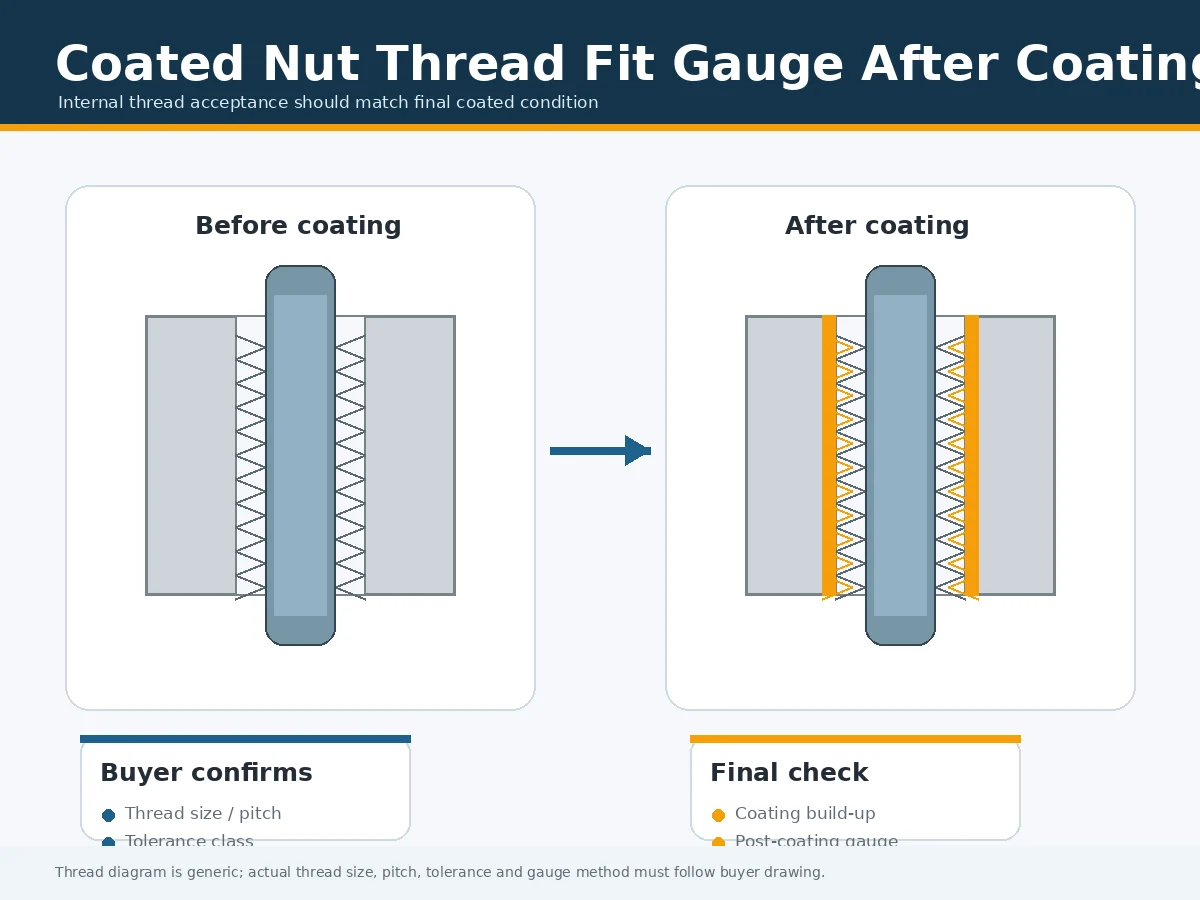
Le diagramme de filetage est générique ; la taille réelle du filetage, le pas, la tolérance et la méthode de calibrage doivent suivre le dessin de l'acheteur.
Pour les écrous zingués et les écrous zinc-nickel, l'accumulation d'électrodépôt peut réduire le jeu du filetage intérieur. Pour les écrous au zingage lamellaire, le film de revêtement et la couche de finition peuvent également affecter le passage de la jauge et l'assemblage. La solution n'est pas de deviner. Le dessin ou la demande de devis doit définir la condition d'inspection finale.
| Article fileté | L'acheteur doit confirmer | Risque si manquant |
|---|---|---|
| Taille et pas de filetage | Indication sur le dessin | Boulon, vis ou goujon d'accouplement incorrect |
| Tolérance du filetage | Exigence de classe ou d'ajustement | Désaccord sur la jauge |
| Épaisseur de revêtement si spécifiée | Norme client ou code de revêtement | Filetage serré ou ajustement irrégulier |
| Condition de jauge | Avant revêtement, après revêtement ou les deux | Litige d'approbation d'échantillon |
| Chanfrein / entrée | Condition d'entrée contrôlée par dessin | Problème d'assemblage difficile ou d'entrée de jauge |
| Couche de finition / lubrifiant | Si une exigence de friction s'applique | Dispersion de couple ou variation de précharge |
| Registre d'inspection | Rapport de jauge si nécessaire | Preuve d'approbation manquante |
Connexion du dessin : Pour les projets personnalisés, les exigences de revêtement et de filetage doivent être clairement indiquées dans le dessin ou le dossier de demande de prix. Pour plus de contexte sur le contrôle des dessins, consultez SUNHYINGS écrous spéciaux fabriqués sur plan.
Risque de fragilisation par l'hydrogène : ce que les acheteurs doivent confirmer
Le risque de fragilisation par l'hydrogène est l'une des considérations techniques les plus importantes lors de la sélection de revêtements pour les fixations en acier à haute résistance ou trempé. Il est particulièrement pertinent lorsque des systèmes de revêtement par électrozingage sont utilisés.
Pour les écrous automobiles, l'acheteur doit confirmer le matériau, la dureté, le traitement thermique et la voie de revêtement avant de supposer qu'une finition est acceptable. Les écrous zingués et zingués nickel sont des systèmes électroplaqués, donc les pièces à haute résistance ou trempées peuvent nécessiter un examen de fragilisation par l'hydrogène, un revenu ou des contrôles de processus spécifiques au client si spécifiés.

Le flux de travail des risques est fourni à titre indicatif uniquement ; le contrôle final du processus doit suivre la norme client et la spécification de revêtement approuvée.
Le flocon de zinc est un système de revêtement non électrolytique et est souvent considéré lorsqu'il est important d'éviter le risque de fragilisation par l'hydrogène lié à l'électrozingage. Mais cela ne doit pas être interprété comme “ le flocon de zinc élimine tout risque ”. Le projet nécessite toujours un prétraitement correct, un contrôle du processus de revêtement, une couche de finition, une inspection et une approbation du client.
| Facteur de risque | Pourquoi c'est important | L'acheteur doit confirmer |
|---|---|---|
| Classe de matériau | Détermine la résistance et la sensibilité au processus | Dessin ou norme client |
| Classe de dureté / de propriété | Une dureté plus élevée peut accroître les préoccupations | Plage de dureté et méthode d'essai |
| Traitement thermique | Affecte le comportement mécanique | Exigences de traitement thermique et enregistrements |
| Parcours de revêtement | Examen des risques liés aux changements de voie électrolytique vs non électrolytique | Norme de revêtement ou procédé approuvé |
| Traitement de cuisson / relaxation | Peut être requis par la norme ou le client | Calendrier et condition requis si spécifiés |
| Approbation du client | La décision finale dépend des règles du programme | Revêtement client et processus d'approbation |
Aucune revendication universelle de risque zéro
Un revêtement non électrolytique peut être un facteur de sélection important, mais l'évaluation du risque de fragilisation par l'hydrogène dépend toujours du matériau, de la dureté, du traitement thermique, des contrôles de processus et des exigences du client. Ne pas revendiquer une fragilisation par l'hydrogène garantie sans validation spécifique au projet.
Comportement de la couche de finition, du lubrifiant et du couple de serrage
Le revêtement n'est pas seulement une couche anticorrosion. Il modifie l'état de surface de l'écrou et peut affecter le frottement lors du serrage. À couple de serrage égal, différents systèmes de revêtement, couches de finition ou lubrifiants peuvent générer des charges de serrage différentes.
Ceci est important pour les joints automobiles où la précharge, la résistance au desserrage, le couple résistant ou la constance d'assemblage sont importants. Cela est particulièrement pertinent lorsque des écrous revêtus sont utilisés avec des boulons d'accouplement qui ont également leur propre revêtement, lubrifiant ou état de surface.

Aucune valeur de couple ou de frottement n'est implicite ; les valeurs d'essai doivent provenir du dessin de l'acheteur ou de la norme d'assemblage.
Pour les écrous zingués, la passivation, le scellant et l'état du lubrifiant peuvent affecter le frottement. Pour les écrous à flocons de zinc, la couche de finition et le lubrifiant intégré ou ajouté peuvent être critiques. Pour les écrous zinc-nickel, le système de finition exact peut également influencer le frottement et le comportement d'assemblage.
L'acheteur ne doit pas demander au fournisseur de deviner la valeur de couple ou le coefficient de frottement. Si le comportement couple-tension est important, l'appel d'offres doit inclure la plage de coefficient de frottement requise, la méthode d'essai, l'état lubrifié ou sec, l'état du boulon d'accouplement et les critères d'acceptation.
| Variable | Pourquoi c'est important | L'acheteur doit confirmer |
|---|---|---|
| Couche de finition | Modifie le comportement de frottement et de corrosion | Code de couche de finition requis |
| Lubrifiant | Modifie le comportement couple-tension | État lubrifié ou sec |
| Coefficient de frottement | Contrôle la cohérence d'assemblage | Plage cible si nécessaire |
| Finition du boulon d'accouplement | Affecte le comportement complet de l'assemblage | Revêtement et état de surface du boulon |
| Dispositif de verrouillage | Affecte le couple résistant | Méthode d'essai et critères d'acceptation |
| Épaisseur du revêtement | Affecte l'ajustement du filetage et le frottement | État final de jauge et d'inspection |
Pour les applications de verrouillage et sensibles au couple, les acheteurs peuvent également consulter SUNHYINGS écrous autofreinés tout métal et commun Problèmes d'assemblage automobile résolus par des écrous spéciaux.
Liste de contrôle des dessins et des demandes de devis pour les écrous automobiles revêtus
Une demande de devis pour un écrou automobile revêtu ne doit pas seulement indiquer “ zingué ”, “ zingage par flocons ” ou “ zinc-nickel ”. Ces noms ne suffisent pas pour une revue technique. Le fournisseur a besoin du dessin, du code de revêtement, de la norme client, du contexte d'application, de l'état du filetage, de l'état du matériau, de l'exigence de frottement et du périmètre documentaire.

La liste de contrôle est uniquement pour la préparation des RFQ ; les rapports PPAP, IMDS et de revêtement ne s'appliquent que lorsqu'ils sont exigés par le client ou le programme.
Une demande de devis complète aide à éviter une substitution incorrecte du revêtement, une défaillance du filetage après revêtement, une dispersion du couple, un désaccord sur la corrosion et un conflit documentaire tardif. Pour le contexte de révision côté fournisseur, voir SUNHYINGS comme fournisseur d'écrous spéciaux pour applications automobiles.
| Article RFQ | Requis ? | Pourquoi c'est important | Nécessite confirmation |
|---|---|---|---|
| Dernière révision du plan | Oui | Contrôle la base technique | Dessin actuel et révision approuvée |
| Type et fonction de l'écrou | Oui | Les écrous à souder, à sertir, de blocage et à bride présentent différents risques | Fonction, pièce d'accouplement et mode de défaillance |
| Emplacement d'assemblage | Oui | Détermine l'exposition à la corrosion et la fonction du joint | Intérieur, extérieur, soubassement, compartiment moteur ou zone électrique |
| Diamètre de filetage, pas et tolérance | Oui | Contrôle l'ajustement de l'assemblage final | Méthode de calibrage et état avant/après revêtement |
| Matériau / dureté / traitement thermique | Oui si spécifié | Soutient l'examen de fragilisation par l'hydrogène | Nuance de matériau, classe de propriété, plage de dureté ou note de traitement thermique |
| Type de revêtement | Oui | Zingué, flocage de zinc ou zinc-nickel n'est que le point de départ | Famille et voie de revêtement exactes |
| Code de revêtement client | Fortement recommandé | Empêche la substitution générique de revêtement | Plan client, code OEM ou spécification d'achat |
| Épaisseur du revêtement | Si spécifié | Affecte l'ajustement du filetage et les attentes en matière de corrosion | Plage spécifiée, méthode d'inspection et état final |
| Couche de finition / scellant / lubrifiant | Si requis | Contrôle le frottement et le comportement de finition | Système approuvé et condition sèche / lubrifiée |
| Méthode d'essai de corrosion | Si requis | Définit l'attente de validation | Brouillard salin neutre, corrosion cyclique ou essai spécifique client |
| Jauge de filetage après revêtement | Si le filetage est critique | Évite les litiges d'ajustement final | Avant revêtement, après revêtement ou les deux |
| Coefficient de frottement | Si requis | Favorise la cohérence couple-tension | Plage cible, méthode d'essai et état du boulon d'accouplement |
| PPAP / IMDS / rapport de revêtement | Si requis | Définit la portée du document d'approbation | Exigence client ou programme |
| Volume annuel | Oui | Affecte le trajet et la planification du processus de revêtement | Prototype, approbation d'échantillon et volume de production |
| Emballage | Si requis | Empêche les dommages au revêtement et les lots mélangés | Vrac, sac, plateau, étiquette, séparation des lots et prévention de la rouille |
Le PPAP doit être traité comme une exigence spécifique au client ou au programme. L'IMDS doit également être traité comme une exigence de données sur les matériaux automobiles lorsque cela est requis. Ceux-ci doivent être confirmés avant la soumission plutôt que d'être ajoutés après l'approbation du prix.
Comment SUNHYINGS examine les exigences de revêtement avant la soumission
SUNHYINGS doit examiner les projets d'écrous automobiles revêtus en vérifiant le dessin, l'exigence de revêtement, l'état du filetage, le risque matériel et le contexte d'application avant la soumission. L'objectif n'est pas de sélectionner le revêtement le plus cher, mais de confirmer le système de revêtement qui correspond au dessin de l'acheteur et à l'exigence du client.
Examen du dessin et du code de revêtement
La revue commence par la dernière révision du dessin et la note de revêtement. Si le dessin indique seulement “ zinc ”, “ Zn ”, “ finition noire ” ou “ résistant à la corrosion ”, l'exigence de revêtement n'est pas assez claire pour une soumission automobile. Le code de revêtement, la couleur de finition, la couche de finition, le produit d'étanchéité, le lubrifiant, l'exigence de corrosion et le périmètre du rapport doivent être confirmés.
Revue du matériau, de la dureté et du risque de fragilisation par l'hydrogène
SUNHYINGS doit revoir la nuance de matériau, la dureté, le traitement thermique et l'exigence de résistance avant de confirmer une voie de revêtement électrolytique. Si le risque de fragilisation par l'hydrogène est pertinent, le projet doit être revu conformément à la norme client et à l'exigence du processus de revêtement.
Revue du filetage et des exigences fonctionnelles
Pour les écrous, l'état final du filetage intérieur est critique. La revue doit confirmer la taille du filetage, le pas, la tolérance, le chanfrein, l'exigence de calibre après revêtement et les besoins de test fonctionnel. Écrous à souder à bride, écrous à souder hexagonaux, écrous auto-poinçonneurs, les écrous autofreinés tout métal et les écrous à bride peuvent nécessiter des points de revue différents.
Revue de l'échantillon et du contrôle de production
Avant l'échantillonnage, l'acheteur et le fournisseur doivent confirmer si la voie d'échantillonnage correspond à la voie de production. Ils doivent également définir le périmètre du rapport de revêtement, le plan d'inspection, l'emballage, la traçabilité des lots, le PPAP si requis et l'IMDS si requis.
Ce qui peut être vérifié avant le devis
Pour les projets d'écrous automobiles sensibles au revêtement, SUNHYINGS peut examiner le dessin du client et le dossier de demande de devis pour identifier les données techniques manquantes avant la confirmation du prix. Cette vérification est un contrôle technique au stade du devis, et ne remplace pas l'approbation du client, la validation en laboratoire de revêtement ou la soumission formelle du PPAP.
| Élément à examiner | Ce que SUNHYINGS peut vérifier | Limite |
|---|---|---|
| Révision du dessin et note de revêtement | Si la spécification de revêtement est suffisamment claire pour le devis et l'échantillonnage | Le dessin client et la spécification de revêtement restent l'autorité finale |
| Ajustement du filetage intérieur | Si l'état du calibre de filetage après revêtement doit être défini | L'acceptation réelle du calibre doit suivre le dessin du client et la méthode d'inspection |
| Matériau, dureté et traitement thermique | Si un examen de la fragilisation par l'hydrogène liée à l'électroplacage est pertinent | Aucune voie de revêtement ne doit être approuvée sans examen des exigences du client |
| Exigence de rapport de revêtement | Si un rapport de revêtement, des données d'essai de corrosion ou une documentation du fournisseur sont demandés | La portée du rapport dépend du client, du programme et de la capacité du partenaire de revêtement |
| Exigence de frottement et de couple-tension | Si la couche de finition, le lubrifiant, le coefficient de frottement ou la finition du boulon d'accouplement sont manquants | Les valeurs de couple et de frottement doivent provenir de la norme client ou d'essais qualifiés |
| Emballage et traçabilité des lots | Si la prévention des dommages au revêtement, la séparation des lots et les exigences d'étiquetage sont définies | La méthode d'emballage finale doit suivre la commande et les exigences logistiques du client |
Questions ouvertes avant devis
Si les données de revêtement sont incomplètes, SUNHYINGS doit clarifier les points manquants avant le devis final. Les questions ouvertes typiques incluent : Quel est le code exact du revêtement ? L'écrou est-il à haute résistance ou traité thermiquement ? Le filetage doit-il passer au calibre après revêtement ? Une plage de frottement est-elle requise ? L'exigence de corrosion est-elle un brouillard salin, une corrosion cyclique ou spécifique au client ? Les PPAP, IMDS ou rapports de revêtement sont-ils requis ?
Les acheteurs peuvent consulter SUNHYINGS en tant que fabricant d'écrous sur mesure pour les projets personnalisés d'écrous automobiles impliquant la révision des dessins, l'ajustement du filetage, les exigences de revêtement et le contrôle de production.
Périmètre de l'examen : Les données de revêtement ou d'inspection manquantes doivent être marquées comme “ à confirmer ”. Elles ne doivent pas être remplacées par une hypothèse générique.
Avant de demander un devis pour des écrous automobiles revêtus
Préparez la révision du dessin, le code de revêtement, la fonction de l'écrou, l'emplacement d'assemblage, le matériau / la dureté, la tolérance du filetage, l'exigence de jauge après revêtement, la couche de finition, le lubrifiant, la méthode d'essai de corrosion, la plage de frottement si nécessaire, le volume annuel et l'exigence d'emballage avant la soumission.
Si l'un de ces éléments manque, le choix du revêtement doit être traité comme “ à confirmer ” plutôt que supposé. Ceci est particulièrement important pour les écrous zingués, zingues flocons et zinc-nickel utilisés dans les assemblages automobiles où l'ajustement du filetage, l'examen de la fragilisation par l'hydrogène ou le comportement couple-tension affectent l'approbation.
Dossier technique minimum
Envoyez la dernière révision du dessin, la taille et la tolérance du filetage, la fonction de l'écrou, la note de revêtement, l'exigence de matériau ou de dureté, l'emplacement d'assemblage et le volume annuel.
Données supplémentaires pour les projets sensibles au revêtement
Confirmer le code de revêtement client, la couche de finition, le lubrifiant, la méthode d'essai de corrosion, le calibre de filetage après revêtement, le coefficient de frottement si nécessaire, le PPAP si nécessaire et l'IMDS si nécessaire.
Références techniques et contexte normatif
Les références ci-dessous sont fournies comme contexte technique pour la voie de revêtement, les systèmes de revêtement des fixations, l'évaluation du risque de fragilisation par l'hydrogène et les exigences documentaires automobiles. Elles ne remplacent pas le dessin de l'acheteur, la norme spécifique au client, la spécification de revêtement ou l'évaluation technique qualifiée.
| Référence | Comment cela soutient ce guide | Utiliser la limite |
|---|---|---|
| ISO 4042 : Fixations — Systèmes de revêtement électrolytique | Fournit un contexte pour les systèmes de revêtement électrolytique sur les fixations et des conseils pour minimiser le risque de fragilisation par l'hydrogène. | Utiliser uniquement comme contexte de voie de revêtement ; l'exigence finale doit suivre la norme client et le dessin approuvé. |
| ISO 10683 : Systèmes de revêtement non électrolytiques à base de paillettes de zinc | Fournit le contexte pour les systèmes de revêtement en flocons de zinc pour les fixations en acier, y compris les écrous, avec ou sans couche de finition ou lubrifiant. | Utiliser uniquement comme contexte de revêtement en flocons de zinc ; le système final doit être spécifié par le code client ou une spécification de revêtement approuvée. |
| AIAG PPAP-4 | Fournit le contexte pour l'approbation des pièces de production lorsque les enregistrements de conception technique du client et les exigences de spécification doivent être démontrés. | Le PPAP s'applique uniquement lorsqu'il est exigé par le client, le programme ou la spécification d'achat. |
| IMDS : Système international de données sur les matériaux | Fournit le contexte pour la déclaration des données sur les matériaux automobiles lorsqu'elle est exigée par les programmes automobiles. | L'IMDS doit être traité comme une exigence du client ou du programme automobile, et non comme une exigence par défaut pour chaque commande d'écrou personnalisé. |
Pour plus de ressources techniques SUNHYINGS, consultez les guides techniques archives et le écrous spéciaux personnalisés hub produits.
FAQ
Quel est le meilleur pour les écrous automobiles, le zingage, le zingage lamellaire ou le zinc-nickel ?
Il n'existe pas d'option universelle idéale. Les écrous zingués peuvent convenir aux applications sensibles aux coûts et à faible corrosion. Les écrous au flocon de zinc sont souvent considérés pour des exigences de corrosion plus élevées et des besoins de revêtement non électrolytique. Les écrous en zinc-nickel sont souvent sélectionnés lorsque la spécification client exige une performance de corrosion renforcée ou un système de finition défini. Le choix final dépend du dessin, de la norme client, du matériau, de la dureté, de l'ajustement du filetage, de l'exigence de friction et du périmètre d'approbation.
Les écrous zingués sont-ils adaptés aux applications automobiles ?
Oui, les écrous zingués peuvent convenir à certaines applications automobiles lorsque le dessin ou le cahier des charges du client le permet. Ils sont souvent utilisés dans des environnements sensibles aux coûts ou à faible corrosion. Cependant, les pièces à haute résistance ou trempées nécessitent une évaluation de la fragilisation par l'hydrogène, et l'ajustement final du filetage après zingage doit être confirmé si nécessaire.
Pourquoi les revêtements de flocons de zinc sont-ils utilisés sur les fixations automobiles ?
Les revêtements de flocons de zinc sont souvent utilisés car ils offrent une forte protection contre la corrosion et sont appliqués de manière non électrolytique. Ils sont souvent envisagés pour les fixations automobiles exposées ou les fixations à haute résistance lorsque la spécification du client le permet. L'acheteur doit encore confirmer le système de revêtement, la couche de finition, la plage de frottement, le calibre de filetage et les exigences de test de corrosion.
Le zinc-nickel est-il meilleur que le zingage pour les écrous ?
Le zinc-nickel peut offrir de meilleures performances anticorrosion qu'un zingage standard lorsqu'il est correctement spécifié, mais il n'est pas automatiquement le meilleur choix pour chaque écrou. Il coûte généralement plus cher et nécessite toujours un code de revêtement précis, un contrôle de l'ajustement du filetage, une exigence de corrosion et un examen de la fragilisation par l'hydrogène lorsque des pièces à haute résistance ou trempées sont concernées.
Le revêtement affecte-t-il l'ajustement du filetage intérieur des écrous ?
Oui. Le revêtement peut réduire le jeu du filetage intérieur et affecter l'inspection par calibre. Un écrou peut réussir l'inspection du filetage avant revêtement mais échouer après si la tolérance du filetage, l'épaisseur du revêtement ou l'état final du calibre ne sont pas définis. Les acheteurs doivent confirmer si l'acceptation finale a lieu avant revêtement, après revêtement ou les deux.
Quel revêtement présente le risque de fragilisation par l'hydrogène le plus faible ?
Le risque de fragilisation par l'hydrogène dépend du matériau, de la dureté, du traitement thermique, du procédé de revêtement et des exigences du client. Le zingage et le zinc-nickel sont des systèmes électrolytiques, donc les pièces à haute résistance ou trempées peuvent nécessiter une évaluation. Le zingage en flocons est appliqué de manière non électrolytique et est souvent envisagé lorsqu'il est important d'éviter les risques liés à l'électrolyse, mais l'approbation finale doit suivre les exigences techniques du client.
Le revêtement de flocons de zinc modifie-t-il le comportement couple-tension ?
Oui, c'est possible. Les systèmes à flocons de zinc incluent souvent une couche de finition ou un lubrifiant, ce qui peut affecter le frottement. Si le comportement couple-tension est important, l'acheteur doit définir le coefficient de frottement, la finition du boulon d'accouplement, la méthode d'essai et les conditions d'assemblage plutôt que de se fier à des noms de revêtement génériques.
Que dois-je inclure dans une demande de devis pour des écrous automobiles revêtus ?
Inclure la dernière révision du dessin, le type d'écrou, l'emplacement d'application, la taille du filetage, le pas, la tolérance, le matériau, la dureté, le code de revêtement, la couche de finition, le lubrifiant, le calibre de filetage après revêtement, l'exigence de test de corrosion, le coefficient de frottement si requis, le PPAP si requis, l'IMDS si requis, le volume annuel et l'exigence d'emballage.
Pages SUNHYINGS connexes
Consultez les pages connexes pour les écrous personnalisés, les applications automobiles, la fonction spéciale des écrous et les conseils techniques.
Note de révision technique
Cet article a été préparé pour les responsables d'approvisionnement, les ingénieurs achats, les équipes SQE, les ingénieurs en fixations et les équipes de projets automobiles comparant les écrous zingués, zingués lamellaires et zingués nickel avant RFQ, échantillonnage ou approbation de production.
Périmètre examiné : itinéraire de revêtement, exposition à la corrosion, ajustement du filetage intérieur, état de la jauge après revêtement, examen du risque de fragilisation par l'hydrogène, couche de finition, lubrifiant, comportement couple-tension, dureté du matériau, fonction de l'écrou, données RFQ, PPAP si requis et IMDS si requis.
Note sur les normes et limitations : Cet article est un guide pratique d'approvisionnement et d'ingénierie. Il ne remplace pas le dessin client, la spécification de revêtement, l'exigence spécifique du client, l'examen d'ingénierie qualifié, la soumission formelle PPAP, l'obligation de déclaration IMDS ou l'approbation du processus fournisseur. Les données manquantes concernant le revêtement, le filetage, le frottement, le matériau ou les documents doivent être considérées comme nécessitant confirmation, et non comme des faits avérés.