
Heavy-Duty Concrete Wedge Anchors (Carbon Steel & Stainless A4-70)
Structural stability in concrete fastening relies on maximizing friction and minimizing displacement under load. Our wedge anchors utilize a specialized 360-degree expansion clip design that permanently deforms against the concrete wall upon torque application. This mechanism creates a positive mechanical interlock, critical for preventing “creep” in static loading scenarios like pallet racking or structural steel columns. Unlike chemical anchors that require cure time, these mechanical anchors allow for immediate load application, significantly reducing project downtime in industrial construction.
- Load Capacity: High tensile/shear strength (Grade 8.8 equiv).
- Expansion: 360° clip ensures uniform load distribution.
- Compliance: Meets ASTM E488 & ICC-ES criteria.
- Material: 316 Stainless Steel for chloride environments.
- Installation: Immediate loading; no curing time needed.
- Versatility: Suitable for variable embedment depths.
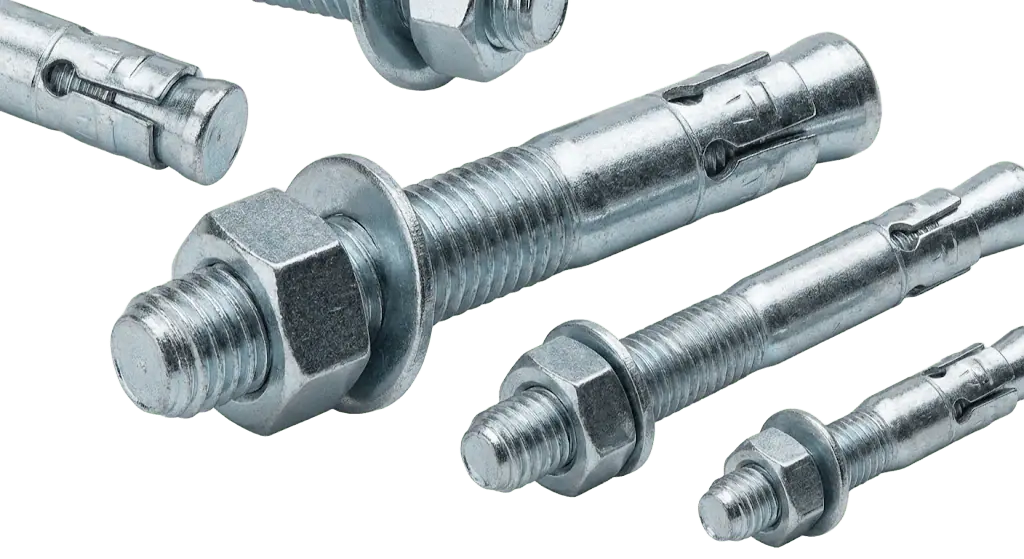
Technical Specifications
Product Name
Wedge Anchor / Through Bolt / Expansion Anchor
Standards
ASTM E488, ICC-ES AC193 (Performance), ASME B18.16.6
Material
Carbon Steel (1035/1045), Stainless Steel (AISI 304, AISI 316)
Mechanical Grades
Carbon Steel: Grade 5, Grade 8 equiv.
Stainless: A2-70, A4-70 (700 MPa Tensile)
Base Material
Normal weight concrete, Sand-lightweight concrete
Diameter Range
Imperial: 1/4″ – 1-1/4″
Metric: M6 – M30
Surface Finish
Zinc Plated (5-8µm), Hot-Dip Galvanized (ASTM A153, >45µm)
Certifications
ISO 9001:2015, CE Option 7 (Uncracked), CE Option 1 (Cracked)
Focusing on high-volume search sizes found in your data (1/2, 3/8, 5/8).
| Anchor Size | Metric Equiv. | Min. Embedment Depth (hnom) | Drill Bit Diameter (dcut) | Thread Length | Tensile Strength (Ult)* |
| 1/4″ | M6 | 1-1/8″ (29mm) | 1/4″ | 3/4″ | 2,200 lbs |
| 3/8″ | M10 | 1-5/8″ (41mm) | 3/8″ | 7/8″ | 3,800 lbs |
| 1/2″ | M12 | 2-1/4″ (57mm) | 1/2″ | 1-1/4″ | 6,400 lbs |
| 5/8″ | M16 | 2-3/4″ (70mm) | 5/8″ | 2″ | 9,600 lbs |
| 3/4″ | M20 | 3-1/4″ (83mm) | 3/4″ | 2″ | 14,200 lbs |
| 1″ | M24 | 4-1/2″ (114mm) | 1″ | 2-1/4″ | 23,400 lbs |
*Note: Ultimate Load in 4000 psi (27.5 MPa) concrete. Apply Safety Factor $\ge$ 4:1 for Safe Working Load.
Based on ISO 4017 / DIN 933 (Full Thread)
| Thread Size (d) | Pitch (P) | Head Width (s) | Head Height (k) | Proof Load (8.8 Grade) |
| M6 | 1.00 mm | 10.00 mm | 4.00 mm | 11,600 N |
| M8 | 1.25 mm | 13.00 mm | 5.30 mm | 21,200 N |
| M10 | 1.50 mm | 17.00 mm | 6.40 mm | 33,700 N |
| M12 | 1.75 mm | 19.00 mm | 7.50 mm | 48,900 N |
| M16 | 2.00 mm | 24.00 mm | 10.00 mm | 91,000 N |
| M20 | 2.50 mm | 30.00 mm | 12.50 mm | 147,000 N |
Hole Cleaning (Critical): Failure to clean the hole reduces holding power by up to 50%. Use a blow-out bulb or compressed air to remove all concrete dust before installation.
Hole Clearance (ISO 273): The fixture hole must be slightly larger than the anchor. For a 1/2″ anchor, the fixture hole should be 9/16″.
Torque ($T_{inst}$): Always use a calibrated torque wrench. Over-torquing leads to thread stripping or concrete cone failure; under-torquing results in insufficient clip expansion. Refer to the specific datasheet for Nm/ft-lb values.
Edge Distance: Maintain a minimum edge distance of $12 \times$ anchor diameter to prevent “concrete blowout” (spalling).
Hammering: Only strike the nut (threaded on flush) to protect the thread integrity during insertion. Do not hammer the exposed threads directly.
Related Products
DIN 9021 Large Series Washers
Recommended for fastening wood sills or softer materials to concrete to distribute the high clamp load of wedge anchors.
Drop-In Anchors
An internal thread alternative for flush-mount applications (e.g., hanging pipe supports) where protruding studs are not acceptable.
Chemical Anchor Studs (Chisel Point)
For applications with close edge distances or weak concrete where the expansion force of wedge anchors risks splitting the substrate.
SDS-Plus Drill Bits
Carbide-tipped masonry bits matched to the specific tolerance of our wedge anchors for optimal hole geometry.
FAQ
What is the difference between a wedge anchor and a sleeve anchor?
Wedge anchors are designed for heavy-duty loads in solid concrete, utilizing a small clip for expansion. Sleeve anchors have a full-length expansion sleeve, making them suitable for block, brick, or softer base materials where spreading the load over a larger area is necessary to prevent cracking.
Can I use wedge anchors in brick or block masonry?
No, wedge anchors are engineered specifically for solid concrete. The concentrated expansion force at the tip can crack hollow block or brick. For masonry applications, specify Sleeve Anchors or Double Expansion Shields.
How deep should I drill for a wedge anchor?
Drill the hole depth to the embedment depth plus 1/2 inch. This extra space allows concrete dust and debris to settle at the bottom without interfering with the anchor’s full insertion depth.
Are 304 Stainless Steel wedge anchors sufficient for coastal areas?
Generally, no. For coastal or marine environments (within 5 miles of saltwater), 316 Stainless Steel (A4-70) is mandatory to prevent chloride stress corrosion cracking. 304 Stainless is suitable for outdoor, non-marine environments.
Can wedge anchors be removed and reused?
No, wedge anchors are permanent fasteners. Once the clip expands into the concrete, it cannot be reversed. To remove the fixture, the anchor must be cut off at the surface or driven deeper into the hole (if depth permits).