







Selección de Recubrimiento para Tuercas Automotrices
Tuercas cincadas vs. cinc-flake vs. cinc-níquel: Guía de selección de recubrimientos para automoción
Seleccionar el recubrimiento adecuado para tuercas automotrices no es solo una decisión anticorrosiva. Las tuercas cincadas, con recubrimiento de escamas de zinc y de zinc-níquel pueden comportarse de manera diferente después del recubrimiento, la inspección de rosca, el par de apriete de montaje, la vibración, la exposición a la sal y la aprobación de producción.
Esta guía compara las tres opciones de recubrimiento según la exposición a la corrosión, el ajuste de la rosca interna, el riesgo de fragilización por hidrógeno, el control de fricción, la capa superior, los datos de RFQ y los requisitos de documentación automotriz.
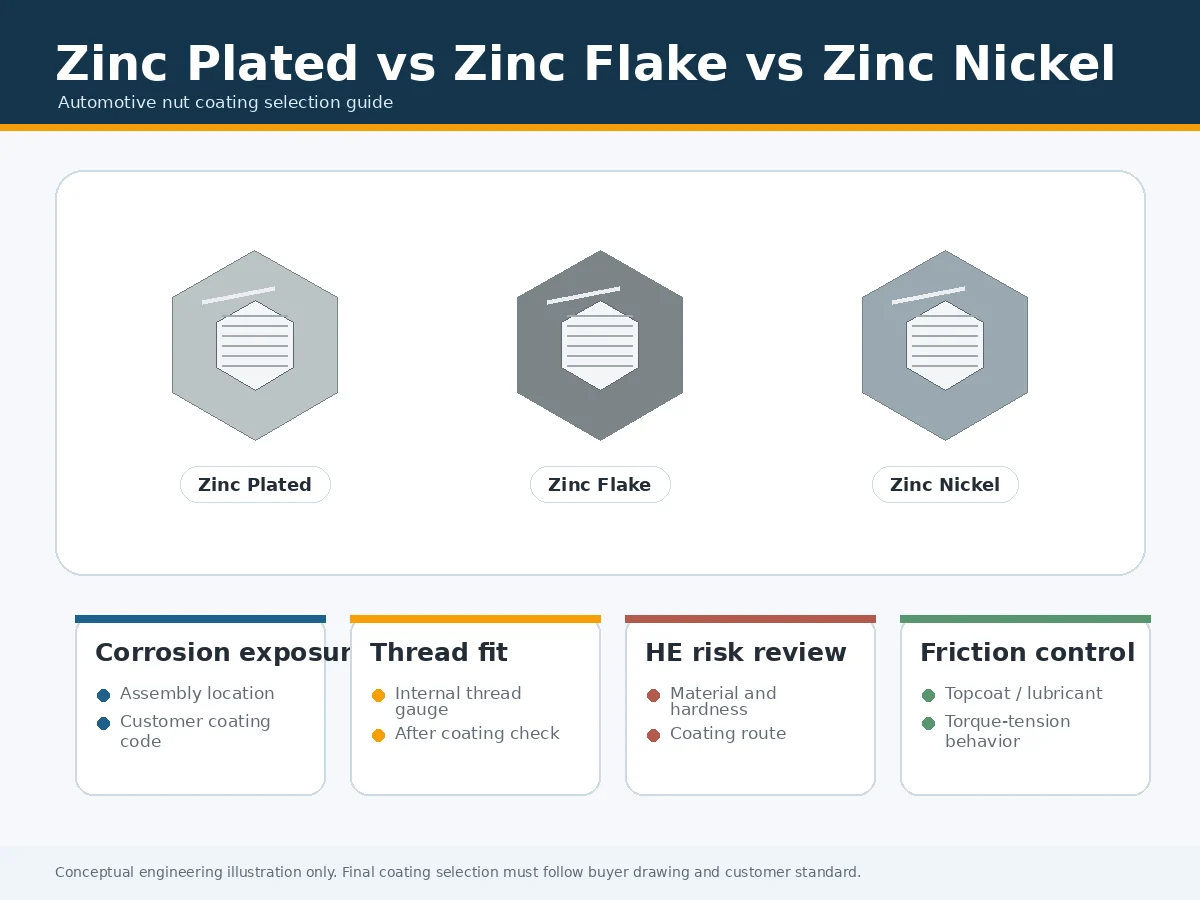
Comparación conceptual de recubrimientos únicamente; la selección final del recubrimiento debe seguir el plano del comprador y el estándar del cliente.
Respuesta rápida: ¿Qué recubrimiento deben elegir los compradores automotrices?
No existe un recubrimiento universalmente mejor para cada tuerca automotriz. La elección correcta depende del entorno de aplicación, la resistencia del material, el tratamiento térmico, el requisito de ajuste de rosca, el código de recubrimiento del cliente, la capa superior, el lubricante, el rango de fricción, el método de inspección y el alcance de los documentos de aprobación.
Las tuercas con recubrimiento de zinc se seleccionan a menudo para aplicaciones sensibles al costo, exposición a corrosión baja o proyectos donde el dibujo del cliente ya especifica un acabado de zinc electrodepositado. Pueden ser prácticas y ampliamente disponibles, pero las piezas de alta resistencia o endurecidas requieren una revisión del riesgo de fragilización por hidrógeno cuando se involucra el electrochapado.
Las tuercas con recubrimiento de escamas de zinc se consideran a menudo para requisitos de corrosión más altos, sujetadores automotrices expuestos externamente o proyectos donde se prefiere un método de recubrimiento no electrolítico. Sin embargo, el recubrimiento de escamas de zinc no elimina la necesidad de verificar el ajuste de la rosca, la acumulación del recubrimiento, la capa superior, el coeficiente de fricción y la inspección final con calibre.
Las tuercas de zinc-níquel se seleccionan a menudo cuando una especificación automotriz requiere un rendimiento de corrosión más fuerte que el galvanizado estándar, una apariencia definida, un comportamiento de superficie conductora o un código de recubrimiento específico del cliente. El zinc-níquel sigue siendo un sistema electrochapado, por lo que la dureza del material y la revisión de fragilización por hidrógeno aún pueden ser importantes.
| Condición de aplicación | Tuercas galvanizadas | Tuercas con recubrimiento de escamas de zinc | Tuercas de zinc-níquel |
|---|---|---|---|
| Aplicación sensible al costo | A menudo adecuado | Generalmente mayor costo | Generalmente mayor costo |
| Menor exposición a la corrosión | A menudo adecuado si se especifica | Puede ser más de lo necesario | Puede ser más de lo necesario |
| Alta exposición a la corrosión | Limitado a menos que sea aprobado por el cliente | A menudo un candidato fuerte | A menudo un candidato fuerte |
| Tuerca de alta resistencia o endurecida | Requiere revisión de fragilización por hidrógeno | A menudo considerado cuando se prefiere un recubrimiento no electrolítico | Requiere revisión de fragilización por hidrógeno |
| Sensibilidad del ajuste de la rosca interna | Requiere control de rosca después del chapado | Requiere control del espesor y calibre del recubrimiento | Requiere control de tolerancia de rosca y calibre |
| Control de par-tensión | Requiere control de acabado y lubricante | Requiere control de capa superior / fricción | Requiere control de acabado / fricción |
| Preocupación por conexión a tierra o conductividad eléctrica | Requiere confirmación del cliente | Puede no ser adecuado a menos que se especifique | Requiere confirmación del cliente |
| Función de soldadura o engrapado | Requiere revisión específica del proceso | Requiere revisión de compatibilidad de recubrimiento/instalación | Requiere revisión específica del proceso |
Regla de Selección
Seleccione el recubrimiento según los requisitos de ingeniería confirmados, no solo por el nombre del recubrimiento. Para tuercas automotrices, el comprador debe confirmar la ubicación de montaje, función de la tuerca, condición de la rosca, dureza del material, código de recubrimiento del cliente, capa superior, objetivo de fricción, método de prueba de corrosión, alcance del documento de aprobación y requisitos de embalaje antes de la cotización.
Tuercas con recubrimiento de zinc, zinc laminar y zinc-níquel: tabla comparativa
La primera comparación debe separar la ruta de recubrimiento, la expectativa de rendimiento y el riesgo de ingeniería. Solo el nombre del recubrimiento no es suficiente para la cotización. Los compradores deben especificar el código exacto de recubrimiento del cliente, el sistema de recubrimiento, la capa superior, la condición de inspección de la rosca y los requisitos de documentación.
| Factor | Tuercas galvanizadas | Tuercas con recubrimiento de escamas de zinc | Tuercas de zinc-níquel |
|---|---|---|---|
| Ruta de recubrimiento | Sistema de recubrimiento de zinc electrochapado | Sistema de recubrimiento de zinc laminar no electrolítico | Sistema de recubrimiento de aleación de zinc-níquel electrochapado |
| Ventaja principal | Costo, disponibilidad y opciones de acabado comunes | Rendimiento frente a la corrosión y ruta no electrolítica cuando se especifica | Rendimiento frente a la corrosión, apariencia y ajuste según código del cliente |
| Principal preocupación de ingeniería | Revisión de fragilización por hidrógeno para piezas de alta resistencia; acumulación de rosca después del recubrimiento | Capa superior, espesor del recubrimiento, control de fricción y calibre de rosca | Costo, especificación exacta, control del sistema y revisión de fragilización por hidrógeno |
| Pregunta típica del comprador | ¿Es suficiente el galvanizado estándar para esta ubicación? | ¿El proyecto requiere zinc laminado con capa superior y control de fricción? | ¿El dibujo o la norma del OEM exige zinc-níquel? |
| Riesgo de ajuste de rosca | La rosca interna puede apretarse después del galvanizado | La acumulación de recubrimiento puede afectar el calibre de la rosca interna | El espesor, la pasivación o el sellador pueden afectar el ajuste final de la rosca |
| Comportamiento torque-tensión | El acabado y el lubricante pueden modificar la fricción | La capa superior y el lubricante pueden modificar la fricción | El sistema de acabado puede modificar la fricción |
| Revisión de fragilización por hidrógeno | Importante para piezas de alta resistencia o endurecidas | A menudo considerado cuando se prefiere una ruta de recubrimiento no electrolítico | Importante para piezas de alta resistencia o endurecidas |
| Debe confirmarse en la solicitud de cotización | Código de recubrimiento, espesor si se especifica, calibre post-revestimiento y horneado si es necesario | Sistema de recubrimiento, capa base, capa superior, rango de fricción y calibre post-revestimiento | Especificación de zinc-níquel, pasivación/sellador, ajuste de rosca y alcance del informe |
| No asuma | Todo el galvanizado es aceptable para automoción | Todos los sistemas de zinc en escamas funcionan igual | El zinc-níquel resuelve automáticamente cualquier problema de corrosión o montaje |

La matriz es solo para discusión de selección; la aprobación final del recubrimiento depende del plano, código de recubrimiento del cliente y requisito de prueba.
Por qué la selección de recubrimiento para tuercas de automoción no se trata solo de horas de niebla salina
Las horas de niebla salina son fáciles de comparar, pero no definen completamente el rendimiento de una tuerca automotriz. Un recubrimiento puede parecer resistente en una prueba de corrosión, pero aún así crear problemas de montaje si la rosca interna se vuelve apretada, el coeficiente de fricción no está controlado, se usa la capa superior incorrecta o no se sigue el código de recubrimiento del cliente.
La selección del recubrimiento para tuercas automotrices debe comenzar con la unión real y el entorno. Una tuerca para soporte interior, tuerca soldada para bastidor de asiento, tuerca para bajos, tuerca de engaste en chapa, tuerca de conexión a tierra eléctrica y tuerca de seguridad totalmente metálica pueden tener diferentes prioridades de recubrimiento. La resistencia a la corrosión importa, pero también el ajuste de la rosca, el comportamiento de asiento, la soldabilidad o el rendimiento de engaste, la fricción, el comportamiento par-tensión, la apariencia, la conductividad y la documentación.
El comprador también debe confirmar si el requisito de corrosión se basa en niebla salina neutra, corrosión cíclica, pruebas específicas del cliente u otro método de validación. Las afirmaciones genéricas no deben reemplazar el plano o la especificación del cliente.
Regla de ingeniería
No seleccione tuercas automotrices recubiertas solo por las horas de corrosión anunciadas. Confirme la ubicación del montaje, el código de recubrimiento del cliente, la dureza del material, el requisito de rosca, el rango de fricción y el método de inspección antes de la cotización.
Ubicación de la unión
Las áreas interiores, exteriores, bajos, compartimento del motor y eléctricas pueden requerir diferentes sistemas de recubrimiento y diferentes alcances de inspección.
Condición de la rosca
Las roscas internas pueden volverse apretadas después del recubrimiento. Se debe definir el requisito de calibre posterior al recubrimiento si el ajuste final de la rosca es crítico.
Fricción de montaje
El acabado de la capa superior, el lubricante y el perno de acoplamiento pueden cambiar el comportamiento de par-tensión. Los valores de par no deben deducirse del nombre del recubrimiento.
Por qué la función de la tuerca cambia la selección del recubrimiento
El mismo recubrimiento puede no generar el mismo riesgo en cada tipo de tuerca. Una tuerca hexagonal estándar, tuerca de brida, tuerca de soldadura, tuerca autoperforante, tuerca de seguridad totalmente metálica o tuerca de puesta a tierra puede tener diferentes prioridades de recubrimiento porque el modo de fallo es diferente.
Por ejemplo, tuercas con brida dentadas puede necesitar condición de la cara de apoyo y control de fricción, mientras que las tuercas de soldadura pueden necesitar revisión del recubrimiento alrededor de la condición de la proyección de soldadura y protección contra la corrosión posterior. Una tuerca autoperforante necesita compatibilidad con el material de la chapa y comportamiento de instalación. Una tuerca de seguridad totalmente metálica necesita comportamiento de par de apriete predominante. Una tuerca de puesta a tierra puede requerir confirmación de conductividad superficial.
| Función de la tuerca | Preocupación por la selección del recubrimiento | El comprador debe confirmar |
|---|---|---|
| Tuerca estándar con rosca interior | Ajuste de la rosca después del recubrimiento y exposición a la corrosión | Condición del calibre de rosca, código de recubrimiento y requisito de corrosión |
| Tuerca de brida | Fricción de la cara de apoyo y comportamiento de asentamiento | Recubrimiento superior, lubricante, superficie de acoplamiento y requisito de par-tensión si corresponde |
| Tuerca de soldadura de brida / tuerca de soldadura hexagonal | Comportamiento de la proyección de soldadura y protección contra la corrosión después del montaje | Compatibilidad del proceso de soldadura, secuencia de recubrimiento y requisito posterior a la soldadura |
| Tuerca autoperforante | Comportamiento de instalación en material de chapa y riesgo de daño del recubrimiento | Material de chapa, espesor de chapa, condición del recubrimiento y extracción por empuje / torsión si es necesario |
| Tuerca de seguridad totalmente metálica | Par de apriete predominante y estabilidad de fricción | Sistema de recubrimiento, lubricante, rango de fricción y prueba de par de apriete predominante si es necesario |
| Tuerca de conexión a tierra o eléctrica | Conductividad superficial y fiabilidad de contacto | Revestimiento aprobado por el cliente y requisito de conductividad si corresponde |
Límite funcional: La selección del revestimiento no puede finalizarse solo con la geometría de la tuerca. El proveedor necesita la ubicación del ensamblaje, el tipo de junta, el material de acoplamiento, el modo de fallo, el requisito de rosca y cualquier especificación de par, extracción, torsión, empuje, par de apriete o conexión a tierra indicada por el comprador.
Tuercas con recubrimiento de zinc: cuándo son adecuadas y dónde presentan riesgos
Las tuercas con recubrimiento de zinc se utilizan ampliamente porque están disponibles, son económicas y familiares para muchos compradores. Para entornos de baja corrosión, ensamblajes sensibles al costo o aplicaciones aprobadas por el cliente, el recubrimiento de zinc puede ser una opción práctica.
Sin embargo, las tuercas con recubrimiento de zinc no deben seleccionarse automáticamente para todos los proyectos automotrices. Los recubrimientos electrodepositados requieren una revisión más cuidadosa cuando el material de la tuerca es de alta resistencia, endurecido o tratado térmicamente. La norma ISO 4042 cubre los sistemas de recubrimiento electrodepositado para sujetadores de acero e incluye recomendaciones para minimizar el riesgo de fragilización por hidrógeno.
Cuándo pueden ser adecuadas las tuercas con recubrimiento de zinc
Las tuercas con recubrimiento de zinc pueden ser adecuadas cuando el plano o la especificación del cliente ya exige recubrimiento de zinc, la exposición a la corrosión es moderada o baja, la tuerca no se utiliza en un entorno severo de parte inferior o exterior, y el sistema de recubrimiento ha sido aprobado por el cliente.
También pueden ser adecuados para soportes no críticos, ensamblajes cerrados, piezas de servicio o aplicaciones donde el costo y la disponibilidad son importantes. Incluso en estos casos, el comprador debe confirmar el ajuste de la rosca después del recubrimiento, el espesor del recubrimiento si se especifica, la pasivación, la capa superior, el horneado si es necesario y el alcance del informe de inspección.
Principales riesgos de las tuercas cincadas
Los principales riesgos incluyen la revisión de fragilización por hidrógeno para piezas de alta resistencia o endurecidas, acumulación de rosca interna después del recubrimiento, fricción inconsistente si el lubricante o el estado del acabado no se controlan, y rendimiento de corrosión insuficiente para entornos automotrices severos.
Una tuerca cincada puede pasar la inspección dimensional antes del recubrimiento, pero fallar el calibre de rosca después del recubrimiento si no se definen la tolerancia y la condición final del calibre. Esto es especialmente importante para roscas internas, tamaños de rosca pequeños o requisitos de tolerancia de rosca ajustados.
| Artículo de solicitud de cotización de tuerca cincada | Por qué es importante | Requiere confirmación |
|---|---|---|
| Norma de recubrimiento o código del cliente | Evita la sustitución genérica de “cincado” | Plano del comprador o especificación de recubrimiento del cliente |
| Espesor de recubrimiento si se especifica | Afecta la corrosión, el ajuste de la rosca y la inspección | Estándar del cliente o nota en el plano |
| Pasivación / sellador / capa superior | Afecta la apariencia y el comportamiento frente a la corrosión | Código de acabado y sistema aprobado |
| Requisito libre de Cr(VI) si aplica | Apoya el requisito de cumplimiento del cliente | Requisito del cliente o normativo |
| Alivio de fragilización por horneado si es necesario | Apoya el control del riesgo de fragilización por hidrógeno | Norma de dureza del material y recubrimiento |
| Calibre de rosca post-galvanizado | Confirma el ajuste del ensamblaje final | Antes del recubrimiento, después del recubrimiento o ambos |
| Informe de recubrimiento / prueba de corrosión | Define el alcance de la documentación y validación | Solo si lo requiere el cliente o el programa |
Límite de galvanizado
El galvanizado puede ser un recubrimiento práctico, pero no debe tratarse como una respuesta automática para automoción. Si la tuerca está endurecida, tratada térmicamente, es crítica para la rosca, sensible al par o expuesta a corrosión severa, se debe revisar la ruta de recubrimiento y los requisitos del cliente antes de cotizar.
Tuercas con recubrimiento de escamas de zinc: objetivos de alta corrosión, piezas de alta resistencia y control de fricción
Los recubrimientos de escamas de zinc se consideran a menudo para sujetadores de automoción porque se aplican no electrolíticamente y pueden especificarse con sistemas de capa superior y lubricante. La norma ISO 10683 cubre los sistemas de recubrimiento de escamas de zinc aplicados no electrolíticamente para sujetadores de acero y se aplica a tuercas, pernos, tornillos, espárragos y otros tipos de sujetadores.
Para tuercas de automoción, se puede considerar el recubrimiento de escamas de zinc cuando la resistencia a la corrosión es importante, la aplicación está expuesta al entorno vial o el proyecto desea evitar una ruta de galvanoplastia para piezas de alta resistencia o endurecidas. Aun así, el recubrimiento de escamas de zinc debe especificarse cuidadosamente. Diferentes sistemas, capas base, capas superiores y lubricantes pueden comportarse de manera diferente.
Por qué el recubrimiento de escamas de zinc se considera a menudo para sujetadores de automoción
Los sistemas de escamas de zinc se utilizan a menudo donde la resistencia a la corrosión y el riesgo del proceso son importantes. Pueden ser útiles para conjuntos de bajos, chasis, soportes expuestos u otros ensamblajes de automoción cuando la especificación del cliente lo permite o lo requiere.
El recubrimiento de escamas de zinc también se discute a menudo para sujetadores de alta resistencia porque no es una ruta de recubrimiento electrolítico. Sin embargo, los compradores no deben asumir que “escamas de zinc significa sin riesgo” sin confirmación de ingeniería. La condición del material, el pretratamiento, el proceso de recubrimiento, la capa superior y la norma del cliente siguen siendo importantes.
Principales riesgos de las tuercas con recubrimiento de escamas de zinc
Los recubrimientos de escamas de zinc pueden afectar el ajuste de la rosca. La acumulación del recubrimiento, el espesor de la capa superior o una cobertura desigual pueden influir en el calibre de la rosca interna. El comportamiento de fricción también puede cambiar según la capa superior y el lubricante. Para ensamblajes automotrices controlados por par, el coeficiente de fricción debe confirmarse si así lo requiere el plano o la norma del cliente.
No todos los sistemas de escamas de zinc tienen el mismo rendimiento. Un comprador debe evitar escribir solo “escamas de zinc” en una solicitud de cotización sin especificar el sistema de recubrimiento, la capa superior, el rango de fricción, el requisito de corrosión y la condición de inspección.
| Artículo de RFQ de escamas de zinc | Aclaración requerida | Riesgo si falta |
|---|---|---|
| Sistema de recubrimiento | Código del cliente, sistema aprobado o especificación del proveedor de recubrimiento | El proveedor puede cotizar un sistema de escamas de zinc diferente |
| Capa base + capa superior | Requerido cuando la corrosión o la fricción dependen de la capa superior | La expectativa de fricción o corrosión puede no coincidir |
| Condición del lubricante | Condición de fricción seca, lubricada o especificada | El comportamiento par-tensión puede cambiar |
| Coeficiente de fricción | Rango objetivo si es necesario | Dispersión del par de montaje |
| Calibre de rosca post-revestimiento | Condición de aceptación final de la tuerca | Disputa del calibre de rosca después del recubrimiento |
| Método de ensayo de corrosión | Niebla salina, corrosión cíclica o ensayo específico del cliente | Una declaración genérica de rendimiento puede no cumplir con los requisitos del comprador |
| Paquete de documentación | Informe de recubrimiento, IMDS o PPAP solo si es necesario | Conflicto de documentación tardía |
Límite de copos de zinc
Los copos de zinc deben especificarse como un sistema de recubrimiento, no solo como un nombre de recubrimiento. Se deben confirmar la capa base, la capa superior, el lubricante, la condición de fricción, el método de ensayo de corrosión, el calibre de rosca posterior al recubrimiento y el alcance de la documentación cuando afecten la aprobación.
Tuercas de Zinc Níquel: Resistencia a la Corrosión, Control de Rosca y Ajuste de Especificación
Las tuercas de zinc níquel se seleccionan a menudo para proyectos automotrices que requieren mejor resistencia a la corrosión que el galvanizado estándar, una apariencia definida, comportamiento de superficie conductiva o un código de recubrimiento OEM específico. El zinc níquel puede ser una opción sólida cuando el plano y la norma del cliente lo requieren.
Sin embargo, el zinc níquel no es simplemente un “mejor galvanizado” en todos los proyectos. Por lo general, cuesta más que el galvanizado estándar, y se debe especificar el sistema exacto de zinc níquel. Los compradores deben confirmar el código de recubrimiento, el rango de espesor si se especifica, la pasivación, el sellador, la condición de inspección de la rosca, el requisito de corrosión y el alcance de la documentación.
Por qué se puede seleccionar el zinc níquel
El zinc níquel se puede seleccionar cuando la pieza está expuesta a condiciones de corrosión más exigentes, cuando la especificación del cliente exige zinc níquel, o cuando el proyecto necesita un sistema de acabado con apariencia y comportamiento de ingeniería definidos.
También se puede seleccionar cuando el ensamblaje requiere un equilibrio entre protección contra la corrosión, control dimensional y propiedades de superficie conductiva. Estos beneficios dependen del sistema de recubrimiento exacto y la aprobación del cliente, no solo de las palabras “zinc níquel”.”
Principales riesgos de las tuercas de zinc níquel
Los principales riesgos incluyen mayor costo, especificación poco clara, espesor de recubrimiento incorrecto, problemas de ajuste de rosca después del recubrimiento y revisión de fragilidad por hidrógeno para piezas de alta resistencia o endurecidas. Debido a que el zinc níquel es un sistema electrochapado, los compradores no deben ignorar la dureza del material y el riesgo del proceso.
Si la solicitud de cotización solo dice “níquel zinc” sin un código de cliente o especificación de recubrimiento, los proveedores pueden cotizar diferentes sistemas. Eso puede provocar problemas de aprobación de muestras, discrepancia en los informes o desacuerdo sobre el rendimiento del recubrimiento.
| Artículo de solicitud de cotización de níquel zinc | Por qué es importante | Requiere confirmación |
|---|---|---|
| Código de recubrimiento de níquel zinc | Evita cotizar el sistema incorrecto | Plano del cliente o especificación de recubrimiento |
| Contenido de níquel / requisito del sistema si se especifica | Debe seguir el estándar del cliente | Sistema de níquel zinc aprobado |
| Rango de espesor si se especifica | Afecta la corrosión y el ajuste de la rosca | Rango de especificación y método de inspección |
| Pasivación / sellador / capa superior | Afecta la apariencia y el comportamiento frente a la corrosión | Código de acabado del cliente |
| Calibre de rosca post-revestimiento | Confirma el ajuste del ensamblaje final | Antes del recubrimiento, después del recubrimiento o ambos |
| Revisión de fragilización por hidrógeno | Necesario según material y dureza | Requisito de material, dureza y proceso del cliente |
| Informe de recubrimiento / IMDS / PPAP | Define la evidencia de aprobación si es necesario | Alcance documental específico del programa |
Límite de Zinc Níquel
El zinc-níquel debe seleccionarse cuando coincida con el código de recubrimiento del cliente y el requisito del proyecto. No debe utilizarse como sustituto genérico para todos los problemas de corrosión automotriz sin confirmar el costo, el ajuste de la rosca, la revisión de fragilidad por hidrógeno, el comportamiento de fricción y la documentación de aprobación.
Ajuste de la rosca después del recubrimiento: Calibre de rosca interna e inspección posterior al recubrimiento
Las tuercas son componentes de rosca interna, por lo que la selección del recubrimiento debe considerar el ajuste de la rosca después del recubrimiento. Un sistema de recubrimiento que funciona bien en un perno externo puede crear riesgo dentro de una tuerca si no se controlan la tolerancia de la rosca, la acumulación del recubrimiento o la condición final del calibre.
La inspección de la rosca antes del recubrimiento no garantiza automáticamente la aceptación final de la rosca recubierta. El comprador debe aclarar si la tuerca debe pasar un calibre de rosca antes del recubrimiento, después del recubrimiento o ambos. Esto es especialmente importante cuando el dibujo exige una tolerancia de rosca ajustada, un tamaño de rosca pequeño, un sistema de recubrimiento grueso o un ensamblaje funcional posterior al recubrimiento.
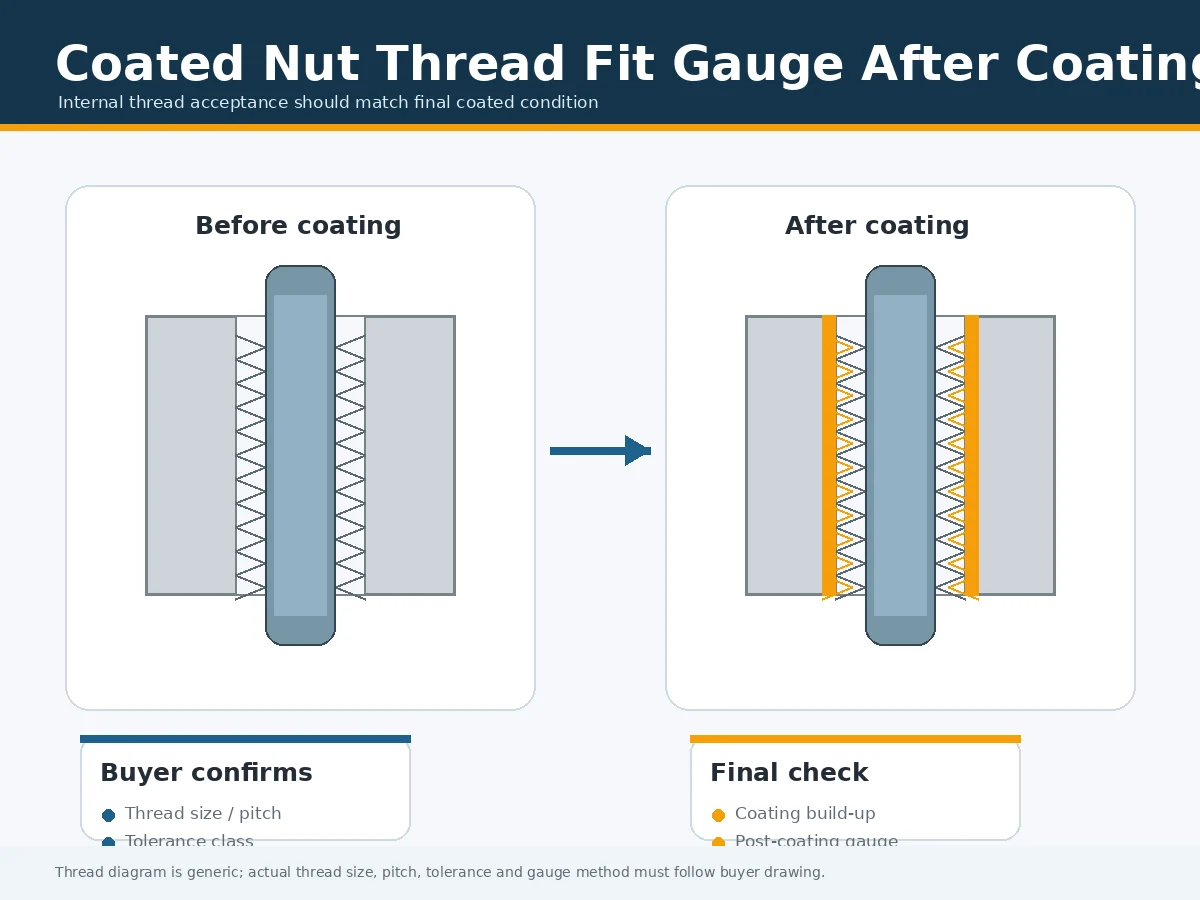
El diagrama de rosca es genérico; el tamaño real de la rosca, el paso, la tolerancia y el método de calibre deben seguir el dibujo del comprador.
Para tuercas con recubrimiento de zinc y tuercas de zinc-níquel, la acumulación por galvanoplastia puede reducir el espacio libre de la rosca interna. Para tuercas de escamas de zinc, la película de recubrimiento y la capa superior también pueden afectar la entrada del calibre y el ensamblaje. La solución no es adivinar. El dibujo o la solicitud de cotización deben definir la condición final de inspección.
| Artículo de rosca | El comprador debe confirmar | Riesgo si falta |
|---|---|---|
| Tamaño y paso de rosca | Referencia en plano | Perno, tornillo o espárrago de acoplamiento incorrecto |
| Tolerancia de rosca | Requisito de clase o ajuste | Discrepancia de calibre |
| Espesor de recubrimiento si se especifica | Norma del cliente o código de recubrimiento | Rosca apretada o ajuste inconsistente |
| Estado del calibre | Antes del recubrimiento, después del recubrimiento o ambos | Disputa de aprobación de muestra |
| Chaflán / entrada | Condición de entrada controlada por plano | Problema de montaje difícil o entrada de calibre |
| Capa superior / lubricante | Si aplica requisito de fricción | Dispersión de par o variación de precarga |
| Registro de inspección | Informe de calibre si es necesario | Falta de evidencia de aprobación |
Conexión de dibujo: Para proyectos personalizados, los requisitos de recubrimiento y rosca deben mostrarse claramente en el dibujo o en el paquete de solicitud de cotización. Para más contexto sobre el control de dibujos, revise SUNHYINGS tuercas especiales fabricadas según plano.
Riesgo de fragilización por hidrógeno: lo que los compradores deben confirmar
El riesgo de fragilización por hidrógeno es una de las consideraciones de ingeniería más importantes al seleccionar recubrimientos para sujetadores de acero de alta resistencia o endurecidos. Es especialmente relevante cuando se utilizan sistemas de recubrimiento por electrodeposición.
Para tuercas automotrices, el comprador debe confirmar el material, la dureza, el tratamiento térmico y la ruta de recubrimiento antes de asumir que un acabado es aceptable. Las tuercas cincadas y de zinc-níquel son sistemas electrodepositados, por lo que las piezas de alta resistencia o endurecidas pueden requerir revisión de fragilización por hidrógeno, horneado o controles de proceso específicos del cliente si se especifica.

El flujo de trabajo de riesgo es solo explicativo; el control de proceso final debe seguir la norma del cliente y la especificación de recubrimiento aprobada.
El zinc en escamas es un sistema de recubrimiento aplicado no electrolíticamente y a menudo se considera cuando es importante evitar el riesgo de fragilización por hidrógeno relacionado con la electrodeposición. Pero esto no debe interpretarse como “el zinc en escamas elimina todo riesgo”. El proyecto aún necesita un pretratamiento correcto, control del proceso de recubrimiento, capa superior, inspección y aprobación del cliente.
| Factor de riesgo | Por qué es importante | El comprador debe confirmar |
|---|---|---|
| Grado de material | Determina la resistencia y la sensibilidad al proceso | Dibujo o estándar del cliente |
| Dureza / clase de propiedad | Una mayor dureza puede aumentar la preocupación | Rango de dureza y método de ensayo |
| Tratamiento térmico | Afecta el comportamiento mecánico | Requisito y registros de tratamiento térmico |
| Ruta de recubrimiento | La ruta electrochapada vs. no electrolítica cambia la revisión de riesgos | Estándar de recubrimiento o proceso aprobado |
| Tratamiento de horneado / alivio | Puede ser requerido por norma o por el cliente | Tiempo y condición requeridos si se especifica |
| Aprobación del cliente | La decisión final depende de las reglas del programa | Código de recubrimiento del cliente y proceso de aprobación |
Sin afirmación universal de riesgo cero
Un recubrimiento no electrolítico puede ser un factor de selección importante, pero la revisión del riesgo de fragilización por hidrógeno aún depende del material, la dureza, el tratamiento térmico, los controles del proceso y los requisitos del cliente. No afirme una fragilización por hidrógeno garantizada sin validación específica del proyecto.
Capa superior, lubricante y comportamiento par-tensión
El recubrimiento no es solo una capa anticorrosiva. Cambia la condición superficial de la tuerca y puede afectar la fricción durante el apriete. Con el mismo par de apriete, diferentes sistemas de recubrimiento, capas superiores o lubricantes pueden generar diferentes cargas de sujeción.
Esto es importante para uniones automotrices donde la precarga, la resistencia al aflojamiento, el par de fijación o la consistencia del montaje son críticos. Es especialmente relevante cuando se utilizan tuercas recubiertas con pernos de acoplamiento que también tienen su propio recubrimiento, lubricante o condición superficial.

No se implica ningún valor de par o fricción; los valores de prueba deben provenir del plano del comprador o de la norma de ensamblaje.
Para tuercas con recubrimiento de zinc, la pasivación, el sellador y la condición del lubricante pueden afectar la fricción. Para tuercas con escamas de zinc, la capa superior y el lubricante integrado o añadido pueden ser críticos. Para tuercas de zinc-níquel, el sistema de acabado exacto también puede influir en la fricción y el comportamiento de ensamblaje.
El comprador no debe pedir al proveedor que adivine el valor de par o el coeficiente de fricción. Si el comportamiento par-tensión es importante, la solicitud de cotización debe incluir el rango requerido del coeficiente de fricción, el método de prueba, la condición lubricada o seca, la condición del perno de acoplamiento y los criterios de aceptación.
| Variable | Por qué es importante | El comprador debe confirmar |
|---|---|---|
| Capa superior | Cambia el comportamiento de fricción y corrosión | Código de capa superior requerido |
| Lubricante | Cambia el comportamiento par-tensión | Condición lubricada o seca |
| Coeficiente de fricción | Controla la consistencia del montaje | Rango objetivo si es necesario |
| Acabado del perno de acoplamiento | Afecta el comportamiento de la junta completa | Revestimiento y condición superficial del perno |
| Función de bloqueo | Afecta el par de apriete predominante | Método de ensayo y criterio de aceptación |
| Espesor de recubrimiento | Afecta el ajuste y la fricción de la rosca | Condición final de calibración e inspección |
Para aplicaciones de bloqueo y sensibles al par, los compradores también pueden consultar SUNHYINGS tuercas autoblocantes totalmente metálicas y comunes problemas de ensamblaje automotriz resueltos por tuercas especiales.
Lista de verificación de dibujo y RFQ para tuercas automotrices recubiertas
Una RFQ de tuerca automotriz recubierta no debe decir solo “zincado”, “escamas de zinc” o “zinc-níquel”. Esos nombres no son suficientes para la revisión técnica. El proveedor necesita el dibujo, el código de recubrimiento, la norma del cliente, el contexto de aplicación, la condición de la rosca, la condición del material, el requisito de fricción y el alcance de la documentación.

La lista de verificación es solo para preparación de RFQ; PPAP, IMDS e informes de recubrimiento aplican solo cuando el cliente o programa lo requiera.
Una RFQ completa ayuda a prevenir la sustitución incorrecta del recubrimiento, fallas de rosca post-recubrimiento, dispersión del par, desacuerdo sobre corrosión y conflictos de documentación tardía. Para el contexto de revisión del lado del proveedor, consulte SUNHYINGS como un proveedor especializado en tuercas para aplicaciones automotrices.
| Elemento de RFQ | ¿Requerido? | Por qué es importante | Requiere confirmación |
|---|---|---|---|
| Última revisión del plano | Sí | Controla la línea base técnica | Plano actual y revisión aprobada |
| Tipo y función de tuerca | Sí | Las tuercas de soldadura, engaste, bloqueo y brida tienen diferentes riesgos | Función, pieza de acoplamiento y modo de falla |
| Ubicación de ensamblaje | Sí | Determina la exposición a la corrosión y la función de la junta | Interior, exterior, parte inferior, compartimento del motor o área eléctrica |
| Tamaño de rosca, paso y tolerancia | Sí | Controla el ajuste del ensamblaje final | Método de calibre y condición antes/después del recubrimiento |
| Material / dureza / tratamiento térmico | Sí si se especifica | Apoya la revisión de fragilidad por hidrógeno | Grado de material, clase de propiedad, rango de dureza o nota de tratamiento térmico |
| Tipo de recubrimiento | Sí | El zincado, el recubrimiento de escamas de zinc o el zinc-níquel son solo el punto de partida | Familia y ruta de recubrimiento exactas |
| Código de recubrimiento del cliente | Altamente recomendado | Evita la sustitución genérica de recubrimiento | Dibujo del cliente, código OEM o especificación de compra |
| Espesor de recubrimiento | Si se especifica | Afecta el ajuste de la rosca y la expectativa de corrosión | Rango especificado, método de inspección y condición final |
| Capa superior / sellador / lubricante | Si es necesario | Controla la fricción y el acabado | Sistema aprobado y condición seca / lubricada |
| Método de ensayo de corrosión | Si es necesario | Define la expectativa de validación | Niebla salina neutra, corrosión cíclica o prueba específica del cliente |
| Calibre de rosca post-revestimiento | Si la rosca es crítica | Evita disputas en el ajuste final | Antes del recubrimiento, después del recubrimiento o ambos |
| Coeficiente de fricción | Si es necesario | Garantiza consistencia par-tensión | Rango objetivo, método de prueba y condición del perno de acoplamiento |
| Informe PPAP / IMDS / recubrimiento | Si es necesario | Define el alcance del documento de aprobación | Requisito del cliente o del programa |
| Volumen anual | Sí | Afecta la ruta de recubrimiento y la planificación del proceso | Prototipo, aprobación de muestra y volumen de producción |
| Embalaje | Si es necesario | Evita daños en el recubrimiento y lotes mezclados | A granel, bolsa, bandeja, etiqueta, separación de lotes y prevención de óxido |
PPAP debe tratarse como un requisito específico del cliente o del programa. IMDS también debe tratarse como un requisito de datos de materiales automotrices cuando sea necesario. Estos deben confirmarse antes de la cotización en lugar de agregarse después de la aprobación del precio.
Cómo revisa SUNHYINGS los requisitos de recubrimiento antes de la cotización
SUNHYINGS debe revisar los proyectos de tuercas automotrices recubiertas verificando el dibujo, el requisito de recubrimiento, la condición de la rosca, el riesgo del material y el contexto de aplicación antes de la cotización. El objetivo no es seleccionar el recubrimiento más caro, sino confirmar el sistema de recubrimiento que coincida con el dibujo del comprador y el requisito del cliente.
Revisión del dibujo y código de recubrimiento
La revisión comienza con la última revisión del dibujo y la nota de recubrimiento. Si el dibujo solo dice “zinc”, “Zn”, “acabado negro” o “resistente a la corrosión”, el requisito de recubrimiento no es lo suficientemente claro para una cotización automotriz. Deben confirmarse el código de recubrimiento, el color de acabado, la capa superior, el sellador, el lubricante, el requisito de corrosión y el alcance del informe.
Revisión del material, dureza y riesgo de fragilización por hidrógeno
SUNHYINGS debe revisar el grado del material, la dureza, el tratamiento térmico y los requisitos de resistencia antes de confirmar una ruta de recubrimiento electroquímico. Si existe riesgo de fragilización por hidrógeno, el proyecto debe revisarse según la norma del cliente y los requisitos del proceso de recubrimiento.
Revisión de requisitos de rosca y funcionales
Para las tuercas, la condición final de la rosca interna es crítica. La revisión debe confirmar el tamaño de la rosca, el paso, la tolerancia, el chaflán, el requisito de calibre posterior al recubrimiento y las necesidades de prueba funcional. Tuercas de soldadura para brida, tuercas de soldadura hexagonales, tuercas autoperforantes, las tuercas de seguridad totalmente metálicas y las tuercas con brida pueden requerir diferentes puntos de revisión.
Revisión de control de muestras y producción
Antes del muestreo, el comprador y el proveedor deben confirmar si la ruta de la muestra coincide con la ruta de producción. También deben definir el alcance del informe de recubrimiento, el plan de inspección, el embalaje, la trazabilidad del lote, el PPAP si es necesario y el IMDS si es necesario.
¿Qué se puede verificar antes de la cotización?
Para proyectos de tuercas automotrices sensibles al recubrimiento, SUNHYINGS puede revisar el plano del comprador y el paquete de solicitud de cotización para identificar datos técnicos faltantes antes de la confirmación del precio. Esta revisión es una verificación técnica en la etapa de cotización, no un sustituto de la aprobación del cliente, la validación del laboratorio de recubrimiento o la presentación formal de PPAP.
| Elemento de revisión | Lo que SUNHYINGS puede verificar | Límite |
|---|---|---|
| Revisión del dibujo y nota de recubrimiento | Si la indicación del recubrimiento es lo suficientemente clara para cotización y muestreo | El dibujo del cliente y la especificación del recubrimiento siguen siendo la autoridad final |
| Ajuste de rosca interna | Si es necesario definir la condición del calibre de rosca después del recubrimiento | La aceptación real del calibre debe seguir el dibujo del comprador y el método de inspección |
| Material, dureza y tratamiento térmico | Si la revisión de fragilización por hidrógeno relacionada con el galvanizado puede ser relevante | Ninguna ruta de recubrimiento debe aprobarse sin la revisión de los requisitos del cliente |
| Requisito de informe de recubrimiento | Si se solicita informe de recubrimiento, datos de prueba de corrosión o documentación del proveedor | El alcance del informe depende del cliente, programa y capacidad del socio de recubrimiento |
| Requisito de fricción y par de apriete | Si falta capa superior, lubricante, coeficiente de fricción o acabado del perno de acoplamiento | Los valores de par y fricción deben provenir del estándar del cliente o de pruebas calificadas |
| Embalaje y trazabilidad de lotes | Si se definen requisitos de prevención de daños por recubrimiento, separación de lotes y etiquetado | El método de embalaje final debe seguir la orden de compra y los requisitos logísticos del cliente. |
Preguntas abiertas antes de la cotización
Si los datos de recubrimiento están incompletos, SUNHYINGS debe aclarar los puntos faltantes antes de la cotización final. Las preguntas abiertas típicas incluyen: ¿Cuál es el código exacto del recubrimiento? ¿La tuerca es de alta resistencia o tratada térmicamente? ¿Debe pasar el calibre de rosca después del recubrimiento? ¿Se requiere un rango de fricción? ¿El requisito de corrosión es niebla salina, corrosión cíclica o específico del cliente? ¿Se requieren informes PPAP, IMDS o de recubrimiento?
Los compradores pueden revisar SUNHYINGS como fabricante de tuercas personalizadas para proyectos personalizados de tuercas automotrices que implican revisión de planos, ajuste de rosca, requisitos de recubrimiento y control de producción.
Revisar límite: Los datos faltantes de recubrimiento o inspección deben marcarse como “necesita confirmación”. No deben reemplazarse por una suposición genérica.
Antes de Solicitar una Cotización para Tuercas Automotrices Recubiertas
Prepare la revisión del plano, el código de recubrimiento, la función de la tuerca, la ubicación de montaje, el material/dureza, la tolerancia de rosca, el requisito de calibre post-recubrimiento, la capa superior, el lubricante, el método de prueba de corrosión, el rango de fricción si se requiere, el volumen anual y el requisito de embalaje antes de la cotización.
Si falta alguno de estos elementos, la elección del recubrimiento debe tratarse como “necesita confirmación” en lugar de asumirse. Esto es especialmente importante para tuercas con recubrimiento de zinc, escamas de zinc y zinc-níquel utilizadas en uniones automotrices donde el ajuste de rosca, la revisión de fragilidad por hidrógeno o el comportamiento torque-tensión afectan la aprobación.
Paquete técnico mínimo
Envíe la última revisión del plano, el tamaño de rosca y tolerancia, la función de la tuerca, la nota de recubrimiento, el requisito de material o dureza, la ubicación de montaje y el volumen anual.
Datos adicionales para proyectos sensibles al recubrimiento
Confirmar código de recubrimiento del cliente, capa superior, lubricante, método de prueba de corrosión, calibre de rosca post-recubrimiento, coeficiente de fricción si se requiere, PPAP si se requiere e IMDS si se requiere.
Referencias técnicas y contexto de normas
Las referencias a continuación se proporcionan como contexto técnico para la ruta de recubrimiento, sistemas de recubrimiento de sujetadores, revisión de riesgo de fragilización por hidrógeno y requisitos de documentación automotriz. No reemplazan el plano del comprador, el estándar específico del cliente, la especificación de recubrimiento o la revisión de ingeniería calificada.
| Referencia | Cómo Apoya Esta Guía | Usar límite |
|---|---|---|
| ISO 4042: Sujetadores — Sistemas de recubrimiento electrodepositado | Proporciona contexto para sistemas de recubrimiento electrodepositado en sujetadores y orientación para minimizar el riesgo de fragilidad por hidrógeno. | Usar solo como contexto de ruta de recubrimiento; el requisito final debe seguir la norma del cliente y el plano aprobado. |
| ISO 10683: Sistemas de recubrimiento de copos de zinc aplicados no electrolíticamente | Proporciona contexto para sistemas de recubrimiento de copos de zinc para sujetadores de acero, incluyendo tuercas, con o sin capa superior o lubricante. | Usar solo en contexto de recubrimiento de escamas de zinc; el sistema final debe ser especificado por el código del cliente o la especificación de recubrimiento aprobada. |
| AIAG PPAP-4 | Proporciona contexto para la aprobación de piezas de producción cuando se deben demostrar los registros de diseño de ingeniería del cliente y los requisitos de especificación. | PPAP aplica solo cuando lo requiere el cliente, el programa o la especificación de compra. |
| IMDS: Sistema Internacional de Datos de Materiales | Proporciona contexto para el informe de datos de materiales automotrices cuando lo requieren los programas automotrices. | IMDS debe tratarse como un requisito del cliente o del programa automotriz, no como un requisito predeterminado para cada pedido de tuerca personalizada. |
Para más recursos de ingeniería de SUNHYINGS, revise el guías técnicas archivo y el tuercas especiales personalizadas centro de productos.
PREGUNTAS FRECUENTES
¿Cuál es mejor para tuercas automotrices, cincado, copos de zinc o zinc-níquel?
No existe una opción universalmente mejor. Las tuercas con recubrimiento de zinc pueden ser adecuadas para aplicaciones sensibles al costo y con baja corrosión. Las tuercas con escamas de zinc suelen considerarse para requisitos de corrosión más altos y necesidades de recubrimiento no electrolítico. Las tuercas de zinc-níquel se seleccionan a menudo cuando la especificación del cliente exige un rendimiento anticorrosión más fuerte o un sistema de acabado definido. La elección final depende del plano, la norma del cliente, el material, la dureza, el ajuste de la rosca, el requisito de fricción y el alcance de la aprobación.
¿Son adecuadas las tuercas cincadas para aplicaciones automotrices?
Sí, las tuercas cincadas pueden ser adecuadas para algunas aplicaciones automotrices cuando el plano o la especificación del cliente lo permite. Se utilizan a menudo en entornos sensibles al costo o de baja corrosión. Sin embargo, las piezas de alta resistencia o templadas requieren una revisión de fragilización por hidrógeno, y se debe confirmar el ajuste final de la rosca después del cincado cuando sea necesario.
¿Por qué se utilizan recubrimientos de escamas de zinc en los sujetadores automotrices?
Los recubrimientos de escamas de zinc se utilizan a menudo porque proporcionan una fuerte protección contra la corrosión y se aplican de forma no electrolítica. Se consideran frecuentemente para sujetadores automotrices expuestos o sujetadores de alta resistencia cuando la especificación del cliente lo permite. El comprador aún debe confirmar el sistema de recubrimiento, la capa superior, el rango de fricción, el calibre de rosca y los requisitos de prueba de corrosión.
¿Es el zinc-níquel mejor que el cincado para las tuercas?
El zinc-níquel puede ofrecer un mejor rendimiento anticorrosión que el galvanizado estándar cuando se especifica correctamente, pero no es automáticamente la mejor opción para cada tuerca. Generalmente cuesta más y aún requiere un código de recubrimiento exacto, control de ajuste de rosca, requisito de corrosión y revisión de fragilización por hidrógeno cuando se trata de piezas de alta resistencia o endurecidas.
¿El recubrimiento afecta el ajuste de la rosca interna en las tuercas?
Sí. El recubrimiento puede reducir la holgura de la rosca interna y afectar la inspección con calibre. Una tuerca puede pasar la inspección de rosca antes del recubrimiento, pero fallar después si no se definen la tolerancia de la rosca, el espesor del recubrimiento o la condición final del calibre. Los compradores deben confirmar si la aceptación final es antes del recubrimiento, después del recubrimiento o ambas.
¿Qué recubrimiento tiene el menor riesgo de fragilización por hidrógeno?
El riesgo de fragilización por hidrógeno depende del material, la dureza, el tratamiento térmico, el proceso de recubrimiento y los requisitos del cliente. El zincado y el zinc-níquel son sistemas electrodepositados, por lo que las piezas de alta resistencia o endurecidas pueden requerir revisión. Las escamas de zinc se aplican de forma no electrolítica y a menudo se consideran cuando es importante evitar el riesgo asociado a la electrodeposición, pero la aprobación final debe seguir los requisitos de ingeniería del cliente.
¿El recubrimiento de escamas de zinc cambia el comportamiento de torque-tensión?
Sí, es posible. Los sistemas de copos de zinc suelen incluir una capa superior o lubricante, y estos pueden afectar la fricción. Si el comportamiento par-tensión es relevante, el comprador debe definir el coeficiente de fricción, el acabado del perno de acoplamiento, el método de ensayo y la condición de montaje, en lugar de basarse en nombres genéricos de recubrimiento.
¿Qué debo incluir en una solicitud de cotización para tuercas automotrices recubiertas?
Incluir la última revisión del dibujo, tipo de tuerca, ubicación de aplicación, tamaño de rosca, paso, tolerancia, material, dureza, código de recubrimiento, capa superior, lubricante, calibre de rosca post-recubrimiento, requisito de prueba de corrosión, coeficiente de fricción si se requiere, PPAP si se requiere, IMDS si se requiere, volumen anual y requisito de embalaje.
Páginas relacionadas de SUNHYINGS
Revise las páginas relacionadas para tuercas personalizadas, aplicaciones automotrices, función especial de tuerca y orientación de ingeniería.
Nota de revisión técnica
Este artículo fue preparado para gerentes de abastecimiento, ingenieros de compras, equipos SQE, ingenieros de sujetadores y equipos de proyectos automotrices que comparan tuercas cincadas, con recubrimiento de zinc escamado y zinc-níquel antes de RFQ, muestreo o aprobación de producción.
Alcance revisado: ruta de recubrimiento, exposición a corrosión, ajuste de rosca interna, condición del calibre post-recubrimiento, revisión de riesgo de fragilización por hidrógeno, capa superior, lubricante, comportamiento torque-tensión, dureza del material, función de la tuerca, datos de RFQ, PPAP si se requiere e IMDS si se requiere.
Nota de estándares y limitaciones: Este artículo es una guía práctica de abastecimiento e ingeniería. No reemplaza el plano del cliente, la especificación de recubrimiento, el requisito específico del cliente, la revisión de ingeniería calificada, la presentación formal de PPAP, el requisito de informe IMDS o la aprobación del proceso del proveedor. Los datos faltantes de recubrimiento, rosca, fricción, material o documento deben tratarse como necesita confirmación, no asumirse como hecho.