








All-Metal Lock Nuts (Prevailing Torque Metal Nuts) — High-Temperature Anti-Loosening
In harsh service, “tight” does not mean “secure.” When a joint is exposed to heat, oil, and continuous vibration, the first failure mode is usually preload decay and rotation, not bolt tensile rupture. Nylon insert lock nuts can lose locking efficiency when the insert softens, creeps, or is chemically attacked. All-metal lock nuts avoid that mechanism entirely.
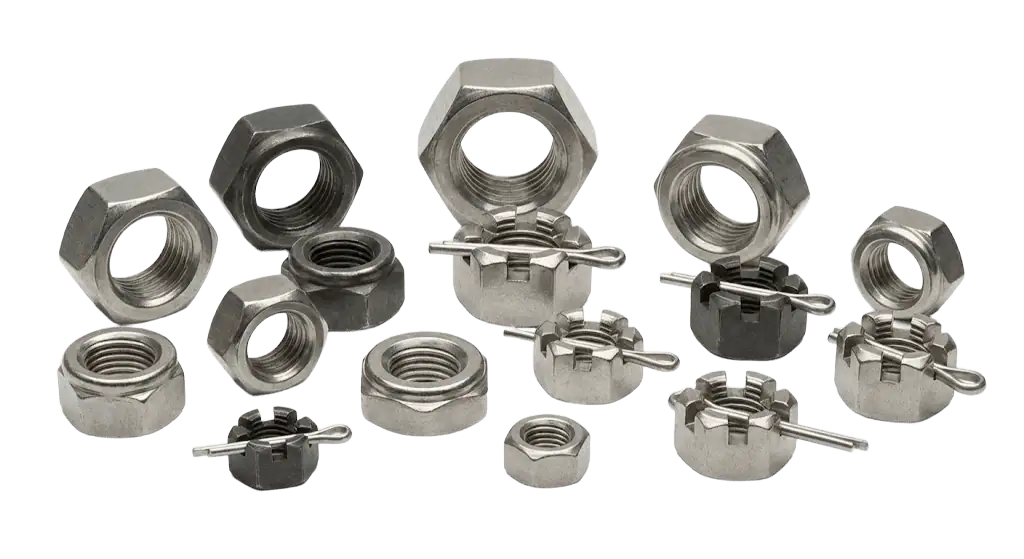
These nuts achieve locking by controlled thread deformation (prevailing torque): the nut creates an interference zone that resists rotation across the full service temperature range of the base metal. In real assemblies—exhaust brackets, engine peripherals, heavy equipment frames, rail fastenings, and high-load industrial machinery—this translates into fewer re-torque events and reduced risk of backing-off in “no-access” locations. The image shows typical all-metal prevailing-torque forms (including top-lock / stover-type features) designed for vibration resistance without polymer components.
- Maintain locking at high heat
- Resist vibration-induced back-off
- Deliver prevailing torque control
- Eliminate nylon insert failures
- Offer stover/top-lock styles
- Support Class 10/12 strength
Technical Specifications
Product Name
All-Metal Lock Nuts / Self-locking Metal Nuts / Prevailing Torque Metal Nuts / Deformed Thread Lock Nuts / Stover Lock Nuts / Top Lock Nuts
Standards
DIN 980V (hexagon prevailing torque, all-metal), ISO 7042 (international all-metal lock nut), ISO 7719 (related all-metal locking programmes), DIN 6925 (all-metal flange lock nut), IFI 100/107 (inch lock nut programmes; Grade C / Grade G)
Material
Alloy steel (for high-strength programmes), Carbon steel; Stainless steel options where corrosion drives selection (A2 / A4), per drawing
Grades / Classes
Metric: Class 10 / Class 12 typical for high-preload joints; Inch/IFI: Grade C / Grade G programmes; Stainless strength classes per requirement
Thread
Metric coarse/fine; UNC/UNF for inch; right-hand standard; left-hand available by drawing
Diameter Range
Metric: common M5–M24 (larger by request); Inch sizes per IFI programmes
Surface Finish
Plain, Zinc plated (Cr3), Zinc-Nickel, Black oxide; Flake coatings (Geomet/Dacromet) where corrosion + friction control are required; Passivation for stainless
Certifications
ISO 9001:2015, RoHS/REACH on request; EN 10204 3.1 MTC/traceability available; PPAP support for automotive programmes
1: Nylon insert lock nuts fail at temperature.
What happens: Under sustained heat, nylon can creep or soften; prevailing torque drops and the nut may back off.
All-metal solution: All-metal lock nuts use a metallic interference zone (deformed thread) to generate prevailing torque, maintaining anti-loosening function without polymer dependence.
Pain Point 2: Vibration loosening in heavy equipment and transport.
What happens on machines: Transverse vibration causes micro-slip at the joint interface; preload relaxes, and conventional nuts can rotate loose.
Engineering response: The prevailing torque feature provides a resisting torque that increases rotation resistance even after some preload loss, improving retention in vibration-dominated assemblies.
Pain Point 3: High preload + high strength pairing.
Real scenario: Automotive and heavy machinery often run higher bolt preloads; if nut grade is insufficient, thread stripping or bearing surface issues appear before design load is reached.
Solution: Specify nut class/grade aligned to the bolt grade (e.g., Class 10/12 programmes). High strength is not marketing—it is a requirement for maintaining clamp force without thread failure.
Pain Point 4: Procurement risk—same “lock nut” name, different performance.
Issue: “All-metal lock nut” can refer to multiple designs (top-lock / stover, center-lock, flange lock). Their prevailing torque values and reuse characteristics differ.
Solution: Purchase by standard + type (DIN 980V / ISO 7042; stover/top-lock vs center-lock; flange vs non-flange) and define the torque performance requirements when the assembly process is sensitive.
Example table to capture “all-metal lock nut dimensions / chart” traffic. Confirm exact dimensions and tolerances against the specified standard edition.
| Thread d | Pitch P (coarse) | Across flats s | Nut height m | Notes |
|---|---|---|---|---|
| M6 | 1.0 | 10 | 6 | prevailing-torque type |
| M8 | 1.25 | 13 | 8 | top-lock options |
| M10 | 1.5 | 17 | 10 | common automotive size |
| M12 | 1.75 | 19 | 12 | heavy duty brackets |
| M16 | 2.0 | 24 | 16 | machinery frames |
| M20 | 2.5 | 30 | 20 | high preload joints |
Dimension checks engineers care about
m must deliver adequate thread engagement for the bolt clamp length.
For flange types (DIN 6925), verify flange OD and seating surface constraints.
For coated nuts, confirm thread tolerance and coating build to avoid assembly “false torque.”
Achieve target preload while preserving prevailing torque performance.
Torque vs prevailing torque
An all-metal lock nut introduces a resisting torque component; tightening torque includes both clamp-load generation and prevailing torque. For automated lines, define the measurement approach and acceptance criteria to avoid under-preload.
Preload strategy
For critical joints, verify clamp force by validated torque–tension correlation. All-metal lock nuts resist rotation, but they do not automatically guarantee correct preload if friction scatter is uncontrolled.
Lubrication and friction control
Lubrication reduces friction and changes achieved preload for a given torque. If lubrication is used, lock it down in the process spec.
For flake coatings or zinc-nickel, confirm friction window to keep installation torque consistent.
Washers and bearing surface
Use hardened washers where the joint surface is soft or coated to reduce embedment and maintain preload. Embedment is a major driver of preload loss even when the nut does not rotate.
Hole clearance (ISO 273)
If the bolt passes through clearance holes, follow ISO 273 to avoid binding and misalignment. Binding can create false torque and lead to under-preload, especially when prevailing torque is present.
Reuse guidance
Prevailing torque typically decreases after repeated cycles. For safety-critical or high-vibration joints, define reuse limits and verify prevailing torque after reassembly if reuse is unavoidable.
Related Products
High Strength Bolts (ISO 4014/4017, Grade 8.8/10.9/12.9)
all-metal lock nuts are commonly paired with higher bolt grades to maintain clamp force under load.
Serrated Flange Nuts (DIN 6923)
alternative anti-loosening approach when surface bite is acceptable and parts count must be reduced.
Wedge-Lock Washers
effective for transverse vibration cases where joint slip drives loosening; used when validation supports washer-based locking.
Hex Nuts (ISO 4032 / DIN 934)
baseline option for non-vibration or serviceable joints; useful for cost/complexity comparison.
FAQ
What is an all-metal lock nut?
An all-metal lock nut is a self-locking nut that prevents loosening by thread deformation that creates prevailing torque. It contains no nylon insert, so locking performance does not depend on polymer behaviour.
Why choose all-metal lock nuts over nylon insert (nyloc) nuts?
Choose all-metal lock nuts when temperature, chemicals, or high vibration could reduce nylon insert performance. All-metal designs maintain locking in harsh environments where nylon can soften or creep.
What does “stover nut” mean?
A stover nut is a common industry term for a top-lock all-metal prevailing torque nut. The locking feature is formed at the top section to create interference and resist rotation under vibration.
Do all-metal lock nuts guarantee the right preload?
No—lock nuts resist rotation, but preload still depends on friction, lubrication, and tightening method. For critical joints, you must validate torque–tension behaviour and control the friction condition.
Can all-metal lock nuts be reused?
Sometimes, but prevailing torque usually decreases after reuse. For high-vibration or safety-critical joints, define reuse limits and verify prevailing torque performance after reassembly.