Damit ist A490 das Produkt mit der höheren Festigkeit, aber nicht automatisch die bessere Wahl für eine Stahlverbindung. Der Unterschied von 25% zwischen den Gruppenbezeichnungen bedeutet nicht pauschal eine Erhöhung der Verbindungskapazität um 25%. A325 und A490 müssen außerdem mit der Tragwerksplanung, den Anforderungen an den Korrosionsschutz, den geltenden Montagevorschriften sowie kompatiblen Muttern und Unterlegscheiben abgeglichen werden.
A325 und A490 nach ASTM F3125: Was die Bezeichnungen bedeuten
A325 und A490 wurden ursprünglich durch separate ASTM-Spezifikationen definiert. Ihre Anforderungen an die Strukturverschraubung sind heute unter ASTM F3125/F3125M, der mehrere Produktkategorien hochfester Schrauben für den Stahlbau zusammenführt, geregelt.
In der aktuellen Spezifikationssprache kann ein Ingenieur eine Schraube als ASTM F3125 Grade A325 oder ASTM F3125 Grade A490 bezeichnen. Die Grade bezeichnet eine festgelegte mechanische Festigkeitskategorie, während der Typ die Werkstoffchemie und damit zusammenhängende Eigenschaften abdeckt. Diese Unterscheidungen sind wichtig, weil eine Bestellung, die nur “A490-Schrauben” angibt, relevante Werkstoff- und Beschichtungsdetails undefiniert lassen kann.
Beide Grade sind, soweit zutreffend, den Werkstoffklassifizierungen Type 1 und Type 3 zugeordnet. Type 1 steht für die entsprechende nicht witterungsbeständige Werkstoffklassifizierung. Type 3 bezeichnet eine wetterfeste Stahlchemie, die die atmosphärische Korrosionsbeständigkeit unter geeigneten Umgebungsbedingungen verbessern soll. Type 3 ist keine separate Zugfestigkeitsklasse, und ihre Bezeichnung bedeutet nicht, dass eine aufgebrachte Schutzbeschichtung immer entbehrlich ist.
Produktausführung und Abmessungen sind separate Spezifikationselemente. Eine strukturelle Schwer-Sechskantschraube muss die Abmessungsanforderungen ihrer festgelegten Produktkonfiguration erfüllen; eine optisch ähnliche Standard-Sechskantschraube ist nicht zwangsläufig ein konformer Ersatz. Nenndurchmesser, Länge, Gewindeausführung und das zutreffende Produktstandard müssen bestätigt werden, bevor die Komponenten als gleichwertig akzeptiert werden.
Auch die maßgebliche Ausgabe ist von Bedeutung. Der Katalog des ASTM-Herausgebers für 2026 führt ASTM F3125/F3125M-26 auf, doch ein Projekt kann vertraglich eine frühere Ausgabe verlangen. Ein Ingenieur oder Einkäufer sollte mechanische Eigenschaften, Beschichtungszulässigkeiten oder Abnahmeverfahren aus verschiedenen Ausgaben nicht miteinander kombinieren, ohne festzulegen, welche Anforderungen für die Bestellung maßgeblich sind.
ASTM F3125 betrifft das Schraubenprodukt; die montierte strukturelle Verbindung muss separat ihre maßgeblichen Auslegungs- und Montageanforderungen erfüllen. Für Stahlkonstruktionen nach dem RCSC-Regelwerk umfassen diese Anforderungen den relevanten Verbindungstyp sowie Bestimmungen zu Montage, Installation und Prüfung.
Festigkeitsvergleich: Warum eine festere Schraube nicht automatisch eine festere Verbindung bedeutet
Der wesentliche mechanische Unterschied ist eindeutig: A490 ist einer höheren Mindestzugfestigkeitsgruppe zugeordnet als A325.
Der folgende Vergleich verwendet die RCSC-Schraubengruppen und Beschichtungsbestimmungen von 2025. Er ist keine Wiedergabe der vollständigen mechanischen Abnahmetabellen nach ASTM F3125.
| Merkmal | Güte A325 | Grade A490 |
|---|---|---|
| ASTM-Produktspezifikation | ASTM F3125/F3125M | ASTM F3125/F3125M |
| RCSC-Schraubengruppe 2025 | Gruppe 120 | Gruppe 150 |
| Mindestzugfestigkeitsgruppe | 120 ksi | 150 ksi |
| Relative Zugfestigkeitsgruppierung | Referenzniveau | 25% höher |
| Feuerverzinkung oder mechanische Verzinkung nach RCSC 2025 | Zulässig für geeignete konforme Ausführungen | Für Gruppe 150 nicht zulässig |
| Zinklamellenbeschichtung | Zulässigkeit und Montageanforderungen sind zu prüfen | Bestimmte ASTM F3393-Systeme sind bedingt zulässig |
| Tragfähigkeit der Strukturverbindung | Muss durch die Verbindungsauslegung festgelegt werden | Muss durch die Verbindungsauslegung festgelegt werden |
Die Mindestzugfestigkeitsgruppe beschreibt die Werkstoffanforderung an den Schraubenbolzen. Sie legt nicht fest, wie viel Last eine montierte Verbindung aufnehmen kann.
Betrachten Sie zwei Schraubenbolzen mit gleichem Nenndurchmesser, einen A325 und einen A490. Sind ihre wirksamen Spannungsquerschnitte vergleichbar, bietet der höherfeste Bolzen bei einer durch die Bolzenzugkraft bestimmten Situation ein größeres potenzielles Widerstandsvermögen. Diese Beobachtung allein sagt nichts Endgültiges über die Tragfähigkeit der gesamten Verbindung aus.
Eine Stahlverbindung kann stattdessen durch Lochleibung, Verformung des Schraubenlochs, Randabstand, Festigkeit des angeschlossenen Materials, Blockversagen oder einen anderen maßgebenden Grenzzustand bestimmt werden. Eine Erhöhung der Bolzenwerkstofffestigkeit erhöht nicht die Blechdicke, ändert nicht die Randabstände und verbessert nicht die Festigkeit des umgebenden angeschlossenen Materials.
Auch die Lage des Gewindes ist von Bedeutung. Ob Gewinde in einer Scherfuge liegen, kann den nach dem maßgebenden Bemessungsverfahren angesetzten Scherwiderstand des Bolzens beeinflussen. Eine bloße Änderung der Festigkeitsklasse ohne Überprüfung der festgelegten Bolzengeometrie und Verbindungsdetails kann eine wichtige Bemessungsannahme ungeklärt lassen.
Vorspannung ist nicht gleich Zugfestigkeit
Eine weitere häufige Verwechslungsquelle ist der Zusammenhang zwischen Bolzenzugfestigkeit und montierter Vorspannung.
Die Zugfestigkeit ist eine Werkstoffeigenschaft, die durch die maßgebende Produktspezifikation und die Prüfanforderungen festgelegt wird. Die Vorspannung ist die Klemmkraft, die in einer montierten Bolzenverbindung aufgebaut wird, wenn die Verbindung eine Vorspannung erfordert.
Bei einer gleitfesten Verbindung hängt der Gleitwiderstand von der maßgebenden Bemessungsbeziehung ab, in die die Bolzenvorspannung, der Zustand der Kontaktflächen, die Anzahl der Gleitfugen und weitere vorgeschriebene Faktoren eingehen. Ein höherfester Bolzen kann eine andere festgelegte Vorspannung zulassen, doch seine Auswirkung auf den Verbindungswiderstand muss anhand der maßgebenden Bemessungsanforderungen bewertet werden.
Auch die Bolzenbeschichtung und die Behandlung der Kontaktflächen sind voneinander zu unterscheiden. Die Zulassung einer Schutzbeschichtung auf dem Bolzen belegt nicht, dass eine bestimmte beschichtete oder unbeschichtete Kontaktfläche die geforderte Gleitwiderstandsklasse erfüllt.
Bei einer Scher-Lochleibungsverbindung können die maßgebenden Bemessungsnachweise anders ausfallen. Je nach tatsächlicher Ausführung kann eine Erhöhung der Bolzenfestigkeit einen technischen Vorteil bieten, keine nutzbare Erhöhung des maßgebenden Verbindungswiderstands ergeben oder eine Überprüfung anderer Teile der Verbindung erforderlich machen.
Die Auswahlentscheidung lautet daher nicht “150 ksi ist besser als 120 ksi”. Sie lautet, ob die höherfeste Klasse eine dokumentierte strukturelle Anforderung erfüllt, die die gesamte Verbindung nutzen kann.
Betrachten Sie eine beispielhafte Überprüfung einer Verbindung, bei der A490 vorgeschlagen wird, um eine Bewegung in einer A325-Verbindung zu beheben. Liegt die Ursache in einem nicht verifizierten Montageverfahren oder in ungeeigneten Kontaktflächen, löst eine höhere Bolzenfestigkeitsklasse das Problem nicht. Ermitteln Sie den tatsächlichen Grenzzustand und die Montagenachweise, bevor Sie die Verbindung umgestalten. Verwenden Sie Terminologie zur Schraubenfestigkeit um Produkteigenschaften von der Verbindungsleistung getrennt zu halten.
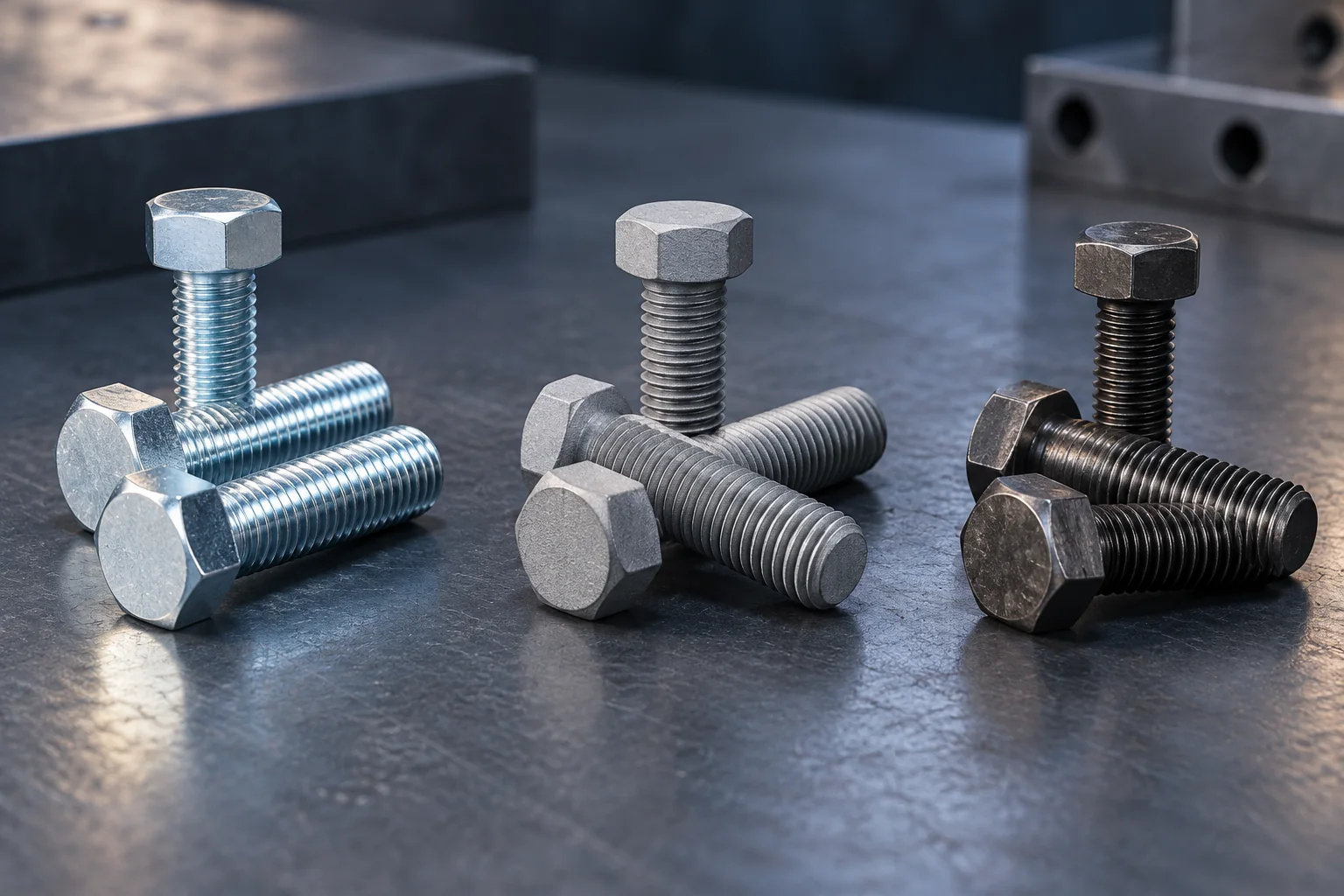
Beschichtungsunterschiede: Feuerverzinkung, zugelassene Beschichtungen und Korrosionsschutz
Coating selection is one of the clearest practical differences between A325 and A490 structural bolts.
Steel structural bolts may require corrosion protection when used outdoors, in industrial atmospheres or in other environments where unprotected steel is unsuitable. However, an acceptable coating must be evaluated as part of the specified bolt assembly. Its chemistry, application process, interaction with the fastener material and effect on installation can all matter.
Why hot-dip galvanizing and zinc-flake coatings must be distinguished
Hot-dip galvanizing and mechanical galvanizing are established zinc-coating processes, but their acceptance is not identical across the two structural bolting groups.
Under the 2025 RCSC Specification, Group 150 bolting cannot be hot-dip galvanized or mechanically galvanized; specified ASTM F3393 zinc-flake systems are a separate, conditional route.
This distinction prevents two opposite specification errors.
The first error is ordering hot-dip galvanized A490 bolts because galvanized A325 bolts were previously accepted in a similar application. The higher-strength grade does not inherit the lower-strength group’s coating permissions.
The second error is rejecting every zinc-based coating for A490. Certain ASTM F3393 zinc-flake coating systems are permitted within the applicable RCSC requirements. That permission is not a blanket approval for any commercial zinc-flake coating, arbitrary application process or unverified bolt-and-nut combination.
The applicable coating specification, bolting grade, component configuration and qualification requirements must all agree.
Why high-strength bolt coatings receive special scrutiny
High-strength steel fasteners can be susceptible to hydrogen-assisted cracking under unfavorable combinations of material condition, applied stress and hydrogen exposure.
Coating and surface-treatment processes may introduce or influence that risk. Its significance depends on the strength and material characteristics of the fastener and the specific processing route.
This is one reason coating suitability cannot be judged solely by the appearance or nominal corrosion resistance of the finished bolt. A process that produces acceptable corrosion protection does not necessarily satisfy the requirements applicable to a particular high-strength structural bolt grade.
Measures intended to control hydrogen-related risks also do not override explicit prohibitions in the governing structural bolting specification.
There is an additional assembly consequence. Protective coatings can alter thread dimensions and frictional behavior. Galvanized or otherwise coated fasteners may require specific matching nut conditions and lubrication provisions. Combining a coated bolt with an unrelated nut is not equivalent to procuring a compliant structural bolting assembly.
When pretensioning is required, the specified assembly and installation procedure must also be capable of satisfying the applicable verification requirements. Coating qualification, product testing and field installation verification are related but separate responsibilities.
Type 3 weathering steel is another selection route
Type 3 structural bolts use weathering-steel material characteristics rather than relying exclusively on a subsequently applied protective coating.
In suitable atmospheric exposure, weathering steels can develop a protective corrosion-product layer that reduces further atmospheric corrosion compared with conventional unprotected steel. Their effectiveness depends on the environment and the conditions that allow the protective layer to develop.
Persistent wetness, aggressive chloride exposure, contaminated runoff and sheltered moisture-retaining details can change that behavior. A weathering designation alone does not establish acceptable corrosion performance in every outdoor location.
Where Type 3 bolts are specified, matching nuts and washers must also satisfy the applicable assembly requirements. Combining weathering and non-weathering components without checking the specified configuration can create an unintended materials mismatch.
The real decision is between approved protection systems for the actual service environment, not between a supposedly corrosion-proof bolt and one that always needs coating.
In a hypothetical outdoor order, the buyer changes A325 to A490 while retaining the hot-dip-galvanized finish line. The original coating permission cannot be carried across automatically. Hold the revised order, check the permitted coating route and confirm the corresponding nuts, washers and assembly evidence. Compare coating processes without treating a finish name as structural approval.
Wann sollten Planer A325 oder A490 festlegen?
A325 is a reasonable selection when the governing structural design permits Group 120 bolting and its available, compliant corrosion-protection options satisfy the project requirements.
A490 becomes relevant when the engineer specifies Group 150 bolting or establishes that the higher-strength product offers a useful advantage for the actual connection design. That decision must still account for coating restrictions, assembly requirements and installation conditions.
The comparison becomes more useful when applied to specific purchasing situations.
A connection already designed and approved for A325
If an approved connection specifies Grade A325, purchasing should follow that designation unless a formal substitution is accepted. A490 should not be treated as an automatic upgrade merely because it has a higher minimum tensile-strength level.
Changing the grade may alter design assumptions, pretension requirements, coating eligibility and matching component selection. Even when the proposed bolt has the same nominal diameter and thread, those differences require review.
A connection where higher-strength bolting is specified
If the structural design specifically requires Grade A490, substituting A325 because it is more readily available or easier to galvanize is not acceptable without an engineering review.
The lower-strength grade may not satisfy the design basis. Where corrosion protection is also required, the coating system must be compatible with the specified higher-strength bolting group rather than selected independently.
An outdoor connection requiring corrosion protection
For an outdoor structural assembly, the designer must establish whether an appropriately galvanized Group 120 assembly, an approved coated Group 150 assembly or a suitable weathering-steel configuration fulfills the combined structural and exposure requirements.
The environmental requirement cannot be separated from the mechanical requirement. A coating acceptable on one grade is not necessarily transferable to the other, while a weathering material may be unsuitable for particular wet or chloride-rich conditions.
Hypothetical selection example: a proposed bolt upgrade
Consider a hypothetical outdoor steel connection whose approved documents specify ASTM F3125 Grade A325 Type 1 bolts with a compliant hot-dip galvanized assembly.
A purchaser proposes replacing the specified bolts with Grade A490 of the same nominal diameter, also hot-dip galvanized, on the assumption that stronger bolts provide a greater safety margin.
That substitution has two separate problems.
First, the stronger bolt does not automatically increase the approved connection resistance. The design would need to be checked against the relevant limit states and installation assumptions.
Second, the proposed hot-dip galvanized Group 150 configuration conflicts with the 2025 RCSC coating restriction. Matching the original bolt diameter cannot resolve a coating prohibition.
The appropriate response is to retain the specified compliant A325 assembly unless the engineer approves a different design and matching bolting configuration. If A490 is genuinely required, the protection system must be selected from the options permitted by the governing project requirements, with any applicable ASTM F3393 qualification independently confirmed.
This is an illustrative engineering scenario, not a SUNHY customer project, test result or approval of a particular product.
So werden A325/A490-Schraubgarnituren festgelegt und geprüft
A structural bolt order should identify more than the grade printed on the drawing.
The buyer needs sufficient information to distinguish the specified bolt product from visually similar fasteners, confirm the correct corrosion-protection system and ensure that the matching components meet the project requirements.
A practical purchasing specification should establish the following:
- Product identity: ASTM F3125/F3125M, the governing edition, Grade A325 or A490, applicable Type, product style, nominal diameter, length and thread configuration.
- Coating and exposure: Required surface protection, the exact coating specification, its eligibility for the selected grade and the relevant corrosion environment.
- Matching components: Applicable nut and washer product specifications, their grades or types, coating compatibility and any specified lubrication or assembly conditions.
- Joint requirements: The approved structural design basis, whether pretensioning is required, applicable installation method and any project-specific inspection requirements.
- Acceptance documents: Manufacturer identification, product and lot traceability, required material or mechanical test records, coating documentation and any additional project inspection evidence.
ASTM A563 nuts and ASTM F436 washers are commonly referenced in structural bolting assemblies, but their acceptable grades, types and coating combinations depend on the applicable specifications. A purchaser should not select a nut solely by nominal thread size or assume that any hardened washer satisfies every structural connection requirement.
The same principle applies to testing and documentation. A manufacturer may provide test records showing that a production lot was evaluated against specified product requirements. Those records do not by themselves demonstrate that a field-installed joint achieved the required pretension or that its installation inspection was completed correctly.
Product qualification and joint acceptance therefore require different evidence.
Bolt head markings can help identify the declared grade and manufacturer, but visual markings alone do not establish material chemistry, tensile-test compliance, coating qualification or full lot traceability. Receiving inspection should reconcile the actual components with the purchase order, applicable standard and supplied documentation.
For pretensioned assemblies, preinstallation verification and installation inspection must follow the governing requirements. A generic torque chart is not an adequate substitute for those procedures, since the torque needed to develop a particular clamp load can vary with the fastener assembly and its frictional condition.
There is also a difference between a supplier offering a nominally matching bolt and supplying a documented assembly acceptable for the specified structural work. If the requested grade, coating or matching components cannot be supported by appropriate records, the discrepancy should be resolved before substitution or installation.
The final choice should preserve the engineer’s approved connection requirements. Material strength determines only part of what a structural bolt can do; coating eligibility, matched components and verified installation requirements determine whether that bolt can be used as specified.
Häufig gestellte Fragen
Ist A490 immer die bessere Schraube für den Stahlbau?
Nein. Die korrekte Festigkeitsklasse richtet sich nach den freigegebenen Anforderungen an Verbindungsausführung, Montage und Korrosionsschutz. Eine höhere Zugfestigkeitsgruppe verbessert nicht automatisch jede Verbindung.
Können A490-Schrauben nach RCSC 2025 feuerverzinkt werden?
Nein. Die zitierte Spezifikation schließt diesen Weg für Schrauben der Gruppe 150 aus. Andere zulässige Beschichtungswege haben separate Bedingungen und müssen geprüft werden.
Kann ich die A325-Mutternspezifikation nach dem Wechsel auf A490 weiterverwenden?
Erneut prüfen. Zulässige Mutternfestigkeitsklassen hängen von der Schraubengruppe, dem Schraubentyp und dem Beschichtungszustand ab; eine übereinstimmende Nenngröße des Gewindes reicht nicht aus.