








Stainless Steel Threaded Flanges (NPT)
Sunhy is a leading manufacturer and supplier of high-quality stainless steel threaded flanges. We engineer these flanges for applications where welding (hot work) is hazardous or prohibited, such as in explosive (ATEX) environments or highly flammable areas.
Unlike welded flanges, this design uses threads (typically NPT per ASME B1.20.1) to form a seal, allowing for easy assembly and disassembly without specialized labor. Our flanges, forged from SS316L and SS304L grades, are ideal for small-bore (NPS 1/2″ to 4″), low-to-medium pressure systems in water treatment, fire protection, and instrumentation.
Types of Threaded Flanges We Supply
 Stainless Steel Flanges
By Design Type
By Standard & Class
Advanced Materials
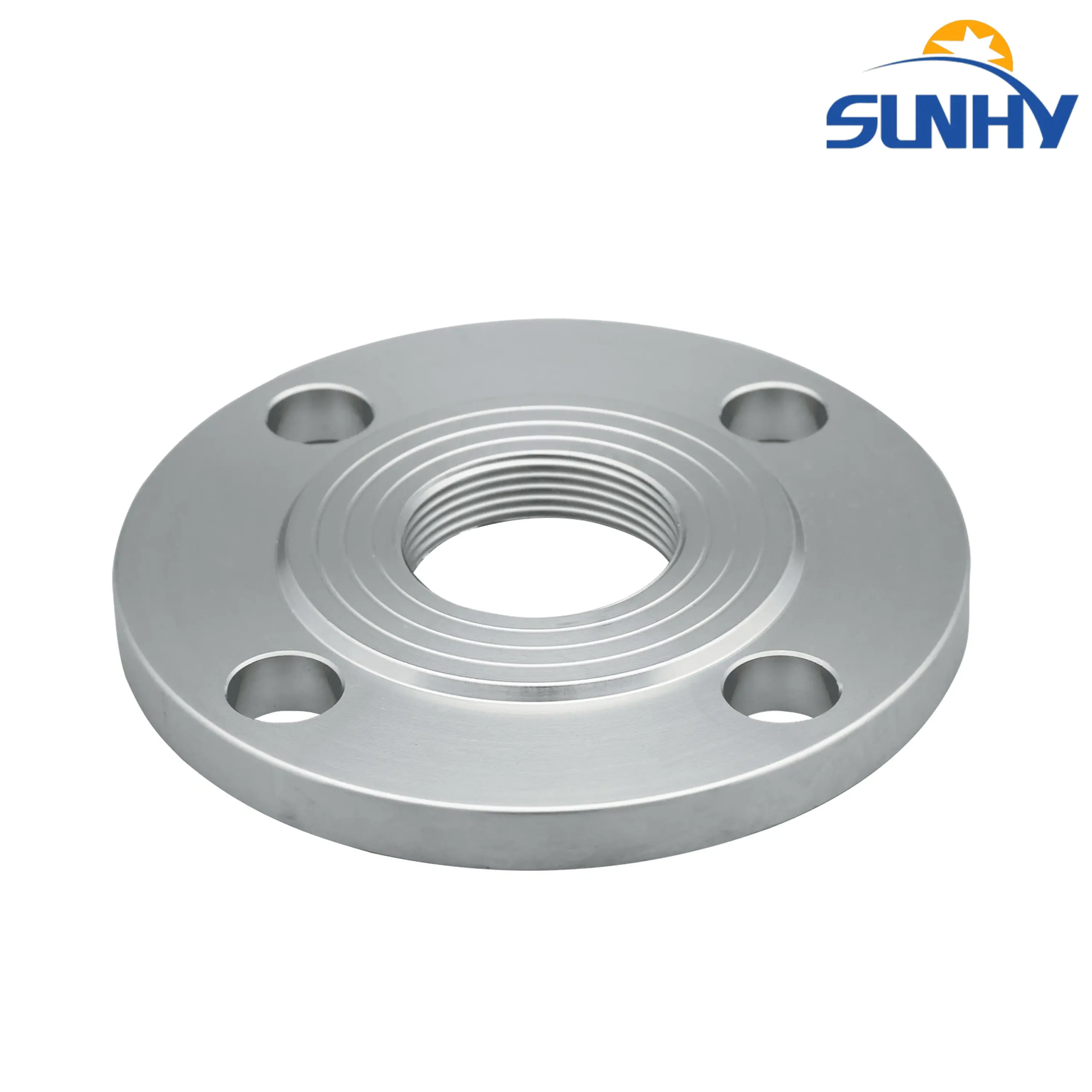
4-Bolt Stainless Steel Threaded Flange, NPT Raised Face (RF)
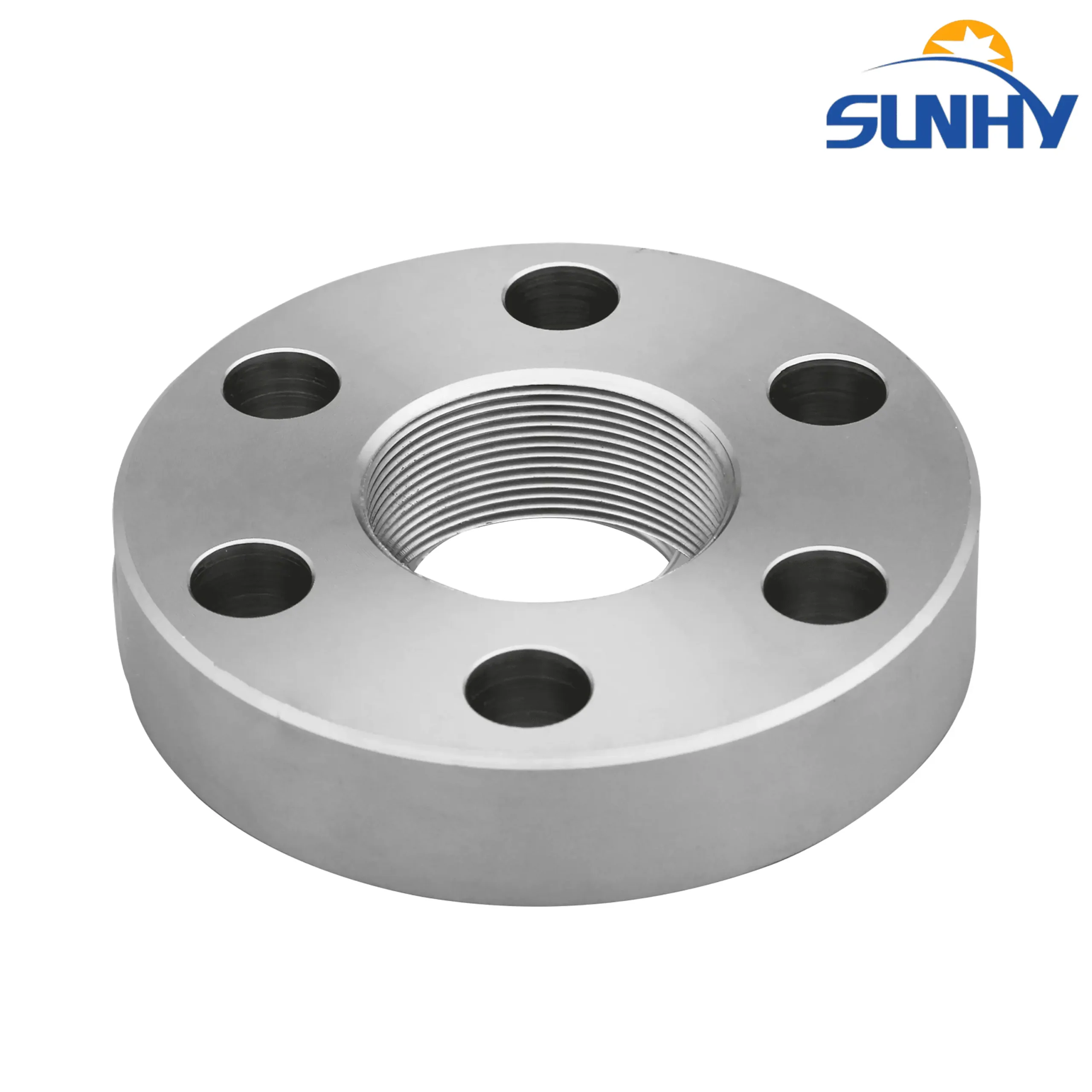
6-Bolt Stainless Steel Threaded Pipe Flange, Raised Face (RF)
Stainless Steel Threaded Flanges: Features & Specifications
When your system requires secure, non-weld integrity and ease of maintenance, we are your specialized Stainless Steel Threaded Flanges manufacturer. Our components are optimized for rapid assembly and disassembly in areas where welding is impractical or prohibited (e.g., ATEX-rated hazardous environments).
Our manufacturing focuses on precision threading to ensure a tight, reliable seal. We produce all common thread types, including:
NPT (ASME B1.20.1)
BSPT (ISO 7-1)
BSPP (ISO 228-1)
Every flange is forged from certified SS316L (for maximum corrosion resistance) or SS304L (for general use) stainless steel and meets stringent ASME B16.5 standards for dimensional accuracy.
Your Factory-Direct Supply
Maximize your project speed and cost efficiency. We stock a ready inventory of standard stainless steel threaded flanges for genuine wholesale pricing and reliable global performance.
What is a Threaded Flange
A threaded flange is a type of flange that connects to a pipe without welding. It features internal (female) threads, such as NPT, which screw onto the external (male) threads of a pipe. This design is ideal for small-bore piping systems (NPS 4″ / DN100 and smaller) and is essential in hazardous environments (ATEX) where welding (hot work) is prohibited.
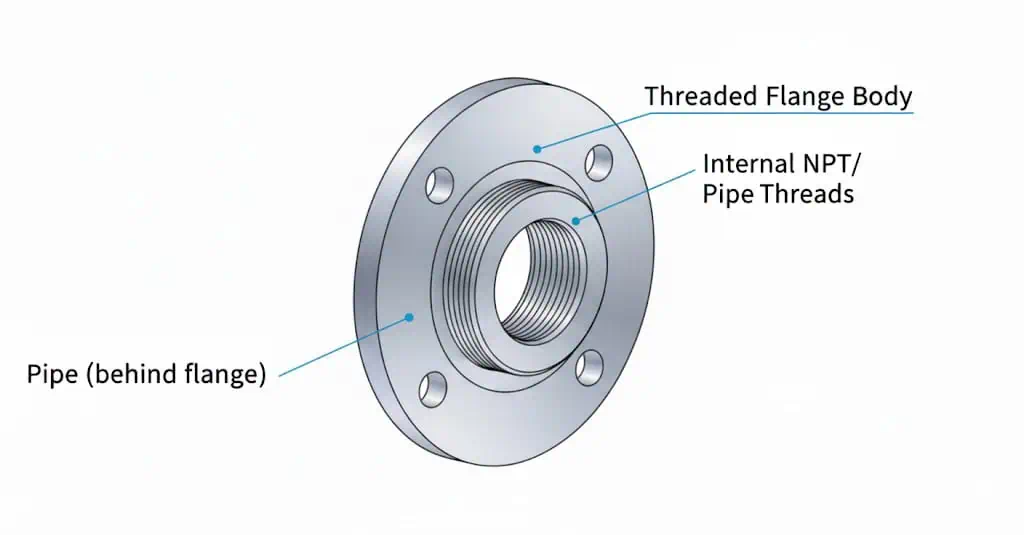
Threaded Flanges (TH) Specifications
Standard Compliance
These dimensions strictly conform to ASME B16.5 (Classes 150 & 300) and encompass EN 1092-1 Type 13 specifications.
Thread Standard: All internal threads are machined to ASME B1.20.1 (NPT) standards to ensure a tight, leak-proof seal with standard NPT pipe fittings.
Material & Application
Manufactured from Forged Stainless Steel SS304/304L and SS316/316L.
Welding-Free Solution: Ideal for applications where welding is hazardous (e.g., explosive environments) or difficult to execute.
Assembly: Allows for easy assembly and disassembly of piping connections without thermal distortion.
Dimensional Reference
Refer to the cross-section diagram and the table headers for key measurements:
O: Outside Diameter
Y: Length through Hub (critical for clearance)
BC: Bolt Circle Diameter
Technical Note: Please verify your mating pipe is NPT threaded. Attempting to mate NPT with BSPT/ISO threads will result in seal failure.

Threaded Flange (TH) Dimensions
Standard: ASME B1.20.1 (NPT)ASME B16.5 Class 150 Threaded
| NPS (Size) |
Outside Dia (O) (mm) |
Length (Y) (Through Hub) |
Bolt Circle (BC) (mm) |
Holes (Qty) |
Bolt Size (Inch) |
Thread (Std) |
|---|---|---|---|---|---|---|
| 1/2" | 88.9 | 15.7 | 60.5 | 4 | 1/2" | 1/2 NPT |
| 3/4" | 98.6 | 15.7 | 69.9 | 4 | 1/2" | 3/4 NPT |
| 1" | 108.0 | 17.5 | 79.2 | 4 | 1/2" | 1 NPT |
| 1-1/2" | 127.0 | 22.4 | 98.6 | 4 | 1/2" | 1-1/2 NPT |
| 2" | 152.4 | 25.4 | 120.7 | 4 | 5/8" | 2 NPT |
| 3" | 190.5 | 30.2 | 152.4 | 4 | 5/8" | 3 NPT |
| 4" | 228.6 | 33.3 | 190.5 | 8 | 5/8" | 4 NPT |
| 6" | 279.4 | 39.6 | 241.3 | 8 | 3/4" | 6 NPT |
| 8" | 342.9 | 44.5 | 298.5 | 8 | 3/4" | 8 NPT |
ASME B16.5 Class 300 Threaded
| NPS (Size) |
Outside Dia (O) (mm) |
Length (Y) (Through Hub) |
Bolt Circle (BC) (mm) |
Holes (Qty) |
Bolt Size (Inch) |
Thread (Std) |
|---|---|---|---|---|---|---|
| 1/2" | 95.3 | 22.4 | 66.5 | 4 | 1/2" | 1/2 NPT |
| 3/4" | 117.3 | 25.4 | 82.6 | 4 | 5/8" | 3/4 NPT |
| 1" | 124.0 | 27.0 | 88.9 | 4 | 5/8" | 1 NPT |
| 1-1/2" | 155.4 | 30.2 | 114.3 | 4 | 3/4" | 1-1/2 NPT |
| 2" | 165.1 | 33.3 | 127.0 | 8 | 5/8" | 2 NPT |
| 3" | 209.6 | 42.9 | 168.1 | 8 | 3/4" | 3 NPT |
| 4" | 254.0 | 47.8 | 200.2 | 8 | 3/4" | 4 NPT |
ASME B16.5 Class 600 Threaded
| NPS (Size) |
Outside Dia (O) (mm) |
Length (Y) (Through Hub) |
Bolt Circle (BC) (mm) |
Holes (Qty) |
Bolt Size (Inch) |
Thread (Std) |
|---|---|---|---|---|---|---|
| 1/2" | 95.3 | 22.4 | 66.5 | 4 | 1/2" | 1/2 NPT |
| 3/4" | 117.3 | 25.4 | 82.6 | 4 | 5/8" | 3/4 NPT |
| 1" | 124.0 | 27.0 | 88.9 | 4 | 5/8" | 1 NPT |
| 1-1/2" | 155.4 | 30.2 | 114.3 | 4 | 3/4" | 1-1/2 NPT |
| 2" | 165.1 | 36.6 | 127.0 | 8 | 5/8" | 2 NPT |
Class 900 & 1500 (Instrumentation)
Warning: Threaded flanges in Class 900/1500 are prone to leakage in cyclic environments.
| NPS (Size) |
Class (Rating) |
Outside Dia (mm) |
Min Thread Length (mm) |
Bolt Circle (mm) |
Holes (Qty) |
Thread (Std) |
|---|---|---|---|---|---|---|
| 1/2" | 1500 | 120.7 | 22.0 | 82.6 | 4 | NPT |
| 3/4" | 1500 | 130.0 | 25.0 | 88.9 | 4 | NPT |
| 1" | 1500 | 149.4 | 28.0 | 101.6 | 4 | NPT |
| 1-1/2" | 1500 | 177.8 | 31.0 | 123.9 | 4 | NPT |
| 2" | 1500 | 215.9 | 38.0 | 165.1 | 8 | NPT |
Recommend Weld Neck (WN) or SW for High Pressure Safety.
View Weld Neck FlangesEngineering Note: NPT vs BSPT
- Region: USA, Canada.
- Angle: 60° thread angle.
- Seal: Tapered threads requiring sealant/tape.
- Standard Supply: All Sunhyings ASME flanges come with NPT by default.
- Region: Europe, Asia, Australia.
- Angle: 55° thread angle.
- Incompatibility: NPT and BSPT represent different geometries and cannot be mixed.
- Note: Specify "BSPT Threads" clearly in your RFQ.
Order Threaded Flanges Parameters
To ensure you receive an accurate, factory-direct quote for the correct product, please specify the following key parameters:
| Parameter | Specification |
|---|---|
| Size Range | NPS 1/2″ to NPS 4″ (DN15 to DN100) (Note: Larger sizes are not recommended for threaded flanges) |
| Material Grade | Stainless Steel: SS316/L (F316/L), SS304/L (F304/L) per ASTM A182 |
| Thread Standard | NPT (ASME B1.20.1), BSPT (ISO 7-1), or BSPP (ISO 228-1) |
| Pressure Class (US) | ASME B16.5: Class 150, 300, 600, 900, 1500 |
| Pressure Rating (EU) | EN 1092-1 Type 13: PN10, PN16, PN25, PN40 |
| Flange Face Type | Raised Face (RF) or Flat Face (FF) |
| Certification | Material Test Report (MTR) per EN 10204 3.1 must be supplied. |
Applications & Limitations for Stainless Steel Threaded Flanges
- Stainless Steel Threaded Flanges are a critical solution for small-bore piping systems (NPS 4″ / DN100 and smaller). Their primary advantage is installation without welding (hot work).
This makes them the only choice for applications in hazardous, flammable, or explosive environments (ATEX-rated zones) where welding is prohibited.
Key Applications:
- Hazardous Environments (ATEX): Used in chemical plants, refineries, and offshore platforms where welding poses a fire or explosion risk.
- Easy Assembly & Maintenance: Ideal for temporary systems or lines that require frequent disassembly and maintenance. No certified welder is required for installation.
- Corrosive Low-Pressure Systems: The SS316L grade provides excellent corrosion resistance for water treatment, fire protection systems, and instrumentation lines.
Critical Limitations (Important for Engineers):
You must NOT use threaded flanges in the following applications:
- High-Temperature Services: Temperature cycles (heating and cooling) will cause the threads to expand and contract, leading to leakage.
- High-Pressure Cycles or Vibration: These conditions can cause the threads to loosen over time, compromising the seal.
- Severe Corrosive Services: The thread itself creates a crevice, which can be a point for crevice corrosion.
Threaded Flange Installation Best Practices (Non-Welded)
A successful threaded flange installation requires two key steps: 1) sealing the pipe threads and 2) bolting the flange connection. For a full engineer-focused guide covering NPT vs BSPT compatibility, leak prevention, troubleshooting, and maintenance best practices, see our threaded flange installation guide.
1. Sealing the Pipe Threads (The Critical Step)
The thread itself does not create a complete leak-tight seal in service. You must use an appropriate thread sealant to reduce leakage risk at the thread helix.
- PTFE Tape (Teflon Tape): A common field method. Wrap the male pipe threads (not the flange threads) 3–5 turns in the direction of tightening.
- Liquid Pipe Sealant (Pipe Dope): Use a high-quality sealant paste rated for your service (e.g., water, gas, oil) and compatible with stainless steel.
- Important: Thread compatibility (e.g., NPT vs BSPT) must still be correct. Sealant should not be used to force mismatched threads. See our threaded flange installation and leak prevention guide for common mismatch symptoms and checks.
2. Bolting the Flange Connection
Once the flanges are screwed onto the pipes, the connection is bolted like any other gasketed flange joint. The goal is even gasket compression, not simply maximum torque.
- Gasket and Alignment: Use a new, correct gasket (e.g., non-asbestos sheet, spiral wound where applicable) and ensure the flange faces are properly aligned.
- Bolt Lubrication: Crucial for stainless steel. Apply a stainless-steel-compatible anti-seize lubricant to the bolt threads and nut faces to help prevent galling during tightening.
- Tightening Sequence: Use a star pattern (crisscross) and tighten in staged passes (e.g., 50%, 80%, 100%) to compress the gasket evenly.
Need more detail? Read the full threaded flange installation guide for troubleshooting (thread leaks vs flange-face leaks), maintenance checks, and when to choose threaded vs welded connections.

FAQ
Do metal threaded flanges leak?
Yes, all threaded flanges can leak if they are installed incorrectly or used in the wrong application.
Leaks are common in high-temperature services (due to thermal expansion/contraction) or high-vibration systems. To prevent leaks, you MUST use a proper thread sealant (like PTFE tape or pipe dope) and NEVER use threaded flanges for high-temperature cyclic services.
When to use threaded or flanged pipe fittings?
This depends on the application, especially on whether welding is allowed.
- Use Threaded Fittings for small-bore pipes (NPS 4″ and smaller) in areas where welding (hot work) is prohibited, such as hazardous or ATEX-rated zones.
- Use Flanged Fittings (Welded) like Weld Neck or Slip-On for larger pipes, high-pressure, or high-temperature systems that require a more robust, permanent, and leak-proof connection.
What is the difference between flanged and threaded?
- A Threaded Connection screws directly onto a pipe (like a nut on a bolt). It is used for small pipes and does not require welding.
- A Flanged Connection uses two flanges (e.g., Weld Neck) that are welded onto the pipes. These two flanges are then bolted together with a gasket in between. This creates a much stronger, more reliable seal for large pipes and high pressures.