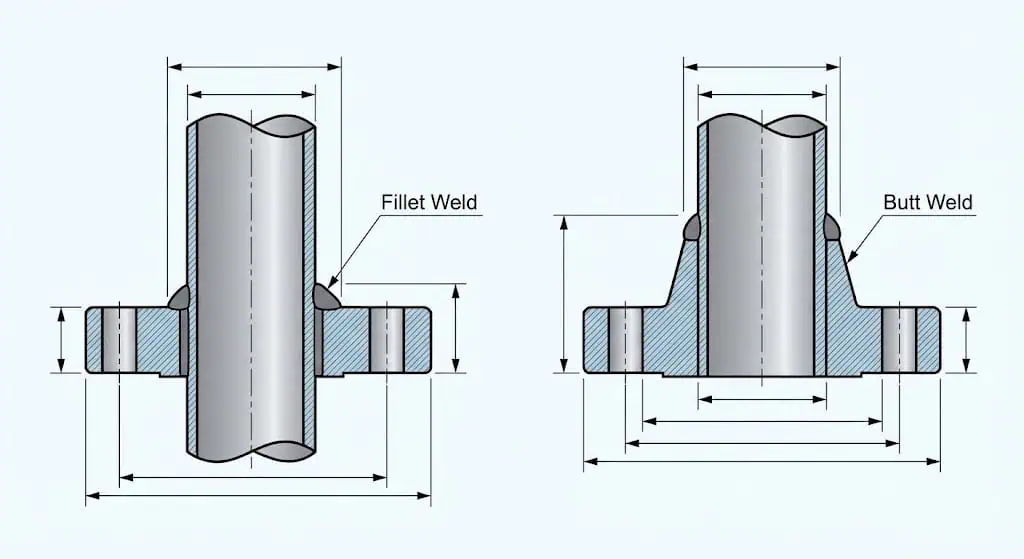
The difference between a slip-on flange and a weld neck flange is not just “cost vs strength.” It is a difference in load path, fatigue behavior, weld inspection reality, and long-term leak risk. A slip-on flange (SO) slides over the pipe OD and is typically secured by fillet welds. That makes fit-up faster, but it also creates stress concentration at the weld toes. A weld neck flange (WN) uses a tapered hub and a full-penetration butt weld, creating smoother stress transfer and better tolerance to vibration, thermal cycling, and bending loads.
Two practical selection rules used on real piping jobs:
- Use weld neck when the line is safety- or availability-critical: cyclic pressure/temperature, rotating equipment vibration, hazardous service, or when your QA plan requires meaningful volumetric weld inspection.
- Use slip-on for stable utility services: low pressure, limited thermal cycling, non-hazardous fluids, and where the project is schedule-driven and surface NDT is acceptable.
Important note for engineers and buyers: ASME “pressure class” is a rating framework, not a direct PSI number. Actual allowable working pressure depends on the applicable material group and temperature under the governing standard. The flange type affects fatigue performance, inspection options, and leak consequence management more than it changes the bolt pattern or dimensional interface.
Engineering view: slip-on vs weld neck is rarely a “fits or doesn’t fit” decision. In most real projects, both may share the same B16.5 bolt pattern. The real decision is whether the service can tolerate fillet-weld fatigue sensitivity and lower inspection credibility.
Slip-On Flange vs Weld Neck Flange Comparison
Key Differences Table
Engineering differences show up in geometry, stress distribution, fabrication method, and inspection practice. The matrix below focuses on what actually changes in the field:
| Feature | Slip-On Flange | Weld Neck Flange |
|---|---|---|
| Design | Slides over pipe OD; typically fillet welded | Tapered hub; full-penetration butt welded |
| Load Path | Geometric discontinuity at fillet weld; higher local stress at weld toes | More continuous stress transfer through hub and butt weld |
| Fatigue Performance | Lower under vibration and thermal cycling | Higher under cyclic loads due to reduced stress intensification |
| Inspection Reality | Mostly surface NDT on fillet welds; volumetric inspection is limited | RT/UT can be applied to butt welds when required |
| Typical Use Envelope | Stable utility services; avoid severe cyclic duty | Process-critical lines, high consequence of leak, cyclic duty |
| Installation | Faster fit-up; less sensitive to exact pipe cut length | Requires bevel prep, alignment control, qualified welding procedure |
| Cost Driver | Lower material weight; faster fabrication | More forging and machining; higher welding skill and QA cost |
| Typical Applications | Firewater, cooling loops, low-pressure air and nitrogen, general utilities | High-pressure steam, hydrocarbons, corrosive service, rotating equipment discharge |
Summary of Main Points
- Design and fit-up: slip-on flanges fit faster because the flange slides over the pipe. Weld neck flanges require bevel prep and alignment control, but the finished joint is structurally cleaner.
- Structural integrity: weld neck flanges use a long tapered hub that reduces bending stress at the flange-to-pipe transition and protects gasket seating under combined loading.
- Fatigue and vibration: slip-on fillet weld toes are common initiation points for cracking under vibration and thermal cycling. Weld neck butt welds typically perform better when supports, alignment, and weld quality are controlled.
- Pressure capability: both flange types may be built to the same ASME class system, but class alone does not determine long-term reliability under combined loads.
- Total installed cost: slip-on reduces fit-up time, but weld neck often reduces lifecycle cost when leak consequence, inspection credibility, and shutdown risk are high.
Practical conclusion: if the line is cyclic, hazardous, hard to access, or near rotating equipment, weld neck is usually the default engineering answer. Slip-on is a rational choice when the system is stable, low-consequence, and the piping class explicitly allows fillet-weld construction.
Slip-On Flanges Overview
Design and Construction
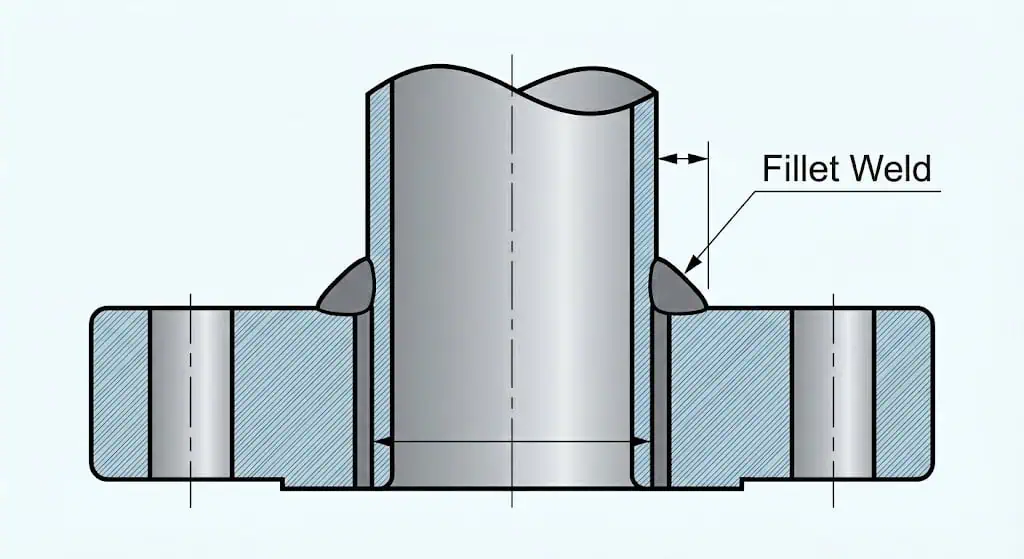
Slip-on flanges are rings with a bore slightly larger than the pipe OD, allowing quick alignment and rotation before welding. In normal shop practice, the pipe end is set back slightly from the flange face so the inside fillet weld can be placed without disturbing gasket seating. That easy fit-up is the main reason slip-ons are popular in utility piping—but it also creates a crevice-prone geometry if weld profile, insertion depth, or corrosion control is poor.
Common material routes include:
- ASTM A105 carbon steel for general industrial service where corrosion allowance or coating is practical
- ASTM A182 F304 / F316L stainless for chemical, food, water, and more corrosive service
- ASTM A182 F11 / F22 alloy steel for elevated-temperature service where procedure control matters
- Duplex stainless for chloride-bearing offshore or desalination conditions where higher strength and corrosion resistance are required
Expert note: in wet, stagnant, or oxygenated service, slip-on geometry can hold moisture and deposits at the weld region. In those cases, weld neck often performs better over time even if pressure class is not especially high.
Welding and Installation
Slip-on flange reliability is dominated by weld execution and fit-up discipline. The common mistake is assuming the design is “easy,” then skipping the controls that actually prevent leak paths.
Field checklist that consistently reduces rework:
- Confirm the pipe end is square and burr-free; out-of-square ends create uneven fillet size.
- Control insertion depth consistently around the circumference; avoid one-side bottoming.
- Verify the flange face is perpendicular to the pipe axis; out-of-square fit-up later shows up as gasket seating problems.
- After welding, perform VT + PT/MT as required; do not assume a smooth toe is crack-free.
Engineering case: A cooling-water header repeatedly failed hydrotest at a slip-on flange. Root cause was an incomplete inside fillet weld combined with poor pipe squareness. Water tracked through a pinhole at the weld toe. The fix was to cut out the joint, re-fit with controlled insertion depth, complete the inside weld, and inspect before repainting.
Pressure and Strength
Slip-on flanges can be manufactured to the same ASME B16.5 classes as weld neck flanges, but practical usage is often limited by fatigue and inspection considerations. In vibration, thermal shock, or frequent startup-shutdown duty, the fillet-weld detail often becomes the limiting feature—not the bolt circle.
For reference only, typical allowable working pressures depend on material group and temperature, so verify directly against the governing ASME B16.5 tables rather than assuming class equals PSI.
| ASME B16.5 Class | Practical Interpretation |
|---|---|
| Class 150–2500 | Rating framework only; verify allowable working pressure by material group and temperature |
| Slip-On in cyclic duty | Often restricted by owner standards because fillet-weld details are more fatigue-sensitive |
Cost Factors
The cost advantage of slip-on flanges comes mainly from easier fit-up and simpler welding preparation—not just flange unit price. Pipe ends do not usually require beveling, and fit-up is faster than a butt-welded joint. But if repeated leaks or hydrotest rework occur, the economic benefit can disappear quickly.
- Preparation: less bevel work, faster setup
- Welding time: fillet welds are faster than full-penetration butt welds
- Inspection: surface NDT is usually cheaper than RT/UT
- Lifecycle cost: in wet or corrosive utilities, crevice behavior and weld toe fatigue can dominate maintenance cost
Typical Applications
Slip-on flanges are widely used in low-consequence utility and auxiliary systems where vibration and thermal cycling are limited.
- Cooling water and general utility lines
- Compressed air and nitrogen service
- Firewater mains where the specification permits
- Municipal water treatment and wastewater systems
- HVAC chilled-water and heating loops
- Marine ballast and non-essential shipboard piping
Where slip-ons often cause trouble: pump discharge headers, compressor piping, and lines with repeated thermal transients. Those services can produce weld-toe fatigue cracking when supports are marginal or alignment is poor.
Weld Neck Flanges Overview
Design and Construction
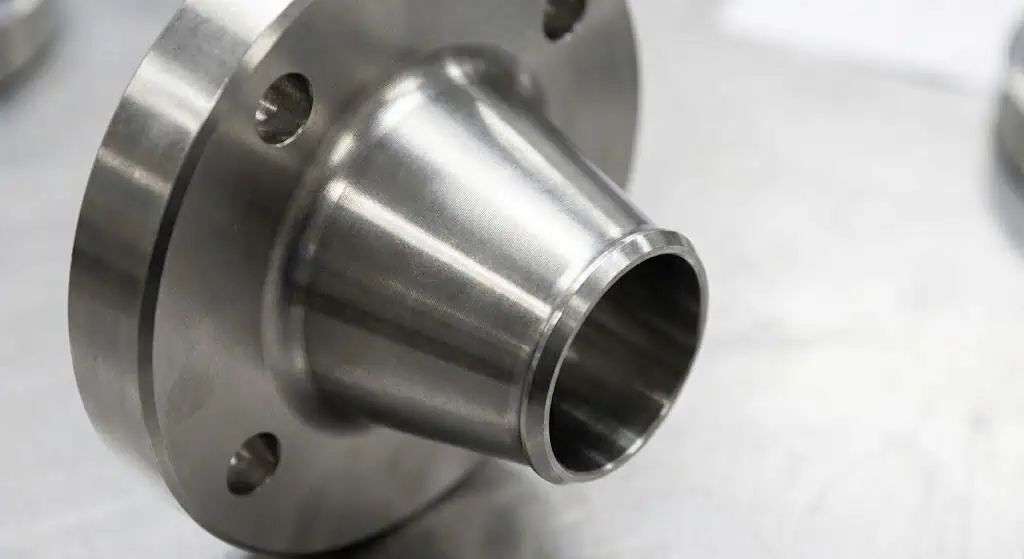
Weld neck flanges use a long tapered hub that reduces stress concentration at the flange-to-pipe transition. That is why they dominate in critical service: the hub acts like a stress diffuser, limiting flange rotation and protecting gasket seating under bending moments caused by misalignment, thermal growth, and vibration.
Key design elements engineers typically verify:
| Feature | Technical Function |
|---|---|
| Long tapered hub | Smooth stress transfer from flange to pipe wall |
| Bore matching | Improves flow profile and avoids abrupt transitions |
| Butt-weld connection | Allows meaningful volumetric inspection where required |
| Raised face option | Provides concentrated sealing surface where compatible with gasket selection |
| Standards interface | Usually specified to ASME B16.5 or EN 1092-1 depending on project basis |
Welding and Installation
Weld neck flange performance is only as good as the butt weld quality and alignment control. In critical systems, the weld procedure is normally qualified, and alignment tolerances are controlled because even small internal misalignment can become a fatigue hot spot.
- Preparation: clean bevels and verify bevel angle and land
- Alignment: control root gap and internal high-low
- Root pass: ensure penetration and a sound internal profile
- Fill and cap: avoid undercut and abrupt weld profile transitions
- PWHT where required: apply per material and project specification
- NDT: RT/UT where specified, with PT/MT as needed for surface-breaking indications
Engineering case: A high-pressure steam line leaked shortly after startup. Investigation found flange-face out-of-square and internal misalignment at the butt weld, causing poor gasket seating and cyclic bending at the hub. Corrective action was to re-cut, re-bevel, re-align, re-weld, and verify both RT and face perpendicularity before final bolt-up.
Pressure and Strength
Weld neck flanges are the default choice when the piping system must tolerate bending moments, thermal cycling, vibration, and a high consequence of leakage. They do not increase class rating by themselves, but they improve how the joint behaves under real-world combined loads.
- Pressure Class is a rating framework, not a direct PSI label.
- Allowable pressure still depends on the material group and temperature in the governing standard.
- Joint reliability improves because the butt-welded, tapered-hub geometry handles cyclic loading more predictably.
| ASME B16.5 Pressure Class | Engineering Interpretation |
|---|---|
| Class 150–2500 | Dimension and rating system; verify allowable pressure per material group and temperature |
| Critical service | Weld neck is preferred because the butt weld can be controlled and inspected, and the hub protects gasket seating under bending |
Cost Factors
Weld neck flanges cost more because you pay for more forging/machining mass and for butt-weld QA discipline. If the specification requires RT/UT, inspection cost can exceed the flange price difference. In critical service, that cost is usually justified by lower leak probability and lower shutdown risk.
| Feature | Weld Neck Flange | Slip-On Flange |
|---|---|---|
| Material & Machining | Higher | Lower |
| Installation Labor | Higher, due to butt-weld fit-up and alignment control | Lower, due to faster fillet-weld fit-up |
| QA / Inspection | Often higher, with RT/UT possible or required | Often lower, mainly surface NDT |
Installed cost should be judged against leak consequence and rework probability—not just unit price.
Typical Applications
Weld neck flanges are standard in services where process safety, fatigue resistance, and inspection credibility matter.
- Oil and gas transmission and high-integrity process piping
- Chemical reactors and high-temperature columns
- High-pressure and high-temperature steam lines
- Refinery piping for volatile hydrocarbons, acid gas, and rotating equipment tie-ins
Engineering case: A pump discharge line originally used slip-on flanges to save fabrication time. Within months, toe cracking appeared at the fillet weld during vibration monitoring. Retrofitting to weld neck flanges, with improved support and alignment control, eliminated recurring weld repairs and reduced leakage risk.
Comparison of Advantages and Disadvantages
The trade-off between slip-on and weld neck flanges is speed and cost versus structural durability and inspectability. The right choice depends on piping class, service criticality, and the plant’s risk tolerance.
Advantages of Slip-On Flanges
- Rapid installation and easier fit-up
- Simpler bolt-hole orientation during spool fabrication
- Lower initial fabrication cost
- Wide availability for standard utility applications
Advantages of Weld Neck Flanges
- Higher structural robustness under combined loading
- Better compatibility with RT/UT where required
- Improved fatigue resistance under vibration and thermal cycling
- Cleaner flow profile when bore matching is important
- Better choice for severe service and higher consequence of leak
Disadvantages Matrix
| Disadvantage | Slip-On Flange | Weld Neck Flange |
|---|---|---|
| Fatigue / Vibration | Higher sensitivity to weld toe quality and support problems | More tolerant, but still depends on alignment and weld quality |
| Inspection | Mostly surface NDT; hidden defects may survive until hydrotest or startup | Volumetric NDT possible, but higher QA cost |
| Installation Skill | Faster, but still requires disciplined fit-up | Requires qualified butt welding and stricter alignment control |
| Maintenance | Crevice geometry can accelerate wet-service corrosion | Repair may require cut-out and re-beveling if weld defects occur |
| Cost | Lower installed cost in stable utilities | Higher installed cost, justified for critical services |
Decision tip: use slip-on flanges to control schedule and cost in stable, low-consequence lines. Use weld neck flanges to control risk and lifecycle cost in process-critical lines.
Slip-On Flange vs Weld Neck Flange: Performance and Cost
Strength and Durability
Weld neck flanges usually outperform slip-on flanges in combined loading because the hub reduces stress concentration and protects gasket seating under bending moments. Slip-on joints rely on fillet welds where toe profile, undercut, and fit-up quality heavily influence fatigue life. In wet or corrosive environments, slip-on geometry can also trap moisture and deposits, increasing crevice-driven damage if surface condition and maintenance are poor.
- Weld neck joints behave more like a continuous pipe wall under load
- Slip-on joints introduce a geometric discontinuity that can initiate fatigue or localized corrosion
- Where vibration exists, support design and weld profile often matter more than nominal pressure class
Installation Time and Skill
Slip-on flanges offer a logistical advantage in fast-track projects, but they are not “forgiving” of poor workmanship. Faster fit-up can hide squareness and alignment issues that later appear as gasket leaks. Weld neck flanges demand more precision, but that discipline is usually exactly what severe service needs.
- Slip-on: faster positioning and easier bolt-hole orientation
- Weld neck: slower fit-up, but cleaner long-term structural behavior
- Labor strategy: reserve weld neck for the highest-risk locations and use slip-on only where the specification and risk profile support it
Budget Considerations
Slip-on flanges can reduce initial fabrication cost, while weld neck flanges reduce risk-driven cost. If a leak can trigger shutdown, environmental reporting, safety exposure, or difficult access rework, the economics often shift in favor of weld neck flanges and stronger QA.
Engineering case: A plant used slip-ons on a utility header to save time and money and had no trouble for years. The same approach on a cyclic process line caused repeated repairs and lost production. The lesson was simple: apply flange type by consequence and duty, not by procurement habit.
Choosing Between Slip-On and Weld Neck Flanges
Application Scenarios
Flange selection is dictated by the piping material specification and the real operating envelope. For high-pressure steam, hazardous service, or cyclic loads, robust connections and credible inspection become mandatory.
- Weld neck flanges: preferred for high consequence of leak, cyclic duty, high temperature, vibration, and lines where QA requires RT/UT
- RTJ flange arrangements: used for demanding sealing applications where face, gasket, and class justify the system
- Socket weld flanges: sometimes used for small-bore piping depending on service and code/spec
- Slip-on flanges: appropriate for stable utilities where leakage consequence is low and the specification permits fillet-weld construction
Factors to Consider
| Flange Type | Strength and Cyclic Resistance | Cost and Installation Ease | Best Applications |
|---|---|---|---|
| Weld Neck Flange | Higher fatigue tolerance under pressure, bending, and vibration | Higher cost and slower installation | Refineries, power plants, offshore, rotating equipment tie-ins |
| Slip-On Flange | Adequate for stable utilities; more sensitive to weld-toe quality and vibration | Lower cost and faster installation | Firewater, cooling water, HVAC, and low-consequence utility services |
Before finalizing, evaluate fluid toxicity, operating temperature range, startup/shutdown frequency, vibration potential, and required NDT level. If the specification follows ASME B31.3 Process Piping, follow the project piping class rules rather than assuming “utility = slip-on” by default.
If you need broader flange selection guidance, continue with how to choose stainless steel flanges for your project.
FAQ
What is the main difference between slip-on flange and weld neck flange?
The main difference is the weld joint design and the resulting stress and inspection behavior. Slip-on flanges are typically fillet welded, which makes fit-up faster but increases stress concentration at the weld toes. Weld neck flanges use a full-penetration butt weld with a tapered hub, creating better structural continuity and enabling more meaningful RT/UT when required.
When should you use a slip-on flange instead of a weld neck flange?
Use slip-on flanges for stable, low-consequence utility services where the piping class permits fillet-weld construction. Typical examples are cooling water, firewater, compressed air, and nitrogen, provided vibration and thermal cycling are limited and volumetric NDT is not required.
Are weld neck flanges better for high-pressure applications?
Weld neck flanges are generally preferred for high-pressure and cyclic applications because they handle combined loads better and support stronger inspection practice. Pressure rating still has to be verified against the applicable ASME B16.5 material group and temperature tables.
How do you choose between slip-on flange vs weld neck flange?
Choose based on consequence of leak, cyclic duty, vibration, and required NDT. Use weld neck flanges for severe cyclic conditions, high temperatures, hazardous fluids, and lines near rotating equipment. Use slip-on flanges for low-risk utilities where faster fabrication is valuable and the piping class allows it.
Can slip-on and weld neck flanges share the same ASME B16.5 bolt pattern?
Yes, they can share the same dimensional interface under the same standard and class, but that does not make them equivalent in fatigue, inspection, or service reliability. The real difference is how the weld geometry behaves under combined loading and what kind of weld inspection is realistically possible.