
Threaded Bushings & Plugs | Hex Reducing Bushings & Pipe Plugs
SUNHY supplies threaded bushings and threaded plugs for line reduction and line termination in serviceable piping systems. These fittings are commonly used where projects need quick assembly, compact layouts, and straightforward maintenance access.
Our range covers hex bushings / reducing bushings (male × female) and common plug styles such as hex head plug, square head pipe plug, and socket/countersunk plug for flush installation. We support NPT / BSP / BSPT threads with stainless options (SS304/SS316, often cast stainless steel) and iron/galvanized selections as specified. Documentation and inspection scope can be provided per project requirement.
- Compact reduction, space-saving design
- Quick sealing, clean line closure
- Tool-friendly heads, easy make-up
- Tool-friendly heads, easy make-up
- Stable fit, reduced mismatch risk
- Docs available, per project spec
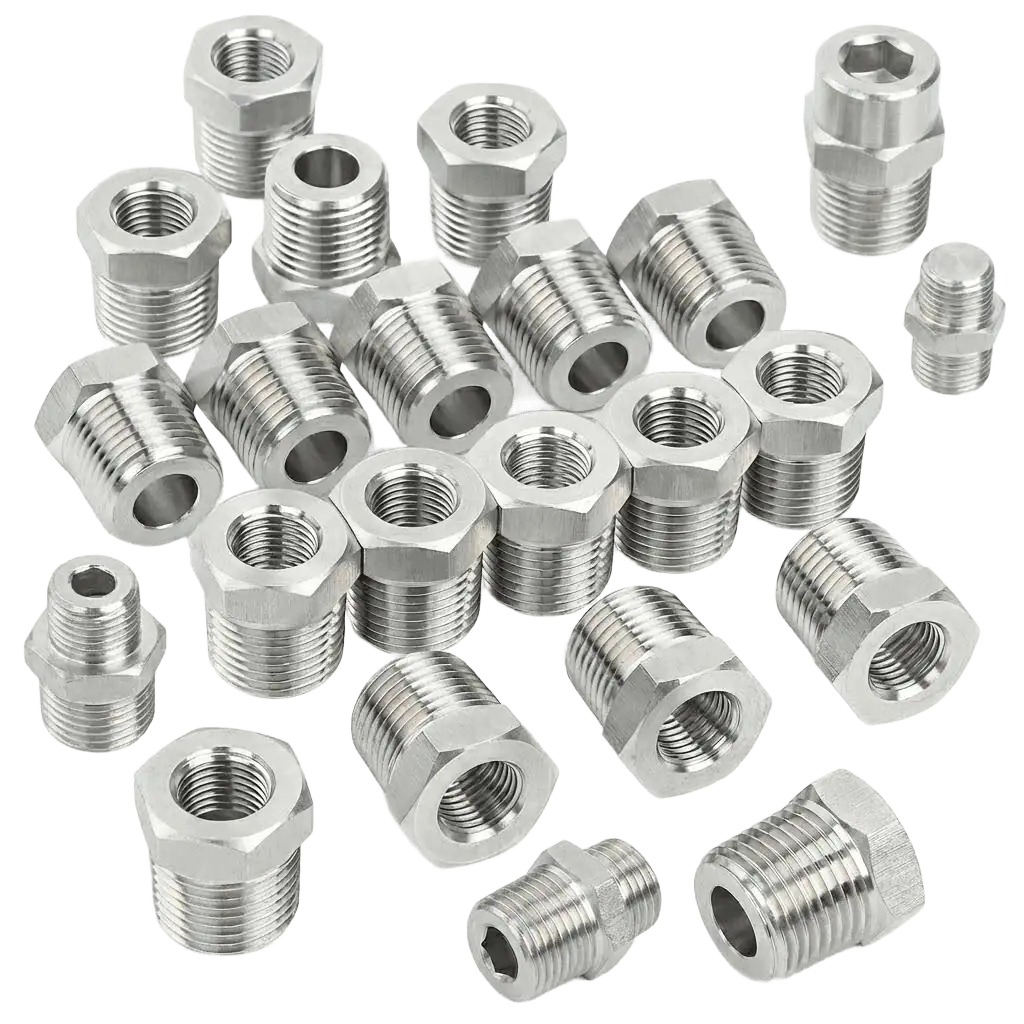
Specification & Standard
Product
Threaded Bushing / Pipe Bushing / Threaded Plug / Pipe Plug
Type (Plugs)
Hex Head Plug / Square Head Plug / Socket Head Plug / Countersunk Plug
Cored Plug / Solid Plug (as specified)
Thread Standard
NPT (ASME B1.20.1) / BSP / BSPT (ISO 7-1) as specified
Materials
Stainless steel: SS304 / SS316 common (cast stainless options)
Malleable iron / black iron / galvanized options as specified
Type (Bushings)
Hex Bushing / Hex Reducing Bushing / Flush Bushing / Male × Female Bushing
Nominal Size
Commonly 1/8″ – 4″; reducing sizes specified as Large × Small (e.g., 1/2″ × 1/4″)
Pressure Rating
Class 150 (typical for this category) / per project requirement
Standards (Reference)
MSS SP-114 (stainless Class 150 threaded fittings, when specified)
ISO 4144 (light-duty threaded fittings, when specified)
ASME B16.14 (iron plugs & bushings, when specified)
Threaded Bushings & Plugs for Compact Reduction and Line Termination
Threaded bushings and threaded plugs are widely used in serviceable piping systems to reduce a threaded port size or to close an unused outlet. They are commonly selected for utility and general industrial lines where fast assembly and space efficiency matter.
Threaded Bushings (Male × Female)
- Hex Bushing / Hex Reducing Bushing — most common, wrench-friendly for installation.
- Flush Bushing — low-profile option for tight layouts and panel-style applications.
- Male × Female Bushing — compact reduction directly in a fitting, valve, or instrument port.
Threaded Plugs (Male Thread Closure)
- Hex Head Plug — common choice for general pipe closure.
- Square Head Pipe Plug — frequently used in industrial and legacy piping practices.
- Socket Head / Countersunk Plug — flush finish where protruding heads are not preferred.
- Cored vs Solid Plug — specified by design/cost and project practice.
Selection Guide: Bushing vs Reducer Coupling, Plug vs Cap
Correct selection reduces site rework and avoids ordering the wrong thread form or fitting type. Use the quick rules below when building your BOM.
Bushing vs Reducer Coupling
- Bushing: Male × Female — screws into a larger female thread and provides a smaller female outlet.
- Reducer Coupling: Female × Female — connects two male-threaded pipes/fittings.
- Practical note: A bushing is a space-saving alternative to reducer couplings in compact layouts.
Plug vs Cap
- Plug: Male thread — screws into a female port to close an outlet.
- Cap: Female thread — screws over a male pipe end.
Ordering Checklist
| Item | What to Specify | Example |
|---|---|---|
| Product | Bushing or Plug | Hex Reducing Bushing / Square Head Plug |
| Size | For reducing: Large × Small | 1/2" × 1/4" bushing |
| Thread | NPT / BSP / BSPT | NPT plug for NPT port |
| Material | Based on corrosion/service | SS316 for corrosion-prone service |
| Head Style | Tool access requirement | Hex / Square / Socket / Countersunk |
| Docs | Receiving & handover scope | MTC / PMI / inspection (as specified) |
Related note: Need a female-thread closure over a male pipe end? Select a threaded cap instead of a plug.
Product Assembly | Installation Notes for Bushings & Plugs
Threaded bushings and plugs are installed by engaging tapered threads into mating threads. Final procedures should follow project specification and be performed by qualified personnel.
Installation Steps (General)
- Confirm compatibility — verify thread standard (NPT/BSP/BSPT) and size (including reducing size format).
- Inspect threads — ensure threads are clean and undamaged; avoid cross-threading.
- Apply sealant per spec — use approved tape or thread sealant compatible with service media.
- Make-up with proper tool — hex/square/socket head selection should match wrench access on site.
- Do not over-torque — excessive torque can damage threads or ports; tighten to achieve a stable seal.
- Leak test — perform pressure/leak test per project requirement after installation.
Practical Tips
- Flush bushings and countersunk plugs help keep surfaces clear in compact skids and panels.
- Solid plugs may be specified for more robust closure; confirm by BOM when required.
FAQ
What is the difference between a threaded bushing and a reducer coupling?
A bushing is male × female and reduces a port size inside a fitting or valve. A reducer coupling is female × female and connects two male-threaded ends.
What is the difference between a plug and a cap?
A plug has male threads and closes a female port. A cap has female threads and closes over a male pipe end.
Which head styles are available for pipe plugs?
Common types include hex head plugs, square head pipe plugs, and socket/countersunk plugs for a flush finish, as specified by installation access requirements.
Do you supply stainless steel bushings and plugs in SS304/SS316?
Yes. SS304 and SS316 are commonly supplied for corrosion-prone environments. Other materials such as malleable iron or galvanized options can be provided as specified.
What threads and documents can be provided?
NPT is commonly supplied, with BSP/BSPT available on request. MTC (EN 10204 3.1) and inspection options such as dimensional checks, thread gauging, and PMI for stainless can be provided as specified.
Related Products
Butt Weld Tee (Equal / Reducing)
For branch connections in welded piping spools.
Concentric Reducer
Smooth centerline transition for vertical lines and pumps.
Eccentric Reducer
Flat side design to reduce air pockets in horizontal piping.
Butt Weld End Cap
Clean closure for pipe ends—ideal for test spools and headers.
Stub End (Lap Joint)
Common with lap joint flanges for frequent disassembly service.
FAQ
What is the difference between a threaded bushing and a reducer coupling?
The main difference is the thread gender and installation profile.
Hex Bushing (ASME B16.11): Designed to insert into a larger female port to reduce its size. It features one Male (external) thread and one Female (internal) thread. It is compact and “nests” inside the fitting, saving axial space.
Reducer Coupling: Designed to connect two male-threaded pipes of different sizes. It features two Female (internal) threads. It acts as a bridge between pipes and adds length to the assembly.
What is the difference between a plug and a cap?
The difference lies in the direction of installation:
Pipe Plug: Has Male (external) threads and is screwed INTO a female fitting (like a valve, tee, or elbow) to close it.
Pipe Cap: Has Female (internal) threads and is screwed OVER the end of a male pipe nipple to seal it.
Selection Logic: Refer to the decision tree below to choose the correct component for your application.
Which head styles are available for pipe plugs?
According to ASME B16.11, there are three standard head styles for high-pressure plugs, each serving a specific purpose:
Hex Head: The most common style; easily installed with a standard adjustable wrench or socket.
Round Head: Used for aesthetic finishes or tight spaces where a wrench cannot swing; often installed with a pipe wrench on the smooth head.
Square Head: The heavy-duty standard for oil & gas; allows for maximum torque application using a pipe wrench without stripping the corners.
Do you supply stainless steel bushings and plugs in SS304/SS316?
Yes. We supply forged fittings in both ASTM A182 F304 and F316.
Choose F316 (Marine Grade): For saltwater, chlorides, or acidic environments. The addition of 2-3% Molybdenum provides superior resistance to pitting corrosion.
Choose F304: For standard atmospheric or freshwater applications where cost is a priority.
Performance Comparison: The chart below illustrates the relative corrosion resistance of these two grades in common industrial environments.
What threads and documents can be provided?
Threads: We supply both NPT (National Pipe Taper) for North American ANSI systems and BSPT (British Standard Pipe Taper) for ISO/International systems.
Warning: NPT (60° angle) and BSPT (55° angle) are not compatible. Mixing them creates a spiral leak path.
Documents: For high-pressure applications, we provide an EN 10204 Type 3.1 Material Test Certificate (MTC). This traces the fitting back to the specific heat number and verifies chemical composition and mechanical properties.