
Branch Outlets (Olets) | Integrally Reinforced Forged Branch Fittings | MSS SP-97
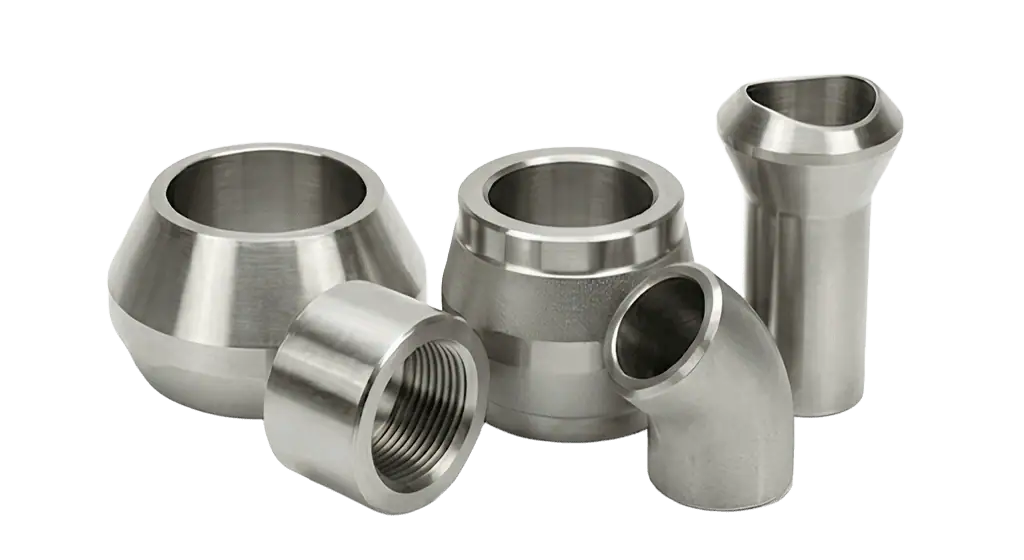
SUNHY supplies branch outlet fittings (olets) for building reinforced branch connections on a run pipe without using a full tee. These fittings are typically specified as integrally reinforced forged branch outlet fittings, and are widely referenced under MSS SP-97 for butt-weld, socket-weld, and threaded outlet types.
Common configurations include weldolet-style (butt-weld outlet), sockolet (socket-weld outlet), and threadolet (threaded outlet)—selected based on branch connection method, pressure class, and site fabrication preference.
- Clean branching, compact outlet
- Strong reinforcement, stable joint
- Multiple types, easy selection
- Fit-up friendly, faster fabrication
- Clear traceability, heat ID
- Docs available, per spec
Specification & Standard
Nominal Size (Run / Branch)
Commonly 1/4″ – 2″ (other sizes on request)
Angle
90° (45° available when required)
Manufacturing & QC
Hot forged; heat number traceability; inspection level per project requirement
Standards
MSS SP-97 (integrally reinforced forged branch outlet fittings)
Outlet Type
Butt-weld outlet / Socket-weld outlet / Threaded outlet (as specified)
Pressure Class
Commonly Class 3000 / 6000 / 9000 (by type and size)
Materials
Carbon steel: ASTM A105 (common)
Stainless/alloy: ASTM A182 (304/316L common)
Low-temp option: ASTM A350 LF2 (as required)
Documentation & Inspection
EN 10204 3.1 MTC; dimensional inspection; PMI/NDT available as specified
Branch Outlets (Olets) | Reinforced Branch Connections
Branch outlet fittings (often called olets) are used to form a reinforced branch connection on a run pipe without installing a full tee. They are commonly specified as integrally reinforced forged branch outlet fittings and referenced to MSS SP-97 when required by project specifications.
Key Benefits
- Reinforced branch design — supports branch connections in accordance with applicable piping code requirements when installed correctly.
- Compact layout — efficient for skids, manifolds and tight piping runs.
- Multiple outlet types — choose butt-weld, socket-weld or threaded outlet based on fabrication method.
- Material flexibility — carbon steel, stainless (304/316L) and low-temperature options by request.
- Project-ready deliverables — documentation and inspection level available for QA and handover.
Weldolet / Sockolet / Threadolet Styles | How to Choose
Select the outlet style by the branch connection method and your project specification. Provide run size, branch size, pressure class and material grade on the BOM/RFQ.
Common Types
- Weldolet-style (BW outlet) — butt-weld branch connection for welded piping systems.
- Sockolet (SW outlet) — socket-weld branch outlet, often used in small-bore high-pressure service.
- Threadolet (Threaded outlet) — threaded branch outlet where threaded take-offs are specified.
Selection Notes
- Run / Branch sizes — specify run size and branch size (for reducing outlets, state run × branch clearly).
- Angle — 90° is common; 45° is available when required by layout.
- Standard — MSS SP-97 is commonly referenced for integrally reinforced forged branch outlet fittings.
- Threads — if choosing threaded outlets, confirm thread system (e.g., NPT or BSPT) per project spec.
Ordering Guide & Installation Notes | Branch Outlet Fittings
Recommended RFQ Format
| Item | Specify |
|---|---|
| Outlet Type | BW / SW / Threaded |
| Run × Branch | Run size + Branch size (reducing: run × branch) |
| Angle | 90° (45° if required) |
| Class | 3000 / 6000 / 9000 (as specified) |
| Material | A105 / A182 (304/316L) / A350 LF2 (if required) |
| Docs | EN 10204 3.1 MTC; PMI/NDT if specified |
Installation Notes (Summary)
- Follow project spec & qualified WPS — branch outlets rely on correct fit-up and welding execution.
- Hole cutting & alignment — verify branch location and angle before welding.
- Inspection — apply required inspection level (visual/dimensional, PMI/NDT if specified) and keep records for handover.
Related Products
Butt Weld Tee (Equal / Reducing)
For branch connections in welded piping spools.
Concentric Reducer
Smooth centerline transition for vertical lines and pumps.
Eccentric Reducer
Flat side design to reduce air pockets in horizontal piping.
Butt Weld End Cap
Clean closure for pipe ends—ideal for test spools and headers.
Stub End (Lap Joint)
Common with lap joint flanges for frequent disassembly service.
FAQ
What are branch outlets (olets) used for?
Branch Outlets, commonly referred to as Olets, are integrally reinforced forged fittings used to create a branch connection from a larger main pipe (run) to a smaller or equal-sized outlet pipe (branch). Unlike standard tees, Olets are designed to provide integral reinforcement to the run pipe, compensating for the structural strength lost when cutting the branch hole. They are the preferred solution for high-pressure, high-temperature piping systems where minimizing stress concentration factors (SCF) is critical for safety.
Which standard is commonly referenced for olets?
Selection depends primarily on the branch size, pressure class, and connection method required by the piping specification :
Weldolet® (Butt-Weld): The most robust connection, suitable for all pressure classes and sizes. It features a beveled end for a butt weld to the branch pipe, allowing for full radiographic inspection (RT). It is ideal for critical, high-stress services.
Sockolet® (Socket-Weld): Typically used for smaller branch sizes (≤ 2 inches). It features a socket bore that aligns the branch pipe for a fillet weld. It is faster to install than a Weldolet but requires a 1/16″ expansion gap at the bottom of the socket to prevent weld cracking. Common classes are 3000# and 6000#.
Thredolet® (Threaded): Used for low-pressure systems or instrumentation connections (e.g., pressure gauges) where welding is not feasible. It uses a tapered pipe thread (NPT) for connection.
How do l choose between weldolet-style, sockolet, and threadolet?
he primary manufacturing standard for integrally reinforced forged branch outlet fittings is MSS SP-97. This standard governs the design, dimensions, pressure ratings, and proof-of-design burst testing requirements.
ASME B16.9 / B16.25: Referenced for the bevel dimensions of Weldolets.
ASME B16.11: Referenced for the socket dimensions (Sockolet) and thread specifications (Thredolet).
ASME B31.1 / B31.3: The piping design codes that validate the use of MSS SP-97 components without requiring additional area replacement calculations.
What information should be on the RFQ/BOM?
To ensure the correct “consolidated run size” and fit-up, your Request for Quotation (RFQ) or Bill of Materials (BOM) must specify these five data points :
Run Size (Header): The Olet is contoured to fit a range of header sizes (e.g., 36″-22″).
Branch Size (Outlet): The specific size of the connecting branch pipe (e.g., 4″).
Style: The specific type (e.g., Weldolet, Sockolet, Elbolet).
Rating/Schedule:
For Weldolets: Specify the Schedule (e.g., STD, XS, Sch160) to match the branch pipe wall thickness.
For Sockolets/Thredolets: Specify the Pressure Class (e.g., 3000#, 6000#).
Material Grade: The material specification (e.g., ASTM A105, A182 F316).
What documentation can you provide?
Olets are frequently chosen over standard tees for cost efficiency and installation flexibility :
Reduced Welding Costs: Installing an Olet requires only 2 welds (one header-to-Olet, one Olet-to-branch), whereas a Tee requires 3 butt welds (cutting the main line). This can reduce welding and inspection labor by 50% to 90% (see chart in report).
Inventory Optimization: Due to “size consolidation,” a single Olet item code can fit a wide range of run pipe sizes (e.g., one 4″ Weldolet fits all headers from 10″ to 36″), drastically reducing warehouse inventory compared to stocking individual reducing tees for every header size.
Retrofit Capability: Olets can be installed on existing pipelines via “hot tapping” without cutting the line, which is impossible with standard tees.