Cette distinction est importante car le même groupe de résistance 144 ksi comprend des produits qui ne sont pas interchangeables. Une vis à tête hexagonale lourde ASTM F3125 Grade 144, un ensemble à tête cassante F3125 Grade 144TC et un ensemble à cannelures fixes ASTM F3148 Grade 144 ont des identités produit et des configurations d'installation différentes. Spécifier uniquement des “ vis de structure Grade 144 ” laisse des décisions importantes en suspens.
Quand la Grade 144 est-elle entrée dans l'ASTM F3125 ?
La Grade 144 n'a pas été introduite pour la première fois dans l'ASTM F3125/F3125M-26. Le domaine d'application publié de la édition 2023 a identifié les classes de résistance de la série pouces 120 ksi et 150 ksi, tandis que l' édition 2025 incluait déjà la nuance supplémentaire 144 ksi. L' édition 2026 la conserve.
Il existe une autre source potentielle de confusion : ASTM F3148 traite d'un ensemble de boulonnerie structurelle à cannelures fixes de nuance 144 distinct. Il ne s'agit pas simplement d'un autre nom pour F3125 Grade 144TC. Une spécification de projet historique qui exige explicitement F3148 ne doit pas être convertie en F3125 simplement parce que les deux familles de produits utilisent la même classification nominale de résistance à la traction.
La règle pratique consiste à identifier la désignation complète de la norme avant de comparer les prix ou d'accepter une substitution. Le catalogue ASTM actuel identifie F3125/F3125M-26, mais un contrat peut exiger une édition différente. Toute modification proposée de cette base de référence relève du processus d'approbation du projet, et non de l'interprétation par le fournisseur d'un numéro de nuance.
Grade 144 tête hexagonale lourde, tête cassante et cannelures fixes : quelles différences ?
La différence la plus importante entre les configurations de nuance 144 n'est pas la classification nominale de résistance à la traction. C'est l'agencement physique de l'élément de fixation et le système d'installation pour lequel le produit est spécifié.
RCSC 2025 classe les produits suivants dans le groupe 144 :
| Désignation du produit | Configuration | Conséquence sur l'approvisionnement |
|---|---|---|
| ASTM F3125 Grade 144 | Boulon structural à tête hexagonale lourde | Préciser les dimensions du boulon, les écrous et rondelles compatibles, la finition et les exigences d'installation applicables. |
| ASTM F3125 Grade 144TC | Ensemble apparié à contrôle de tension à rupture d'embout | Commander l'ensemble apparié spécifié et vérifier le système d'installation à rupture d'embout ainsi que la documentation. |
| ASTM F3148 Grade 144 | Ensemble apparié à cannelures fixes | Identifier séparément la norme F3148 et vérifier sa méthode d'installation dédiée ainsi que les exigences relatives à l'ensemble. |
Pour un boulon à tête hexagonale lourde, le serrage s'effectue selon une méthode de mise en œuvre autorisée pour l'assemblage structural spécifié. La géométrie de sa tête hexagonale lourde est régie par les exigences dimensionnelles applicables aux boulonnerie de structure. Le boulon nécessite toujours des composants d'accouplement compatibles ; sa nuance et la forme de sa tête ne suffisent pas à établir si l'assemblage réalisé est adapté.
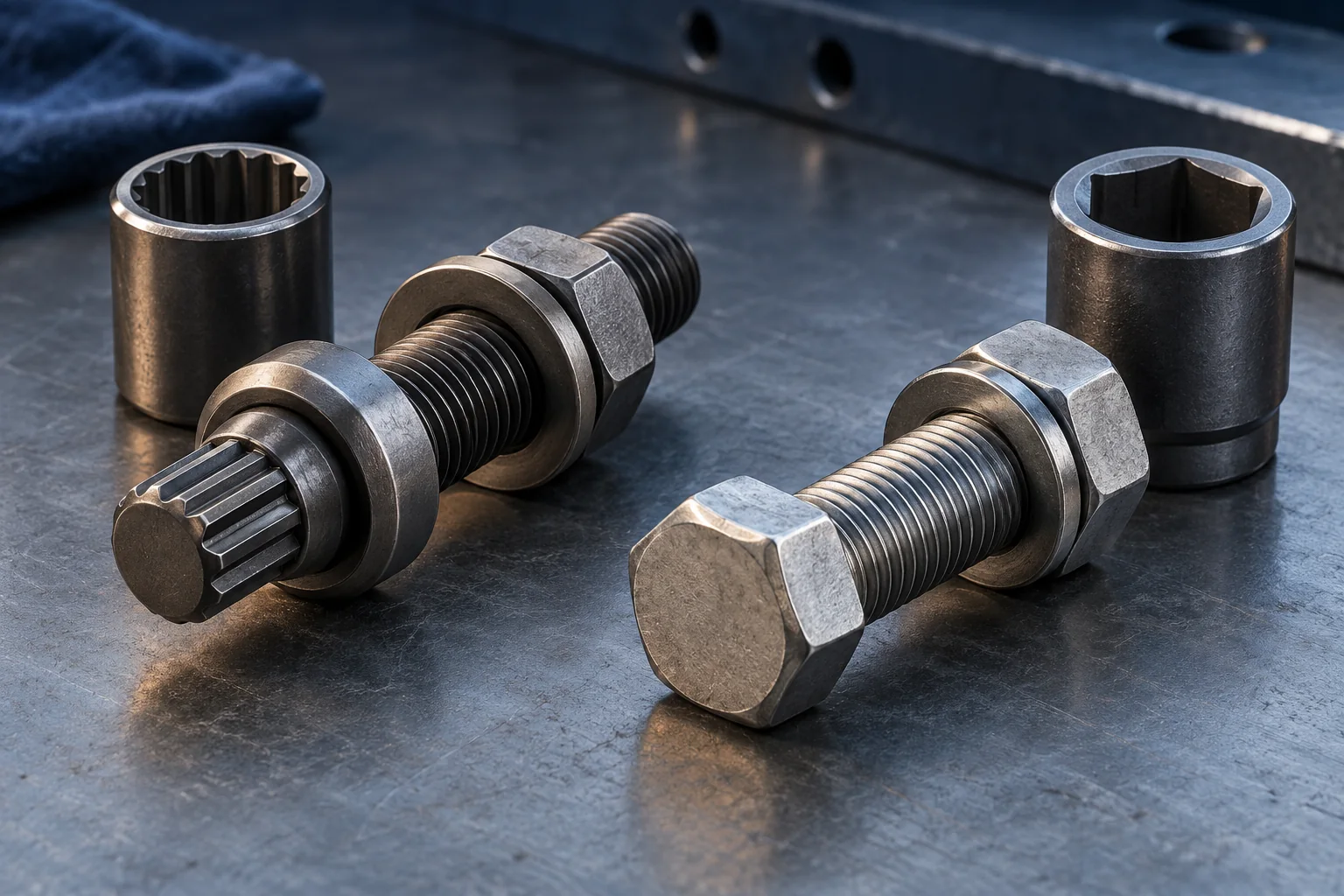
Un assemblage de nuance 144TC possède une extrémité cannelée conçue pour se séparer lors de l'installation selon la méthode de contrôle de tension par rupture de l'embout applicable. Il s'agit d'un assemblage apparié et non d'un ensemble libre de composants individuellement interchangeables. Les caractéristiques du boulon, de l'écrou, de la rondelle, de la finition et de la lubrification doivent être compatibles avec le système d'installation prévu.
Un assemblage à cannelures fixes F3148 fonctionne différemment. Ses cannelures sont conçues pour rester en place après l'installation, et la spécification produit applicable décrit un serrage couple-angle. Un assemblage à cannelures fixes ne peut donc pas être traité comme un assemblage de nuance 144TC simplement parce qu'une clé à chocs motorisée engage une cannelure à l'extrémité du boulon.
Même la forme visible de la tête ne suffit pas à résoudre toutes les distinctions. Les commentaires du RCSC reconnaissent que les assemblages appariés à rupture d'embout peuvent avoir des têtes rondes ou hexagonales lourdes. Par conséquent, un acheteur doit utiliser conjointement la désignation du produit, la configuration des cannelures, les marquages pertinents, la documentation du fabricant et la norme applicable, plutôt que d'identifier l'ensemble du système à partir d'une photographie.
Les types 1 et 3 sont des classifications de matériau, et non des styles alternatifs
La nuance 144 comporte également des classifications de matériau de type 1 et de type 3.
Type 1 couvre des familles de matériaux en acier au carbone et en acier allié spécifiées, y compris les compositions contenant du bore autorisées. Type 3 identifie les aciers présentant des caractéristiques de résistance aux intempéries et une meilleure résistance à la corrosion atmosphérique.
Le type 3 ne constitue pas une garantie inconditionnelle de résistance à la corrosion. L'adéquation réelle dépend de l'exposition environnementale, de la rétention d'humidité, des détails d'assemblage, de la finition protectrice et de la stratégie de protection contre la corrosion du projet. Le choix du type 3 n'élimine pas non plus la nécessité d'associer les écrous et rondelles appropriés.
Les commentaires du RCSC 2025 expliquent que, lorsqu'un type n'est pas spécifié, le fabricant peut avoir la latitude de fournir l'un ou l'autre des types autorisés. Un acheteur exigeant une catégorie de matériau particulière doit donc la préciser explicitement plutôt que de se fier à une supposition sur ce que signifie habituellement “ nuance 144 ”.
La composition chimique et l'ensemble des critères d'acceptation doivent toujours être vérifiés par rapport à l'édition ASTM applicable. Une simple description de famille de matériaux ne prouve pas qu'un lot de production donné satisfait aux propriétés chimiques ou mécaniques requises.
Dans une demande d'illustration, le cahier des charges n'indique que le grade 144 et le devis propose un système à cannelures fixes là où un ensemble à rupture prédéterminée (twist-off) était prévu. Le groupe de résistance n'a pas permis d'identifier le produit. Confirmez la spécification complète, le style et le système d'installation avant de comparer les composants ou les prix. Conservez le assembly identity and supporting records tied to that exact configuration.
Quelle plage de dimensions la F3125 Grade 144 couvre-t-elle ?
ASTM F3125 Grade 144 heavy hex bolts and twist-off assemblies have a published nominal diameter range of 1/2–1-1/4 in. That limit applies to the Grade 144 products described in the published F3125 scope.
It must not be confused with the wider 1/2–1-1/2 in. range published for Grade A325 and Grade A490 heavy hex bolts under the same F3125 family.
This is an important purchasing distinction. A supplier’s general structural-bolt size chart may combine several grades, but a dimension appearing in that chart is not necessarily available or permitted for every grade.
RCSC 2025 also includes tables covering multiple strength groups and nominal diameters. Such a table cannot independently extend the diameter range specified by the ASTM product standard. Product-scope applicability must be established before using a group-level installation or verification value.
Nominal diameter is only one part of dimensional acceptance
Within the permitted range, the buyer must still specify the required bolt length and verify its suitability for the joint.
Structural bolt geometry involves more than a nominal diameter. Important considerations include head dimensions, threaded length, unthreaded shank, grip thickness, washer arrangement, and sufficient thread engagement after installation.
For example, two bolts with the same nominal diameter and overall length may not be appropriate for the same joint if their thread configurations differ. Where the connection design requires threads to be excluded from a shear plane, the position of the threaded portion becomes part of the dimensional selection.
RCSC identifies ASME B18.2.6 as the relevant dimensional standard for these structural bolting configurations, while its provisions for bolt length and thread engagement address installed-joint needs. These are separate from the grade’s basic diameter range. Exact length allowances, thread configurations, and dimensional tolerances should be obtained from the applicable standard and product documentation rather than inferred from a generic catalog illustration.
Hypothetical example: An EPC purchaser receives a request for an ASTM F3125 Grade 144 heavy hex bolt with a nominal diameter of 1-1/2 in. The procurement team notices that 1-1/2 in. bolts appear in other structural bolt listings and assumes this size can also be ordered as Grade 144.
The published F3125 Grade 144 scope does not support that assumption. The requested diameter exceeds the grade’s stated 1-1/4 in. upper limit.
The appropriate response is not to relabel the item as Grade A490, select an F3148 assembly, or approve a different nominal diameter without review. Each would change some aspect of the technical specification. The purchaser should return the discrepancy to the responsible engineer so that a suitable, explicitly approved product specification can be established.
This example illustrates a specification conflict, not a tested product limitation or an approved substitution.
A hypothetical purchaser copies a size from a general A325/A490 chart into a Grade 144 request. The shared F3125 family name does not extend each grade's published range. Check the actual Grade 144 scope before ordering and return any conflict to the engineer. Do not solve an out-of-scope size by silently changing grade or assembly system.
Pourquoi 144 ksi ne suffit pas à définir la spécification de boulonnerie de structure
A 144 ksi minimum tensile-strength classification describes a mechanical characteristic of the fastener product. It is not the required installed bolt pretension, the allowable tensile load of an assembled joint, or a universal tightening-torque value.
The distinction is fundamental. Product strength is established through the applicable ASTM requirements, while the structural connection must be designed and installed under its governing engineering and project requirements. Connection geometry, loading, pretension requirements, joint type, installation method, and inspection responsibilities cannot be derived from the grade number alone.
The RCSC Spécification pour les assemblages structuraux utilisant des boulons à haute résistance addresses these installed-joint considerations. Its 2025 edition recognizes Group 144 products, but it does not make every Group 144 assembly appropriate for every connection or installation method.
Matching nuts, washers and material Type
The selected nut must satisfy the applicable requirements for the bolt Group, material Type, and coating condition.
RCSC 2025 provides a useful example of how these variables interact. For Groups 144 and 150, its permitted-nut table identifies ASTM A563 Grades DH or DH3 for Type 1 plain-finish bolts, DH for the listed permitted Type 1 coated condition, and DH3 for Type 3 plain-finish bolts. Certain ASTM A194 Grade 2H substitutions are addressed separately.
These are not general permission to mix nut grades, material Types, and finishes. They demonstrate why a buyer needs the exact assembly specification rather than a statement that the nut has sufficient strength.
The washer also has a defined role. RCSC addresses ASTM F436 hardened washers and requires washer Type to correspond to the bolt Type. Other washer configurations, including direct-tension-indicating devices and specialized reaction washers, have their own requirements.
If a supplier proposes different components, the buyer should require confirmation that the complete combination is permitted under the governing requirements. Matching nominal thread size is not enough.
Coating choice can change the acceptable assembly
Grade 144 should not be described simply as either “galvanizable” or “not galvanizable.”
RCSC 2025 allows specified galvanizing arrangements for Grade 144 heavy hex bolting components, subject to the applicable process and assembly requirements. Its rules include requirements for galvanizing methods, nut thread allowances, and compatible components.
However, hot-dip galvanizing is not permitted for spline-end matched bolting assemblies under RCSC 2025, regardless of their Group. This distinction includes the spline-end Grade 144 systems discussed earlier.
Mechanical galvanizing of twist-off and fixed-spline assemblies is subject to manufacturer direction and permission under the respective product specifications. Zinc-flake coatings have a separate requirements framework and must not be assumed interchangeable with hot-dip or mechanical galvanizing.
The engineering reason for these restrictions goes beyond visible corrosion protection. Coating affects thread fit and friction. When nuts are overtapped to accommodate a coating, the effective thread engagement and resistance to stripping must remain adequate. Changes in lubrication and thread friction also affect the relationship between applied torque and developed bolt pretension.
For this reason, coated high-strength bolting components must be evaluated as the appropriate matched assembly rather than as independently finished items assembled without compatibility verification. A buyer specifying a coating should also specify the corresponding permitted nuts, washers, lubrication condition, and required assembly tests or documentation.
Product conformity and installation verification are different evidence
A bolt head marking can help identify the grade and manufacturer, but it cannot establish the complete chemical composition, mechanical test results, or acceptance status of a particular lot.
Likewise, a material test report or a supplier’s declaration should be evaluated for what it actually demonstrates. A report for raw material alone is not automatically evidence that the finished bolt and its assembled mating components satisfy all applicable requirements.
RCSC 2025 requires relevant test reports documenting conformity of bolting components and matched assemblies to be available to the Engineer of Record and Inspector before structural-steel assembly or erection. The applicable product specifications determine the required product tests and acceptance criteria.
Pre-installation verification serves a different purpose. Where required, it checks the behavior of representative bolting assemblies with the specified installation method and conditions. It does not replace the manufacturer’s product conformity evidence, and a product test report does not eliminate the project’s applicable installation verification.
The buyer should therefore distinguish three questions: Is the delivered product correctly identified? Does the documentation establish conformity to the applicable product and assembly requirements? Has the installed joint been verified according to the governing project requirements?
Those questions are related, but they are not interchangeable.
Contrôles d'achat et de réception de la Grade 144
The safest way to purchase Grade 144 bolting is to convert the engineering decision into an order that uniquely identifies the required product and assembly.
A useful Grade 144 RFQ should establish the following information:
- Governing standard and edition. State ASTM F3125/F3125M and the project-required edition, or ASTM F3148 where the engineer actually specifies that separate fixed-spline system. Identify any applicable RCSC edition and additional project requirements.
- Grade, Type and style. Specify Grade 144, Type 1 or Type 3, and the required heavy hex, Grade 144TC twist-off, or F3148 fixed-spline configuration. A request containing only “Grade 144” is insufficient to identify the intended assembly.
- Exact dimensions and configuration. Give the nominal inch diameter, required length, applicable thread and head configuration, and any restrictions on thread position or engagement established by the connection design. Check the diameter against the published grade scope before requesting pricing.
- Finish and coating. State whether the required assembly is plain or coated and identify the coating process and applicable specification. For a coated product, confirm its compatibility with the selected Grade 144 configuration rather than assuming permission transfers between styles.
- Mating components. Specify the required nuts and washers, including their applicable standards, grades, Types, and finish conditions. For matched assemblies, define the complete supply arrangement and any required manufacturer-controlled components.
- Inspection and documentary requirements. Identify required product test reports, lot or batch traceability, relevant marking verification, coating or assembly test evidence, and any additional inspection or acceptance documentation required by the contract. Distinguish the project’s requirements from optional documents requested for purchasing convenience.
- Quantity and delivery scope. State the required quantity and whether the order covers individual heavy hex bolts, complete matched bolting assemblies, or separately specified components. Confirm the precise supply scope and available documentation before finalizing the purchase order.
For receiving inspection, the purchasing description should be compared with the delivered product markings, packaging identification, component configuration, coating condition, and traceable documentation. A report bearing the right standard number is not enough if it describes a different grade, Type, assembly or production lot.
Physical inspection should also check for obvious discrepancies between the ordered and delivered configuration. A fixed spline presented as a twist-off assembly, an unapproved coating, or a bolt outside the specified dimensional scope should be identified before the parts enter the installation process.
Where a discrepancy exists, the appropriate response is to isolate the affected material for technical and contractual disposition. Receiving personnel should not independently approve a substitute structural fastener simply because the strength designation appears similar.
For an unfamiliar Grade 144 source, supplier verification should establish whether the manufacturer can supply the exact specified configuration and provide the required conformity evidence. Catalog information from another manufacturer may help explain product categories, but it cannot prove that a particular supplier’s Grade 144 bolts have been manufactured, tested, or approved.
The broader purchasing objective is straightforward: a Grade 144 designation is useful only when it leads to an identifiable product that matches the engineering specification and can be verified at delivery. When the style, size, Type, finish or documentary basis remains unresolved, those uncertainties should be settled before issuing the order.
Technical source basis: ASTM’s published scope pages for F3125/F3125M-23, F3125/F3125M-25et F3125/F3125M-26; the published scope of ASTM F3148-17a(2024); and the RCSC 2025 Specification for Structural Joints Using High-Strength Bolts, especially its provisions on Group designations, matching components, dimensions, coatings, test reports and installation verification. Detailed product acceptance against a particular ASTM edition requires the applicable controlled requirements and lot-specific evidence.
Questions fréquemment posées
Les F3125 Grade 144TC et F3148 sont-ils le même produit ?
Non. Ils identifient des systèmes d'assemblage différents. Confirmez la configuration à rupture (twist-off) ou à cannelures fixes (fixed-spline) ainsi que les exigences produit et d'installation applicables.
La plage de dimensions F3125 A325 s'applique-t-elle au grade 144 ?
Non. Vérifiez la portée publiée propre à chaque nuance. Un catalogue multi-nuances ou un tableau d'installation n'étend pas la gamme de produits.
La nuance 144 a-t-elle été introduite pour la première fois dans la norme F3125 en 2026 ?
Non. Le périmètre publié de 2025 l'incluait déjà. Utilisez l'édition applicable à la commande et vérifiez séparément le style de produit prévu.