Écrous auto-poinçonneurs vs écrous à souder pour tôles minces : Comparaison du processus, de la résistance et des risques
Les écrous auto-poinçonneurs et les écrous à souder peuvent tous deux créer des filetages internes dans les tôles minces, mais ils ne sont pas interchangeables uniquement en fonction de la taille du filetage. Un écrou auto-poinçonneur dépend de l'épaisseur de la tôle, de sa dureté, de la qualité du trou et d'une installation contrôlée par pressage. Un écrou à souder dépend de la soudabilité, de la conception des bossages, de l'accès à la soudure, du contrôle du gabarit et de l'inspection de la soudure.
Le principal risque de sélection est de choisir en fonction du nom du produit plutôt que des conditions de l'assemblage. Avant de soumettre un devis, confirmez le matériau de la tôle, son épaisseur, la tolérance du trou, le revêtement, la direction de la charge, le couple de rotation, l'arrachement, la poussée, le processus d'installation, la méthode d'inspection et la norme du client.
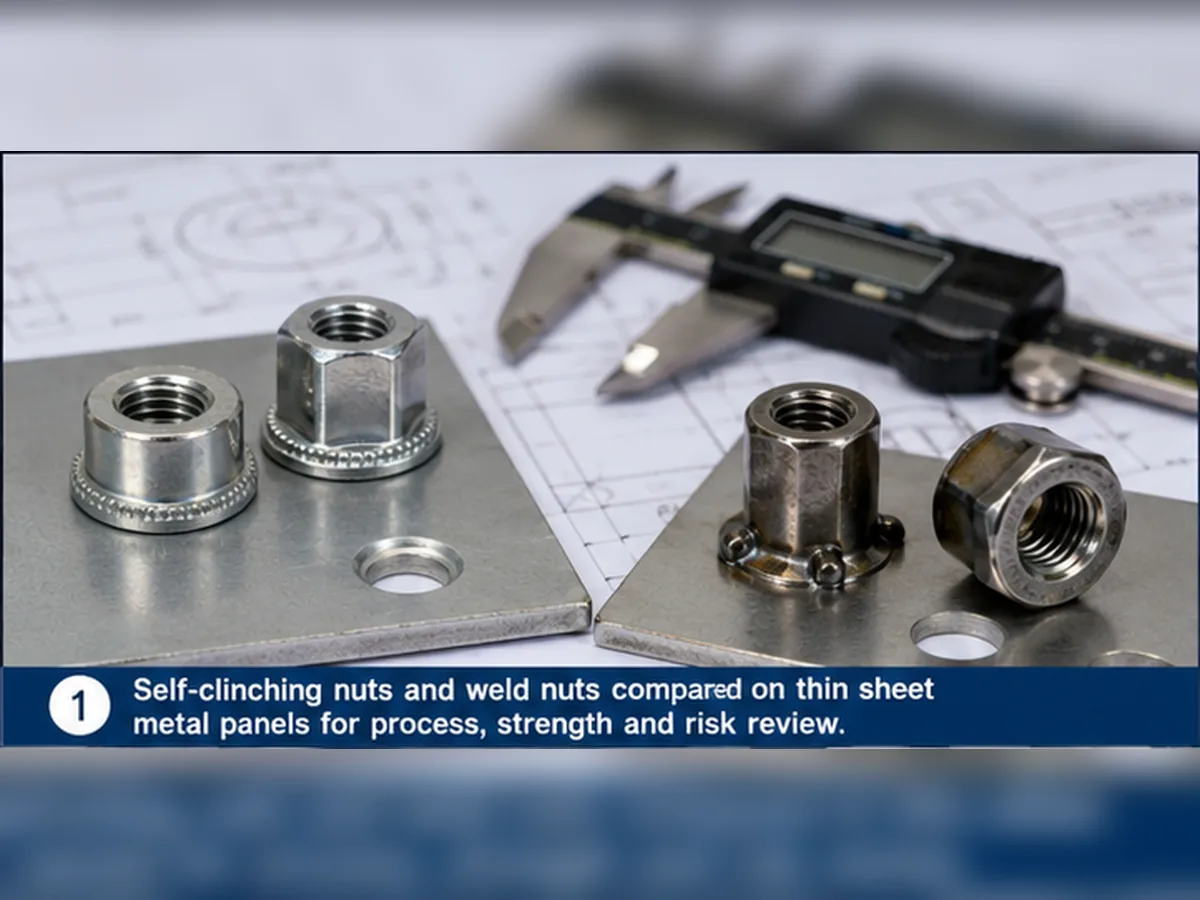
Les écrous auto-poinçonneurs et les écrous à souder doivent être comparés en fonction de l'état de la tôle, du processus d'installation, de la direction de la charge, de l'inspection et des exigences du client.
Visuel d'ingénierie conceptuelle uniquement ; la sélection finale dépend du dessin, des données de la tôle, de la validation du processus et de la norme du client.
Réponse rapide : Quand les acheteurs doivent-ils choisir des écrous auto-poinçonneurs ou des écrous à souder ?
Les écrous auto-poinçonneurs sont généralement examinés en premier lorsque le matériau de la tôle peut supporter un fluage à froid dans la caractéristique de poinçonnage, que le trou peut être maintenu dans la tolérance, que l'accès à la presse est disponible et que la chaleur de soudage ou les résidus de soudure doivent être évités. Les écrous à souder sont généralement examinés en premier lorsque l'assemblage est conçu pour le soudage, que l'accès à la soudure est disponible, que la soudabilité de la tôle est confirmée et que l'inspection de la soudure peut contrôler la qualité des projections, l'alignement et l'état du filetage.
Il n'y a pas de gagnant universel. Un écrou auto-poinçonneur peut échouer si la tôle est trop dure, trop fine, mal poinçonnée ou mal pressée. Un écrou à souder peut échouer si la soudure est faible, surchauffée, mal alignée, contaminée par un revêtement ou si des projections endommagent le filetage.
Condition de l'acheteur
Révision habituelle des écrous auto-poinçonneurs
Révision habituelle des écrous à souder
Nécessite confirmation
Tôle fine avec accès par presse
Possible si la dureté, la ductilité et la tolérance du trou de la tôle permettent le poinçonnage
Possible si le soudage est approuvé
Épaisseur, dureté, diamètre du trou et accès de la tôle
La chaleur de soudage doit être évitée
Souvent examiné en premier
Nécessite une évaluation des risques de soudage
Revêtement, distorsion, composants thermosensibles et séquence d'assemblage
Ligne de soudage et montage existants
Possible, mais peut nécessiter une opération de presse séparée
Souvent examiné en premier
Accès de soudage, conception de projection, montage et méthode d'inspection
Soudage non autorisé par conception
Souvent examiné
Généralement non préféré
Note de dessin, norme client et restriction de processus
Exigence de couple de serrage élevé
Conditionnel
Conditionnel
Valeur de couple de rotation, direction de charge, état du trou et méthode d'essai
Projet d'homologation automobile
Conditionnel
Conditionnel
Norme client, révision de plan, plan de contrôle et champ d'application PPAP si nécessaire
La taille du filetage seule ne prouve pas la performance du joint
Une désignation de filetage M6, M8 ou M10 ne définit que le filetage d'accouplement. Elle ne prouve pas la résistance à l'arrachement, la résistance à la poussée, la résistance au couple de rotation, la qualité de soudure, la rétention par sertissage, la compatibilité des revêtements ou l'homologation automobile. Le joint de tôle doit être examiné comme un système.
Que sont les écrous auto-sertisseurs ?
Écrous auto-clincheurs sont des fixations filetées intérieurement installées dans des trous préparés dans la tôle par un processus de pressage. Lors de l'installation, le matériau de la tôle s'écoule dans la caractéristique de sertissage de l'écrou. Cela crée une rétention mécanique et aide à résister à la rotation, à la poussée ou à l'arrachement lorsque le joint est conçu et installé correctement.
Les écrous auto-sertisseurs sont couramment examinés pour les assemblages de tôles où le soudage n'est pas préféré, où l'apport de chaleur peut endommager les revêtements ou les pièces environnantes, ou lorsqu'un filetage propre est nécessaire après le formage ou la finition du panneau.
Comment fonctionne la caractéristique de sertissage
La fonction d'emboutissage est conçue pour se verrouiller dans le matériau de la tôle après pressage. La géométrie exacte dépend de la conception de l'écrou et du dessin. La tôle doit être suffisamment ductile pour s'écouler dans la fonction de retenue, mais pas trop molle, fine ou instable au point que l'assemblage se déforme ou perde de sa résistance.
Le trou d'installation est également critique. Si le trou est trop grand, trop petit, non rond, ébarburé ou mal positionné, l'écrou peut ne pas se mettre en place correctement. L'acheteur doit confirmer le diamètre du trou, la tolérance, l'état des bavures, la planéité de la tôle et la direction d'installation avant l'échantillonnage.
Que peut-il mal se passer lors de l'installation
Les problèmes courants des écrous auto-emboutissants incluent un mauvais positionnement, une déformation de la tôle, un emboutissage insuffisant, une rotation de l'écrou, un arrachement, un endommagement du filetage, une préparation incorrecte du trou et un marquage de surface. Ces problèmes sont généralement liés au processus et doivent être vérifiés par des essais d'installation et une inspection, et non supposés d'après l'apparence du catalogue.
Que sont les écrous à souder ?
Les écrous à souder sont des écrous filetés fixés à la tôle par soudage. De nombreux modèles d'écrous à souder utilisent des bossages ou une zone de contact soudable afin que l'écrou puisse être assemblé à la tôle par soudage contrôlé. La soudure assure alors la retenue et l'anti-rotation.
Les familles courantes d'écrous à souder incluent écrous à souder à bride, écrous à souder hexagonaux et les écrous à souder à bossages personnalisés. Le type correct dépend de la surface d'appui, de la position de la tôle, de l'accès, de la direction de la charge, de la conception du gabarit de soudage et des exigences du dessin client.
Fonction de l'écrou à souder par bossages
Les écrous à souder par bossages utilisent des points de contact ou des bossages conçus pour concentrer l'énergie de soudage. Cela permet de créer une soudure entre l'écrou et la tôle. Les performances dépendent de la géométrie de l'écrou, du matériau de la tôle, du revêtement, des paramètres de soudage, de l'alignement du montage et de la répétabilité du processus.
Un écrou à souder avec la taille de filetage correcte peut encore échouer si la soudure est faible, mal alignée, surchauffée, sous-chauffée ou affectée par le revêtement, l'huile, la contamination ou une mauvaise géométrie des projections.
Types courants d'écrous à souder pour tôle
Les écrous à souder à bride peuvent offrir une plus grande surface d'appui et une surface de soudure contrôlée. Les écrous à souder hexagonaux peuvent être utilisés lorsque le dessin, le montage et les conditions d'assemblage exigent cette géométrie. Des écrous à souder personnalisés peuvent être nécessaires lorsque la forme des projections, la longueur du pilote, le diamètre de la bride, la profondeur du filetage, le revêtement ou l'emballage doivent suivre un dessin client.
Comparaison des procédés : sertissage par pression vs soudage
La première différence majeure est le procédé. Les écrous auto-sertisseurs sont installés en pressant l'écrou dans un trou préparé dans la tôle. Les écrous à souder sont fixés par soudage. Chaque procédé a son propre équipement, ses points de contrôle et ses risques de défaillance.
L'installation par auto-sertissage nécessite généralement une préparation précise du trou, une force de pressage contrôlée, une dureté de tôle correcte et un accès suffisant pour l'outil d'installation. L'installation d'écrous à souder nécessite un équipement de soudage, un accès à l'électrode ou au soudage, un contrôle des projections, un alignement du montage, un contrôle des paramètres de soudage et une inspection de la soudure.
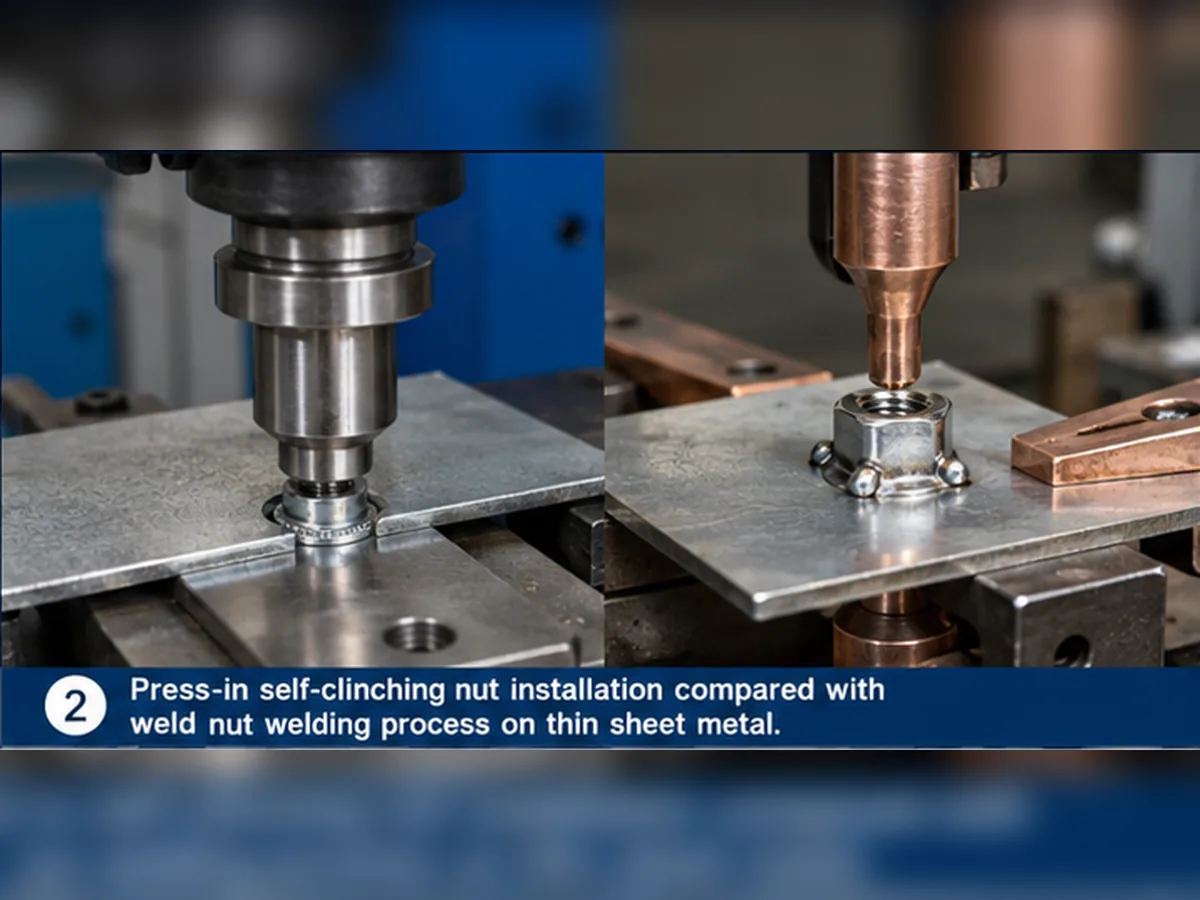
Les écrous auto-sertisseurs dépendent de l'installation par pressage et de l'écoulement de la tôle, tandis que les écrous à souder dépendent de l'accès au soudage, de la qualité des projections et de l'inspection de la soudure.
Le visuel du procédé est conceptuel ; la force d'installation réelle ou les paramètres de soudage doivent provenir du dessin, de la configuration de l'équipement et des exigences du client.
Élément de processus
Écrou auto-sertissant
Écrou à souder
Méthode d'installation
Emboutissage par pression
Soudage par bossages ou procédé de soudage spécifié par le client
Équipement principal
Presse, outillage d'insertion ou équipement d'emboutissage dédié
Équipement de soudage, électrodes, montage et contrôles de processus
Condition de la tôle clé
Épaisseur, dureté, ductilité et qualité du trou
Soudabilité, revêtement, épaisseur et accès à la soudure
Contrôle principal du processus
Tolérance du trou, force d'installation, assise et perpendicularité si nécessaire
Paramètre de soudure, qualité de projection, alignement, contrôle des projections et protection du filetage
Risque principal
Mauvais sertissage, rotation de l'écrou, déformation du panneau ou marquage de surface
Soudure faible, projections, brûlure, désalignement ou contamination du filetage
Point clé de l'inspection
Assise, calibre de filetage, couple de sortie et poussée/traction si nécessaire
Qualité de soudure, calibre de filetage, couple de sortie et traction si nécessaire
Pour les acheteurs qui se procurent écrous spéciaux personnalisés, le choix du procédé doit être traité comme faisant partie de la conception du joint, et non seulement comme une comparaison de prix unitaire.
Conditions de tôle qui modifient la décision
La tôle mince n'est pas une condition unique. Un écrou qui fonctionne sur un panneau peut ne pas fonctionner sur un autre panneau avec une épaisseur, une dureté, un revêtement ou une préparation de trou différents.
Pour les écrous auto-poinçonneurs, l'épaisseur et la dureté de la tôle sont critiques car le matériau de la tôle doit se déformer dans la caractéristique de sertissage. Pour les écrous à souder, l'épaisseur et la soudabilité de la tôle sont critiques car une tôle mince peut être sensible à l'apport de chaleur, à la distorsion ou à la brûlure.
L'épaisseur, la dureté, la tolérance de trou, le revêtement et l'accès peuvent modifier la décision entre les écrous auto-poinçonneurs et les écrous à souder.
Aucune limite universelle d'épaisseur de tôle n'est implicite ; les données de tôle doivent suivre le dessin, la conception de l'écrou et l'exigence du client.
Épaisseur et dureté de la tôle
L'épaisseur et la dureté de la tôle doivent être confirmées à partir du dessin, de la spécification du matériau ou de la norme client. Ne présumez pas d'une épaisseur minimale universelle pour tous les écrous auto-poinçonneurs ou tous les écrous à souder. La plage acceptable dépend de la conception de l'écrou, du matériau de la tôle, de la méthode d'installation et des performances d'essai requises.
Préparation et tolérance du trou
Le diamètre du trou, la tolérance du trou, la direction des bavures, la position du trou et la planéité de la tôle affectent les performances d'auto-poinçonnage. Pour les écrous à souder, l'alignement du trou et le positionnement du montage affectent l'emplacement du filetage et la cohérence de l'assemblage. Si le trou fait partie d'un panneau embouti, découpé au laser ou usiné, le processus et la capacité de tolérance doivent être confirmés avant approbation.
Revêtement et état de surface
Le revêtement peut affecter les deux options. Pour les écrous auto-poinçonneurs, le revêtement peut influencer l'état du trou, le marquage de surface et l'ajustement du filetage. Pour les écrous à souder, le revêtement peut affecter la soudabilité, les projections de soudure, la résistance de la soudure, la protection contre la corrosion après soudure et la propreté du filetage. La séquence de revêtement doit être confirmée car une pièce soudée après revêtement peut créer des risques différents d'une pièce revêtue après soudure.
Comparaison de résistance : arrachement, poussée, couple et charge de filetage
Lorsque les acheteurs demandent si les écrous auto-poinçonneurs ou les écrous à souder sont plus résistants, la question doit être décomposée en modes de résistance spécifiques. L'arrachement, la poussée, le couple et la charge de filetage sont des exigences de performance différentes.
La résistance à l'arrachement concerne la capacité de l'écrou à résister à une traction hors de la tôle. La résistance à la poussée peut être importante lorsque la charge agit depuis la direction opposée. La résistance au couple est importante lorsque le boulon d'accouplement est serré et que l'écrou doit résister à la rotation. La charge sur le filetage dépend de la taille du filetage, de l'engagement, du matériau, du boulon d'accouplement et des conditions d'assemblage.
L'arrachement, la poussée, le couple et la charge sur le filetage sont différents modes de résistance et doivent être spécifiés séparément.
Aucune valeur de résistance fixe n'est implicite ; les valeurs d'acceptation doivent provenir du plan, de la méthode d'essai ou de la norme client.
Mode de résistance
Pourquoi c'est important
Vérification de l'écrou auto-clinchant
Vérification de l'écrou à souder
Arrachement
Résiste à l'extraction axiale de la tôle
Caractéristique de clinchage, engagement dans la tôle, dureté de la tôle et épaisseur de la tôle
Résistance de soudure, zone de soudure, qualité de projection et état de la tôle
Refoulement
Résiste à la force exercée depuis la direction opposée
Assise, géométrie de sertissage, déformation de la tôle et direction de la charge
Régularité de la soudure, support de la tôle et direction de la charge
Test de couple
Empêche la rotation de l'écrou lors du serrage
État du trou, verrouillage par sertissage, qualité d'installation et dureté de la tôle
Résistance de la soudure, alignement de l'écrou, qualité du point de soudure et contrôle du gabarit
Charge sur le filetage
Contrôle la fonction du boulon d'accouplement
Diamètre de filetage, pas, tolérance, engagement, compatibilité du matériau et du boulon
Diamètre de filetage, pas, tolérance, engagement, compatibilité du matériau et du boulon
Stabilité de l'assemblage
Vérifie que l'assemblage vissé reste fonctionnel après installation
Assise installée, déformation du panneau et chemin de charge de serrage
Alignement de soudure, intégrité de la soudure et chemin de charge de serrage
Aucune valeur de résistance à l'arrachement, à la poussée ou au couple ne doit être supposée sans dessin, norme produit, exigence client ou méthode d'essai. Pour les projets contrôlés par dessin, les acheteurs peuvent consulter les conseils de SUNHYINGS sur écrous spéciaux fabriqués sur plan.
Comparaison des risques : déformation, défauts de soudure, endommagement du filetage et impact du revêtement
Les écrous auto-poinçonneurs et les écrous à souder présentent des profils de risque différents. Le meilleur choix dépend du risque le plus facile à contrôler dans l'assemblage de l'acheteur.
Les écrous auto-poinçonneurs peuvent provoquer une déformation de la tôle, un marquage de surface ou une mauvaise rétention si le matériau de la tôle, le trou et la force d'installation ne sont pas contrôlés. Les écrous à souder peuvent créer des projections de soudure, des soudures faibles, une brûlure, une contamination du filetage, des dommages au revêtement ou un désalignement si les conditions de soudage ne sont pas contrôlées.
Les risques du procédé incluent un mauvais sertissage, une déformation de la tôle, une soudure faible, des projections, des dommages au filetage, un désalignement et un impact sur le revêtement.
Le visuel des risques est fourni à titre d'explication technique uniquement ; les défauts réels doivent être évalués selon le plan d'inspection approuvé.
Risque
Plus pertinent pour
Vérification de l'acheteur
Déformation de la tôle
Écrous auto-clincheurs
Épaisseur de la tôle, dureté, réglage de la presse et support d'installation
Mauvais sertissage / rotation de l'écrou
Écrous auto-clincheurs
Diamètre du trou, tolérance du trou, dureté de la tôle et force d'installation
Brûlure traversante
Les écrous à souder
Épaisseur de tôle, soudabilité et paramètres de soudage
Projections de soudure
Les écrous à souder
Protection du filetage, plan de nettoyage et méthode d'inspection
Soudure faible
Les écrous à souder
Géométrie de projection, paramètres de soudage, montage et inspection de la soudure
Endommagement du filetage
Les deux
Inspection au calibre passe/ne-passe après installation ou soudage
Dommage au revêtement
Les deux, en particulier les écrous à souder
Séquence de revêtement, exigence de corrosion et état du filetage après traitement
Désalignement
Les deux
Fixation, position du trou, fonction de pilotage, planéité de la tôle et inspection dimensionnelle
Une comparaison utile doit également définir quand chaque option peut être dangereuse ou inadaptée. Il ne s'agit pas d'interdictions universelles, mais de conditions qui doivent déclencher une confirmation technique avant l'appel d'offres ou l'échantillonnage.
Quand les écrous auto-poinçonneurs peuvent ne pas convenir
Le matériau de la tôle est trop dur, trop fragile ou ne convient pas au fluage à froid dans la fonction de sertissage.
La tôle est trop fine ou instable pour les performances requises en traction, poussée ou couple.
Le diamètre du trou, la tolérance, l'état des bavures ou la planéité ne peuvent pas être contrôlés.
Il n'y a pas d'accès à la presse ou l'outil d'installation ne peut pas soutenir correctement le panneau.
Le marquage de surface ou la déformation du panneau est inacceptable.
Le dessin client nécessite une fixation soudée ou une norme spécifique d'écrou à souder.
Quand les écrous à souder peuvent ne pas convenir
L'assemblage ne peut pas tolérer la chaleur de soudage, la distorsion ou les projections.
Le matériau de la tôle ou le revêtement ne convient pas au procédé de soudage requis sans contrôle supplémentaire.
L'accès pour le soudage, l'accès à l'électrode ou l'alignement du montage ne peut être maintenu.
La propreté du filetage après soudage ne peut pas être contrôlée.
La pièce est déjà finie ou revêtue et la protection contre la corrosion après soudage n'est pas claire.
Le dessin client interdit le soudage ou nécessite un insert fileté à presser.
Limite de sélection : Si l'une des options présente des données non résolues concernant l'état de la tôle, le revêtement, l'accès, la direction de la charge ou l'inspection, le statut RFQ correct est nécessite confirmation, pas une approbation automatique.
Processus de fabrication et contrôle de production
Le processus de fabrication de l'écrou et le processus d'installation ne sont pas la même chose. Un écrou auto-emboutissable ou un écrou à souder peut être fabriqué par refoulage à froid, emboutissage, usinage, taraudage, formage de filet, traitement thermique, revêtement ou opérations secondaires selon le dessin et la conception de la pièce. Le processus d'installation a ensuite lieu au niveau du panneau ou de l'assemblage.
Pour les écrous auto-poinçonneurs, le contrôle de production inclut la géométrie de l'écrou, la qualité du filetage, la qualité du trou dans la tôle, la force d'installation, l'état de sertissage et l'inspection après installation. Pour les écrous à souder, le contrôle de production inclut la géométrie de l'écrou, la qualité des bossages, l'accès à la soudure, le dispositif de soudage, les paramètres de soudage, la protection du filetage et l'inspection de la soudure.
Zone de contrôle
Pourquoi c'est important
Nécessite confirmation
Processus de fabrication de l'écrou
Affecte la géométrie, la qualité du filetage, le coût, le délai et la régularité
Refoulage à froid, estampage, usinage, taraudage, formage de filet ou opérations secondaires selon le plan
Traitement thermique / dureté
Affecte la résistance, le comportement du filetage et les performances de sertissage ou de soudage
Matériau, plage de dureté et norme client si spécifiée
Séquence de revêtement
Affecte la protection anticorrosion, l'ajustement du filetage, la soudabilité et le marquage de surface
Avant installation, après installation, avant soudage ou après soudage
Processus d'installation
Détermine la fonction finale du joint après la production de l'écrou
Configuration de presse, montage, équipement de soudage, inspection et fenêtre de processus
Contrôle de lot
Assure la traçabilité et le confinement de la qualité
Numéro de lot, étiquette d'emballage, enregistrement d'inspection et exigence documentaire
La traçabilité des lots, les enregistrements d'inspection, les rapports de revêtement et les certificats de matériaux peuvent être requis selon le programme client. Les documents PPAP, IMDS ou d'approbation spéciale ne doivent être inclus que lorsqu'ils sont exigés par le client ou le programme automobile.
Documents d'inspection et de qualité que les acheteurs doivent confirmer
L'inspection doit correspondre au mode de défaillance. Un assemblage d'écrou en tôle mince peut nécessiter une inspection dimensionnelle, une inspection du filetage, des vérifications de position installée, des tests de couple de dévissage, des tests d'arrachement, des tests de poussée ou une inspection de soudure selon la conception.
Élément d'inspection
Écrou auto-sertissant
Écrou à souder
Document / Preuve si nécessaire
Jauge de filetage
Requis si spécifié ou contrôlé par plan
Requis si spécifié ou contrôlé par plan
Registre d'inspection du filetage
Inspection du trou
Critique avant installation
Important pour l'alignement
Rapport dimensionnel ou contrôle en cours de fabrication
Assise installée
Critique
Important pour l'alignement
Enregistrement d'inspection visuelle/dimensionnelle si requis
Inspection de soudure
Non applicable sauf soudure secondaire
Critique
Enregistrement d'inspection de soudure si requis
Test de couple
Si requis par le plan ou la norme client
Si requis par le plan ou la norme client
Rapport d'essai de couple de torsion si requis
Extraction / poussée
Si requis par le plan ou la norme client
Si requis par le plan ou la norme client
Rapport d'essai d'arrachement / de poussée si requis
État du revêtement
Nécessite confirmation
Nécessite confirmation, surtout après soudure
Rapport de revêtement ou essai de corrosion si spécifié
Documents automobiles
Conditionnel
Conditionnel
PPAP / IMDS uniquement si le client ou le programme l'exige
Les documents qualité ne doivent pas être promis automatiquement pour chaque commande. Ils doivent être confirmés par RFQ, dessin, norme client et exigence d'approbation. Les acheteurs peuvent également consulter SUNHYINGS guides techniques pour les sujets techniques liés à la fixation.
Matrice de décision pour tôles fines automobiles
Les assemblages de tôlerie automobile peuvent utiliser des écrous auto-poinçonneurs ou des écrous à souder en fonction de l'emplacement spécifique, de la fonction et du processus de fabrication. Il n'y a pas d'approbation automatique basée sur le nom de l'écrou.
Condition d'application
Écrous auto-poinçonneurs peuvent s'adapter lorsque
Écrous à souder peuvent s'adapter lorsque
Nécessite confirmation
Panneau intérieur ou support
L'accès à la presse et l'état de la tôle sont appropriés
Le soudage est disponible et approuvé
Données de tôle, charge, tolérance de trou et dessin
Pièce finie sensible à la chaleur
La chaleur de soudage doit être évitée
Le risque de soudage est acceptable
Revêtement, déformation thermique et protection contre la corrosion après traitement
Assemblage de carrosserie en blanc ou de panneaux soudés
Possible uniquement si la conception permet l'emboutissage
Le processus de soudage est déjà planifié
Accès de soudage, norme de soudage et séquence d'assemblage
Support de siège ou support structurel
Conditionnel
Conditionnel
Direction de charge, résistance à l'arrachement, risque de fatigue et approbation client
Couvercle ou boîtier de plateau de batterie
Conditionnel
Conditionnel
Matériau, revêtement, étanchéité, corrosion et exigences du client
Projet de remplacement
Conditionnel
Conditionnel
Échantillon, dessin, état des trous, marques de soudure et voie d'approbation
Les acheteurs automobiles doivent définir la fonction de l'assemblage avant de choisir l'écrou. La capacité de charge, l'anti-rotation, l'accès pour l'entretien, la protection du revêtement, la séquence d'assemblage et la documentation qualité peuvent toutes modifier la décision. Pour l'évaluation côté fournisseur dans les programmes automobiles, les acheteurs peuvent également consulter les conseils de SUNHYINGS sur fournisseur d'écrous spéciaux pour applications automobiles.
Scénario d'ingénierie composite : quand le dessin ne suffit pas
Scénario d'ingénierie composite à des fins de formation uniquement : Un acheteur de support automobile compare un écrou auto-poinçonneur et un écrou à souder pour un support en tôle mince. Le dessin définit la taille du filetage, mais il ne précise pas clairement la dureté de la tôle, la tolérance du trou, l'exigence de couple de dévissage ou si la chaleur de soudage est acceptable après le revêtement.
Dans ce cas, le fournisseur ne doit pas sélectionner l'écrou uniquement par la taille du filetage. L'acheteur doit confirmer si le panneau peut être embouti, si la dureté de la tôle supporte le poinçonnage, si la tolérance du trou peut être maintenue en production, si le revêtement est appliqué avant ou après l'installation, et si des tests de couple de dévissage ou d'arrachement sont requis.
Si le soudage fait déjà partie de la chaîne d'assemblage et que l'accès à la soudure est disponible, un écrou à souder peut être envisagé. Si la chaleur de soudage ou les projections sont une préoccupation et que l'accès à la presse est disponible, un écrou auto-poinçonneur peut être envisagé. L'approbation finale doit suivre le dessin, la norme client et la validation réelle de l'assemblage.
Liste de contrôle de l'acheteur avant échantillonnage
Une RFQ utile ne doit pas seulement indiquer la taille du filetage. Elle doit décrire la tôle, la fonction du joint, la préférence de processus et l'exigence de qualité. Si l'acheteur n'a pas encore choisi entre un écrou auto-clincheur et un écrou à souder, la RFQ doit clairement indiquer que les deux options peuvent être examinées.
Une RFQ utile doit inclure la révision du dessin, les données de la tôle, la tolérance du trou, l'exigence de filetage, le revêtement, les tests de résistance, le volume et les documents d'approbation.
Le visuel de la liste de contrôle ne représente pas un certificat ou un enregistrement d'approbation ; PPAP et IMDS s'appliquent uniquement lorsque requis par le client ou le programme.
Données minimales de la RFQ
Dernière révision du dessin ou photo d'échantillon.
Matériau de la tôle, épaisseur et dureté.
Diamètre du trou, tolérance, état des bavures et processus de perçage si connu.
Préférence de type d'écrou ou demande de comparaison ouverte.
Taille du filetage, pas, tolérance et condition du boulon d'accouplement.
Emplacement d'assemblage et type de joint.
Direction de la charge et si l'arrachement, la poussée ou le couple de dévissage est requis.
Revêtement, exigence de corrosion et séquence de revêtement.
Restriction de soudage ou accès pour installation par pression.
Volume annuel, quantité d'échantillons et calendrier d'approbation cible.
Méthode d'inspection et critères d'acceptation si requis.
PPAP / IMDS uniquement si requis par le client ou le programme.
Exigence d'emballage et d'étiquetage.
Quand envoyer des échantillons ou des photos
Les échantillons ou les photos sont utiles lorsque le dessin est incomplet, lorsque la pièce existante est remplacée, lorsque l'état du panneau n'est pas clair, ou lorsque l'acheteur rencontre un problème de défaillance tel que rotation d'écrou, soudure faible, endommagement du filetage, arrachement, mauvais alignement ou mauvaise qualité de revêtement.
Comment SUNHYINGS examine les demandes de devis pour les écrous à sertir et les écrous à souder
SUNHYINGS peut examiner les demandes de devis pour les écrous à sertir et les écrous à souder du point de vue de la complétude du dessin, de la géométrie de l'écrou, des exigences de filetage, des données de tôle, du matériau, du revêtement, du processus de fabrication et des exigences d'inspection.
Pour les projets d'écrous à sertir, l'examen doit inclure l'épaisseur de la tôle, la dureté de la tôle, le diamètre du trou, la tolérance du trou, la caractéristique de sertissage, l'accès d'installation et les tests de poussée, d'arrachement ou de couple requis, le cas échéant.
Pour les projets d'écrous à souder, l'examen doit inclure la géométrie de l'écrou à souder, la conception des bossages, l'accès de soudage, la soudabilité de la tôle, l'état du revêtement, la protection du filetage et les exigences d'inspection de soudure.
En tant que fabricant d'écrous sur mesure, SUNHYINGS peut aider à déterminer si la demande de devis contient suffisamment d'informations techniques pour la soumission et la préparation d'échantillons. La validation finale de l'assemblage dépend toujours des conditions réelles d'assemblage de l'acheteur, de la norme client, de l'approbation du processus et des exigences de test.
Périmètre de l'examen : SUNHYINGS peut aider à examiner la fabricabilité, l'exhaustivité des dessins et les risques liés à la demande de devis, mais l'approbation finale de l'application doit suivre le processus de validation conjointe de l'acheteur, les exigences spécifiques du client et le processus d'approbation qualité.
Tableau récapitulatif : Écrous auto-poinçonneurs vs écrous à souder
Élément de comparaison
Écrous à sertir (Presse)
Écrous à souder
Processus principal
Emboutissage par pression
Soudage
Dépendance principale de la tôle
Épaisseur, dureté, ductilité et qualité du trou
Soudabilité, revêtement, épaisseur et accès à la soudure
Apport de chaleur
Aucune chaleur de soudure lors de l'installation normale par clinchage
La chaleur de soudure fait partie du processus
Dépendance principale de la résistance
Engagement de la tôle et caractéristique de clinchage
Résistance de soudure, conception de la projection et zone de soudure
Dépendance principale au couple de dévissage
Verrouillage par sertissage, état du trou et dureté de la tôle
Qualité de soudure, alignement de l'écrou et contrôle du montage
Risque principal
Déformation de la tôle, mauvais sertissage, rotation de l'écrou ou marquage de surface
Soudure faible, projections, brûlure, désalignement ou dommage au filetage
Inspection clé
Assise, état du trou, calibre de filetage, couple de dévissage, poussée / traction si nécessaire
Inspection de soudure, alignement, calibre de filetage, couple de dévissage, traction si nécessaire
Généralement examiné lors de
Le soudage n'est pas préféré et l'accès à la presse est adapté
Le soudage est approuvé et le contrôle du processus de soudage est disponible
Base de décision finale
Plan, données de tôle, charge, qualité de trou, méthode d'installation et exigence de test
Plan, données de tôle, charge, processus de soudage, montage, revêtement et exigence de test
La décision la plus sûre est de définir d'abord l'assemblage de tôle, puis de sélectionner le type d'écrou. Un écrou qui fonctionne bien dans une application de tôle mince peut échouer dans une autre si l'épaisseur de la tôle, la préparation du trou, la direction de la charge ou le contrôle du processus changent.
Pages SUNHYINGS connexes
Consultez les pages SUNHYINGS connexes pour les écrous auto-poinçonneurs, les écrous à souder, l'approvisionnement basé sur des plans et la résolution de problèmes d'assemblage automobile.
Les références suivantes sont fournies à titre de contexte général de processus. Elles ne remplacent pas le plan de l'acheteur, la norme client, la fiche technique du produit, la procédure de soudage, la validation de l'installation par sertissage ou l'exigence d'approbation spécifique au projet.
Les références externes sont fournies à titre de contexte technique uniquement. La sélection finale doit suivre la dernière révision du plan, la norme client, la spécification du produit et le processus d'assemblage validé.
FAQ
Les écrous auto-poinçonneurs sont-ils plus résistants que les écrous à souder ?
Pas universellement. La résistance dépend du matériau de la tôle, de son épaisseur, de sa dureté, de la géométrie de l'écrou, de la direction de la charge, de la qualité d'installation, de la qualité de la soudure le cas échéant, et de la méthode d'essai requise.
Quand les acheteurs doivent-ils choisir des écrous auto-emboutisseurs ?
Les acheteurs examinent souvent les écrous auto-poinçonneurs lorsque la tôle peut supporter une installation par pression, que le trou peut être contrôlé avec précision, que l'accès à la presse est disponible et que la chaleur de soudage ou les résidus de soudure doivent être évités.
Quand les acheteurs doivent-ils choisir des écrous à souder ?
Les acheteurs examinent souvent les écrous à souder lorsque l'accès de soudage, la soudabilité, la géométrie des projections, le contrôle du montage et l'inspection des soudures peuvent soutenir la performance requise du joint.
Un écrou auto-poinçonneur peut-il remplacer directement un écrou à souder ?
Non. Un remplacement direct ne doit pas être effectué uniquement sur la base de l'apparence ou de la taille du filetage. Les acheteurs doivent confirmer l'épaisseur de la tôle, la dureté de la tôle, le diamètre du trou, la direction de la charge, le couple de dévissage, la résistance à l'arrachement, le revêtement, la méthode d'inspection et l'approbation du client.
Les écrous à souder peuvent-ils être utilisés sur de la tôle très fine ?
Uniquement après confirmation du matériau de la tôle, de l'épaisseur de la tôle, de la soudabilité, de la conception des bossages, de l'état du revêtement, des paramètres de soudage et de la méthode d'inspection. Les tôles minces peuvent être sensibles à l'apport de chaleur, à la déformation ou à la brûlure.
Qu'est-ce qui provoque la rotation ou l'arrachement des écrous auto-poinçonneurs ?
Les causes courantes incluent un diamètre de trou incorrect, une dureté de tôle inadaptée, une force d'installation insuffisante, une géométrie d'écrou erronée, un mauvais positionnement, une déformation de la tôle ou une inadéquation de la direction de charge.
Quelles sont les causes de défaillance d'un écrou à souder ?
Les causes courantes incluent des soudures faibles, une mauvaise conception de la projection, un désalignement, des projections de soudure, une contamination du filetage, des problèmes de revêtement, une brûlure, un mauvais contrôle du montage ou une inspection insuffisante des soudures.
Quels essais doivent être spécifiés pour les écrous en tôle fine ?
Selon le dessin et les exigences du client, les acheteurs peuvent spécifier un contrôle du calibre de filetage, un contrôle dimensionnel, un essai de couple de dévissage, un essai d'arrachement, un essai de poussée, un contrôle de l'assise installée ou un contrôle de soudure.
Le PPAP s'applique-t-il aux écrous auto-poinçonneurs ou aux écrous à souder ?
Le PPAP s'applique uniquement lorsqu'il est exigé par le client ou le programme automobile. Il ne doit pas être présumé pour chaque commande, sauf si la demande de devis ou la norme client le spécifie.
Quelles informations les acheteurs doivent-ils envoyer avant le devis ?
Les acheteurs doivent fournir la révision du dessin, le matériau de la tôle, l'épaisseur de la tôle, la dureté de la tôle, le diamètre et la tolérance du trou, les exigences de filetage, la direction de la charge, le revêtement, l'accès d'installation, les essais requis, le volume annuel, l'exigence d'approbation d'échantillon et le périmètre des documents qualité.
Note de révision technique
Ce guide a été préparé pour les ingénieurs de conception, les ingénieurs achats, les équipes SQE et les acheteurs de projets automobiles comparant les écrous auto-poinçonneurs et les écrous à souder pour les assemblages en tôle mince.
Périmètre examiné : conditions de tôle mince, processus de sertissage par pression, processus d'écrou à souder, résistance à l'arrachement, au refoulement, au couple, charge du filetage, impact du revêtement, exigences d'inspection et exhaustivité des données RFQ.
Note sur les normes et limitations : Cet article est un guide pratique d'approvisionnement et d'ingénierie. Il ne remplace pas le plan client, la norme produit, la procédure de soudage qualifiée, la validation d'installation du sertissage, l'approbation PPAP formelle ou l'exigence spécifique du client. Les données manquantes sur l'épaisseur de la tôle, la dureté de la tôle, la tolérance du trou, le revêtement, le couple, l'arrachement, le refoulement ou l'inspection doivent être traitées comme nécessitant confirmation, et non comme des faits supposés. Toujours suivre la dernière révision du plan, la norme client et le processus d'assemblage validé.