Esta distinción es importante porque el mismo grupo de resistencia de 144 ksi incluye productos que no son intercambiables. Un perno hexagonal pesado ASTM F3125 Grado 144, un conjunto de rotura de tuerca F3125 Grado 144TC y un conjunto de spline fijo ASTM F3148 Grado 144 tienen identidades de producto y disposiciones de instalación diferentes. Especificar únicamente “pernos estructurales Grado 144” deja sin resolver decisiones importantes.
¿Cuándo se introdujo el Grado 144 en ASTM F3125?
El Grado 144 no se introdujo por primera vez en ASTM F3125/F3125M-26. El alcance publicado de la edición de 2023 identificó las clasificaciones de resistencia de la serie en pulgadas de 120 ksi y 150 ksi, mientras que la edición de 2025 ya incluía el grado adicional de 144 ksi. La edición de 2026 lo mantiene.
Existe otra posible fuente de confusión: ASTM F3148 aborda un conjunto de pernos estructurales de spline fijo de Grado 144 independiente. No es simplemente otro nombre para F3125 Grado 144TC. Una especificación histórica de proyecto que exija explícitamente F3148 no debe convertirse a F3125 solo porque ambas familias de productos utilicen la misma clasificación nominal de resistencia a la tracción.
La regla práctica es identificar la designación completa de la norma antes de comparar precios o aceptar una sustitución. El catálogo actual de ASTM identifica F3125/F3125M-26, pero un contrato puede exigir una edición diferente. Cualquier cambio propuesto a esa base normativa corresponde al proceso de aprobación del proyecto, no a la interpretación del proveedor de un número de grado.
Grado 144 hexagonal pesado, rotura de tuerca y spline fijo: ¿qué los diferencia?
La diferencia más relevante entre las configuraciones del Grado 144 no es la clasificación nominal de resistencia a la tracción. Es la disposición física del elemento de fijación y el sistema de instalación para el que se especifica el producto.
RCSC 2025 clasifica los siguientes productos en el Grupo 144:
| Designación del producto | Configuración | Consecuencia para la adquisición |
|---|---|---|
| ASTM F3125 Grado 144 | Perno estructural de cabeza hexagonal pesada | Especifique las dimensiones del perno, las tuercas y arandelas compatibles, el acabado y los requisitos de instalación aplicables. |
| ASTM F3125 Grado 144TC | Conjunto apareado de control de tensión con rotura por torsión | Solicite el conjunto apareado especificado y verifique el sistema de instalación por rotura por torsión y la documentación. |
| ASTM F3148 Grado 144 | Conjunto apareado de estriado fijo | Identifique F3148 por separado y verifique su método de instalación específico y los requisitos del conjunto. |
Para un perno hexagonal pesado, el apriete se realiza mediante un método de instalación permitido para la unión estructural especificada. La geometría de su cabeza hexagonal pesada se rige por los requisitos dimensionales aplicables a la tornillería estructural. El perno sigue requiriendo componentes de acoplamiento compatibles; su grado y la forma de la cabeza por sí solos no determinan si la unión ensamblada es adecuada.
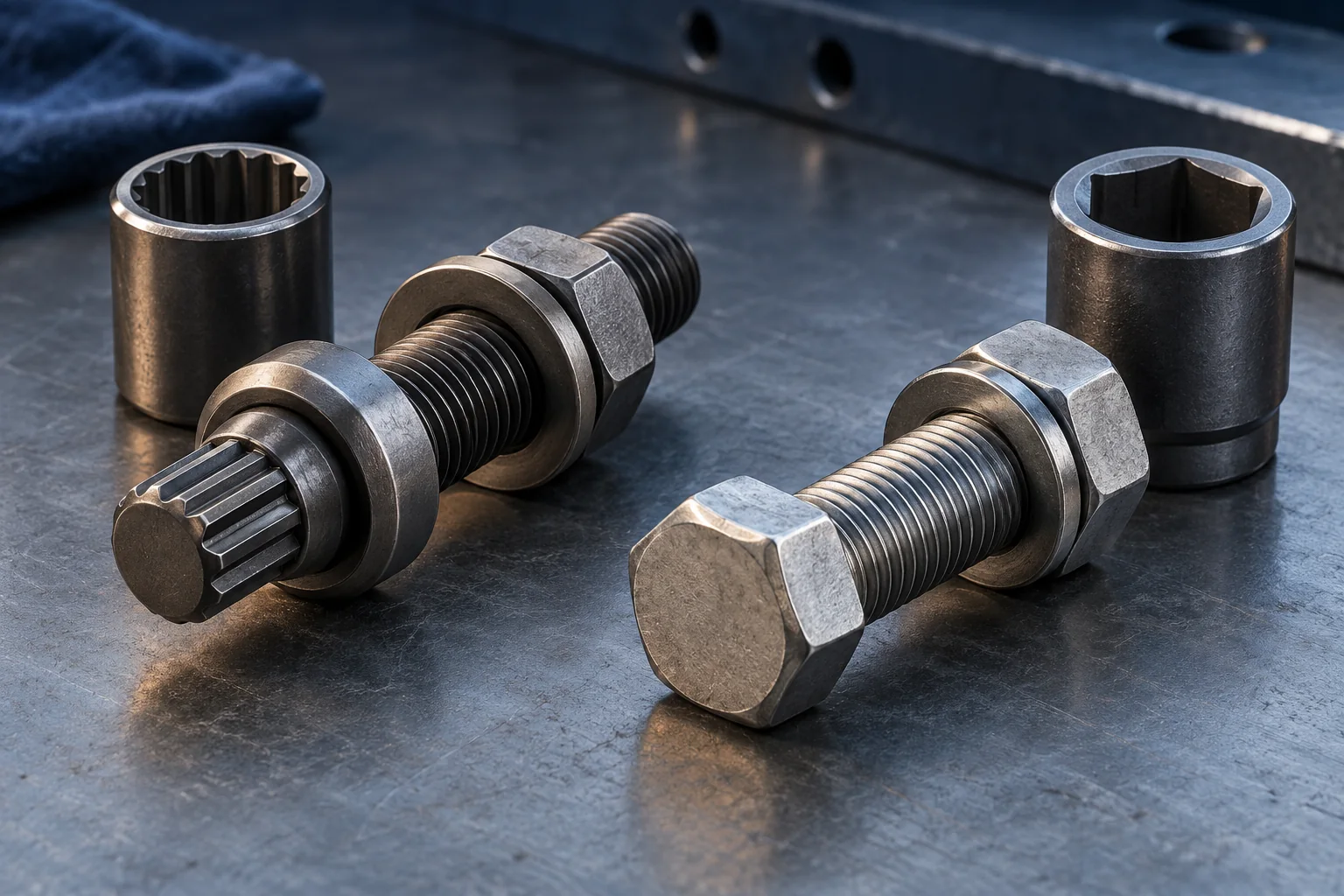
Un conjunto de Grado 144TC tiene un extremo estriado diseñado para separarse durante la instalación mediante el método aplicable de control de tensión por rotura. Es un conjunto aparejado y no una colección libre de componentes intercambiables individualmente. Las características del perno, la tuerca, la arandela, el acabado y la lubricación deben ser compatibles con el sistema de instalación previsto.
Un conjunto de estriado fijo F3148 funciona de forma diferente. Su estriado está diseñado para permanecer unido tras la instalación, y la especificación de producto aplicable describe una disposición de par y ángulo. Por tanto, un conjunto de estriado fijo no puede tratarse como un conjunto de Grado 144TC simplemente porque una llave motorizada acople un estriado en el extremo del perno.
Ni siquiera la forma visible de la cabeza basta para resolver todas las diferencias. El comentario de RCSC reconoce que los conjuntos aparejados de rotura pueden tener cabezas redondas o hexagonales pesadas. En consecuencia, el comprador debe utilizar conjuntamente la designación del producto, la configuración del estriado, las marcaciones pertinentes, la documentación del fabricante y la norma aplicable, en lugar de identificar todo el sistema a partir de una fotografía.
Los Tipo 1 y Tipo 3 son clasificaciones de material, no estilos alternativos
El Grado 144 también tiene clasificaciones de material Tipo 1 y Tipo 3.
Tipo 1 abarca familias especificadas de materiales de acero al carbono y acero aleado, incluidas las composiciones con boro permitidas. Tipo 3 identifica aceros con características de resistencia a la intemperie y resistencia mejorada a la corrosión atmosférica.
El Tipo 3 no es una garantía incondicional de resistencia a la corrosión. La idoneidad real depende de la exposición ambiental, la retención de humedad, los detalles de montaje, el acabado protector y la estrategia de protección contra la corrosión del proyecto. Tampoco la elección del Tipo 3 elimina la necesidad de utilizar las tuercas y arandelas adecuadas.
El comentario de RCSC 2025 explica que, cuando no se especifica un Tipo, el fabricante puede tener discrecionalidad para suministrar cualquiera de los Tipos permitidos. Por tanto, un comprador que requiera una categoría de material concreta debe indicarla explícitamente en lugar de basarse en una suposición sobre lo que normalmente significa “Grado 144”.
La composición química y todos los criterios de aceptación deben verificarse igualmente frente a la edición aplicable de ASTM. La descripción de una familia de materiales por sí sola no es prueba de que un lote de producción concreto cumpla las propiedades químicas o mecánicas exigidas.
En una consulta ilustrativa, la especificación indica únicamente Grade 144 y la cotización ofrece un sistema de spline fijo donde se pretendía un conjunto twist-off. El grupo de resistencia no identificó el producto. Confirme la especificación completa, el estilo y el sistema de instalación antes de comparar componentes o precios. Conserve el assembly identity and supporting records tied to that exact configuration.
¿Qué rango de tamaños cubre ASTM F3125 Grado 144?
ASTM F3125 Grade 144 heavy hex bolts and twist-off assemblies have a published nominal diameter range of 1/2–1-1/4 in. That limit applies to the Grade 144 products described in the published F3125 scope.
It must not be confused with the wider 1/2–1-1/2 in. range published for Grade A325 and Grade A490 heavy hex bolts under the same F3125 family.
This is an important purchasing distinction. A supplier’s general structural-bolt size chart may combine several grades, but a dimension appearing in that chart is not necessarily available or permitted for every grade.
RCSC 2025 also includes tables covering multiple strength groups and nominal diameters. Such a table cannot independently extend the diameter range specified by the ASTM product standard. Product-scope applicability must be established before using a group-level installation or verification value.
Nominal diameter is only one part of dimensional acceptance
Within the permitted range, the buyer must still specify the required bolt length and verify its suitability for the joint.
Structural bolt geometry involves more than a nominal diameter. Important considerations include head dimensions, threaded length, unthreaded shank, grip thickness, washer arrangement, and sufficient thread engagement after installation.
For example, two bolts with the same nominal diameter and overall length may not be appropriate for the same joint if their thread configurations differ. Where the connection design requires threads to be excluded from a shear plane, the position of the threaded portion becomes part of the dimensional selection.
RCSC identifies ASME B18.2.6 as the relevant dimensional standard for these structural bolting configurations, while its provisions for bolt length and thread engagement address installed-joint needs. These are separate from the grade’s basic diameter range. Exact length allowances, thread configurations, and dimensional tolerances should be obtained from the applicable standard and product documentation rather than inferred from a generic catalog illustration.
Hypothetical example: An EPC purchaser receives a request for an ASTM F3125 Grade 144 heavy hex bolt with a nominal diameter of 1-1/2 in. The procurement team notices that 1-1/2 in. bolts appear in other structural bolt listings and assumes this size can also be ordered as Grade 144.
The published F3125 Grade 144 scope does not support that assumption. The requested diameter exceeds the grade’s stated 1-1/4 in. upper limit.
The appropriate response is not to relabel the item as Grade A490, select an F3148 assembly, or approve a different nominal diameter without review. Each would change some aspect of the technical specification. The purchaser should return the discrepancy to the responsible engineer so that a suitable, explicitly approved product specification can be established.
This example illustrates a specification conflict, not a tested product limitation or an approved substitution.
A hypothetical purchaser copies a size from a general A325/A490 chart into a Grade 144 request. The shared F3125 family name does not extend each grade's published range. Check the actual Grade 144 scope before ordering and return any conflict to the engineer. Do not solve an out-of-scope size by silently changing grade or assembly system.
Por qué 144 ksi no completa la especificación de tornillería estructural
A 144 ksi minimum tensile-strength classification describes a mechanical characteristic of the fastener product. It is not the required installed bolt pretension, the allowable tensile load of an assembled joint, or a universal tightening-torque value.
The distinction is fundamental. Product strength is established through the applicable ASTM requirements, while the structural connection must be designed and installed under its governing engineering and project requirements. Connection geometry, loading, pretension requirements, joint type, installation method, and inspection responsibilities cannot be derived from the grade number alone.
The RCSC Especificación para uniones estructurales con pernos de alta resistencia addresses these installed-joint considerations. Its 2025 edition recognizes Group 144 products, but it does not make every Group 144 assembly appropriate for every connection or installation method.
Matching nuts, washers and material Type
The selected nut must satisfy the applicable requirements for the bolt Group, material Type, and coating condition.
RCSC 2025 provides a useful example of how these variables interact. For Groups 144 and 150, its permitted-nut table identifies ASTM A563 Grades DH or DH3 for Type 1 plain-finish bolts, DH for the listed permitted Type 1 coated condition, and DH3 for Type 3 plain-finish bolts. Certain ASTM A194 Grade 2H substitutions are addressed separately.
These are not general permission to mix nut grades, material Types, and finishes. They demonstrate why a buyer needs the exact assembly specification rather than a statement that the nut has sufficient strength.
The washer also has a defined role. RCSC addresses ASTM F436 hardened washers and requires washer Type to correspond to the bolt Type. Other washer configurations, including direct-tension-indicating devices and specialized reaction washers, have their own requirements.
If a supplier proposes different components, the buyer should require confirmation that the complete combination is permitted under the governing requirements. Matching nominal thread size is not enough.
Coating choice can change the acceptable assembly
Grade 144 should not be described simply as either “galvanizable” or “not galvanizable.”
RCSC 2025 allows specified galvanizing arrangements for Grade 144 heavy hex bolting components, subject to the applicable process and assembly requirements. Its rules include requirements for galvanizing methods, nut thread allowances, and compatible components.
However, hot-dip galvanizing is not permitted for spline-end matched bolting assemblies under RCSC 2025, regardless of their Group. This distinction includes the spline-end Grade 144 systems discussed earlier.
Mechanical galvanizing of twist-off and fixed-spline assemblies is subject to manufacturer direction and permission under the respective product specifications. Zinc-flake coatings have a separate requirements framework and must not be assumed interchangeable with hot-dip or mechanical galvanizing.
The engineering reason for these restrictions goes beyond visible corrosion protection. Coating affects thread fit and friction. When nuts are overtapped to accommodate a coating, the effective thread engagement and resistance to stripping must remain adequate. Changes in lubrication and thread friction also affect the relationship between applied torque and developed bolt pretension.
For this reason, coated high-strength bolting components must be evaluated as the appropriate matched assembly rather than as independently finished items assembled without compatibility verification. A buyer specifying a coating should also specify the corresponding permitted nuts, washers, lubrication condition, and required assembly tests or documentation.
Product conformity and installation verification are different evidence
A bolt head marking can help identify the grade and manufacturer, but it cannot establish the complete chemical composition, mechanical test results, or acceptance status of a particular lot.
Likewise, a material test report or a supplier’s declaration should be evaluated for what it actually demonstrates. A report for raw material alone is not automatically evidence that the finished bolt and its assembled mating components satisfy all applicable requirements.
RCSC 2025 requires relevant test reports documenting conformity of bolting components and matched assemblies to be available to the Engineer of Record and Inspector before structural-steel assembly or erection. The applicable product specifications determine the required product tests and acceptance criteria.
Pre-installation verification serves a different purpose. Where required, it checks the behavior of representative bolting assemblies with the specified installation method and conditions. It does not replace the manufacturer’s product conformity evidence, and a product test report does not eliminate the project’s applicable installation verification.
The buyer should therefore distinguish three questions: Is the delivered product correctly identified? Does the documentation establish conformity to the applicable product and assembly requirements? Has the installed joint been verified according to the governing project requirements?
Those questions are related, but they are not interchangeable.
Comprobaciones de compra y recepción del Grado 144
The safest way to purchase Grade 144 bolting is to convert the engineering decision into an order that uniquely identifies the required product and assembly.
A useful Grade 144 RFQ should establish the following information:
- Governing standard and edition. State ASTM F3125/F3125M and the project-required edition, or ASTM F3148 where the engineer actually specifies that separate fixed-spline system. Identify any applicable RCSC edition and additional project requirements.
- Grade, Type and style. Specify Grade 144, Type 1 or Type 3, and the required heavy hex, Grade 144TC twist-off, or F3148 fixed-spline configuration. A request containing only “Grade 144” is insufficient to identify the intended assembly.
- Exact dimensions and configuration. Give the nominal inch diameter, required length, applicable thread and head configuration, and any restrictions on thread position or engagement established by the connection design. Check the diameter against the published grade scope before requesting pricing.
- Finish and coating. State whether the required assembly is plain or coated and identify the coating process and applicable specification. For a coated product, confirm its compatibility with the selected Grade 144 configuration rather than assuming permission transfers between styles.
- Mating components. Specify the required nuts and washers, including their applicable standards, grades, Types, and finish conditions. For matched assemblies, define the complete supply arrangement and any required manufacturer-controlled components.
- Inspection and documentary requirements. Identify required product test reports, lot or batch traceability, relevant marking verification, coating or assembly test evidence, and any additional inspection or acceptance documentation required by the contract. Distinguish the project’s requirements from optional documents requested for purchasing convenience.
- Quantity and delivery scope. State the required quantity and whether the order covers individual heavy hex bolts, complete matched bolting assemblies, or separately specified components. Confirm the precise supply scope and available documentation before finalizing the purchase order.
For receiving inspection, the purchasing description should be compared with the delivered product markings, packaging identification, component configuration, coating condition, and traceable documentation. A report bearing the right standard number is not enough if it describes a different grade, Type, assembly or production lot.
Physical inspection should also check for obvious discrepancies between the ordered and delivered configuration. A fixed spline presented as a twist-off assembly, an unapproved coating, or a bolt outside the specified dimensional scope should be identified before the parts enter the installation process.
Where a discrepancy exists, the appropriate response is to isolate the affected material for technical and contractual disposition. Receiving personnel should not independently approve a substitute structural fastener simply because the strength designation appears similar.
For an unfamiliar Grade 144 source, supplier verification should establish whether the manufacturer can supply the exact specified configuration and provide the required conformity evidence. Catalog information from another manufacturer may help explain product categories, but it cannot prove that a particular supplier’s Grade 144 bolts have been manufactured, tested, or approved.
The broader purchasing objective is straightforward: a Grade 144 designation is useful only when it leads to an identifiable product that matches the engineering specification and can be verified at delivery. When the style, size, Type, finish or documentary basis remains unresolved, those uncertainties should be settled before issuing the order.
Technical source basis: ASTM’s published scope pages for F3125/F3125M-23, F3125/F3125M-25y F3125/F3125M-26; the published scope of ASTM F3148-17a(2024); and the RCSC 2025 Specification for Structural Joints Using High-Strength Bolts, especially its provisions on Group designations, matching components, dimensions, coatings, test reports and installation verification. Detailed product acceptance against a particular ASTM edition requires the applicable controlled requirements and lot-specific evidence.
Preguntas frecuentes
¿Son F3125 Grado 144TC y F3148 el mismo producto?
No. Identifican sistemas de montaje diferentes. Confirme la configuración de rosca desprendible (twist-off) frente a la de spline fijo y los requisitos aplicables del producto y de instalación.
¿Se aplica el rango de tamaños F3125 A325 al grado 144?
No. Consulte el alcance publicado específico de cada grado. Un catálogo o una tabla de instalación multigrado no amplía la gama de productos.
¿Se introdujo por primera vez el grado 144 en la norma F3125 en 2026?
No. El alcance publicado de 2025 ya lo incluía. Utilice la edición aplicable al pedido y verifique por separado el estilo de producto previsto.