Existe otra distinción que importa al realizar un pedido: un tornillo hexagonal pesado general y un tornillo hexagonal pesado estructural no están necesariamente dimensionados según la misma norma. Para elementos de fijación de serie en pulgadas de EE. UU., ASME B18.2.1 abarca los productos hexagonales y hexagonales pesados generales, mientras que ASME B18.2.6 se refiere a elementos de fijación estructurales designados. También deben identificarse el grado de producto aplicable y la especificación de la conexión.
Por tanto, una comparación correcta implica más que decidir qué cabeza parece más grande. El comprador debe comprobar las dimensiones reales de la cabeza, la norma dimensional aplicable, el grado de producto requerido y si un tornillo diferente encajará y funcionará según lo previsto en el conjunto.
Cómo difieren las dimensiones de cabeza hexagonal pesada y hexagonal estándar
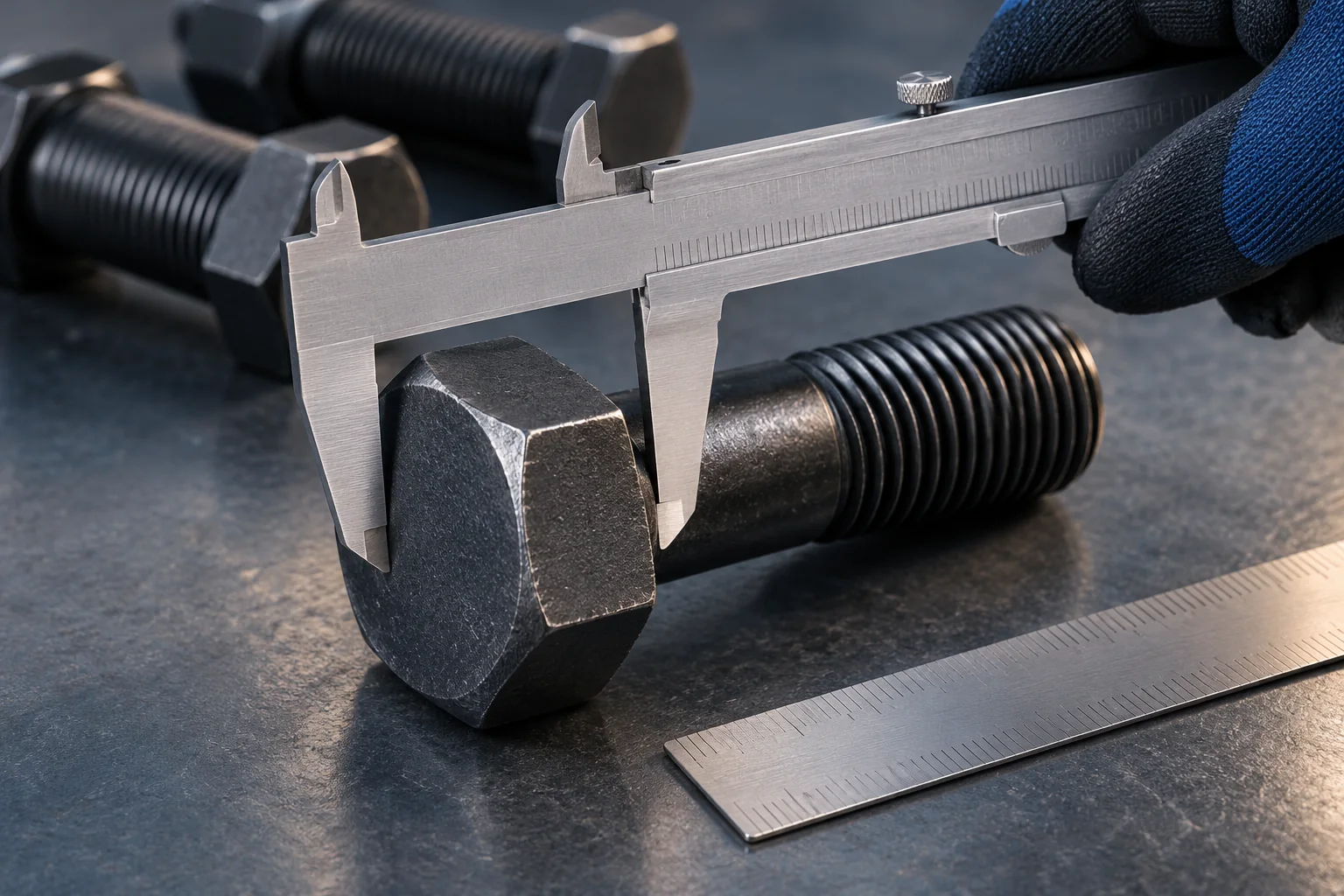
La diferencia más reconocible es el ancho entre caras de la cabeza, a menudo abreviado como AF. Es la distancia entre dos caras planas opuestas del hexágono y es la dimensión que se utiliza para identificar la abertura de llave correspondiente.
Para varios diámetros nominales comunes de la serie en pulgadas, una cabeza hexagonal pesada tiene un ancho entre caras básico 1/8 inch (0.125 in) mayor que una cabeza hexagonal estándar. El diámetro nominal sigue refiriéndose al vástago roscado del tornillo, no a su cabeza.
Los siguientes valores ilustran la diferencia.
| Diámetro nominal del perno | AF estándar hexagonal (in) | AF general hexagonal pesado (in) | AF estructural hexagonal pesado (in) |
|---|---|---|---|
| 1/2 in | 0.750 | 0.875 | 0.875 |
| 3/4 in | 1.125 | 1.250 | 1.250 |
| 1 in | 1.500 | 1.625 | 1.625 |
Base dimensional: dimensiones de referencia publicadas en ASME B18.2.1 para productos hexagonales generales, contrastadas con las dimensiones de referencia estructurales hexagonal pesado identificadas en ASME B18.2.6-2019. Los valores son dimensiones básicas/de referencia entre caras (AF), no límites completos de tolerancia de fabricación ni una tabla de inspección de recepción. La edición aplicable de la norma y el plano del producto rigen la aceptación.
Para un perno de 3/4 de pulgada, el ancho de referencia hexagonal estándar es 1.125 pulgadas, mientras que el ancho hexagonal pesado es 1.250 pulgadas. Esa diferencia requiere una abertura de llave distinta, aunque ambos pernos puedan tener el mismo diámetro nominal de vástago.
La distinción cobra importancia cuando el perno está próximo a una carcasa, un elemento estructural, un soporte de tubería u otro elemento de fijación. Una cabeza hexagonal pesada puede caber en el espacio disponible dejando demasiado poco sitio para la herramienta de instalación.
Es necesario prestar atención por separado a tres dimensiones:
Ancho entre caras determina la abertura nominal de la llave. Una herramienta hexagonal estándar puede no encajar en la cabeza hexagonal pesada más ancha, incluso cuando el diámetro del perno y la rosca coinciden.
Ancho entre esquinas es la envolvente diagonal máxima del hexágono. Es importante al comprobar la holgura cerca de componentes adyacentes o al permitir que una llave de vaso pase a un espacio confinado. El diámetro exterior de la llave de vaso puede requerir bastante más espacio que la propia cabeza del perno.
Altura de la cabeza determina el espacio axial ocupado por la cabeza e influye en el acceso para una herramienta adecuada. No debe inferirse simplemente de la palabra pesada.
Una cabeza hexagonal pesada no siempre es más alta
Una mayor dimensión entre caras no significa que todas las cabezas hexagonales pesadas tengan mayor altura.
For example, published reference dimensions for 3/4-inch standard hex and general heavy hex products both give a head-height range of 0.455–0.524 inches. A corresponding ASME B18.2.6-2019 heavy hex structural reference gives 0.455–0.483 inches.
Estos valores ilustran una distinción importante: los pernos hexagonales pesados generales y los pernos estructurales hexagonales pesados pueden compartir el mismo ancho entre caras básico aunque tengan límites de altura de cabeza diferentes.
Los rangos son datos de referencia para las categorías de producto y ediciones especificadas, no tolerancias universales para todos los elementos de fijación de cabeza hexagonal.
Por ello, una especificación de compra debe identificar el estilo exacto de cabeza y la norma dimensional en lugar de solicitar una “cabeza hexagonal grande” o suponer que cualquier perno hexagonal pesado cumple las dimensiones estructurales.
ASME B18.2.1 frente a B18.2.6: ¿qué norma se aplica?
Las dos normas cubren ámbitos de producto diferentes, y esta distinción afecta tanto a los requisitos de fabricación como al aprovisionamiento.
ASME B18.2.1: Productos hexagonales generales de la serie en pulgadas
ASME B18.2.1-2012 (R2021) abarca las dimensiones de varios tipos de pernos y tornillos cuadrados y hexagonales, incluidas las configuraciones hexagonales generales y hexagonales pesadas.
Proporciona un marco dimensional para identificar los tipos de producto pertinentes y sus requisitos dimensionales de cabeza, cuerpo y relacionados.
No obstante, la especificación debe seguir identificando la forma de producto prevista. Un perno hexagonal y un tornillo hexagonal de cabeza no deben tratarse automáticamente como idénticos solo porque ambos tengan cabezas de seis caras.
No debe suponerse que un perno hexagonal pesado general dimensionado según B18.2.1 cumple todos los requisitos dimensionales de un perno estructural hexagonal pesado según B18.2.6.
ASME B18.2.6: Pernos estructurales hexagonales pesados
ASME B18.2.6-2019 abarca los elementos de fijación estructurales designados, incluidos los pernos estructurales de cabeza hexagonal pesada y los componentes de fijación estructural relacionados dentro de su alcance declarado.
Sus requisitos para pernos estructurales deben aplicarse a la categoría de producto correcta. La altura de cabeza, la configuración del perno y las disposiciones de longitud de rosca pueden diferir de los correspondientes productos generales de cabeza hexagonal pesada.
For an engineer reviewing replacement hardware, this matters beyond the visible head width. A replacement may accept the correct wrench but have a different threaded portion or other dimensional feature that affects the specified assembly.
The dimensional standard is only one part of the product identity. It does not establish the material’s tensile strength, the specified bolt grade, or the installed joint’s required pretension.
ASTM F3125 and RCSC have different responsibilities
For applicable high-strength structural bolts, ASTM F3125/F3125M addresses product requirements, including the relevant grade, type, style, and mechanical or material characteristics within its scope.
The ASTM F3125/F3125M-26 standard catalog identifies structural bolt product categories including Grade A325 and Grade A490. Where that edition is applicable, the precise product classification still matters. A head described as heavy hex does not independently establish its ASTM grade or type.
RCSC’s 2025 Especificación para uniones estructurales con pernos de alta resistencia addresses the design, installation, and inspection of qualifying structural bolted joints.
These documents should not be substituted for one another:
- The ASME dimensional standard establishes the relevant bolt geometry.
- The ASTM product specification establishes applicable requirements for the specified fastener product.
- The RCSC specification governs qualifying structural connections, including relevant installation and inspection provisions.
A purchase order may need all three levels of identification, depending on the application. Passing a head-dimension check alone is not proof that a bolt meets the required ASTM product specification or that its installation satisfies the joint design.
The applicable editions should come from the governing project documents. The latest published edition is not automatically the edition incorporated into an existing contract.
¿Una cabeza hexagonal pesada hace más resistente un tornillo?
Not necessarily. A larger hex head does not establish a higher tensile-strength grade or greater allowable bolt load.
Bolt tensile behavior is associated with properties such as the specified material and mechanical grade, the effective tensile-stress area, and the requirements of the applicable product specification. The width of the wrenching head is not a substitute for those properties.
A wider head can change the geometry of the bearing interface. Depending on the actual under-head bearing surface, washer arrangement, and mating material, this may affect how compressive contact forces are distributed.
But a larger head does not guarantee lower bearing stress throughout the entire joint. The effective contact area depends on the actual surfaces in contact, not simply the hexagon’s overall width.
The same limitation applies to bolt pretension.
Pretension is produced by the specified installation process and the resulting bolt elongation. It is affected by the fastener assembly, joint conditions, and installation method. Increasing the head width alone does not establish a higher pretension.
For a structural connection requiring pretension, the installation and verification method must follow the applicable project and RCSC requirements. A wider head or a larger wrench cannot replace those requirements.
Consider two bolts with matching nominal diameters but different head styles. If their product grades, material requirements, or specified assembly conditions differ, their suitability cannot be established by comparing head dimensions. Conversely, two bolts with similar mechanical-strength designations are not necessarily interchangeable if their geometric or assembly requirements differ.
The useful engineering distinction is that head geometry affects tool engagement and local fit, while product grade and the complete connection design determine whether the bolt is acceptable for the intended service.
A hypothetical buyer selects a wider head to obtain a stronger bolt while leaving the product grade unspecified. Head geometry cannot establish material or mechanical conformity. Define the required grade separately, confirm the dimensional product standard and review the mating parts. The bolt-grade guide is background for the grade terminology, not approval of the proposed joint.
Cuándo utilizar tornillos hexagonales pesados o estándar
The correct selection begins with the assembly specification, not the assumption that one head style is universally better.
For general mechanical equipment, a standard hex bolt or hex cap screw may be suitable when it satisfies the specified product requirements and provides the required installation access. Its smaller head envelope can be useful where fasteners are close to surrounding equipment, guards, brackets, or other components.
This does not mean a standard hex bolt is appropriate for every mechanical connection, or that it is inherently weaker than a heavy hex bolt. The specified grade, dimensions, and service requirements remain decisive.
Heavy hex bolts are relevant where the equipment specification, original design, or mating hardware calls for that geometry. Their wider heads require a corresponding wrench or socket, and the surrounding structure must provide adequate installation clearance.
For structural steel connections requiring heavy hex structural bolts, selection is more restrictive. The engineer and buyer must confirm the specified structural bolt product, applicable grade and style, dimensional requirements, and compatible assembly components.
It is not sufficient to replace a specified structural bolt with a general-purpose heavy hex bolt solely because both use the same nominal diameter and wrench size.
Example: A 3/4-inch replacement bolt in a confined assembly
Illustrative hypothetical example — not a SUNHY customer installation or test result.
Suppose a machine assembly originally uses a 3/4-inch standard hex bolt with a 1.125-inch basic across-flats head width. A replacement supplier proposes a 3/4-inch heavy hex bolt with a 1.250-inch basic across-flats width.
The nominal diameter remains 3/4 inch, but the head is 0.125 inch wider across flats.
That creates an immediate tooling difference. The original 1-1/8-inch nominal wrench opening is not appropriate for the proposed 1-1/4-inch heavy hex head.
If the bolt is recessed or near another component, the installer must also check the outside diameter of the larger socket and the space needed to position and operate it. The 0.125-inch difference between basic across-flats dimensions is not itself the total additional installation clearance required.
There is a second, less visible question: does the proposed replacement satisfy the original bolt’s product and dimensional requirements?
The buyer would need to compare the material or product grade, thread series and class, required threaded length, applicable dimensions, and any relevant washer or nut requirements. If the original bolt belongs to a structural connection, the governing structural design and substitution approval requirements also apply.
The example demonstrates why a replacement can appear dimensionally similar at the threaded shank while still being unsuitable for the original installation.
The same reasoning works in reverse. Replacing a specified heavy hex structural bolt with a smaller standard hex bolt should not be approved merely because it passes through the same bolt hole.
Qué verificar antes de una sustitución o compra
An RFQ that requests only “3/4-inch hex bolts” leaves the supplier to infer several important specifications.
The order should establish the required fastener identity before price or availability is compared.
For a general hex or heavy hex fastener, the essential information includes the nominal diameter, thread series and class, bolt length, head style, governing dimensional standard and edition, and applicable material or mechanical grade.
Where the head geometry is important to installation, the buyer should identify the required across-flats dimension or provide the applicable controlled drawing. A drawing becomes particularly useful for restricted-access assemblies or replacements involving older equipment.
For heavy hex structural bolts, the specification should also identify the relevant ASTM F3125 grade, type and style as applicable, together with the project-governing structural bolting requirements.
Nuts and washers must be considered as part of the specified assembly, not selected only because their nominal threads appear to match. Coating, thread fit, and lubrication requirements may also affect whether the supplied components form an acceptable assembly.
These considerations become especially important for coated structural fasteners, where the governing product and installation requirements may address compatible nuts, washers, and preparation conditions.
What should the buyer request for inspection?
The inspection requirements should follow the purchase specification rather than an arbitrary list of documents.
Relevant evidence may include dimensional inspection records, material or mechanical-test documentation, manufacturer identification, product marking verification, and records supporting the required batch or lot traceability.
A certificate of conformity, material test report, dimensional inspection record, and installed-joint inspection report serve different purposes. None automatically replaces the others.
For example, a report identifying a steel heat does not by itself establish that finished bolt heads comply with the specified dimensional tolerances. Similarly, a compliant finished product does not prove that the installed structural joint received the required pretension.
Before accepting a proposed substitute, the engineer or buyer should be able to answer a few concrete questions: Does the new bolt comply with the specified dimensional standard? Does its product grade meet the governing requirements? Is the head and thread configuration correct? Can the existing tools and mating components accommodate it? If the assembly is structurally controlled, has the substitution been reviewed under the applicable design and project requirements?
If any of these questions remain unresolved, matching nominal diameter alone is not an adequate basis for approval.
For buyers preparing a structural-bolt RFQ, SUNHY’s Structural Bolts product category provides the relevant commercial starting point. Supply scope, required grades, actual dimensions, and supporting documentation should be confirmed against the specific inquiry rather than inferred from a general technical article.
When requesting a dimensional or purchasing review, provide the governing specification, required head style, bolt size and length, product grade, coating, quantity, and any available assembly drawing. This gives the supplier enough information to identify potential dimensional or specification conflicts before an order is placed.
Preguntas frecuentes
¿Una cabeza hexagonal pesada implica mayor resistencia?
El tamaño de cabeza es dimensional. El grado de material y mecánico, la especificación de producto aplicable y los registros de soporte establecen requisitos independientes.
¿La cabeza hexagonal pesada es siempre más alta?
No lo dé por supuesto. Compare los límites dimensionales aplicables para el producto, tamaño y norma exactos; la anchura y la altura no varían de forma idéntica.
¿Pueden los tornillos hexagonales estándar y los de cabeza hexagonal pesada compartir la misma llave de vaso?
Compruebe las dimensiones reales entre caras. Un diámetro nominal de rosca igual no garantiza el mismo tamaño de llave ni el mismo espacio libre de instalación disponible.