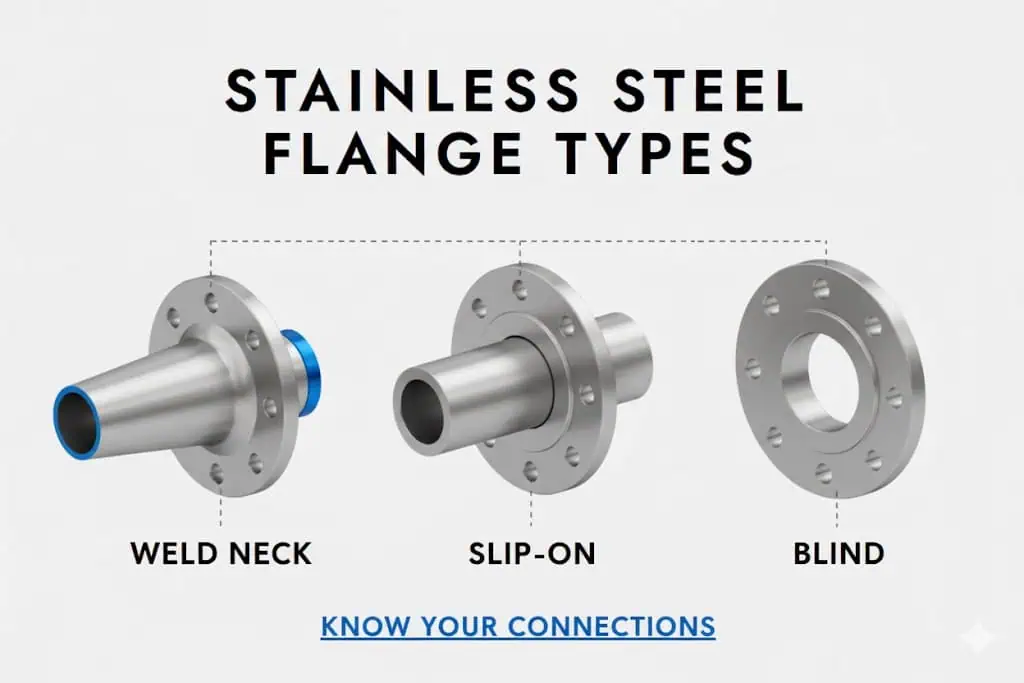
Stainless steel flange types mainly include weld neck, slip-on, socket weld, threaded, blind, lap joint, and orifice flanges. In some high-pressure systems, you may also encounter ring-type joint facing configurations used with flanges designed for RTJ sealing. The right choice depends on pressure, temperature, corrosion exposure, maintenance needs, and whether welding is acceptable.
If you are selecting a flange for a project, focus on four points first: service pressure and temperature, fluid corrosiveness, assembly method, and maintenance access. From an engineering review standpoint, flange selection should start with service conditions rather than price alone, because a lower-cost flange can become the more expensive option if it increases leakage risk, rework, or shutdown frequency. This guide explains the main stainless steel flange types, where each works best, and how to choose the right option for your piping system.
- Weld neck flange
- Slip-on flange
- Socket weld flange
- Threaded flange
- Blind flange
- Lap joint flange
- Orifice flange
- Ring-type joint facing configuration
If you need product-level detail after this overview, see our stainless steel flange range, including weld neck flanges for critical service, slip-on flanges for general piping, blind flanges for isolation duty, and lap joint flanges for maintenance-focused systems.
Stainless steel flange types
What is a flange?
A flange is a mechanical connection point used to join pipes, valves, pumps, and pressure equipment. It creates a bolted joint that can be assembled, inspected, disassembled, and maintained more easily than a permanently welded section alone. In industrial piping, flange selection affects sealing performance, mechanical reliability, inspection access, and long-term maintainability.
Why stainless steel?
Stainless steel offers a practical balance of corrosion resistance, mechanical strength, and long service life. That is why stainless steel flange types are widely used in water systems, food and beverage lines, chemical processing, marine service, pharmaceutical production, and many general industrial applications.
- Good corrosion resistance for wet, chemical, and washdown environments
- Reliable strength for pressure-containing assemblies
- Cleanable surfaces suitable for sanitary and process applications
- Longer service life in many corrosive environments than lower-grade alternatives
Tip: 304 and 304L are often used for general industrial service, while 316 and 316L are commonly chosen where chlorides, seawater splash, or more aggressive media are involved.
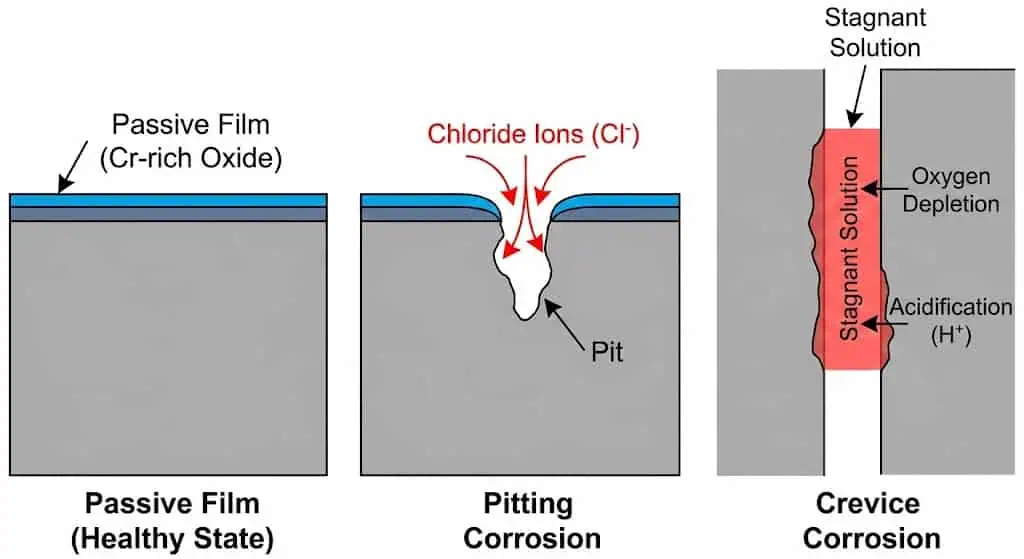
Material selection should also reflect the actual water chemistry or process medium. In practice, chloride-containing environments are treated more cautiously because localized corrosion risk can increase with chloride level, temperature, retained moisture, and crevice conditions. That is one reason 316 or 316L is often evaluated earlier than 304 or 304L in coastal, washdown, or more aggressive process service.
Reference reading: Nickel Institute guidance on stainless steel corrosion in naturally occurring waters.
| Standard | What It Covers |
|---|---|
| ASME B16.5, ASTM A182/A182M | Dimensions, pressure-temperature ratings, materials, and basic requirements for common forged flanges |
| DIN, EN 1092-1 | Dimensions, tolerances, facings, and marking requirements for European applications |
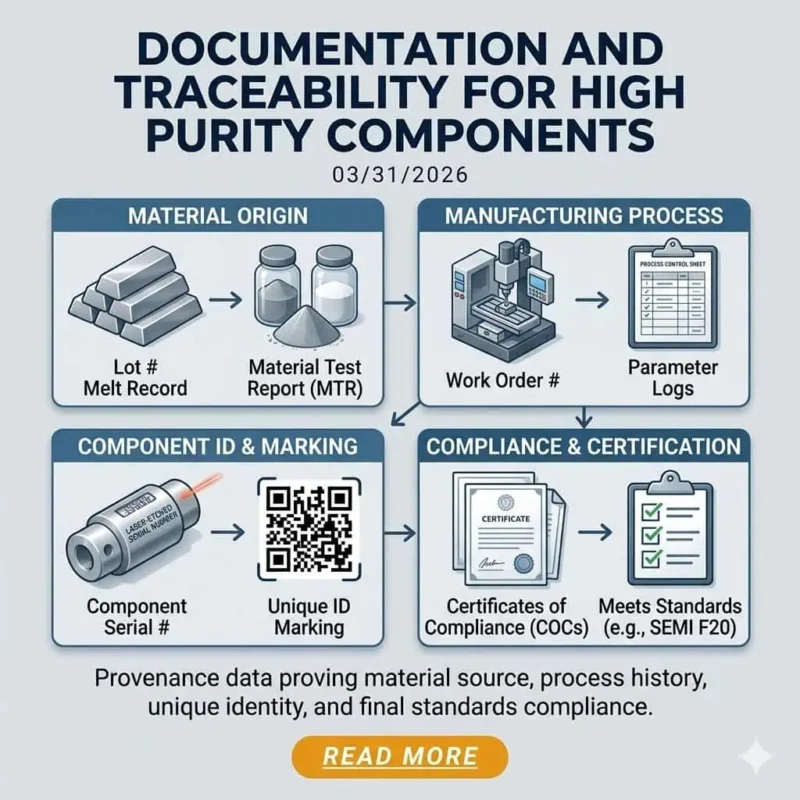
Engineering view: When evaluating a supplier, confirm applicable standards, material traceability, test documentation, and dimensional control before purchase. These factors usually matter more than broad marketing claims when a flange will be used in pressure-containing service.
Understanding the main types of stainless steel flanges helps you choose the right design for your project. When the flange type matches the service conditions, the joint is easier to assemble correctly and more likely to remain reliable over time.
Main types of stainless steel flanges
Weld neck flange
Weld neck flanges provide the highest strength and the best stress distribution among the most common flange types.
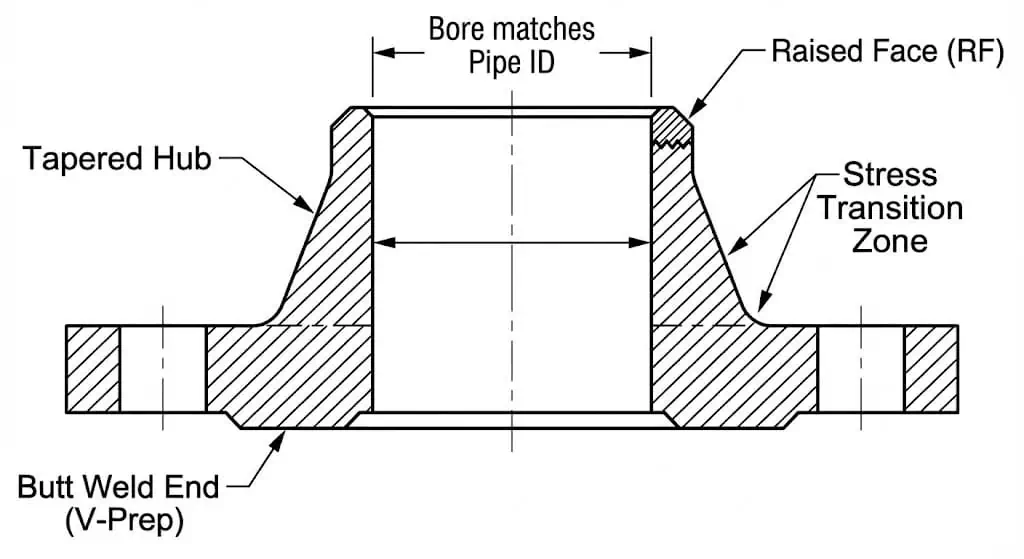
You can recognize a weld neck flange by its long tapered hub and butt-weld end. This design reduces stress concentration at the pipe-to-flange transition and creates a stronger joint than simpler welded flange designs. That is why weld neck flanges are commonly used in oil and gas, power generation, chemical processing, and other higher-class piping systems.
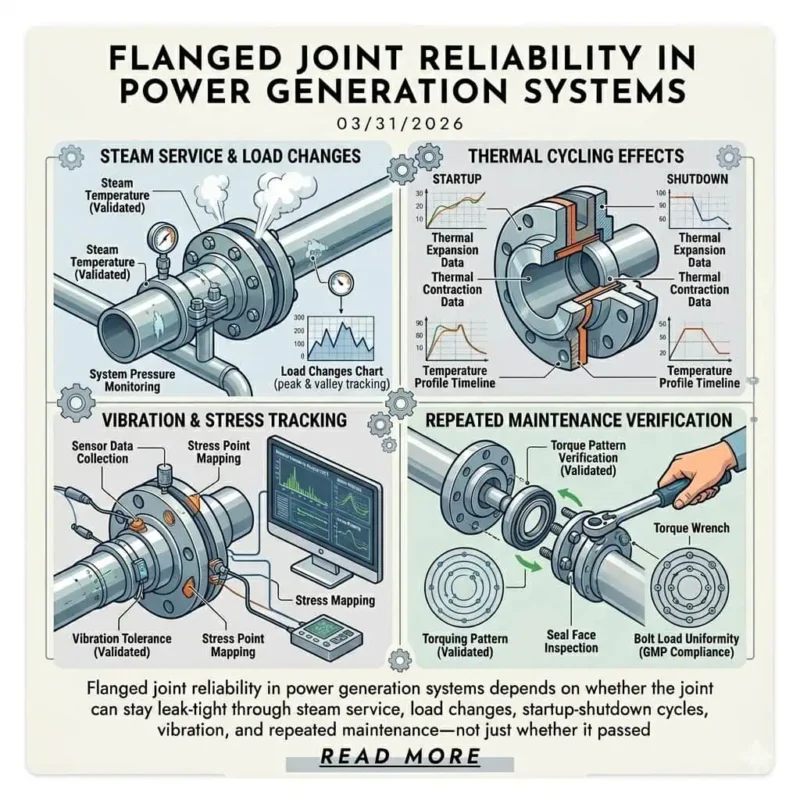
Engineering note: In practice, weld neck flanges are often preferred when the line may experience pressure cycling, thermal fluctuation, or higher bending stress near the flange-to-pipe transition. The tapered hub helps reduce local stress concentration, which is one reason weld neck flanges are widely used in more demanding service.
Field example: In higher-severity steam and process utility systems, engineers often move from slip-on to weld neck flanges when startup-shutdown cycles, vibration, or alignment stresses suggest that long-term joint stability matters more than lower fabrication cost.
| Feature | Description |
|---|---|
| Tapered neck design | Improves stress distribution and load transfer |
| Butt-weld connection | Suitable for higher-integrity fabrication |
| Pressure resistance | Handles high pressures and elevated temperatures |
| Material grades | 304, 304L, 316, 316L |
| Standards | ASME, ASTM, DIN, EN 1092-1 |
Typical applications:
- High-pressure pipelines
- Steam systems
- Cryogenic and corrosive environments
Main advantages:
- Superior strength and durability
- Excellent leak resistance
- Better stress control than simpler flange types
Main limitation:
- Requires proper butt welding, alignment, and inspection
For more detail, see our guide to weld neck flanges for critical service.
Slip-on flange
Slip-on flanges offer easier installation and lower fabrication cost for low- to moderate-pressure systems.
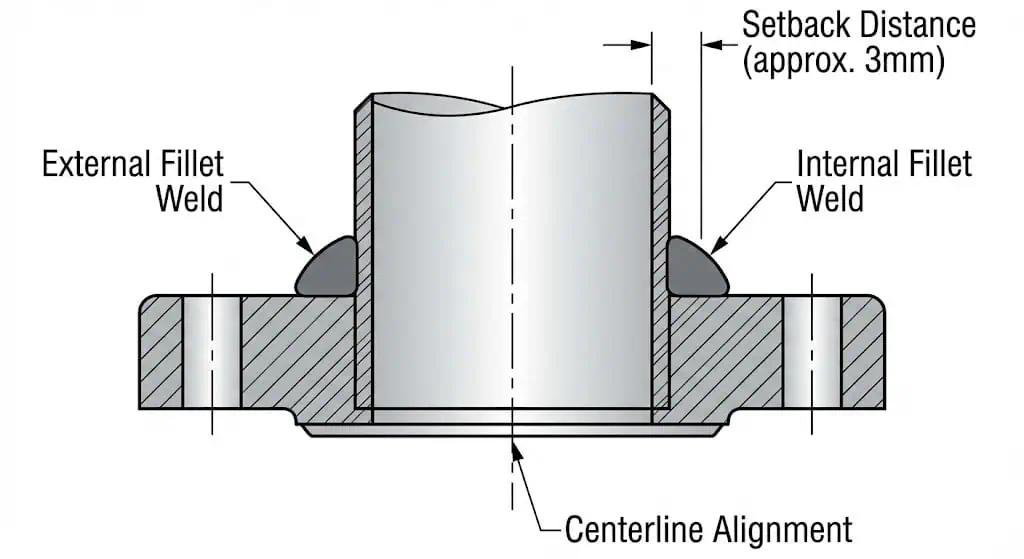
You slide the flange over the pipe and weld it in place, which simplifies fit-up and reduces installation time. Slip-on flanges are common in water treatment, HVAC, fire protection, food processing, and other moderate-duty systems where maximum joint strength is not the primary requirement.
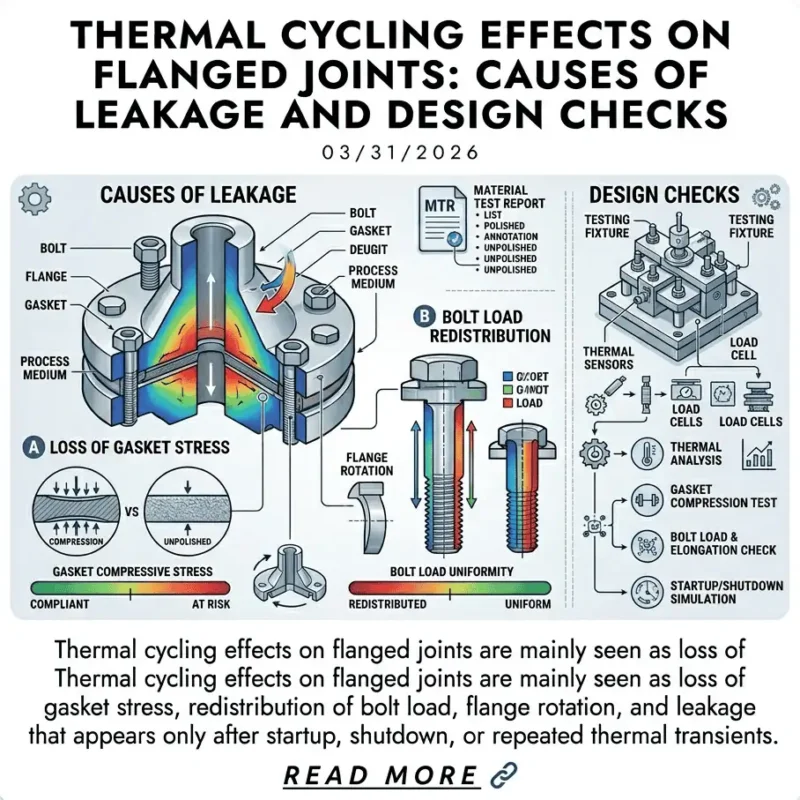
Selection caution: Slip-on flanges are widely used in lower-severity plant piping, but they are not usually the first choice where fatigue, thermal cycling, or higher structural loading is expected. In those services, the short-term fabrication savings may not offset the longer-term reliability tradeoff.
| Characteristic | Description |
|---|---|
| Design | Slides over pipe and is welded in place |
| Installation | Easier alignment than weld neck in many shop conditions |
| Applications | Low- to moderate-pressure piping |
| Material grades | 304, 304L, 316, 316L |
| Standards | ASME, ASTM, DIN, EN 1092-1 |
Typical applications:
- Municipal water systems
- Industrial piping
- Marine and agricultural utility systems
Main advantages:
- Cost-effective
- Simple installation
Main limitation:
- Less suitable for high-pressure, high-temperature, or severe cyclic service
If you are weighing lower fabrication cost against long-term mechanical performance, read our slip-on flange overview for general piping systems.
Socket weld flange
Socket weld flanges are best for small-diameter, high-pressure piping where a compact welded connection is needed.
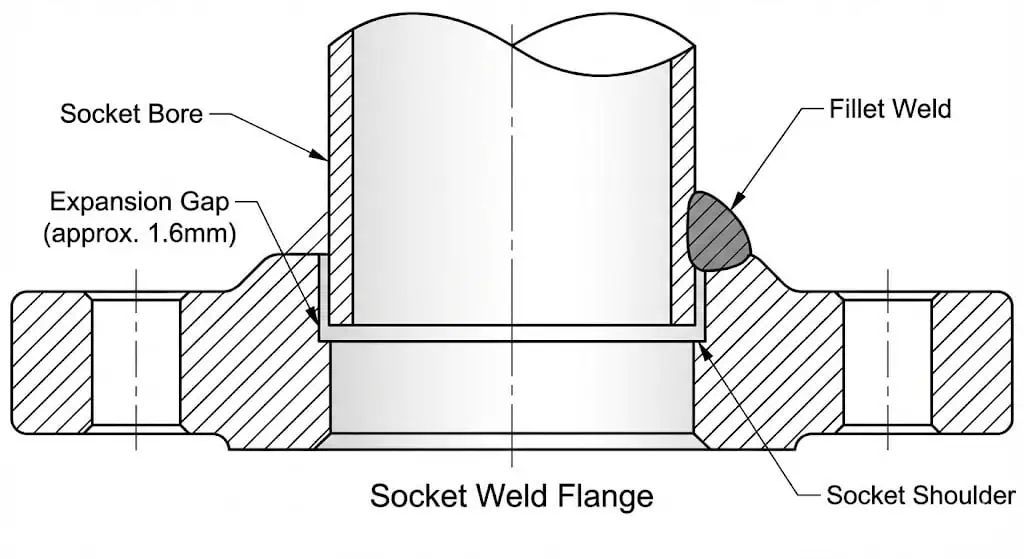
You insert the pipe into the flange socket and secure it with a fillet weld. This creates a strong joint for smaller pipe sizes and is common in hydraulic, chemical, petrochemical, and other compact high-pressure systems.
Engineering note: Socket weld flanges can be a practical choice when space is limited and the pipe size is small, but they are generally evaluated more carefully in services where crevice-related cleanliness concerns or repeated thermal cycling may matter.
| Advantage | Description |
|---|---|
| Compact design | Useful where space is limited |
| Strong mechanical bond | Fillet weld adds strength and vibration resistance |
| Ideal for small pipes | Usually selected for smaller diameter service |
| Material grades | 304, 304L, 316, 316L |
| Standards | ASME, ASTM, DIN, EN 1092-1 |
Typical applications:
- High-pressure hydraulic lines
- Chemical processing
- Compact piping systems
Main advantages:
- Strong, leak-resistant connection for small-bore lines
- Efficient installation for compact systems
Main limitation:
- Not preferred for large-diameter pipes
See our socket weld flange page if your project involves compact high-pressure connections.
Threaded flange
Threaded flanges allow for quick, weld-free connections in small-diameter systems where hot work is restricted.
You screw the flange onto the pipe, which can simplify installation in hazardous or flammable environments. Threaded flanges are often used in oil and gas, chemical, and water treatment applications where welding is not practical. Reference thread standard: ASME B1.20.1.
Practical view: Threaded flanges are useful when no-hot-work installation is important, but they are normally treated with caution in lines exposed to severe vibration, impact, or repeated thermal expansion and contraction.
| Feature/Application | Description |
|---|---|
| No welding required | Easy installation and removal |
| Pressure suitability | Usually used in moderate to high-pressure small-diameter piping |
| Maintenance friendly | Useful for systems needing disassembly |
| Material grades | 304, 304L, 316, 316L |
| Standards | ASME, ASTM, DIN, EN 1092-1 |
Typical applications:
- Hazardous environments
- Temporary or removable connections
- Industrial utility piping
Main advantages:
- Quick installation
- No welding required
Main limitation:
- Not ideal for high temperatures, severe vibration, or bending stresses
See our threaded flange page for weld-free connection options.
Blind flange
Blind flanges seal the end of a pipe, nozzle, or vessel opening for isolation, testing, or future tie-in.
You use blind flanges to close off piping systems, perform pressure tests, or reserve future connections. Because blind flanges contain full internal pressure without a bore, thickness, bolting, and gasket selection matter more than many buyers first expect.
Engineering reminder: Blind flanges are not just closure plates. In pressure-containing service, thickness, bolting pattern, gasket compatibility, and preload control all affect whether the isolation point remains reliable during testing and shutdown conditions.
| Benefit | Description |
|---|---|
| Maintenance access | Quick removal for inspection or repairs |
| System isolation | Safely isolates pipeline sections |
| Pressure testing | Closes pipeline for pressure checks |
| Material grades | 304, 304L, 316, 316L |
| Standards | ASME, ASTM, DIN, EN 1092-1 |
Typical applications:
- Pipeline plugging and system isolation
- Pressure testing
- Future spare interfaces
Main advantages:
- Provides a secure, leak-resistant seal
- Simplifies maintenance and commissioning
Main limitation:
- Adds weight and is not a flow connection
For line isolation and shutdown planning, review our blind flange selection guide.
Lap joint flange
Lap joint flanges provide easy bolt alignment and simplify repeated assembly and disassembly.
You use lap joint flanges with a stub end, allowing the backing flange to rotate freely for easier alignment. They are commonly reviewed in systems that require frequent maintenance, easier fit-up, or lower-cost backing flanges with corrosion-resistant wetted components.
Case perspective: In maintenance-oriented process systems, lap joint arrangements are sometimes reviewed where repeated opening, alignment efficiency, and easier reassembly matter more than maximum joint rigidity. They are less commonly the first choice in services where sealing severity and rigidity dominate the decision.
| Unique Features | Typical Applications |
|---|---|
| Rotates freely for easy alignment | Systems needing frequent maintenance |
| Used with stub end | Corrosive environments with replaceable wetted ends |
| Easy to maintain and connect | Cost-sensitive installations |
| Useful in tight spaces | Piping with alignment constraints |
| Material grades | 304, 304L, 316, 316L |
| Standards | ASME, ASTM, DIN, EN 1092-1 |
Typical applications:
- Removable connections for maintenance
- Temporary or frequently modified piping
- Marine and offshore systems
Main advantages:
- Quick bolt-hole alignment
- Simplifies assembly and disassembly
Main limitation:
- Not usually the first choice for severe pressure sealing duty
If your project includes frequent dismantling or alignment-sensitive installation, see our lap joint flange guide for maintenance-focused systems.
Orifice flange
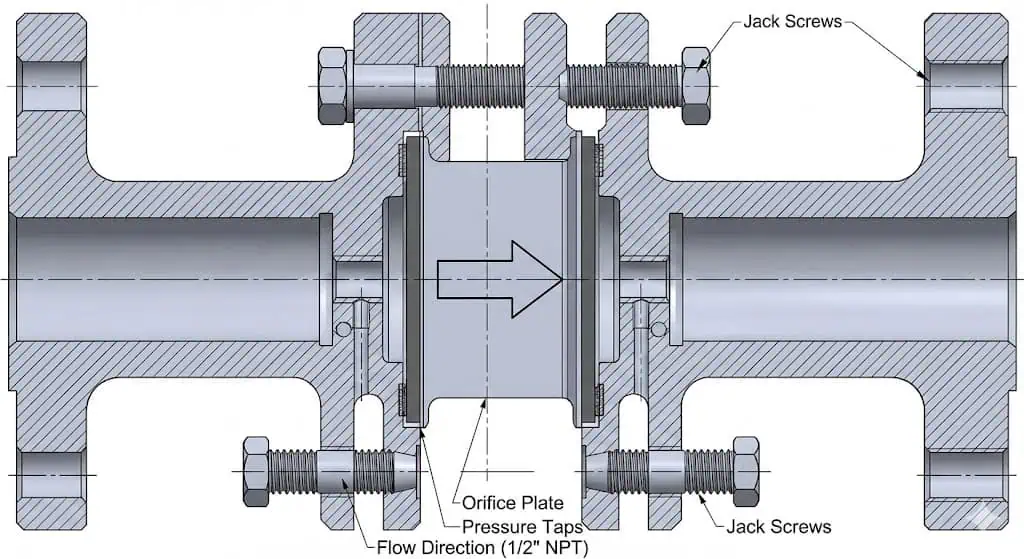
Orifice flanges enable flow measurement and access for instrumentation assemblies.
You use orifice flanges to hold orifice plates and to access pressure taps for differential-pressure measurement. These flanges are essential in gas distribution, water treatment, and chemical processing where monitoring and control of process flow are required. Reference: ASME B16.36.
Selection note: Orifice flanges should be treated as instrumentation-focused components rather than general-purpose piping flanges. Their value lies in measurement access, tapping arrangement, and inspection practicality within the flow monitoring assembly.
| Feature | Description |
|---|---|
| Flow measurement | Measures flow by monitoring pressure drop across an orifice plate |
| Design | Includes pressure taps and features for plate replacement |
| Maintenance | Allows inspection and replacement of orifice plates |
| Material grades | 304, 304L, 316, 316L |
| Standards | ASME, ASTM, DIN, EN 1092-1 where applicable |
Typical applications:
- Gas distribution networks
- Water treatment plants
- Chemical and refinery process control
Main advantages:
- Supports accurate flow measurement
- Integrates into monitored process systems
Main limitation:
- Requires correct installation, orientation, and calibration
See our orifice flange page for instrumentation-focused applications.
Ring-type joint flange arrangement
Ring-type joint, or RTJ, usually refers to a metal-ring sealing arrangement rather than a completely separate flange body type.
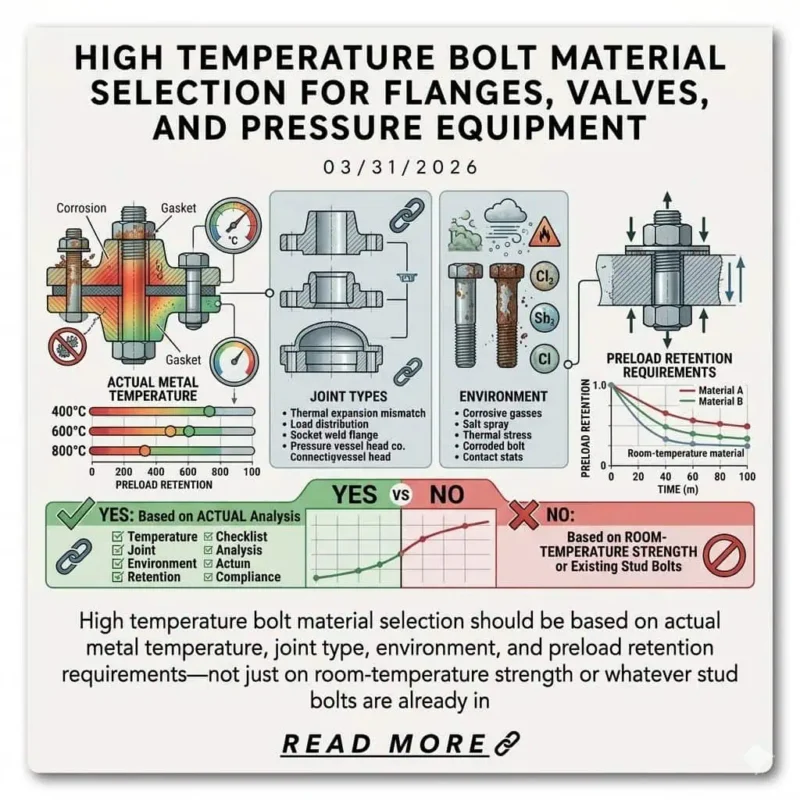
You will find RTJ facings in high-pressure and high-temperature services, especially in oil and gas, steam, and power generation. The seal is created when a metallic ring gasket is compressed into a machined groove, producing a robust metal-to-metal sealing system.
Engineering clarification: In many project documents, RTJ is discussed alongside flange types because the sealing arrangement heavily influences selection. However, from a design standpoint, it is more accurate to treat RTJ as a facing and gasket system used with suitable flange geometries and ratings.
| Characteristic/Application | Description |
|---|---|
| Sealing capability | Metal ring gasket supports sealing under extreme pressure and temperature |
| Types | Oval and octagonal ring designs for different sealing loads |
| Typical service | High-pressure and high-temperature pipelines and equipment |
| Pressure handling | Used in severe-duty applications with appropriate flange ratings |
| Material grades | 304, 304L, 316, 316L where compatible with service and standards |
| Standards | Check applicable ASME and project-specific requirements |
Typical applications:
- Oil and gas pipelines
- Steam boilers
- Chemical and power plants
Main advantages:
- Strong sealing performance in severe service
- Reliable under high pressure and temperature when correctly assembled
Main limitation:
- Requires precise installation, correct ring selection, and proper groove condition
Good flange selection is not only about the flange body. In higher-severity service, material grade, facing, gasket type, bolting, preload control, and service conditions should be reviewed together as one joint system.
Types of stainless steel flanges: comparison
Key differences
You need to understand the main differences between the types of stainless steel flanges to make the right choice for your system.
| Flange Type | Key Characteristics | Pressure Suitability | Welding Required | Typical Use |
|---|---|---|---|---|
| Weld neck flange | Long tapered hub, excellent stress distribution | High | Yes | High-pressure, high-temperature, cyclic service |
| Slip-on flange | Slides over pipe, easy to install, cost-effective | Low to moderate | Yes | General low-pressure and utility piping |
| Socket weld flange | Pipe fits into socket, strong for small diameters | High for small pipes | Yes | Compact, high-pressure small-bore lines |
| Threaded flange | Threaded connection, no welding needed | Moderate, usually small bore | No | Quick assembly, no-hot-work service |
| Blind flange | Solid disc, seals pipe end, no bore | High | No | Capping off lines and isolation duty |
| Lap joint flange | Rotates for easy alignment, used with stub end | Low to moderate | Used with stub end | Frequent maintenance and easier fit-up |
| Orifice flange | Holds orifice plate for flow measurement | Service-dependent | Usually yes | Flow monitoring and instrumentation |
| RTJ facing arrangement | Metal ring gasket for severe service sealing | Very high | Depends on flange geometry | Oil, gas, steam, and power duty |
Note: Lap joint flanges offer flexibility but do not usually provide the same sealing rigidity as weld neck arrangements in severe service. Blind flanges stand out because they isolate the line rather than connect flow. RTJ describes a sealing arrangement, so it should be evaluated with the flange rating, facing geometry, ring gasket, and service conditions together.
Best-use scenarios
You should match each flange type to its ideal industrial applications for best results.
- Weld neck flanges: Use these in oil and gas, chemical processing, and any system with high pressure, high temperature, or cyclic loading.
- Slip-on flanges: Choose these for water treatment, food processing, HVAC, and other lower-severity systems.
- Socket weld flanges: Install these in compact, high-pressure hydraulic or chemical lines with small pipe diameters.
- Threaded flanges: Select these for small-diameter lines where welding is not possible or safe.
- Blind flanges: Apply these to cap off pipelines, perform pressure tests, or isolate sections for maintenance.
- Lap joint flanges: Use these in systems that require frequent disassembly or easier bolt alignment.
- Orifice flanges: Integrate these into process lines where you need flow measurement and control.
- RTJ facing arrangements: Rely on these where severe pressure and temperature demand a metal-ring sealing system.
In practical plant reviews, this comparison often comes down to whether the system prioritizes fabrication speed or long-term mechanical stability. Slip-on flanges can look attractive during installation planning, but weld neck flanges are more frequently retained when cyclic load, misalignment stress, or future reliability risk is part of the design review.
Stainless Steel Flange Quick Selection Guide
Size and dimensions
Choose the correct size and dimensions to ensure a secure fit and reliable performance.
- Identify the flange type by its design features and intended service
- Check outer and inner diameters for compatibility with the pipe and mating flange
- Select thickness and pressure class appropriate for the operating conditions
- Count and measure bolt holes for correct alignment
- Confirm facing type and gasket arrangement before ordering
- Follow the applicable standard, such as ASME B16.5 or EN 1092-1
Material grade
Select the right material grade for corrosion resistance, weldability, and service life.
| Material Grade | Corrosion Resistance | Applications | Engineering Comment |
|---|---|---|---|
| 304 | Good for many general industrial environments | General-purpose process and utility service | Common starting point where chloride exposure is limited |
| 304L | Similar to 304 with lower carbon | General-purpose products where welding response matters | Useful where reduced sensitization risk is preferred |
| 316 | Better chloride resistance than 304 | Marine-adjacent fittings, chemical processing | Often reviewed earlier for more aggressive duty |
| 316L | Strong choice for chloride-containing service | Marine, chemical, pharmaceutical manufacturing | Frequently selected when corrosion resistance and welding performance both matter |
Project note: In coastal utility and washdown-oriented process systems, the material decision is often revised after engineers review chloride exposure, retained moisture, and cleaning frequency. In those cases, the final recommendation may shift from 304 or 304L toward 316 or 316L to improve long-term corrosion resistance and reduce maintenance risk.
Standards and certifications
Verify standards and certifications to support safe selection and reliable procurement.
- ASME B16.5: Common reference for pressure-temperature ratings, materials, dimensions, tolerances, marking, testing, and designation of openings for pipe flanges and flanged fittings
- ASTM A182/A182M: Common material specification for forged or rolled alloy and stainless steel flanges, forged fittings, and related parts for high-temperature service
- EN 1092-1: Common dimensional and marking reference for many European projects
- PED 2014/68/EU: Relevant where pressure equipment compliance is required in applicable markets
- ISO 15156-1 / NACE-related sour service guidance: Relevant where corrosive service conditions require additional material review
Standards should be checked as a matched set rather than in isolation. A flange may be dimensionally correct under one standard, but the project still needs confirmation of material grade, facing, bolting, inspection requirements, and any client-specific documentation.
Related reading: What ASME B16.5 means for pipe flanges and flange fittings.
Gaskets and bolting
Use the right gasket and bolting combination for a reliable seal.
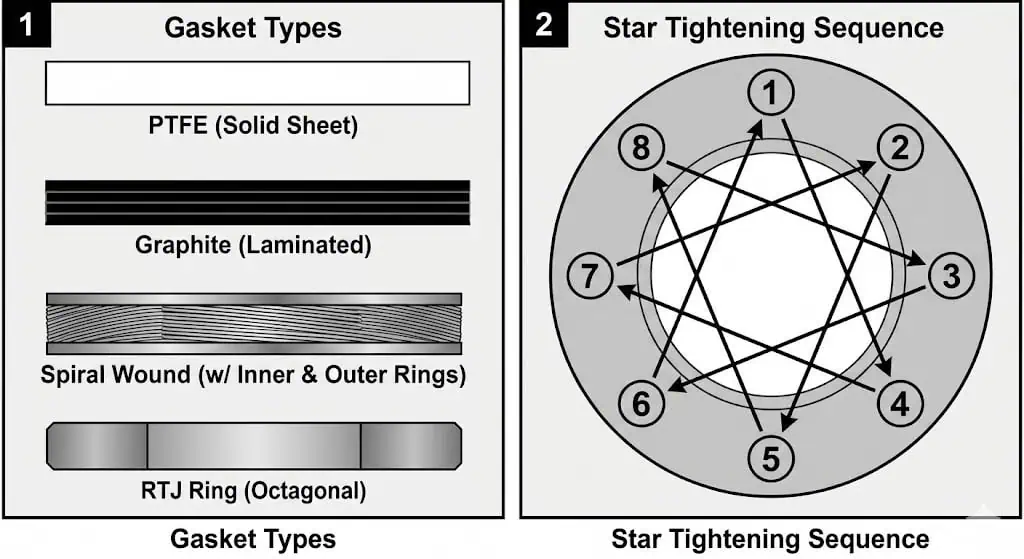
- Gaskets fill the gap between flange faces and help prevent leaks
- Choose gasket material based on pressure, temperature, media, and facing type
- Select the correct gasket category: non-metallic, metallic, or semi-metallic
- Apply proper bolt preload and tightening sequence for even gasket loading
- Ensure flange stiffness and face condition are suitable for the sealing system
Field reminder: Leakage problems are not always caused by the flange type itself. In plant troubleshooting, many sealing failures trace back to gasket mismatch, uneven preload, damaged flange faces, or bolting that does not match the required class or service condition.
Fluid medium
Match the flange material and gasket system to the actual fluid medium.
You need to consider the chemistry, temperature, concentration, and cleaning conditions of the fluid. For aggressive chemicals, saline washdown, or seawater-adjacent service, 316 or 316L is often the safer starting point than 304 or 304L.
Connection and sealing requirements
Pick the flange design based on both mechanical and sealing requirements.
Weld neck flanges offer stronger stress handling for high-pressure systems. Slip-on flanges provide easier installation for lower-severity lines. Socket weld flanges suit small high-pressure pipes. Blind flanges isolate pipe ends. Lap joint flanges allow quick alignment and frequent disassembly. RTJ arrangements are reviewed where severe-duty sealing justifies a metal-ring gasket system.
Engineering insight: Many procurement errors happen when flange type is chosen first and the sealing system is treated as an afterthought. In reliable piping design, the flange, facing, gasket, bolting, and service medium should be evaluated as a single joint system.

Common selection mistakes
Many flange problems come from selection shortcuts rather than manufacturing defects alone.
- Choosing slip-on flanges for service that really requires weld neck strength
- Selecting 304 where chloride exposure suggests 316 or 316L
- Ignoring gasket compatibility with pressure, temperature, and media
- Using non-compliant or mismatched bolting materials
- Overlooking maintenance access when blind or lap joint arrangements would be more practical
- Failing to verify dimensional and material standards before purchase
Application needs
Match the flange type to the actual application instead of relying on generic preference.
For industrial applications, select the flange that fits your system’s pressure, temperature, corrosion risk, assembly method, and maintenance plan. A flange that works well in a utility water line may be the wrong choice for cyclic steam service or a chloride-bearing process line.
Pressure and temperature
Check the flange rating against real operating and design conditions.
Flange ratings such as Class 150, 300, and higher indicate the pressure-temperature range the flange can handle under the governing standard. Higher ratings do not automatically mean a better choice; they must still match the material, facing, gasket, bolting, and actual service conditions.
Installation factors
Plan for welding method, access space, tools, alignment, and inspection needs.
Some flanges require butt welding, some use fillet welds, some use threads, and some mainly rely on correct bolting and gasket assembly. Consider the available space, the skill level of the installation team, and whether the line will need future disassembly or regular maintenance access.
Field note: the right flange is not only the one that fits the pipe. It is the one that matches the service conditions, fabrication method, sealing system, and maintenance plan.
You have now seen the main stainless steel flange types and the logic behind choosing among them. A technically acceptable flange still needs correct documentation, material certificates, dimensional control, markings, and inspection traceability to support dependable long-term service.
If you need deeper guidance on individual products, see our pages for weld neck flanges, slip-on flanges, blind flanges, and custom flange solutions.
FAQ
Which stainless steel flange type is best for high-pressure service?
Weld neck flanges are usually the preferred option for high-pressure and high-temperature service.
They provide better stress distribution and a stronger transition from pipe to flange than simpler designs such as slip-on flanges. Final selection should still follow the project pressure class, material requirement, and fabrication standard.
What is the difference between weld neck and slip-on flanges?
Weld neck flanges are generally stronger, while slip-on flanges are easier and cheaper to install.
Weld neck flanges use a tapered hub and butt-weld connection for more demanding service. Slip-on flanges slide over the pipe and are often used in lower-severity systems where fabrication simplicity matters.
When should I choose 316 or 316L instead of 304?
Choose 316 or 316L when the service is more corrosive, especially where chlorides or seawater exposure are involved.
304 and 304L are widely used for general service, but 316 and 316L are often selected when corrosion resistance needs to be higher. The final material decision should be based on the actual fluid, temperature, concentration, and cleaning conditions.
What should I check before ordering stainless steel flanges?
Confirm flange type, size, pressure class, material grade, facing, standard, and inspection documents before ordering.
You should also check gasket compatibility, bolting requirements, and whether the service needs easier maintenance access or specialized features such as instrumentation connections.