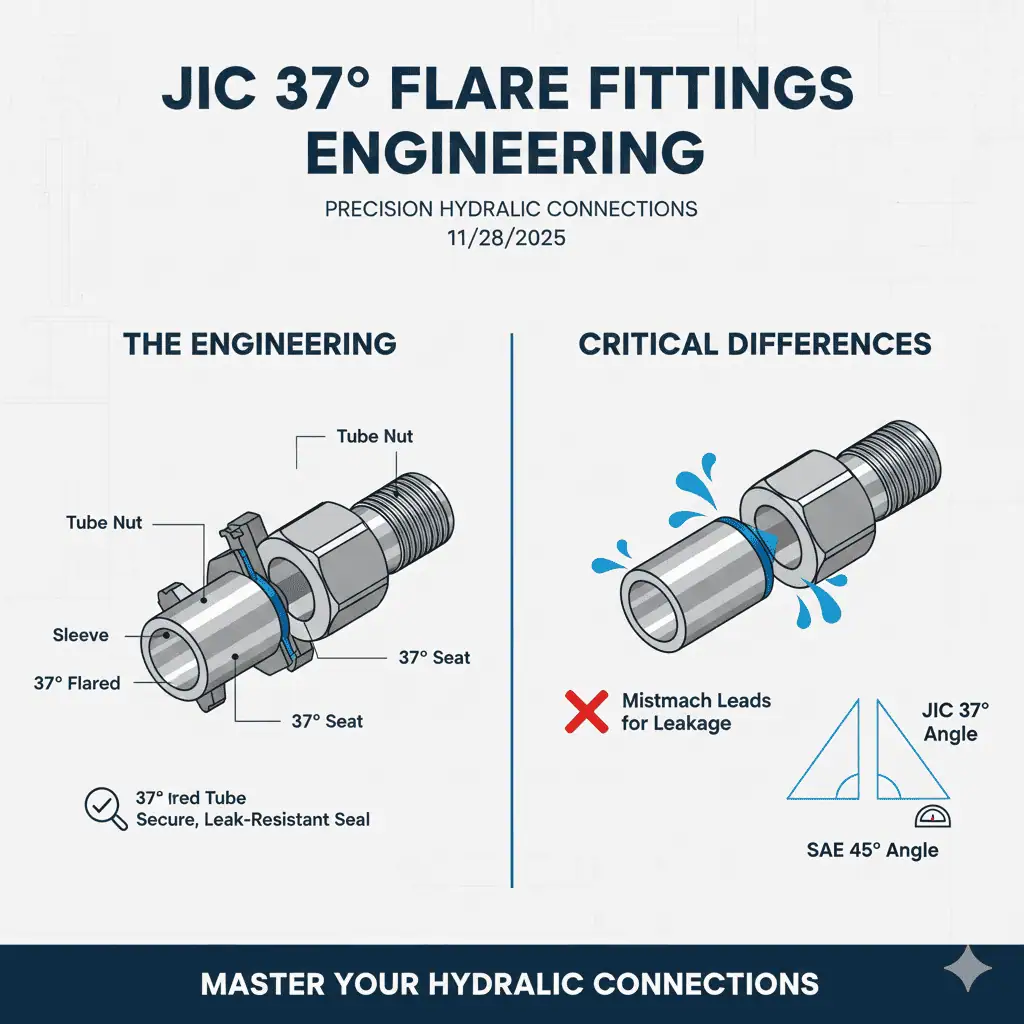
JIC 37° flare fittings seal at the metal seat, not at the threads. Most JIC leaks are caused by seat damage, 37° vs 45° angle mismatch, unsupported tubing, or incorrect pull-up during assembly. If you understand those four failure modes, JIC leaks stop looking random and become much easier to diagnose and prevent.
Quick engineering summary:
- Standard: SAE J514 / ISO 8434-2 for industrial hydraulic service.
- Sealing principle: metal-to-metal contact at the 37° flare seat. No PTFE tape on the threads.
- Assembly control: “Flats From Finger Tight” or the fitting maker’s approved pull-up method is usually more reliable than guessing by feel.
- Most common failure mode: seat damage, angle mismatch, poor tube preparation, or side-load on the joint.
JIC 37° flare fittings, defined by SAE J514 and harmonized in ISO 8434-2, are widely used for medium-to-high pressure hydraulic connections. Unlike pipe threads that depend on thread interference, JIC fittings create a metal-to-metal seal by pulling the flared tube face against the 37° nose cone. The threads provide axial clamp load only. They are not the sealing boundary. That difference is exactly why adding sealant or tape to the threads does not solve a damaged JIC seat.
In field troubleshooting, so-called “mystery leaks” almost always trace back to one of two engineering failures: geometry mismatch, such as forcing a 45° automotive flare onto a 37° JIC seat, or uncontrolled assembly, such as poor tube preparation, missing support, or incorrect pull-up. That is why JIC troubleshooting should begin at the seat, not at the threads.
- The physics of sealing: JIC seals by controlled deformation and burnishing of the tube flare against the fitting cone. The UNF threads create clamp load only.
- The geometry rule: a true JIC joint requires the correct 37° seat geometry. A 45° automotive flare is not an acceptable substitute.
- The installation baseline: square cut, correct deburr, clean flare surface, proper support, and controlled pull-up are non-negotiable. See our complete guide to leak-free tube fitting installation for the tube prep steps that are most often skipped in the field.
| Mismatched Pair | Engineering Consequence | Field Verification |
|---|---|---|
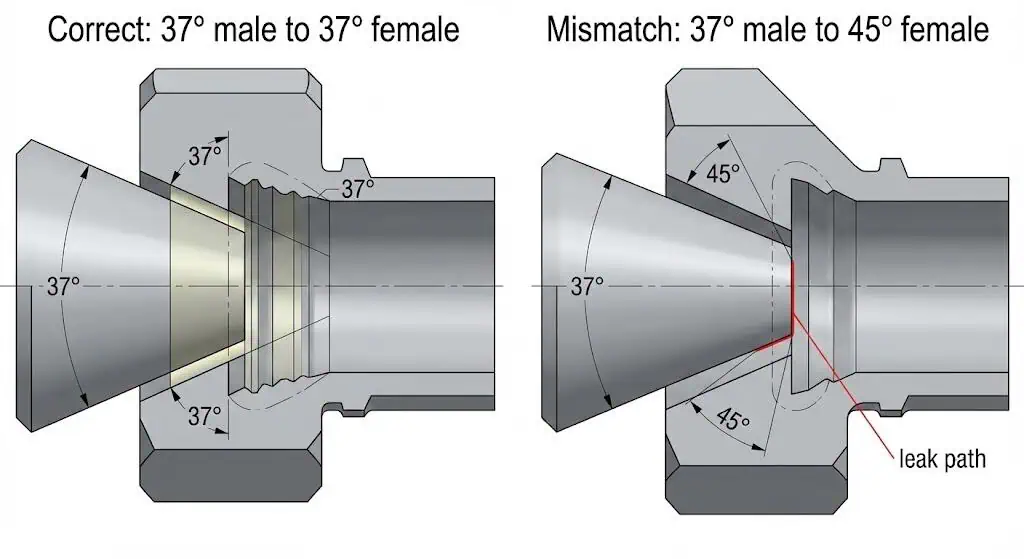
| JIC (37°) Male into SAE (45°) Female | Point-load failure: contact shifts away from the intended sealing face. The seat distorts, the flare thins locally, and vibration turns that distortion into a leak or crack. | Use a seat angle gauge. Visually, 37° cones usually look “sharper,” while 45° cones look “blunter.” |
| Mixing similar-looking thread families | False torque: thread drag creates resistance before the seat has actually sealed, so the joint feels tight while the flare remains under-compressed. | Verify thread size and TPI against the correct dash-size chart before assembly. |
Field example: On one hydraulic skid during commissioning, several joints began weeping during pressure testing. The root cause was a mixed repair kit: technicians had installed SAE 45° brass nuts onto JIC 37° stainless bodies. The threads engaged, but the flare was distorted because the seat geometry was wrong. The fix was simple but important: standardize all bin stock to SAE J514 JIC and require an angle-gauge check for new tube assemblies.
The practical lesson is this: tight does not equal sealed. With JIC, sealing depends on seat geometry, flare quality, and controlled assembly.
What Are JIC 37° Flare Fittings?
Design Specs: SAE J514 & ISO 8434-2
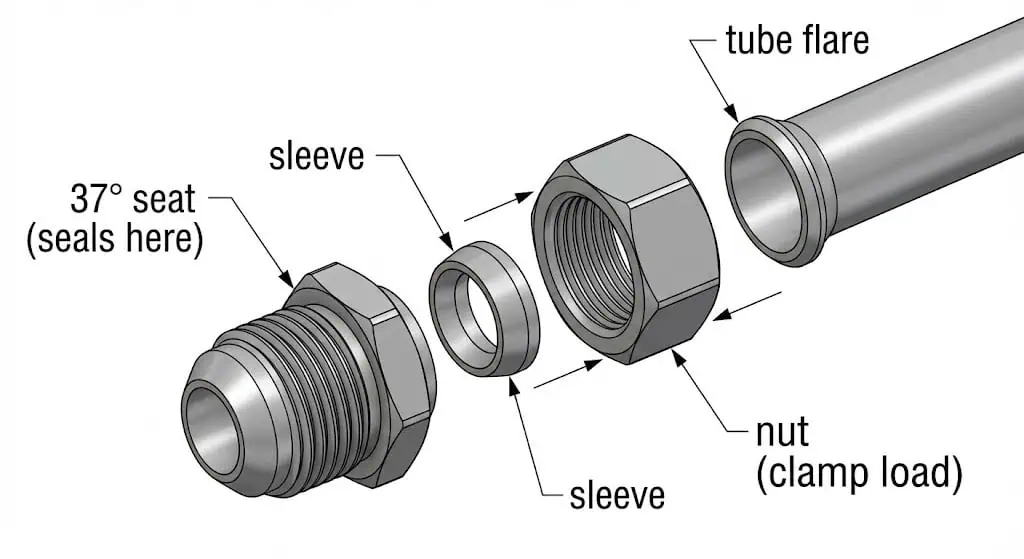
JIC fittings are defined by SAE J514 and harmonized internationally as ISO 8434-2.
“JIC” is the common trade term, but the standards are what keep industrial parts interchangeable across major manufacturers. These fittings are widely used with flared tubing and UNF threads across hydraulic systems where a metal-to-metal flare connection is preferred.
- The body: contains the 37° male cone, which is the critical sealing feature.
- The sleeve: acts as a bearing surface so the nut can rotate without twisting the flare directly.
- The nut: converts wrench rotation into axial clamp load.
Engineer’s note: The sleeve is not optional. If the nut rotates directly against the flare, the flare can gall or distort during tightening and the joint may leak immediately.
ISO 8434-2:2007 also supports metric-tube solutions through appropriate sleeve and fitting arrangements, which is useful in mixed-standard facilities.
Comparison reference: it is important to distinguish industrial JIC from aerospace AN fittings. Both use a 37° flare, but they are not the same product standard and should not be treated as interchangeable in critical aerospace service.
| Feature | JIC (Industrial) | AN (Aerospace / Mil-Spec) |
|---|---|---|
| Standards | SAE J514 / ISO 8434-2 | MIL-F-5509 / SAE AS4841 |
| Thread Tolerance | Class 2A/2B | Class 3A/3B |
| Material Testing | Industrial hydraulic qualification | More stringent aerospace qualification |
| Compatibility | Dimensionally similar in many cases, but not intended for aerospace-spec substitution | Do not replace AN-specified aerospace parts with JIC parts. |
Facility standard: To prevent inventory confusion, many plants physically separate 45° automotive flare stock from JIC stock. That simple control prevents one of the most common causes of repeat JIC leaks.
The Metal-to-Metal Seal Mechanics

The JIC seal is created by controlled contact between the flared tube face and the 37° cone.
Because standard JIC does not rely on an elastomer seal, flare quality and seat condition matter much more than many technicians expect. Even a small scratch across the sealing face can create a hydraulic leak path.
- Surface finish: the sealing surfaces must be smooth and free of damaging scratches.
- Concentricity: if the flare is thin or off-center on one side, clamp load becomes uneven and the weak side is more likely to leak or crack.
- Load path: torque on the nut must become clamp load at the seat. If threads are dry, dirty, or galled, torque is wasted in friction instead of sealing the flare.
Refer to Parker’s Tube Fabricating Guide for fabrication and inspection guidance. A practical shop-floor rule is simple: if you can feel a damaging ridge or longitudinal scratch on the flare or seat, the joint should not be trusted.
| Key Variable | Field Impact |
|---|---|
| Seat Condition | Must be free of damaging longitudinal scratches. Circular burnish marks from normal sealing contact are usually acceptable; radial or deep cuts are leak initiators. |
| Thread Engagement | If the nut bottoms out before the flare is fully seated, check flare size, sleeve condition, and whether the joint has the correct parts. |
| Vibration Resistance | JIC resists vibration well only when the tube is properly supported. Unsupported mass at the fitting can fatigue the flare neck. |
Troubleshooting tip: Never chase a JIC leak with repeated tightening. Depressurize the system, disassemble the joint, and inspect the seat and flare directly. Tightening a damaged seat usually worsens the damage instead of fixing the leak.
Material Selection & Galling Control
Stainless Steel vs. Carbon Steel
Material selection affects corrosion resistance, galling behavior, and the way the fitting responds during assembly. While dimensions may be the same, carbon steel and stainless steel do not behave the same way during tightening or long-term service.
| Material | ASTM / SAE Spec | Application Notes |
|---|---|---|
| Stainless Steel (316/316L) | ASTM A276 / A479 | Common for marine, offshore, and chemical service. Critical: stainless-on-stainless threads are more prone to galling and often need controlled lubrication or anti-seize per manufacturer guidance. |
| Carbon Steel | SAE J514 | Common for indoor industrial hydraulics. Plating and corrosion protection affect service life significantly. |
| Brass | SAE J530 | Typically limited to lower-pressure or non-severe service. It is generally not preferred for high-impulse hydraulic duty. |
The stainless problem: If a 316SS nut and 316SS body are assembled dry, the threads can seize before the seat is fully loaded. In stainless service, follow the fitting maker’s lubrication guidance so clamp load actually reaches the flare.
Manufacturing: Forged vs. Machined
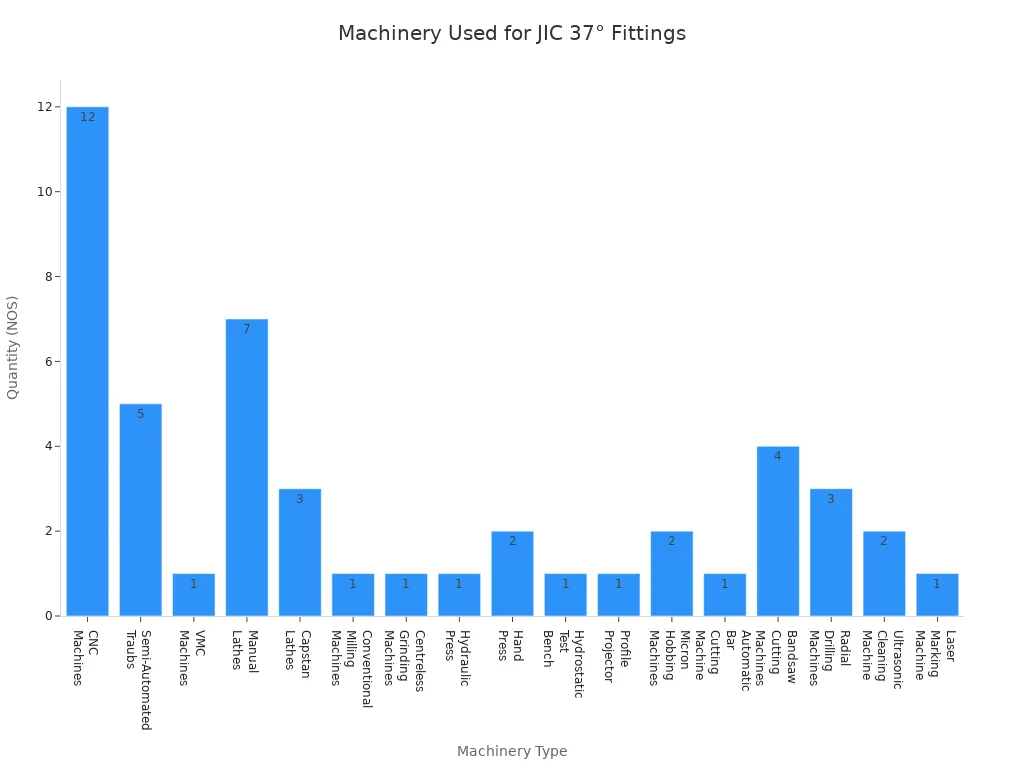
Reliability is influenced by manufacturing method as well as material. High-quality JIC elbows and tees are commonly forged for strength, while many straight fittings are machined from bar stock.
- Forging: helps support strength in angled fittings exposed to pressure spikes and vibration.
- Burnished seats: better seat finish improves sealing consistency. Poorly finished cones can create leak paths even when the thread fit seems normal.
Compliance
Always verify the manufacturer’s imprint and traceability where your system requires it. In regulated or code-governed piping, material identification and traceability may be required for inspection and documentation. Unmarked “white box” fittings create unnecessary compliance risk because the material and source cannot be verified confidently.
Pressure Ratings & Limitations
Dynamic Pressure Handling
JIC pressure performance is not just a static catalog number. Working pressure depends on size, material, tubing, vibration severity, and the manufacturer’s published rating. In real systems, the weak link is often the tubing, the flare, or the unsupported installation rather than the fitting body itself.
| Size (Dash) | Typical Working Pressure (Carbon Steel) | Typical Working Pressure (316 SS) |
|---|---|---|
| -04 (1/4″) | 5,000 – 6,000 PSI | 5,000 PSI |
| -08 (1/2″) | 4,500 – 5,000 PSI | 4,000 PSI |
| -16 (1″) | 3,000 PSI | 3,000 PSI |
Note: Always consult the specific manufacturer’s catalog for the exact fitting family, size, material, and service condition. Proprietary designs and heat treatments can affect ratings.
Why JIC Leaks (And How to Stop It)
One of the biggest enemies of JIC fittings is side-load. Because the seal is metal-to-metal, bending force on the tube can distort the flare and reduce sealing contact.
- Typical symptom: the leak appears only when the machine cycles, vibrates, or heats up.
- The fix: support the tubing properly and install clamps near the fitting so the joint is not carrying the weight or motion of the tube run.
- Thermal cycling: in severe temperature swings, joint relaxation can appear. Where repeated thermal movement is extreme, another fitting family such as ORFS may be worth evaluating.
Installation: The “Flats From Finger Tight” (FFFT) Method
Step-by-Step Assembly Procedure
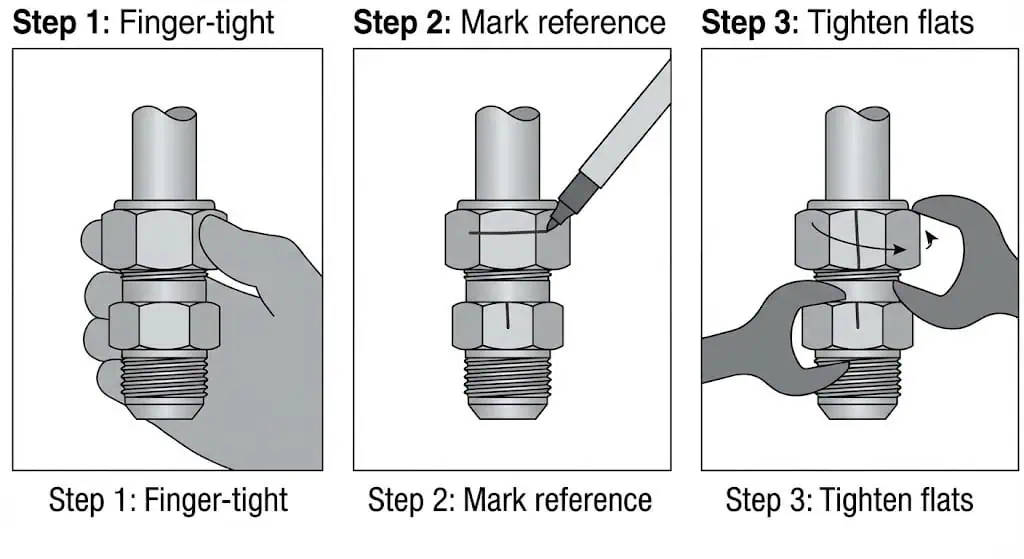
Torque alone is often a weak control for flare fittings because friction can consume most of the wrench effort before the seat is properly loaded. That is why many technicians prefer the Flats From Finger Tight (F.F.F.T.) method or the fitting maker’s specific pull-up procedure for consistent assembly.
- Inspect: confirm the flare is clean and the cone has no damaging radial scratches.
- Align: the tube should meet the seat naturally. If you have to force the tube into place, correct the routing first.
- Finger tighten: bring the nut to initial resistance with the flare seated properly.
- Mark: place a witness mark across the nut and fitting body.
- Tighten by flats: rotate the nut by the prescribed amount for that size and fitting maker’s guidance.
Typical JIC pull-up values:
- Sizes -04 to -08: commonly around 2 flats past finger tight.
- Sizes -10 to -24: commonly around 1 to 1.5 flats depending on size and manufacturer guidance.
Critical safety: Always use a backup wrench on the fitting body. If the body rotates during tightening, the tube can be twisted and left with built-in torsional stress.
Maintenance & Reusability
JIC fittings can often be reused, but only after seat inspection.
- The test: run your fingernail around the nose cone. If you catch a damaging groove, replace it.
- The limitation: repeated remakes work-harden the flare and can gradually reduce sealing reliability.
- The practice: if reusing, align to the previous witness mark and use only a small additional pull-up if your maintenance procedure allows it.
Troubleshooting Checklist
Systematic Leak Detection
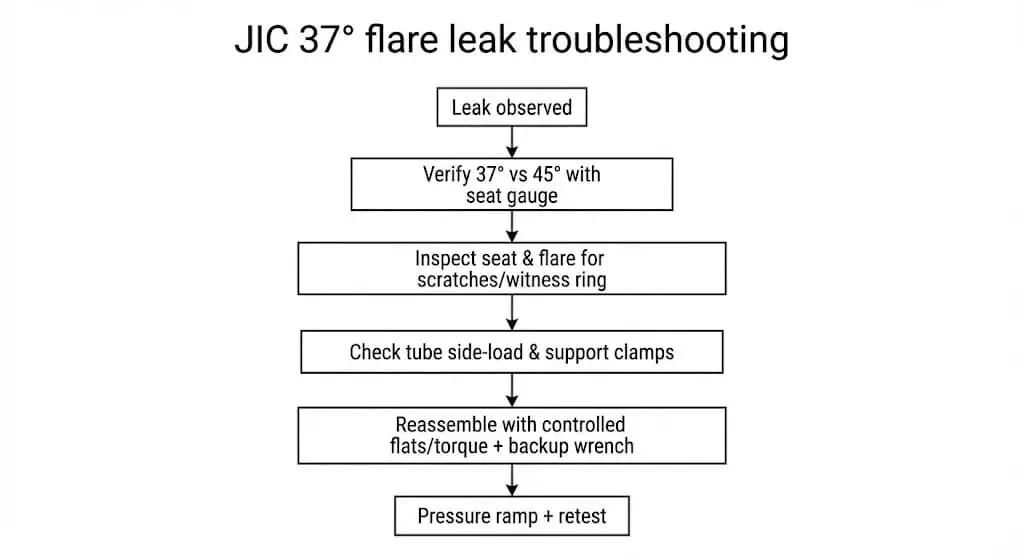
Do not guess. Read the witness marks. Disassemble the leaking joint and inspect the contact pattern on the flare and seat.
| Observation | Probable Cause | Solution |
|---|---|---|
| Ring is only on one side (crescent shape) | Side-load or misalignment | Relieve the load, correct routing, and align the tube naturally before retightening. |
| Nut is tight, but flare is loose | Bottoming out, wrong parts, or thread interference | Check sleeve presence, flare size, thread condition, and whether the nut is reaching the correct seating range. |
| Flare face is cracked | Over-tightening or repeated work hardening | Cut back the tube and re-flare. Do not tighten further. |
| Scratches on the cone | Dirty assembly or damaged seat | Replace the damaged fitting body and improve cleanliness control during installation. |
Engineering FAQ: JIC 37° Fittings
What is the difference between JIC and AN fittings?
Both use a 37° flare and UNF threads, but AN (Air Force-Navy) fittings follow aerospace specifications with tighter tolerances and stricter qualification requirements. JIC (SAE J514) is the industrial hydraulic version. They may be dimensionally similar, but JIC should not be substituted into aerospace flight applications.
Should I use Teflon tape on JIC fittings?
No. JIC fittings seal on the 37° metal seat, not the threads. PTFE tape changes thread friction, can distort pull-up, and may introduce contamination into the hydraulic system.
How tight should a JIC fitting be?
For general maintenance, many technicians use the Flats From Finger Tight (FFFT) method or the specific fitting maker’s pull-up instructions. Smaller sizes commonly need more relative rotation than larger sizes, but always follow the manufacturer’s published guidance for the exact fitting family.
How do I distinguish SAE 45° from JIC 37°?
The thread may look similar in some sizes, but the seat angle is different. JIC 37° cones usually appear slightly sharper, while SAE 45° cones look blunter. The best method is to use a seat angle gauge. Forcing a 37° male into a 45° female damages the sealing contact and often causes leaks.
Technical Review Basis
Reviewed for: hydraulic tube fabrication, JIC flare assembly practice, leak troubleshooting, and field maintenance procedures.
Suggested reviewer title: Hydraulic Application Engineer / Fluid Power Technician
Source basis: SAE J514 terminology, ISO 8434-2 product family references, tube fabrication practice, and field troubleshooting procedures for flare-seat leakage.
Last updated: 2026-03-25