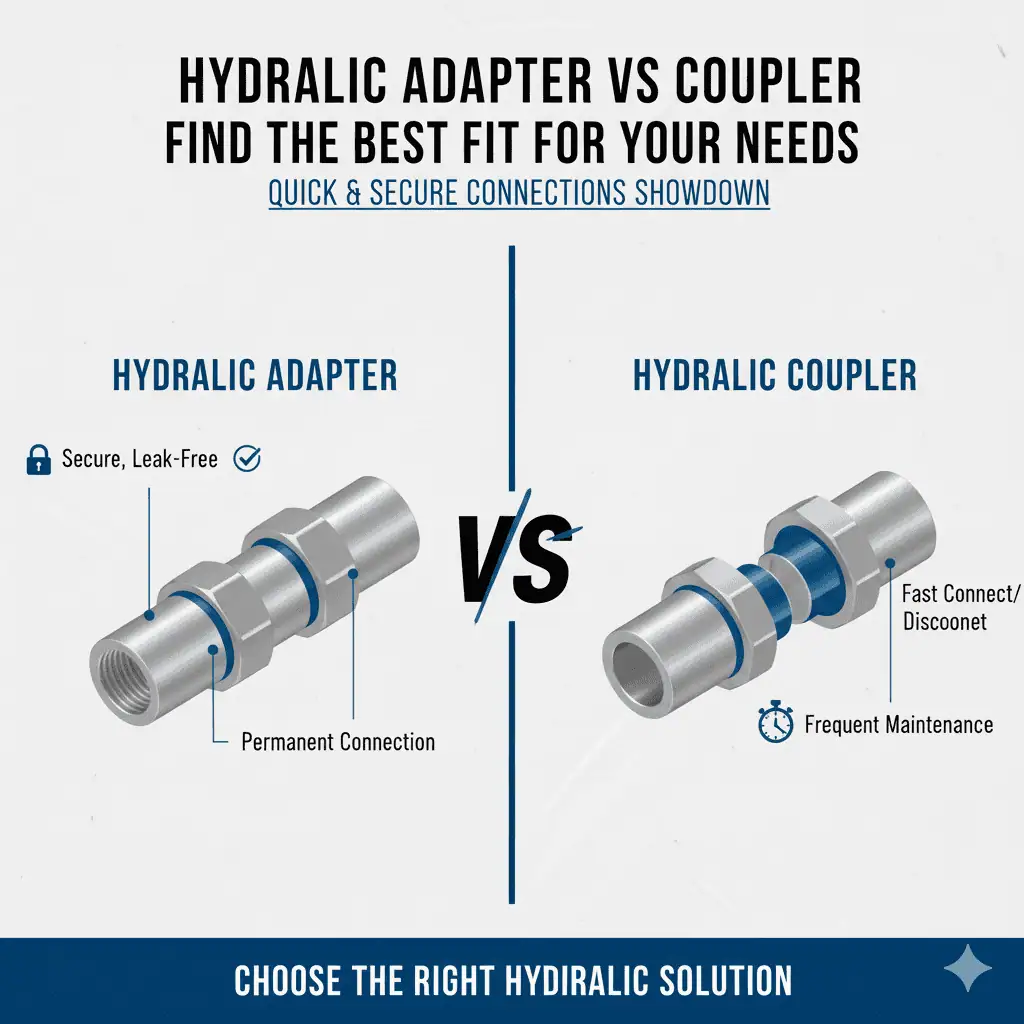
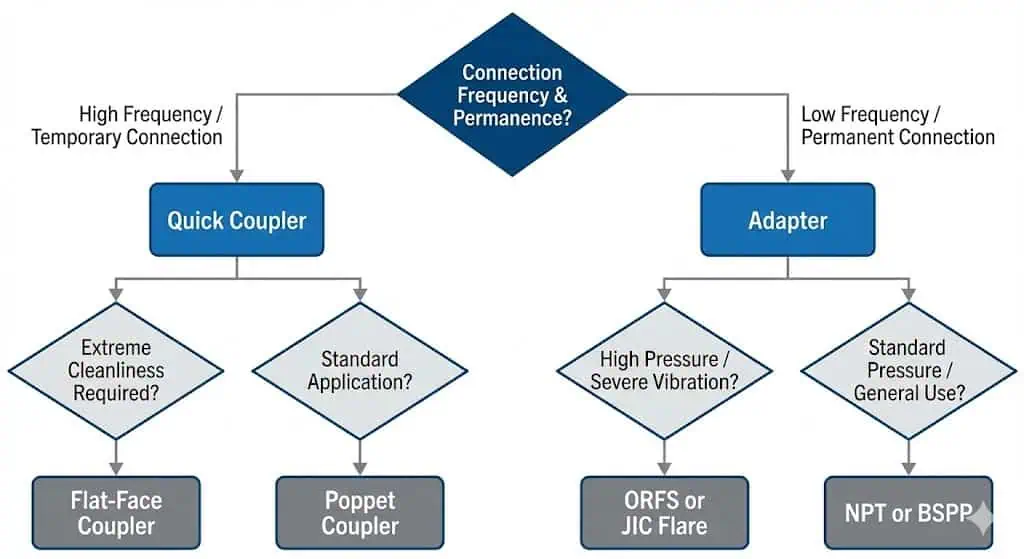
Choose a hydraulic adapter when the job is compatibility and stable plumbing; choose a coupler when the job is speed and repeatable connect/disconnect. In the field, the wrong choice usually shows up as one of three failures: leaks after warm-up, contamination introduced during service, or “can’t connect” events caused by residual pressure. A practical decision between hydraulic adapter vs coupler should be based on pressure rating, sealing style (seat type), service frequency, and contamination control—not on appearance alone. For a fast overview, see selection guidance used in hydraulic service work.
- Hydraulic adapters maintain system compatibility and help control leaks when the correct thread/seat standard is matched.
- Couplers allow quick connections and disconnections, improving maintenance speed—but they require face cleanliness, caps, and seal checks to avoid contamination-driven failures.
Quality and compatibility matter most. Sunhy supports common thread standards, materials, and surface treatments so systems can be built or maintained with fewer rework cycles.
Hydraulic Adapter vs Coupler Overview
What Is a Hydraulic Adapter
A hydraulic adapter connects different types or sizes of hydraulic fittings, hoses, or ports to achieve compatibility and a controlled seal.
Adapters are most often used for thread/seat conversions (for example: NPT to JIC, BSPP to ORFS, metric ports to tube ends) and for routing (straight, elbow, tee). A key engineering point: most “leaks” blamed on adapters are actually seal-style mismatches—the threads may “fit,” but the seat and sealing method do not.
Evidence points engineers use during selection (typical field practice):
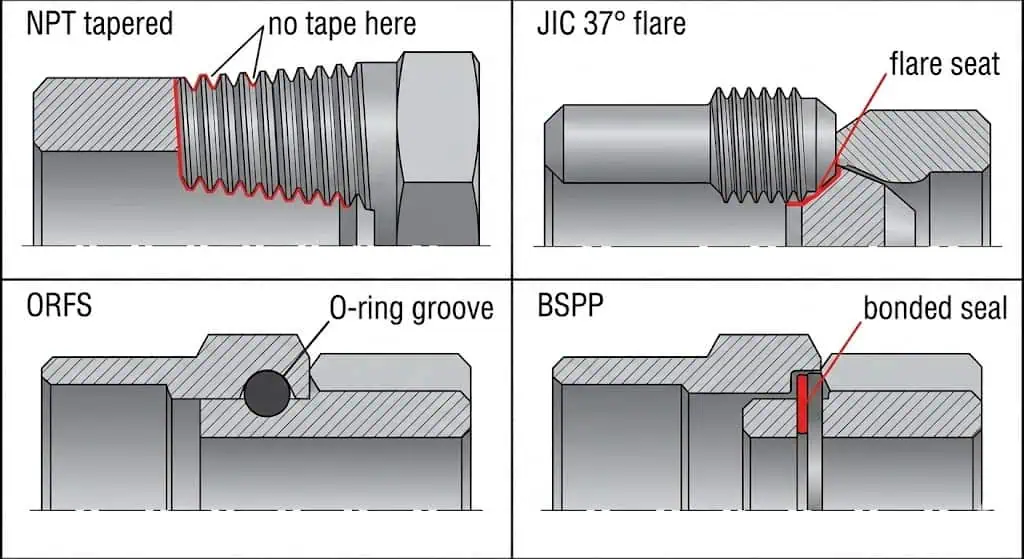
- Thread form and sealing method are a package. NPT/BSPT are tapered threads typically requiring sealant practice, while JIC seals on a 37° flare seat, and ORFS seals with an O-ring on a flat face. If the sealing style is wrong, torque only makes damage happen faster.
- Standard references matter for thread identification. NPT thread practice is governed under ASME/ANSI thread standards (search: ASME B1.20.1), while 37° flare connections and many hydraulic tube fitting conventions are associated with SAE standards (search: SAE J514).
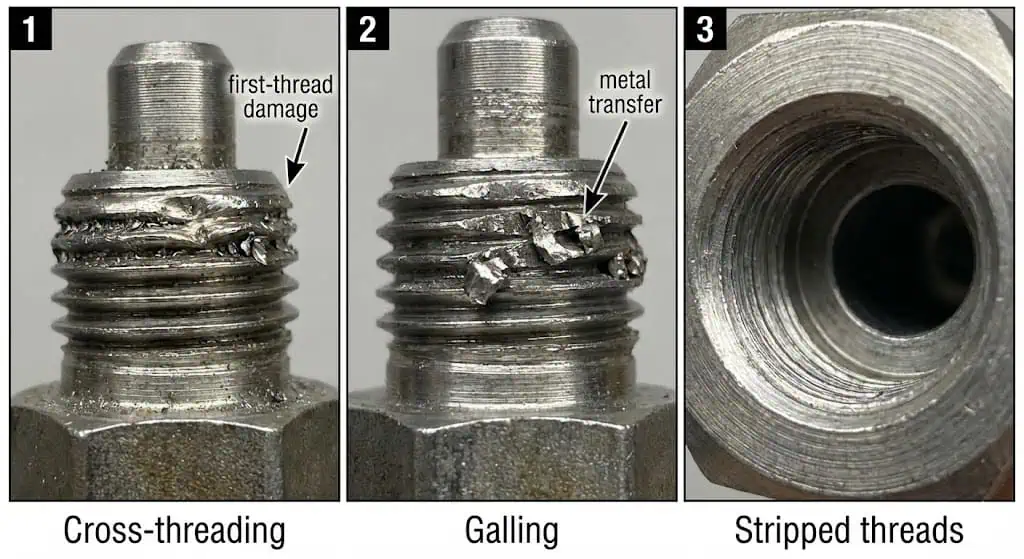
- Do not assume “BSP = NPT.” BSP and NPT differ in thread angle and pitch; forcing them together often strips the first threads and creates a leak path.
- Connect hydraulic equipment of different specifications and types.
- Improve system efficiency by optimizing fluid transmission paths.
- Enhance safety by maintaining a firm, repeatable seal interface.
- Simplify maintenance and upgrades of hydraulic systems.
- Adapt to diverse application needs with various designs.
- Improve system stability by reducing the impact of vibration and shock (when correct seal style is used).
Hydraulic adapters come in a range of materials. Stainless steel offers corrosion resistance and high strength for wet, chemical, or washdown environments. Brass is typically reserved for selected applications and lower pressures where compatibility allows. Aluminum is weight-saving but generally used in lower-pressure or specific mobile applications. Carbon steel is common in industrial service, usually with a protective coating.
Field example (leak after warm-up): A skid was re-plumbed using “thread-compatible” parts, but a seat-style mismatch (flare vs. O-ring face seal) caused a slow seep that only showed once the system reached operating temperature. The fix was not “more torque” but correcting the sealing interface and replacing the damaged seat.
| Type of Adapter | Description |
|---|---|
| Female Threaded | Standard in many industries; verify thread form + seat to avoid mismatch leaks. |
| Male Threaded | Common in construction, mining, and manufacturing; watch for galling on stainless threads. |
| Welded | Used for permanent connections; requires qualified welding and post-weld cleanliness to avoid contamination. |
| Soldered | Limited to low-pressure systems and compatible materials; confirm temperature and joint strength. |
| Straight Adapter | Connects two hoses/ports in a straight line; typically lowest routing stress. |
| Elbow Adapter | Creates a 90-degree or 45-degree angle; reduces hose bend stress when routed correctly. |
| Tee Adapter | Allows for a three-way connection; confirm flow direction and pressure drop impact. |
| Cross Adapter | Enables a four-way connection; verify manifold space and service access. |
| Bulkhead Adapter | Passes through a panel or wall; ensure lock nut torque and vibration control. |
| SAE Standards | SAE standards define dimensions/performance conventions for many hydraulic fittings (search: SAE J514). |
| ISO Standards | ISO standards support consistency in fluid power connections (search: ISO 8434). |
What Is a Hydraulic Coupler
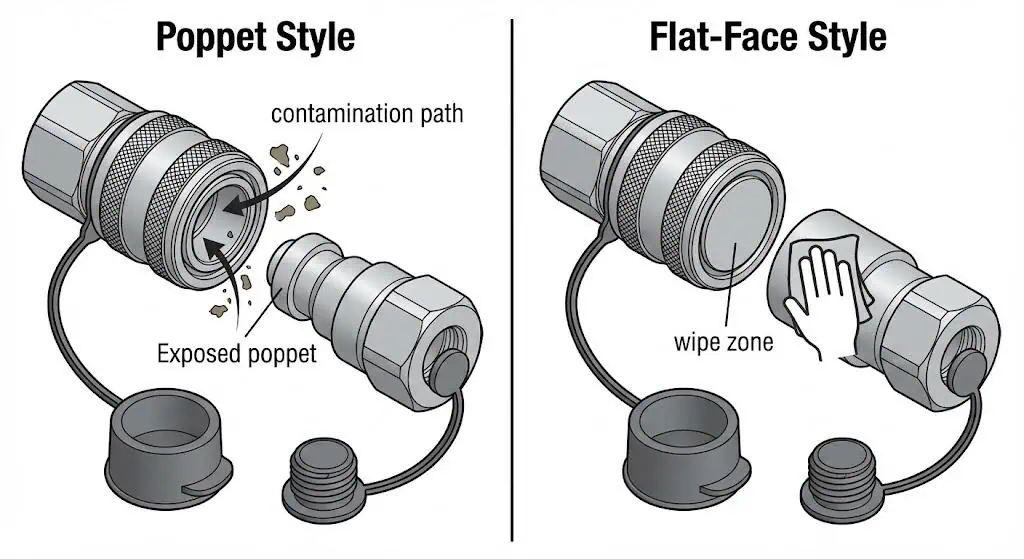
A hydraulic coupler allows you to quickly connect or disconnect hydraulic lines without tools, which is ideal when attachments change or service access is frequent.
Couplers are designed around repeatable connect/disconnect cycles. Most consist of a male and female half with a locking mechanism and internal sealing. Engineering reality: couplers are also a contamination gateway if faces are dirty or left uncapped, especially in mobile equipment working in mud, dust, or abrasive environments.
Hydraulic couplers, including flat-face styles often associated with ISO conventions, serve a wide range of industries. You see them in construction, agriculture, automotive, manufacturing, and healthcare. When cleanliness matters, flat-face couplers are commonly chosen because they reduce exposed cavities at the connection face (reference search: ISO 16028).
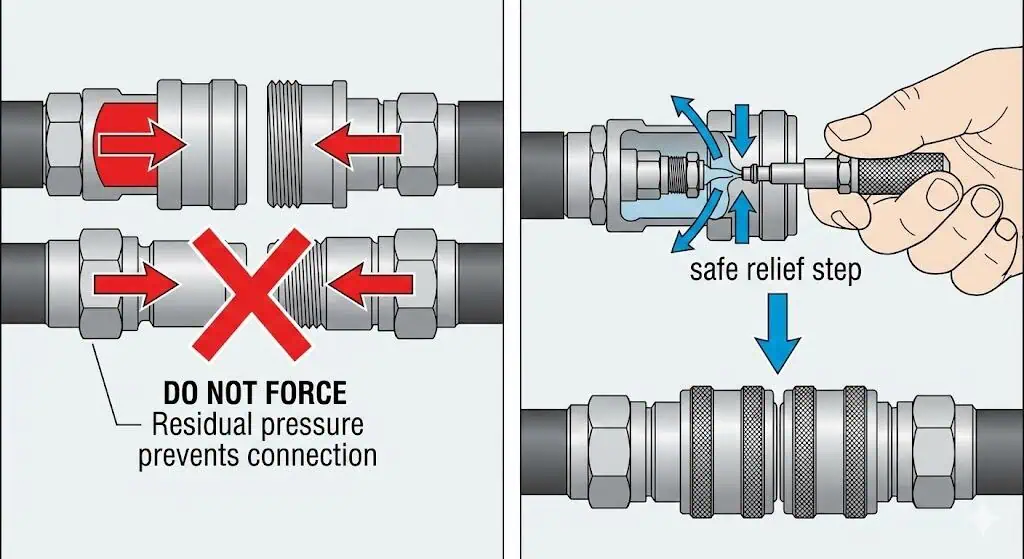
Field example (can’t reconnect): A loader could not reconnect an attachment after sitting in the sun. Residual pressure trapped in one side prevented coupling engagement. The fix was controlled depressurization and adopting a connect-under-pressure (CUP) coupler style for that duty cycle—forcing it would have damaged seals and locking elements.
| Industry | Applications |
|---|---|
| Construction | Excavators, bulldozers, cranes, concrete pumps |
| Agriculture | Tractors, harvesters, irrigation systems |
| Automotive | Production presses, braking systems, hydraulic steering |
| Manufacturing | Presses, injection molding machines, automation systems |
| Healthcare | Hospital beds, surgical tables, patient lifts |
| Energy | Wind turbines, power station valves, offshore drilling |
| Aerospace | Landing gear, flaps, cargo doors |
| Defence & Military | Tanks, submarines, aircraft weapon systems |
| Entertainment | Rollercoasters, water rides, stunt equipment |
| Waste Management | Collection vehicles, recycling balers, compactors |
Key Differences
Hydraulic adapter vs coupler: Adapters convert compatibility for stable installations, while couplers support repeated connect/disconnect for operational speed.
The decision is rarely “either/or.” In many systems, an adapter is used to match thread/seat standards, and a coupler is used downstream to enable fast service. The table below highlights practical distinctions that influence leak risk and maintenance time:
| Feature | Hydraulic Adapters | Hydraulic Couplers |
|---|---|---|
| Design | Simple bodies designed to connect incompatible thread/seat standards. | Locking mechanism + internal valves/seals designed for repeated connect/disconnect. |
| Functionality | Compatibility conversion and routing; typically installed with tools and torque control. | Tool-free (or minimal-tool) quick connect/disconnect; focus on uptime and repeatability. |
| Example Usage | Connecting a hose with BSP thread to a pump with NPT thread (only when verified compatible with sealing method). | Quick-disconnect couplers in construction equipment for switching attachments. |
Tip: If the connection will be separated frequently, choose a coupler and plan for cleanliness (caps + wipe procedure). If the connection is stable and the job is thread/seat conversion, choose an adapter and focus on seal-style correctness and torque practice.
Practical decision matrix (add this to procurement reviews):
| Job Condition | Recommended Choice | Engineering Reason |
|---|---|---|
| Frequent attachment/tool changes | Coupler (often flat-face in dirty environments) | Faster uptime; face design supports contamination control |
| Thread/seat conversion (legacy to new) | Adapter | Compatibility bridging without re-plumbing major components |
| High vibration + leak sensitivity | Coupler + correct seal material, or ORFS-style sealed connections | Better resistance to micro-movement leaks when specified correctly |
| Permanent lines on skids/manifolds | Adapter | Fewer moving parts; lower maintenance burden |
Hydraulic adapter vs coupler selection depends on pressure rating, seal style, contamination control, and service frequency. Adapters can perform extremely well at high pressure when the seal interface is correct; couplers perform best when kept clean and inspected regularly.
Hydraulic Coupler Adapters Explained
Purpose and Function
Hydraulic coupler adapters provide controlled, compatible connections between hydraulic components when coupler styles, sizes, or ports do not match. In mixed fleets (different brands/attachments), these adapters reduce retrofit labor but must be selected with the same discipline as any pressure-containing component: verify rating, series compatibility, and seal materials.
- Ensure a tight seal between hydraulic lines.
- Prevent leaks that can reduce system pressure and efficiency.
- Allow connection between different coupler/port styles or diameters (when confirmed compatible).
- Support quick changes without compromising safety.
Hydraulic coupler adapters are commonly used to maintain consistent performance when equipment is upgraded or standardized. The design emphasis should be durability and repeatable sealing under real duty cycles (vibration, temperature swing, and contamination exposure).
| Feature | Benefit |
|---|---|
| Leak Prevention | Helps maintain system pressure and reduces cleanup and slip hazards |
| Compatibility | Enables integration across equipment standards (verify series and pressure class) |
| Quick Installation | Reduces downtime during attachment changes and retrofits |
| Durability | Supports harsh duty cycles when correct material/coating is chosen |
Note: Confirm coupler series and pressure rating. “Looks similar” is not a compatibility method—mixing series can create partial engagement, leaks, or lock failure.
When to Use Coupler Adapters
You should use hydraulic coupler adapters when you need to connect hydraulic lines with different coupler styles or sizes—especially when attachments are shared across machines or when older tools must be integrated into newer systems.
- You work in construction and need to switch tools on an excavator.
- You operate agricultural machinery with attachments that use different coupler types.
- You maintain hydraulic systems in manufacturing and require fast, reliable connections.
- You handle repairs and upgrades, adapting older equipment to modern hydraulic standards.
Field example (retrofit without downtime): A plant standardized new test rigs to one coupler family, but older skids used a different port standard. Coupler adapters allowed integration without re-tubing the whole skid; the key was documenting series/ratings and adding caps + cleaning steps to the maintenance SOP.
Tip: Add dust caps and a “wipe-before-connect” routine. Most coupler leaks and sticking issues are contamination-driven, not design-driven.
Comparing Couplers and Adapters
Design and Construction
Couplers use locking and valve mechanisms for fast connections; adapters focus on compatibility and stable sealing.
Couplers often use ball-lock systems, flat-face designs, and internal seals to control leakage during connection/disconnection. Adapters rely on thread/seat geometry and material strength. In procurement terms: couplers are a “service interface,” adapters are a “plumbing interface.” For quick coupling standard references, see searches for ISO 7241 (quick-action couplings series) and ISO 16028 (flat-face conventions).
The table below highlights the main design differences that affect durability and compatibility:
| Coupler Type | Connection Method | Durability Features | Compatibility Aspects |
|---|---|---|---|
| Push-to-Connect | Ball-lock mechanism | Reliable and efficient connection when kept clean | Standard compatibility within the same series |
| Push-Pull | Enhanced ball-lock | Convenient hands-free operation | Useful for repeated changeovers |
| Flat-Face | Ball-lock, minimal fluid loss | Reduces contamination and spill at the interface | Often selected for mobile equipment cleanliness needs |
| Screw-to-Connect | Manual threading | High holding strength under extreme conditions | Used where vibration and safety margins are critical |
Hydraulic fittings use O-rings, gaskets, flare seats, and controlled thread seal practice to prevent leaks and contamination. The seal location matters: some connections seal at the face (ORFS), some at the seat (JIC), some at tapered threads (NPT/BSPT).
How They Work
Adapters connect components for permanent or semi-permanent use, while couplers enable quick-release coupling for fast changes.
You use adapters to join hydraulic fittings of different sizes or standards, ensuring compatibility and secure flow. Couplers allow lines to be separated quickly for maintenance or switching attachments. In engineering terms, couplers trade some internal complexity (valves/seals/locking) for service speed and operational flexibility.
The table below explains the working principle:
| Component Type | Function |
|---|---|
| Fittings | Connect hoses and tubes to major components, maintaining secure fluid transfer. |
| Adapters | Convert sizes/types/standards so components can connect correctly. |
Flat face hydraulic couplers provide clean, efficient, and secure connections by reducing leakage and exposed cavities during connection and disconnection. This helps protect systems that are sensitive to contamination.
Typical Applications
Couplers excel when frequent changes are required; adapters excel for stable plumbing and standard conversions.
Couplers are common in mobile equipment (construction/agriculture) and test stations. Adapters are common in industrial skids, oil and gas, and plant plumbing where the connection should not be separated routinely.
- Hydraulic couplers: Excavators, tractors, presses, and maintenance test equipment.
- Adapter couplings: Oil rigs, heavy machinery, industrial plants, manifolds, and panel routing.
- Quick couplings: Automotive and construction equipment needing rapid tool changes.
- Hydraulic fittings: Everywhere fluid power is used—seal style and correct installation determine reliability.
Tip: Match sealing method and material to the application. Most repeat leaks come from seal-style mismatch, dirty coupler faces, or over-torque that damages seats/threads.
Pros and Cons of Hydraulic Adapters
Advantages
Hydraulic adapters offer stable, leak-controlled connections and practical flexibility for compatibility conversions. In many plants, adapters reduce downtime because they prevent “re-plumb everything” scenarios during retrofits. The advantage only holds when the adapter matches the correct standard (thread + seat + seal material where applicable).
| Advantage | Description |
|---|---|
| Leak control (when specified correctly) | Correct seat/seal matching prevents seepage and rework after warm-up cycles. |
| High pressure capability (rating-dependent) | Performance depends on series/size/material; always select by rated pressure and real duty cycle. |
| Ease of retrofit | Converts standards without replacing major components. |
| Flexibility in routing | Elbows/tees/bulkheads solve space and hose-bend issues. |
| Vibration management (design + installation) | Correct routing and seal choice reduce micro-movement leak paths. |
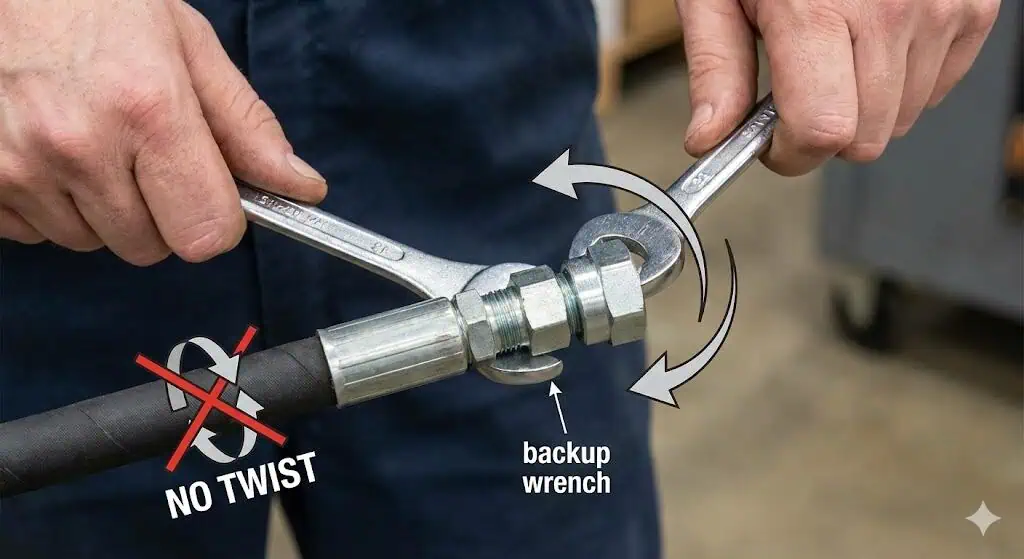
Engineering caution (what installers learn the hard way): Over-tightening does not “make it safer.” It often distorts seats, strips first threads, or causes galling—especially on stainless threads. Use controlled torque practice and inspect sealing faces before assembly.
Tip: Choose adapters when you need to convert thread/seat standards or solve routing, and when the connection will not be separated frequently.
Limitations
Adapters are not a replacement for a quick disconnect interface. If the connection must be separated routinely, an adapter-based solution increases labor time and increases the chance of thread/seat damage over repeated cycles. Always confirm pressure, temperature, thread type, and seal method.
| Limitation Type | Description |
|---|---|
| Material Compatibility | Ensure the adapter’s material and coating match the hydraulic fluid and environment (corrosion, washdown, chemicals). |
| Pressure and Temperature Ratings | Verify ratings meet or exceed system requirements and account for spikes and temperature swings. |
| Thread Types and Standards | Identify and match the thread + seat style to prevent leaks, seat damage, and stripped threads. |
| Size and Fit | Accurate measurement is essential; “close enough” increases rework risk. |
Field example (thread damage): A maintenance team forced a BSP fitting into an NPT port because it “started by hand.” The first threads stripped, sealant contaminated the port, and the joint leaked under load. The corrective action was replacing the damaged port fitting, cleaning out contamination, and enforcing thread identification with gauges.
If you need a leak troubleshooting workflow, use a repeatable method (clean → low-load run → find first wet point → identify seal style → correct repair → retest after warm-up) before changing parts.
Pros and Cons of Hydraulic Couplers
Benefits
Hydraulic couplers deliver fast, repeatable connections that improve uptime when attachments or modules must be swapped. Couplers are most valuable when service time matters and when procedures exist for cleanliness and seal inspection.
- You reduce downtime. Couplers eliminate lost time when hoses refuse to reconnect due to trapped pressure, especially in mobile equipment.
- You improve operator safety by reducing uncontrolled oil spray risks during separation (when depressurization and correct practices are followed).
- You avoid risky workarounds. Couplers provide a designed interface for repeated separation.
- You extend component service life when faces are kept clean and seals are replaced early.
- You achieve faster attachment changeovers, increasing productivity in mobile and stationary equipment.
Tip: A coupler is only as reliable as the maintenance routine around it—clean faces, cap when disconnected, inspect seals, and train operators.
Drawbacks
Couplers add an interface that must be managed. The most common real-world issues are contamination at the face, seal mismatch, and reconnection failures due to residual pressure.
- Choosing the wrong seal for hydraulic fluid or temperature conditions can cause premature failure. Confirm seal material compatibility as part of the spec.
- Leakage and contamination may occur if couplers are installed incorrectly, mixed across incompatible series, or used without caps/cleaning.
- Hoses and fittings connected by couplers are prone to wear if subjected to abrasion, impact, or repeated side-loading. Protect hoses and manage routing.
Note: Inspect couplers regularly. Replace worn seals early, keep faces clean, and do not force reconnection under residual pressure.
Choosing the Right Fit
Decision Checklist
Use this checklist to decide between a hydraulic adapter and a coupler for your system. This is the procurement-friendly version that prevents most “wrong part ordered” failures.
| Criteria | Description |
|---|---|
| Operating Pressure | Confirm the component can handle maximum pressure plus real pressure spikes in the circuit. |
| Thread/Connector Compatibility | For adapters: confirm thread + seat style. For couplers: confirm series, size, and face style. |
| Flow Rate | Ensure the fitting supports required flow without unacceptable pressure drop. |
| Material Compatibility | Select materials that resist corrosion and match your hydraulic fluid. |
Actionable verification steps (what to do before ordering):
- Identify the sealing method: tapered thread (sealant practice), flare seat, or face seal (O-ring).
- Measure and confirm: thread diameter + pitch, and seat angle/face style. Do not guess from photos.
- Confirm duty cycle: continuous vibration, frequent separation, washdown chemicals, outdoor exposure.
- Select seal material: match to fluid and temperature window; document it on the PO/spec.
- Plan contamination control: dust caps, wipe procedure, and storage method for disconnected lines.
Tip: If the connection will be disconnected routinely, write “caps + wipe-before-connect” into the maintenance SOP. It prevents more failures than changing brands.
Use-Case Examples
Choose based on service frequency, contamination risk, and how sensitive the system is to leaks.
- Automotive:
Use an adapter for a stable conversion between mismatched threads/ports. Use couplers for test benches and frequent tool swaps where setup time drives cost. - Construction:
Couplers keep attachment changeovers fast. Select flat-face couplers when the environment is dirty and contamination control matters. Use adapters when hoses/ports must be converted across standards. - Oil & Gas:
Adapters are common for stable, high-integrity plumbing on skids. Couplers are useful for maintenance modules, flushing rigs, and emergency swaps—provided cleanliness is controlled. - Material Handling:
Use adapters for plumbing conversions, and couplers for fast service access on fleets where uptime is the KPI.
Sunhy supports standard and custom configurations (thread types, materials, coatings) so systems can be matched to real duty cycles rather than “one-size-fits-all” parts.
Factors to Consider
These factors determine whether the joint survives real use. Most failures are not “mystery defects”—they are mismatch or installation issues that can be prevented with a disciplined checklist.
| Factor | Description |
|---|---|
| Compatibility | Match size, thread/seat standard, and coupler series. Confirm the sealing method. |
| Pressure Rating | Select components rated for system maximum and spikes. |
| Temperature Range | Choose materials and seals that maintain properties in your operating window. |
| Fluid Type | Ensure compatibility with mineral oil, water-glycol, or synthetic fluids as used. |
| Material | Choose steel/stainless/brass/aluminum based on corrosion, strength, and duty cycle. |
- Every fitting has a rated pressure class; confirm the rating is for your size/series, not a generic marketing claim.
- Temperature swings can change seal behavior; specify seal material and verify compatibility with your fluid.
- If your operation is dirty or abrasive, prioritize contamination control (caps, flat-face designs, and cleaning steps).
Sunhy’s product range covers common standards and materials, and supports customization for non-standard or legacy equipment where compatibility is the main constraint.
In summary:
- Choose a hydraulic adapter when you need a stable, leak-controlled connection between different thread/seat standards or sizes.
- Choose a coupler when you need fast connect/disconnect for frequent changes or maintenance.
- For many systems, the best result is adapter + coupler: adapter for standard conversion, coupler for service workflow.
Hydraulic Adapter and Coupler Applications
Industrial Use
Industrial systems usually favor adapters for stable plumbing and couplers for modular maintenance.
Factories, chemical plants, and material handling sites often prioritize leak control and serviceability. Choose materials and coatings that match the environment. Stainless steel is typically selected for chemical/wet environments; carbon steel with appropriate plating is common for general industry; brass/aluminum are used in selected applications.
For sealing method references and seal material discussion, see sealing types and seal material considerations (use it as a starting point, but confirm against manufacturer data sheets for your actual fluid and temperature).
| Material | Characteristics | Typical Applications |
|---|---|---|
| Stainless Steel | High strength, corrosion resistance | Chemical, marine, washdown, industrial |
| Brass | Good corrosion resistance, moderate strength | Selected lower-pressure applications |
| Aluminum | Lightweight, corrosion resistant | Low-pressure, weight-sensitive systems |
Tip: Don’t specify material alone. Specify material + coating (if carbon steel) + seal material + standard/series. That’s what makes the joint repeatable.
Mobile Equipment
Mobile equipment benefits from couplers for changeovers and adapters for conversions.
Excavators, bulldozers, and cranes see heavy vibration, impacts, and dirt exposure. Coupler face cleanliness and hose routing protection have a direct impact on leak frequency. For typical mobile applications and adapter use cases, see hydraulic adapter applications in mobile equipment.
- Construction equipment uses adapters for secure connections under vibration and load (when sealing method is correct).
- Agricultural machinery benefits from quick-connect couplers for frequent attachment changes.
- Reliable caps/cleaning routines prevent contamination-driven failures and reduce downtime.
Note: Inspect connections regularly. Dirt on coupler faces, hose abrasion, and residual pressure are the top causes of mobile quick-connect problems.
Construction and Agriculture
Construction and agriculture add two stressors: contamination exposure and frequent connect/disconnect cycles.
Adapters and couplers must fit diverse equipment and survive harsh environments. The best improvements usually come from standardizing coupler series, using caps, and training operators on depressurization and cleaning steps.
| Challenge | Description |
|---|---|
| Exposure to harsh conditions | Dirt, chemicals, and moisture degrade components over time and drive contamination events. |
| Compatibility with equipment | Adapters and couplers must match different machines and implements without mixing incompatible series. |
| Risk of leaks and failures | Frequent separation increases seal wear; poor cleaning introduces contamination and sticking. |
- Frequent implement changes can make connecting couplers difficult due to residual pressure.
- Forcing connections under pressure risks equipment damage and operator injury.
- Leak-free connections protect your system from contamination and vibration (when procedures and specifications are correct).
Sunhy’s sealing options (O-rings, flat-face choices, coatings) help maintain reliability—provided the system specification (standard/series/pressure/seal material) is clearly defined.
Choose adapters for stable, leak-controlled conversions. Choose couplers for fast, repeatable service connections.
You should always match pressure rating, temperature compatibility, fluid resistance, and thread type to your system.
- For adapters: confirm thread + seat + pressure rating + material/coating + seal method.
- For couplers: consider pressure, flow rate, seal material, port size, environment, and frequency of use.
Consulting Sunhy’s team helps with custom requirements (legacy ports, mixed standards, limited space) so the final assembly is repeatable and serviceable.
FAQ
What is the main difference between a hydraulic adapter and a coupler?
An adapter converts thread/seat standards for a stable connection; a coupler is a quick-disconnect interface for repeated connect/disconnect cycles.
Adapters solve compatibility and routing. Couplers solve uptime and service access. Both must be selected by rated pressure, seal style, and environment.
| Adapter | Coupler |
|---|---|
| Compatibility conversion, semi-permanent plumbing | Quick connection/disconnection, frequent service use |
When should you use a hydraulic adapter?
Use a hydraulic adapter when you need a stable, leak-controlled connection between mismatched thread/seat standards or sizes.
Confirm the sealing method (tapered thread vs flare seat vs face seal) and use controlled torque. If the joint will be separated often, a coupler is usually the better interface.
Engineering note: If “more torque” is the only fix you can think of, re-check the seal style and thread/seat match before damaging parts.
Can you use hydraulic adapters and couplers together?
Yes, and it is common in real systems.
Use an adapter to convert thread/seat standards, then install a coupler downstream to enable fast attachment changes or maintenance access. This approach reduces rework and improves service time.
How do you select the right material for hydraulic adapters or couplers?
Select material based on corrosion risk, pressure class, environment, and fluid compatibility.
- Stainless steel: corrosion/wet/chemical environments
- Carbon steel with coating: common heavy-duty industrial use
- Brass/aluminum: selected applications (confirm rating and compatibility)
Also specify seal material (O-ring/elastomer) based on hydraulic fluid type and operating temperature range. Material alone is not enough for repeatable reliability.
What maintenance do hydraulic adapters and couplers require?
Inspect for leaks, wear, corrosion, and connection integrity on a routine schedule.
- Wipe coupler faces before connecting; use dust caps when disconnected.
- Replace damaged or flattened seals early (do not “run it until it fails”).
- Check hose routing and abrasion points; protect hoses in vibration zones.
- After service, retest under load and re-check after warm-up.
Safety note: Always depressurize before disassembly. High-pressure hydraulic injection injuries are severe and require immediate medical attention.