Selecting the right flange gasket means matching the gasket material and construction to the media, temperature, pressure, flange face, and bolt load the joint can actually maintain.
In real piping systems, most leaks are not caused by the gasket alone. They happen when service conditions, gasket type, flange facing, and assembly quality do not work together. If you want to choose the right flange gasket, start with the service media and temperature, then confirm flange face type, pressure class, surface finish, and tightening method before final selection.
Flange gasket selection depends on media compatibility, pressure and temperature, flange facing, and verified installation controls.
A practical workflow should follow STAMP-style selection logic and be backed by manufacturer data sheets, flange standards, and bolted-joint assembly guidance. In other words, a gasket is not a stand-alone product decision. It is part of a complete joint integrity decision.
- Chemical compatibility and permeation control
- Pressure and temperature rating, including thermal cycling and start-up or shutdown spikes
- Flange facing type, surface finish, flange condition, and bolt load control
Quick Answer: How to Select a Flange Gasket
Choose the Right Gasket Material for the Media and Temperature
Select a gasket material that matches the exact fluid, concentration, and temperature profile, not just the generic service name.
Start with the process media, including solvent content, pH, steam quality, hydrocarbons, or corrosive chemicals. Then define the real temperature envelope, including normal operating temperature, excursions, and cycling frequency. Finally, check whether the gasket material resists swelling, permeation, oxidation, creep relaxation, or softening under those exact conditions.
- Use chemical compatibility charts only as a starting point, then validate against the exact concentration and temperature.
- Account for creep relaxation and cold flow, especially with PTFE-based materials under elevated temperature or low seating stress.
- For steam, hot oil, or cyclic thermal service, prioritize gasket materials and constructions with better recovery.
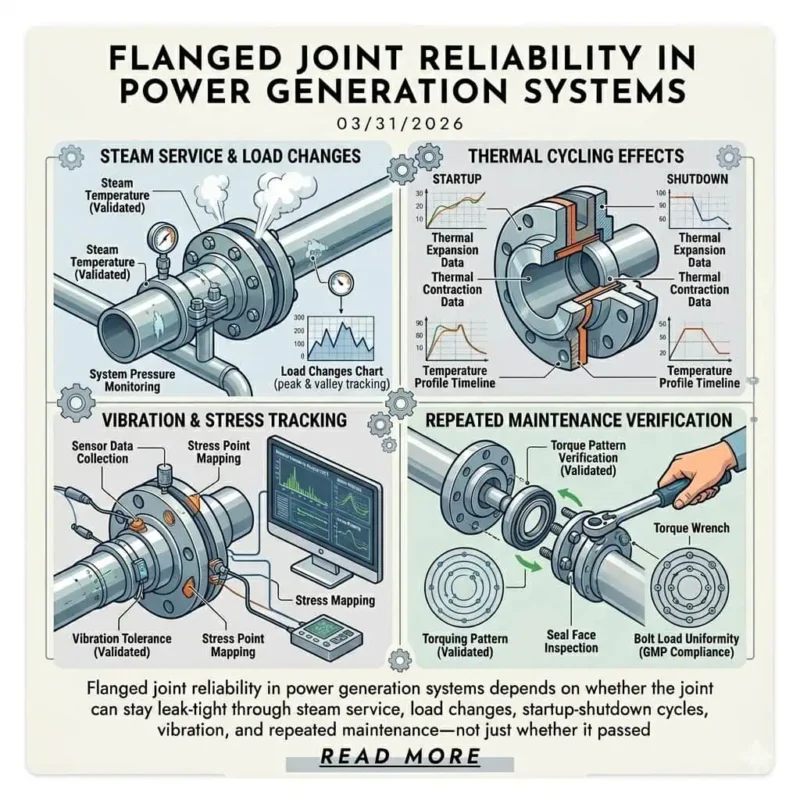
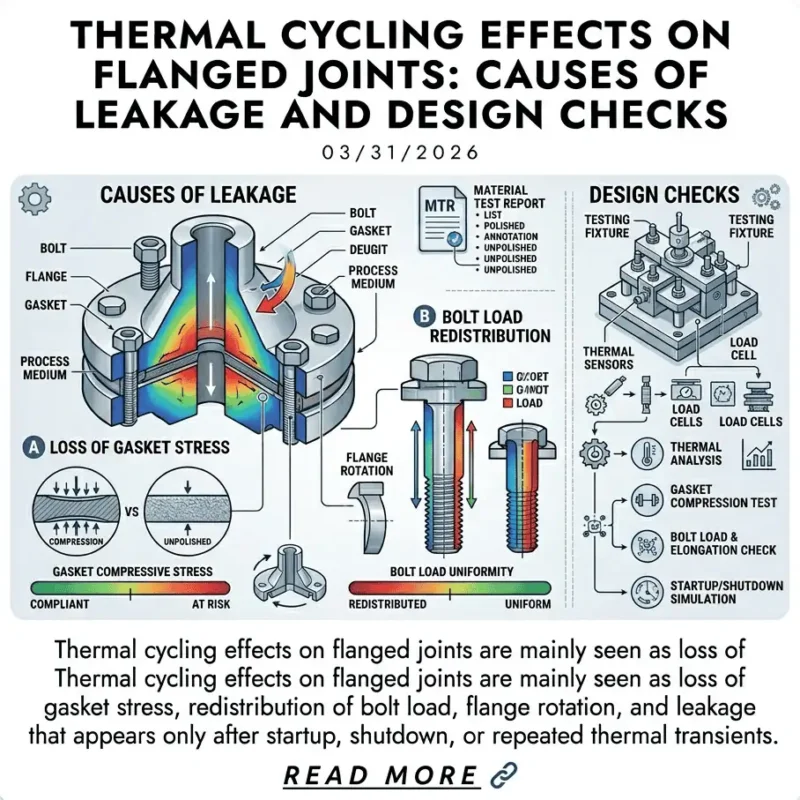
Field note: A common leak pattern is a flange joint that looks dry after installation but starts weeping after the first few heat-up and cool-down cycles. In many of these cases, the gasket material was technically compatible, but the joint lost bolt stress because of relaxation, poor tightening control, or a flange finish that did not suit the gasket construction.
Match the Gasket Type to the Flange Face and Pressure Class
Choose a gasket construction that matches the flange face style, pressure class, and service severity.
Pressure class alone is not enough. You also need to confirm flange facing type such as RF, FF, or RTJ, and then verify pressure-temperature ratings for the actual flange material and design temperature. A gasket that works on one flange facing may be completely wrong on another.
- RTJ gaskets must be used only with RTJ groove flanges.
- Spiral wound and kammprofile gaskets usually perform better than soft sheet gaskets when pressure and temperature cycling are present.
- For low-pressure water, HVAC, and utility systems, full-face or ring gaskets in elastomer, compressed fiber, or PTFE are common when compatibility is confirmed.
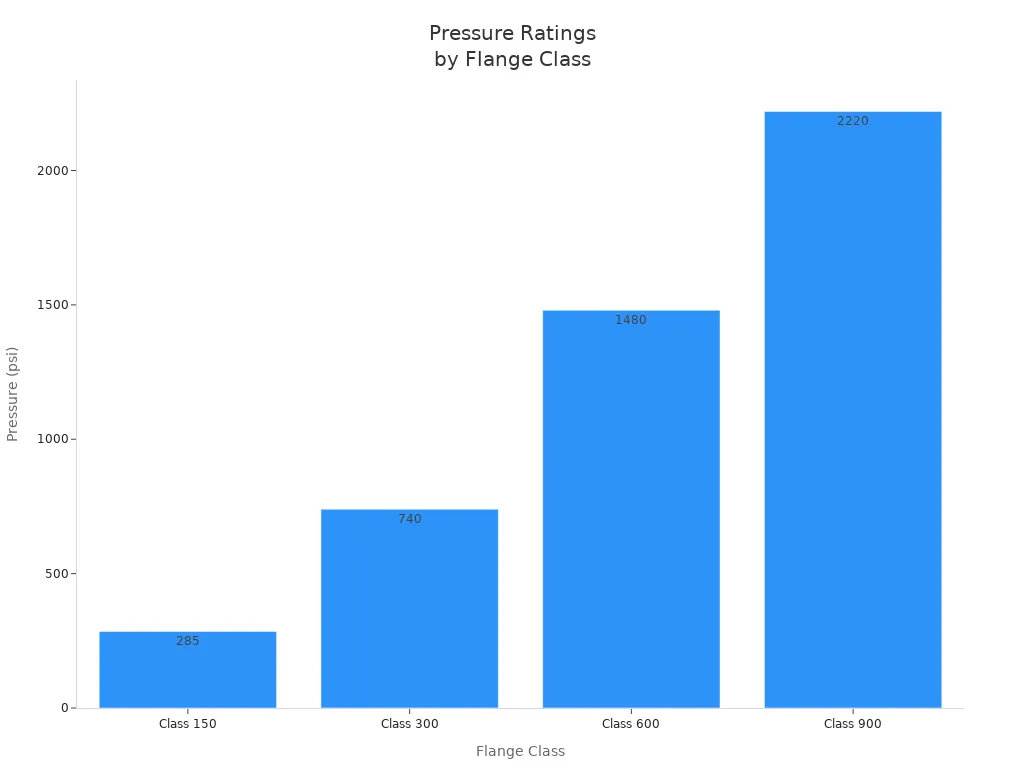
| Flange Class | Typical Rating at 100°F (Example: Carbon Steel per ASME B16.5 tables) | Common Application |
|---|---|---|
| Class 150 | ~285 psi | Water, HVAC, low-pressure steam |
| Class 300 | ~740 psi | Chemical, refinery, oil & gas |
| Class 600 | ~1480 psi | Power generation, higher-temp steam |
| Class 900–2500 | ~2220–6170 psi | High-pressure / specialty services |
Important: Always confirm pressure-temperature ratings using the applicable standard tables for your flange material group and design temperature, not only a room-temperature value. For procurement and design review, document the standard edition, flange material, facing type, and rating basis used.
Verify Standards, Surface Finish, and Bolt Load Control
Final gasket selection must include the standard basis, flange finish, and bolt load method.
For engineered piping systems, gasket selection should be aligned with recognized gasket and flange standards, then supported by a bolted-joint assembly procedure. Many repeat leaks are caused by incorrect bolt loading, damaged flange faces, or wrong surface finish rather than by the gasket material itself.
- Use gasket standards where applicable, such as metallic and semi-metallic gasket standards like ASME B16.20 and nonmetallic gasket dimension standards such as ASME B16.21.
- Use a documented bolt tightening method with staged passes, cross-pattern tightening, and verified torque or tension consistent with good bolted-joint practice.
- Verify flange surface finish and flatness, because a finish that is too smooth or too rough can both increase leak risk depending on gasket type.

| Certification / Standard | Why It Matters in Gasket Selection |
|---|---|
| ASME B16.20 | Defines common metallic and semi-metallic gasket constructions and dimensions used with ASME flanges. |
| ASME B16.21 | Defines dimensions for nonmetallic flat gaskets used with flanged joints. |
| ASME PCC-1 (Guidance) | Provides assembly concepts for bolted flange joints, including tightening patterns and joint integrity control. |
Tip: Many “mystery leaks” are really assembly-controlled leaks. If you do not control flange condition, alignment, and bolt stress, even a high-quality gasket can fail early.
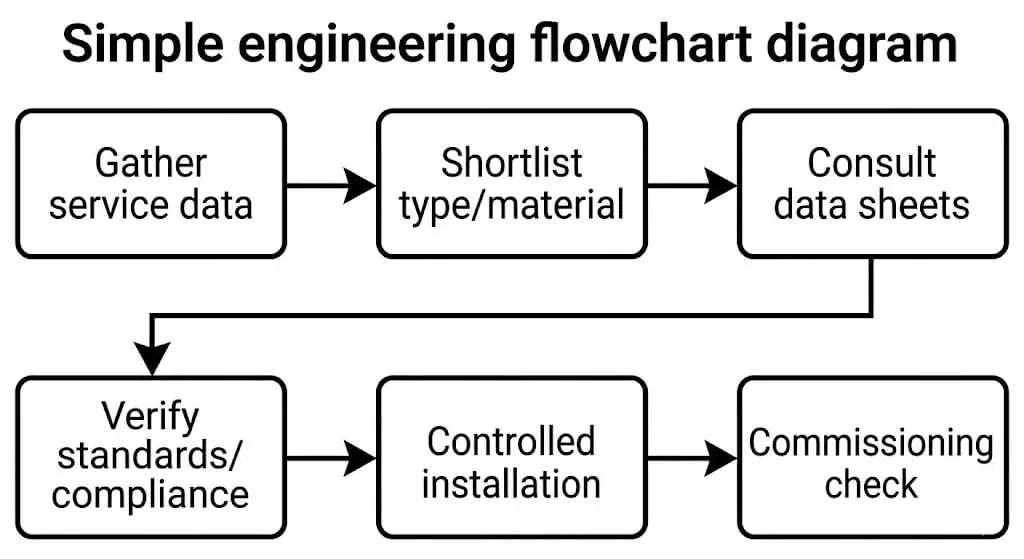
Flange gasket selection should work like an engineering control loop: define the service, choose gasket construction and material, confirm standards, control assembly, then verify sealing performance during commissioning and early operation.
Flange Gasket Types and Materials
Why Gasket Type Matters More Than Many Buyers Expect
Gasket failure is not just a leak issue. It can become a downtime, safety, emissions, and maintenance problem.
- Unplanned shutdowns and production loss
- Safety risk escalation with hot fluids, hydrocarbons, or toxic media
- Environmental reporting and cleanup costs
- Repeat maintenance when the root cause is actually stress loss, misalignment, or wrong gasket construction
Engineering example: A Class 300 hydrocarbon flange may pass hydrotest but begin leaking after thermal cycling if the joint loses stress or the selected gasket does not tolerate cycling. A successful test at one point in time is not the same as long-term sealing reliability.
Main Flange Gasket Types
Most flange gaskets fall into three broad families: non-metallic, semi-metallic, and metallic.
Each family fits a different combination of flange facing, pressure, temperature, and sealing reliability target.
- Non-metallic: elastomer, PTFE, graphite, compressed fiber. Best for low to moderate pressure and temperature when compatibility is proven.
- Semi-metallic: spiral wound, metal-jacketed, corrugated plus soft facing, kammprofile. Best for higher load, cycling, and better blowout resistance.
- Metallic: RTJ rings and solid metal seals. Best for extreme pressure and temperature with tightly controlled joint conditions.
For critical services, gasket selection should always be backed by the exact product data sheet and a written assembly method, not by habit or “what we used last time.” If you are also reviewing flange design basics, it helps to cross-check what the function of a flange is before finalizing the gasket choice.
There are three main types of flange gaskets: non-metallic, semi-metallic, and metallic. Each type serves specific service conditions and joint requirements.
| Type of Gasket | Materials / Structure | Where It Fits Best |
|---|---|---|
| Non-Metallic | Rubber, graphite, PTFE, non-asbestos fiber | Low to moderate pressure and temperature, utilities, water, and many chemical services when compatible |
| Semi-Metallic | Metal core or winding with soft filler or facing | Cycling service, higher pressure and temperature, improved blowout resistance |
| Metallic | Solid metal such as RTJ rings | High pressure, high temperature, and critical hydrocarbon service |
Non-Metallic Gaskets
Non-metallic gaskets are conformable and cost-effective, but they are more sensitive to stress loss and temperature limits.
They can compensate for small flange irregularities, which makes them useful in low-pressure and moderate-temperature service. However, they are not ideal when joint rotation, severe cycling, or very high seating stress stability is required.
Semi-Metallic Gaskets
Semi-metallic gaskets are often the best choice when a flange joint sees cycling, vibration, or higher pressure and temperature.
Spiral wound and kammprofile gaskets are common in refinery, steam, and chemical plant systems because they balance sealing contact with recovery better than many soft sheet materials.
- Better cycling resistance than many soft sheet gaskets
- More tolerant of demanding process conditions when flange finish and bolt load are controlled
- A common starting point for Class 300 and above, depending on the service
Metallic and RTJ Gaskets
Metallic gaskets offer the highest resistance to severe pressure and temperature, but they require precise flange geometry and assembly control.
RTJ gaskets only work correctly when the groove geometry, flange machining, and bolt load are correct. They are not general-purpose replacements for RF or FF gasket types.
- Best suited for critical high-pressure and high-temperature joints
- Requires correct groove or seating design and verified flange condition
- Less forgiving than soft or semi-metallic gaskets if the joint is damaged or misassembled
Best Flange Gasket Materials for Different Services
Compressed Fiber Gaskets
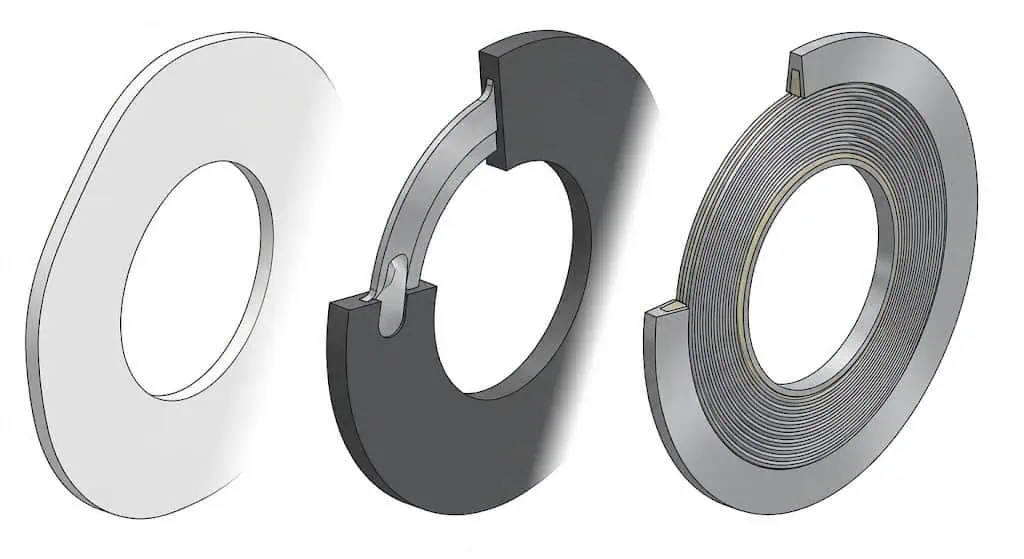
Compressed fiber gaskets are common for general industrial service where pressure and temperature are moderate.
These materials combine fibers with elastomer binders and are often chosen for utility systems, water lines, and general plant service. Their main advantage is cost-effective sealing, but they are less suitable for severe cycling or extreme temperature conditions.
| Gasket Type | Strengths | Limitations (Common) |
|---|---|---|
| Compressed Fiber (CNA) | Cost-effective, good sealability, wide general-service use | Less suitable for severe cycling, extreme temperature, or highly aggressive media without validation |
PTFE and Graphite Gaskets
PTFE and graphite are two of the most searched gasket materials because they solve very different sealing problems.
PTFE: PTFE is a strong choice when chemical resistance is the first priority. It performs well in many aggressive chemical services, but it can creep or relax under sustained load, especially at elevated temperature. If long-term tightness is critical, consider filled PTFE, expanded PTFE, or a semi-metallic construction that maintains sealing stress better.
Graphite: Graphite is widely used for high-temperature service and steam applications because it handles thermal cycling well. However, graphite is not unlimited in oxidizing air at elevated temperature, so the actual grade and operating environment must be checked carefully.
| Material | Advantages | Key Cautions |
|---|---|---|
| PTFE | Excellent chemical resistance; low friction; useful on many flange faces | Creep relaxation and cold flow; temperature limit depends on grade; verify seating stress requirement |
| Graphite | Good thermal cycling performance; strong in steam and many hot services | Oxidation in air at elevated temperature; verify grade and environment |
Engineering example: If a PTFE gasket seals well during commissioning but starts leaking after several weeks, the problem is often loss of joint stress rather than chemical attack. The practical fix may be increasing bolt load within allowable limits, changing to a filled or expanded PTFE grade, or switching to spiral wound or kammprofile for better long-term recovery.
Rubber and Elastomer Gaskets
Elastomer gaskets are common in water, HVAC, and low-pressure service, but chemical compatibility is critical.
Elastomers can swell, soften, crack, or harden when used with incompatible media. Choosing an elastomer “by habit” is one of the fastest ways to create an avoidable leak.
| Elastomer (Typical) | Where It’s Common | Typical Temperature Notes (Confirm by Grade) |
|---|---|---|
| EPDM | Water, outdoor service, ozone exposure | Good weathering; oil compatibility is poor in many cases |
| NBR (Buna-N) | Oils and fuels in many standard services | General oil resistance; verify solvent and aromatic content |
| FKM (Viton® family) | Higher-temperature hydrocarbons and chemicals in many cases | Good heat and chemical resistance; verify for steam, hot water, and amines |
| Silicone | Clean service and some food-related applications when approved | Good flexibility; verify mechanical strength and approvals |
Note: Do not use elastomer gaskets only because the flange is “low pressure.” Media and temperature still decide whether the gasket is suitable.
Spiral Wound and Metal-Reinforced Gaskets
Spiral wound and metal-reinforced gaskets are common when sealing reliability matters more than minimum initial cost.
Spiral wound gaskets combine a metal winding with a soft filler such as graphite or PTFE. Their spring-like behavior helps maintain tightness under cycling, but they still depend on correct flange finish, bolt load, and proper installation.
- Useful in thermal cycling and higher-severity service
- Requires correct flange finish and assembly discipline
- Winding metal and filler must both match the service
Tip: When thermal cycling is severe, kammprofile or corrugated-core designs are often worth evaluating because they can improve stress distribution and long-term tightness.
Flange Gasket Selection Using the S.T.A.M.P. Method
The STAMP method is a practical engineering checklist for flange gasket selection. It prevents the common habit of choosing a gasket only by past experience or by flange class.

| Parameter | Description |
|---|---|
| Size | Flange OD/ID, bolt circle, facing dimensions, gasket thickness, and seating width |
| Temperature | Steady-state, excursions, thermal cycling, and oxidation environment |
| Application | Equipment type, vibration, flange stiffness, rotation risk, and maintenance access |
| Media | Chemical family, concentration, permeability, and emissions needs |
| Pressure | Design pressure, surges, water hammer, and test method |
Size and Flange Face
Always match gasket size and gasket style to the actual flange standard and facing type.
For replacement work, confirm RF, FF, or RTJ before ordering. A wrong gasket style may physically fit the bolt circle yet still fail because the sealing area is wrong.
Temperature and Thermal Cycling
Use continuous-service and cycling limits, not only the maximum advertised temperature.
Thermal cycling drives stress loss and can accelerate oxidation or creep. If the joint will see frequent heat-up and cool-down cycles, prioritize gasket constructions with better recovery and proven product data.
Application and Mechanical Loading
Flange stiffness, vibration, and flange rotation risk directly affect sealing performance.
Thin flanges, long bolt spans, vibration, or misalignment can reduce effective seating stress. This is why the same gasket can work on one service and fail on another even when the media and temperature are similar.
Media and Chemical Compatibility
Chemical compatibility must be confirmed for the exact media and temperature, not only by service name.
Use compatibility charts as the starting point, then verify with the actual concentration, impurities, and process temperature. For emissions-sensitive service, also consider permeability and fugitive emissions behavior, not just resistance to attack.
| Media Type | Typical Starting Point (Verify by Data Sheet) |
|---|---|
| Oil / Fuel | NBR or FKM families are common starting points; verify solvent and aromatic content |
| Hot Water / Steam | Graphite-based and suitable semi-metallic designs are common; verify oxidation and cycling limits |
| Food / Pharma | Approved PTFE or silicone options may apply; verify FDA or EC compliance where required |
Pressure and Pressure Class
Pressure influences required seating stress, blowout risk, and which gasket construction is realistic for the joint.
Beyond steady pressure, include surge conditions, thermal expansion effects, pressure testing method, and any expected transients. The selected gasket must match what the joint can hold over time, not only what it can seal once during testing.
Tip: STAMP improves gasket selection only when the data is real. Measured flange condition, verified media details, and a documented bolt-loading method matter more than guessing from the application name.
Common Causes of Flange Gasket Failure
Material Mismatch and Chemical Attack

Material mismatch remains one of the fastest ways to create a leak.
Swelling, softening, cracking, permeation, oxidation, and stress relaxation all reduce sealing performance. A gasket that is “usually okay” in one service can fail quickly in another.
- Swelling or softening when an incompatible elastomer meets oil or solvent service
- Graphite oxidation in air at elevated temperature when the grade and environment are not checked
- PTFE creep relaxation when seating stress is too low or temperature is too high
Installation and Bolt Load Errors
Improper installation and bolt load errors are among the most common causes of premature gasket failure.
Typical root causes include uneven tightening, misalignment, dirty flange faces, damaged seating areas, and lack of staged tightening passes. Even the correct gasket cannot compensate for a poorly assembled joint.
- Misalignment during assembly
- Over-torque or under-torque
- Uneven bolt stress distribution because no staged passes were used
- Dirty, corroded, or damaged seating surfaces
Tip: Clean flange faces to bare metal, verify alignment, then use a staged cross-pattern tightening sequence with a verification pass.
Flange Surface Damage and Misalignment
Surface damage and misalignment create leak paths even when the selected gasket is technically correct.
Inspect for radial scratches, dents, pitting, flange rotation, and poor gasket centering. A wrong gasket size or damaged flange face reduces the effective sealing area immediately.
| Common Issues | Impact on Gasket Performance |
|---|---|
| Surface damage / pitting | Creates leak paths and reduces contact area |
| Misalignment / flange rotation | Causes uneven stress and early relaxation |
| Poor gasket cut quality | Reduces effective sealing area and compression uniformity |
| Incorrect gasket size | Prevents correct seating and stress distribution |
Step-by-Step Flange Gasket Selection Process
1. Gather Service and Flange Data
Collect service data before choosing the gasket.
Document the real operating envelope, transients, flange details, and maintenance limits. This step prevents wrong assumptions later in the process.
- Maximum and minimum temperature, including excursions
- Design pressure, transients, and test method
- Media composition and concentration
- Flange standard, size, face type, and surface finish
2. Shortlist the Gasket Type and Material
Shortlist gasket constructions that fit the flange face and service severity first, then narrow by material.
Use non-metallic gaskets for lower-severity service, semi-metallic for cycling and higher-severity duty, and metallic types for RTJ or extreme conditions. Then confirm chemical and thermal compatibility.
- RTJ rings for RTJ flanges in critical high-pressure service
- Spiral wound or kammprofile for cycling steam and refinery service
- Sheet PTFE, graphite, or CNA where seating stress and temperature limits are suitable
3. Check Manufacturer Data Sheets
Use the exact product data sheet to confirm pressure-temperature limits, chemical resistance, and seating stress guidance.
Do not rely on generic charts alone. Verify the exact grade, thickness, filler, and facing configuration you plan to order.
- Confirm temperature limits by environment, such as air versus steam or inert service
- Confirm pressure limits and recommended seating stress
- Confirm compatibility, permeability, and any emissions-related notes
Tip: If you cannot obtain a data sheet for the exact gasket grade, treat that as a procurement risk for critical service.
4. Verify Standards, Compliance, and Assembly Method
Verify the gasket standard, compliance requirements, and installation method before approval.
Engineering documentation should clearly state gasket type, standard reference, material grade, thickness, flange face, and installation method.
- Confirm applicable standards for gasket dimensions and construction
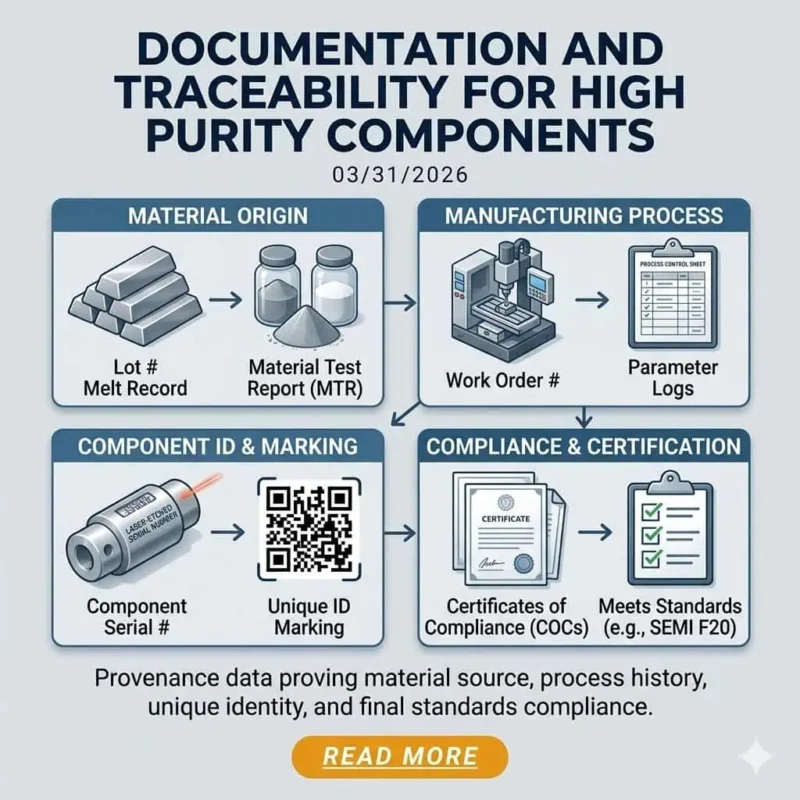
- Verify traceability documentation if required
- Confirm any fire-safe, emissions, or sour-service requirements for the duty
| Step | Purpose |
|---|---|
| Gather Service Data | Define the real operating envelope |
| Shortlist Type and Material | Match flange face and service severity |
| Consult Data Sheets | Validate PxT, compatibility, and stress requirements |
| Verify Standards and Compliance | Confirm fit, safety, and documentation |
Flange Gasket Selection Checklist
Service Conditions Checklist
Before final selection, confirm the service conditions clearly.
- Design pressure and transients are within joint capability
- Temperature envelope matches the gasket grade
- Media compatibility is confirmed for concentration and temperature
- Flange face type and gasket construction match
- Assembly method can achieve uniform bolt load
- Required compliance documents are available
Tip: If bolt stress and flange finish cannot be controlled well, choose a gasket construction that tolerates more assembly variability, but only with supporting data.
Design and Standards Checklist
Design and standards confirm that the gasket will fit correctly and that the joint can achieve tightness.
| Selection Criteria | What to Confirm |
|---|---|
| Flange Standard | Standard edition, flange face type, and dimensional basis |
| Surface Condition | Finish range suits gasket type; no damage or pitting |
| Bolt Load Method | Staged passes, correct pattern, verification, calibrated tool control |
Installation and Maintenance Checklist
Installation quality is part of gasket selection because many gasket failures are actually installation failures.
- Inspect and clean flange faces. Remove old residue and check for damage.
- Confirm gasket size, type, grade, and correct orientation.
- Align flanges and confirm bolt condition and lubrication practice.
- Tighten in a staged cross-pattern sequence using calibrated tools.
- Perform a verification pass and document values if required.
- Inspect the joint during commissioning and follow any approved hot-retorque or recheck procedure if applicable.
Matching gasket material to service conditions improves reliability and reduces leakage risk.
| Gasket Material | Key Properties | Typical Benefits |
|---|---|---|
| PTFE (grade-dependent) | Chemical resistance | Useful in many aggressive environments when creep is controlled |
| FKM (Viton® family) | Heat and chemical resistance (grade-dependent) | Often suitable in higher-temperature hydrocarbon service |
| EPDM | Weather and water resistance | Useful in water and outdoor utility service |
| Silicone | Flexibility | Useful in selected clean services when approved |
| NBR (Buna-N) | Oil resistance | Common starting point for oils and fuels |
Use this checklist and step-by-step process for every gasket selection, not only for critical service. For unusual media, low-emission duty, or severe cycling, consult the gasket manufacturer or joint-integrity specialist before freezing the specification. If you are reviewing suppliers at RFQ stage, it also helps to compare against questions to ask a flange fittings supplier before RFQ.
- Expert review reduces repeat leak cycles and shortens troubleshooting time.
- Correct selection plus controlled assembly supports safer, lower-maintenance operation.
Choosing the right gasket is a joint integrity decision: material, construction, flange condition, and assembly control must all line up.
FAQ
How do I choose the best flange gasket material?
Start with the media, temperature, and pressure, then check whether the joint can maintain enough seating stress for that gasket material.
For example, PTFE may be strong for chemical resistance but weaker for long-term stress retention, while graphite may be better for steam and thermal cycling if oxidation limits are respected.
Which gasket works best for RF, FF, and RTJ flanges?
The flange face controls which gasket style can be used correctly.
RF flanges often use ring-type gaskets such as spiral wound or ring-cut sheet gaskets, FF flanges commonly use full-face gaskets, and RTJ flanges require RTJ gaskets matched to the groove geometry.
Is spiral wound better than PTFE or graphite?
Not always. Spiral wound is often better for cycling and higher-severity service, but PTFE or graphite may be better when chemical resistance or specific temperature performance is the main driver.
The right choice depends on flange face, media, pressure, temperature, and whether the joint can maintain bolt load over time.
How does flange surface finish affect gasket performance?
Surface finish affects how the gasket contacts the flange and whether micro-leak paths form at the interface.
If the finish is too smooth, some gasket types may not bite correctly. If it is too rough, scratches and channels can create leakage paths. Always match finish recommendations to the gasket construction.

When should an engineer consult the gasket manufacturer?
Consult the manufacturer for unusual media, emissions-sensitive service, fire-safe duty, severe cycling, or when the exact product data sheet is unclear.
Ask for the exact grade data sheet, pressure-temperature limits, chemical resistance notes, and seating stress guidance for the flange face and finish you are using.