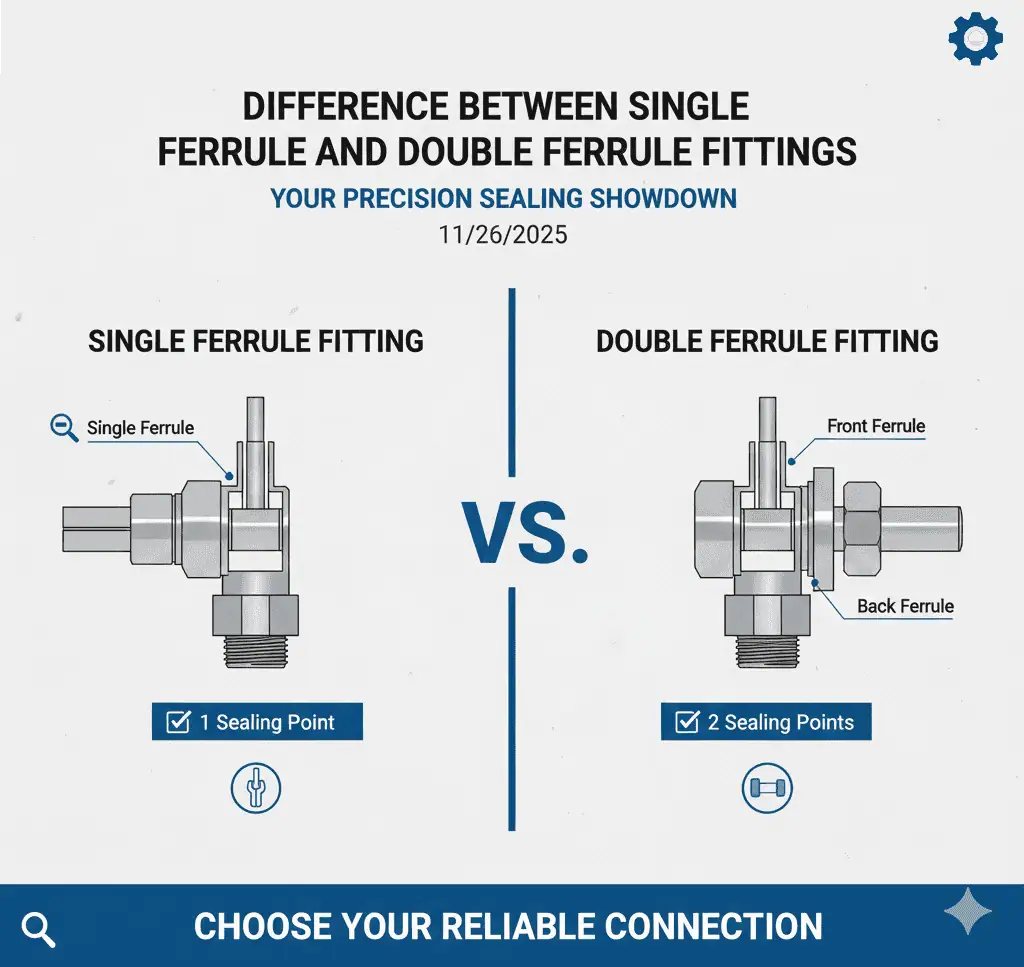
The main difference between single ferrule and double ferrule fittings is functional separation. A single ferrule uses one ring to create both the seal and the tube grip during pull-up, while double ferrule fittings use two ferrules—typically a front ferrule that forms the primary seal and a back ferrule that increases tube grip and resistance to loosening. In practice, the “right” choice is less about marketing claims and more about whether your system has vibration, thermal cycling, aggressive media, or frequent rework.
| Feature | Single Ferrule Fittings | Double Ferrule Fittings |
|---|---|---|
| Best-fit use | General service, simpler assemblies | Higher safety factor systems, vibration / cycling |
| Tube grip | One ferrule must do both jobs | Back ferrule adds mechanical hold |
| Installation control | Fewer parts, easier to learn | More sensitive to tube prep and pull-up method |
If you want a fast decision rule: choose a double ferrule fitting when your risk scenario includes high consequence leaks (flammables, toxins, hot fluids), persistent vibration, or repeated maintenance. Choose single ferrule when the system is low consequence, stable, and installation speed matters—but only if the tube condition and sizing are controlled.
What Are Single Ferrule and Double Ferrule Fittings?
Single Ferrule Fittings Overview
Single ferrule fittings use one ferrule to create both a seal and mechanical grip on the tubing.
During tightening (pull-up), the ferrule plastically deforms to bite/seat against the tube OD and the fitting body. Because one ring has to do both jobs, single-ferrule designs tend to be more sensitive to tubing quality (OD tolerance, ovality, scratches near the engagement zone) and installer technique.
Tip: Treat tube preparation as part of the “fitting system.” A perfect fitting will still leak if the tube end is out-of-square, not deburred, or not fully inserted to the shoulder.
Here is a quick look at the standard definition and core functions:
| Definition | Core Functions |
|---|---|
| Single ferrule fittings have one ferrule that deforms during pull-up to form the seal and tube hold. | They create mechanical, metal-to-metal sealing on tube OD for general service runs where vibration and thermal cycling are controlled. |
Field case (maintenance leak): A utility water skid developed a weeping leak after a technician “snugged” a single ferrule fitting during pump replacement. Root cause was not “bad fitting”—the tube had a shallow circumferential scratch exactly where the ferrule seats, and the tube was reinserted slightly short of the shoulder. Fix: cut back to clean tube, reface/deburr, remake the joint, and add a simple insertion-depth mark procedure.
- Oil and gas utilities / instrument air: Works when tube runs are well supported and vibration is low.
- Pharmaceutical / food support systems: Can be acceptable on non-product-contact lines where quick disassembly is needed and cleaning requirements are defined.
- General hydraulics (low energy): Common on low-pressure auxiliary circuits where leak consequence is low.
Double Ferrule Fittings Overview
Double ferrule fittings use two ferrules to separate sealing and gripping functions.
You will typically see a front ferrule that forms the primary seal against the fitting body, and a back ferrule that increases tube grip and reduces the chance of tube movement under vibration or thermal cycling. This separation is one reason two-ferrule systems are commonly specified for instrumentation and critical service.
Evidence you can verify: qualification and performance testing for metallic tube connections is commonly referenced to standards such as ISO 19879 (test methods for metallic tube connections). If a supplier claims “high vibration” capability, ask what test method they used and what the acceptance criteria were.
Field case (tube blowout risk): On a chemical dosing skid, a tube run was forced into alignment (side-load) and tightened. It held at low pressure but failed during cycling. Root cause was combined side-load + incomplete insertion (tube not seated to shoulder), which reduces effective grip length. Fix: re-route tube to eliminate side-load, use an insertion-depth mark, then remake the joint to the specified pull-up method.
- Chemical processing: Better tolerance to vibration/cycling when tube support and installation are controlled.
- Marine / offshore: Material selection and corrosion control become as important as ferrule count; crevice/under-insulation exposure must be addressed.
- Instrumentation: Preferred where stable, repeatable connections protect sensitive transmitters and analyzers.
You can choose between single ferrule and double ferrule fittings based on your system’s pressure, vibration, thermal cycling, and maintenance plan. Both types can be reliable—but only when the tube specification, preparation, and assembly method are treated as controlled variables.
Key Differences Between Single Ferrule and Double Ferrule Fittings
Design Comparison
Single ferrule and double ferrule fittings differ mainly in how load is distributed during pull-up.
Single-ferrule fittings concentrate sealing and holding loads into one deforming ring. Double-ferrule fittings distribute those functions: the front ferrule primarily seals, while the back ferrule increases mechanical hold and helps resist loosening when the tube experiences vibration or thermal cycling.
Here is a practical design comparison engineers use during selection:
| Feature | Single Ferrule Fittings | Double Ferrule Fittings |
|---|---|---|
| Number of Ferrules | One | Two |
| Primary seal | Same ferrule must seal + grip | Front ferrule forms primary seal |
| Tube hold / pullout resistance | Depends heavily on tube condition + pull-up | Back ferrule adds grip margin |
| Best-fit risk profile | Lower consequence leaks, stable runs | Higher consequence leaks, cycling/vibration |
| Rework behavior | Can be forgiving, but inspect carefully | Repeatable if markings and pull-up control are used |

Procurement note: regardless of type, ask for material traceability (heat/lot), dimensional inspection controls, and documented test approach. For tubing used with these fittings, it is common to specify standards such as ASTM A269 (stainless steel tubing) when applicable.
Sealing and Grip Mechanism
Single ferrule fittings combine seal and grip in one ferrule; double ferrule fittings separate them.
That separation matters when vibration or cycling tries to micro-move the tube. Micro-movement can lead to fretting at the ferrule/tube interface and gradual loss of sealing stress. The mechanism is not “mysterious”—it is contact pressure + movement + surface condition.
- Single-ferrule: one deformation event must achieve both sealing and adequate tube hold.
- Double-ferrule: front ferrule focuses on sealing; back ferrule increases tube grip and helps resist loosening.
- Tube quality drives sealing repeatability: OD tolerance, ovality, and surface damage near engagement commonly explain “random” leaks more than ferrule count does.
Field case (galling → inconsistent pull-up): Stainless-on-stainless threads assembled dry can gall, which changes the effective pull-up and makes the same “turn count” unreliable. Fix: follow the supplier’s guidance on lubrication (where permitted by your cleanliness spec), and standardize assembly using markings or gauges.
Installation Process

Single ferrule fittings install more simply; double ferrule fittings demand tighter control of tube prep and pull-up.
Most field failures trace back to one of four variables: (1) tube end not square/deburred, (2) tube not fully inserted to shoulder, (3) side-load from misalignment, (4) pull-up not executed to the documented method.
Here is a table comparing installation effort and typical use:
| Type of Fitting | Installation Effort | Typical Selection Logic |
|---|---|---|
| Single Ferrule | Lower | General service, low cycling, easier maintenance |
| Double Ferrule | Higher (more control points) | Higher consequence, vibration/thermal cycling |
Practical pull-up control (example method): many two-ferrule systems use a “finger-tight + turns” method, with size-dependent turn counts and optional gap inspection. Refer to your supplier’s written instructions; one widely used reference shows typical tightening increments and reassembly marking practices (example installation guide).
Tip: If your team cannot explain “how we verify full insertion and correct pull-up,” your system is not installation-controlled yet—regardless of fitting type.
Performance and Reliability
Leak Prevention and Pressure Resistance
Leak prevention is a system outcome: fitting design + tubing spec + installation control + operating envelope.
Double ferrule fittings often provide more margin against loosening and tube movement, which helps in cycling service. For critical systems, don’t rely on adjectives like “high pressure.” Ask for test basis. Standards such as ISO 19879 describe uniform test methods for metallic tube connections; that is the level of documentation you want behind performance claims.
Tip: For safety-critical fluids (flammables, toxics, hot condensate), prioritize fittings with documented test methods, controlled installation procedures, and audited traceability.
| Fitting Type | Leak Margin (with controlled installation) | Typical Weak Link in the Field |
|---|---|---|
| Single-ferrule | Good in stable service | Tube condition + insertion depth |
| Dual-ferrule | High in cycling/vibration service | Side-load + inconsistent pull-up |
Vibration and Corrosion Resistance
Vibration failures are usually “support and movement” problems before they are “ferrule count” problems.
Even robust fittings can fail if the tube run is unsupported and allowed to resonate. Vibration can also drive fretting at contact surfaces, which reduces sealing stress over time. If you see intermittent leaks that worsen with pump speed or compressor cycling, inspect tube support spacing and side-load at the fitting first.
Corrosion note (highly practical): austenitic stainless steels can be susceptible to chloride stress corrosion cracking under certain conditions. Industry guidance notes susceptibility concerns above roughly 60 °C in chloride-bearing environments, especially under insulation where wetness can be trapped (Nickel Institute guidance). In these environments, selection may shift to 316L, duplex, coatings, or insulation design changes—depending on your process and inspection strategy.
Field case (under-insulation cracking): A condensate line ran warm and was insulated. Leaks appeared “at fittings,” but the crack initiated in the tube near the fitting due to trapped chloride-laden moisture under insulation. Fix: remove wet insulation, clean and passivate where applicable, redesign insulation to prevent wetness traps, and reassess alloy choice for the real exposure.
Longevity and Maintenance
Longevity depends on whether your maintenance practice preserves the original pull-up condition.
Many tube fitting systems can be disassembled and reassembled when done correctly, but reassembly should not be “tighten until it feels good.” Use a repeatable method: mark the nut position during initial make-up, then return to that position during reassembly and tighten slightly as required by the supplier’s guidance (example reassembly practice).
- Inspection focus: tube scratches at engagement zone, ovality/dents, ferrule deformation, thread damage/galling.
- Leak-tracing: check for side-load, inadequate insertion, and vibration before replacing parts.
- Documentation: record fitting series, tube spec, assembly method (turns/torque/gauge), and any lubrication rules tied to cleanliness requirements.

Note: If you require controlled quality, request ISO 9001 certification evidence, material certificates (e.g., EN 10204 3.1), and inspection records as part of your procurement package.
Advantages and Disadvantages
Single Ferrule Fittings Pros and Cons
Single ferrule fittings reduce parts and can simplify installation, but the margin against movement and installer variation is usually lower.
You can rely on single-ferrule fittings when your service is stable, leak consequence is low, and tube preparation is controlled. Training is typically faster because there are fewer components and fewer “hidden failure modes.”
Here is a table that highlights practical advantages:
| Advantage | Description |
|---|---|
| Ease of Installation | Fewer components and simpler assembly logic. |
| Cost Control | Often lower installed cost where risk profile allows. |
| Maintenance Speed | Faster disassembly/reassembly when tubes are in good condition. |
However, you should plan around these limitations:
| Disadvantage | Description |
|---|---|
| Lower grip margin | More sensitive to incomplete insertion, tube scratches, and side-load. |
| Lower robustness in cycling service | May be less forgiving when vibration/thermal cycling is persistent. |
Tip: Single ferrule can be a good choice when your tube runs are short, supported, and the leak consequence is low—but only if your installation is standardized.
Double Ferrule Fittings Pros and Cons
Double ferrule fittings generally provide higher resistance to tube movement and loosening, which supports reliability in cycling service.
You benefit from double ferrule fittings when your system experiences vibration, temperature swings, or high consequence leaks. The separation of sealing and grip functions increases robustness—assuming your tube is prepared correctly and the pull-up method is followed consistently.
Here are the main advantages you can expect:
- Higher practical margin against loosening in vibration/cycling service.
- Stronger tube grip behavior when installation is controlled.
- Commonly specified for instrumentation and critical process utility lines.
Trade-offs you should plan for:
- More sensitive to tube condition (OD tolerance, out-of-round) and side-load.
- Requires standardized pull-up (turns/torque/gauge) and installer training.
Note: If you need “high reliability,” define it: vibration levels, cycling count, temperature range, media, and leak consequence. Then align fitting choice and installation QA to that definition.
Single ferrule and double ferrule fittings each have strengths and weaknesses. You can select the best option by considering your system’s risk profile, vibration/cycling, and maintenance plan.
Applications of Single Ferrule and Double Ferrule Fittings
Industrial Use Cases
You will find single ferrule and double ferrule fittings across utilities, instrumentation, and process support systems.
Single ferrule fittings are often used where systems are stable and leak consequence is manageable. Double ferrule fittings are commonly selected for instrumentation, analyzers, and critical lines where vibration and thermal cycling exist.
Common industry applications include:
- Oil and Gas (instrumentation / sampling): Two-ferrule designs are widely used for vibration control and maintenance repeatability.
- Chemical Processing: Material compatibility and corrosion control are first-order constraints; fitting design comes next.
- Water Treatment: Single ferrule may be acceptable in low consequence utility services with controlled installation.
- Food and Beverage: If used, define whether the line is product-contact or utility; hygienic requirements may drive other connection types. For broader stainless selection context, see stainless steel flange types and selection.
- Pharmaceutical (utilities / non-product-contact): Define cleaning/validation constraints; avoid practices that trap debris at joints.
Tip: If your site has recurring “mystery leaks,” audit tube support, insertion-depth verification, and pull-up standardization before changing fitting type.
Choosing the Right Fitting for Your Needs
You should select the fitting type based on pressure/energy, vibration/cycling, leak consequence, and material compatibility.
Engineers typically make the decision by scenario, not by catalog language:
| Criteria | Recommendation |
|---|---|
| Persistent vibration / thermal cycling | Favor double ferrule + improve tube support and eliminate side-load |
| Low consequence, stable service | Single ferrule can be acceptable with controlled tube prep and insertion checks |
| High consequence leak (flammable/toxic/hot) | Favor documented test basis (e.g., ISO 19879 reference), traceability, and standardized installation QA |
| Corrosive / chloride exposure | Start with alloy and exposure controls; then verify fitting suitability |
| Procurement quality control | Specify tubing standard (e.g., ASTM A269 where applicable), EN 10204 3.1, and installation method requirements |
Field case (wrong problem definition): A team replaced single ferrule with double ferrule to “fix leaks,” but failures continued. Root cause was tube runs acting as cantilevers off vibrating equipment. After adding proper clamps and correcting alignment, both designs performed reliably. The fitting was not the root cause.
How to Select the Best Fitting
Key Factors to Consider
You should focus on application envelope, tube specification, installation QA, and corrosion exposure when selecting the best ferrule fitting.
Selection is safer when you write down the constraints first: media, normal/upset temperature, pressure/energy, vibration sources, inspection interval, and acceptable leak rate. For systems governed by process piping requirements, standards like ASME B31.3 define broader expectations for design, fabrication, examination, and testing.
| Factor | Why it matters | What to verify |
|---|---|---|
| Tubing standard / condition | OD tolerance, ovality, surface damage directly affect sealing | Material spec (e.g., ASTM A269 when applicable), OD checks, end prep |
| Vibration / cycling | Micro-movement can relax sealing stress over time | Tube support spacing, side-load elimination, documented test basis |
| Threaded adapters in the same system | Wrong thread standard causes leaks that look like “fitting leaks” | NPT context: ASME B1.20.1 (verify thread type) |
| Corrosion exposure | Chlorides, cleaners, insulation wetness can drive cracking/pitting | Exposure mapping, alloy choice, insulation/coating controls |
You should also consider the following factors before making your choice:
- Pressure/Energy Profile: Don’t use “max pressure” alone—consider cycling and consequence of release.
- Material Compatibility: Match fitting material, tube material, and media; avoid unintended galvanic couples.
- Environmental Conditions: Chlorides, insulation wetness, washdown chemicals, and temperature can dominate failure modes.
- Installation Method: Decide whether your site will use turns-from-finger-tight, torque, or gauges—and train to it.
- Documentation: Require traceability and test references for critical service.
Tip: Always verify tube OD and roundness. If you cannot measure it, you cannot control it—and fitting reliability becomes guesswork.
Practical Tips for Selection
You can avoid most leak incidents by standardizing tube prep and assembly verification.
Practical best practices used in real plants:
- Control tube end prep: cut square, deburr ID/OD, clean chips/oil, and avoid ovality at the end.
- Verify full insertion: use an insertion-depth mark so “seat to shoulder” is not a guess.
- Eliminate side-load: don’t force misaligned tube runs into the fitting body.
- Standardize pull-up: turns/torque/gauge—pick one method and document it.
- Define reassembly rules: mark nut position at first make-up; inspect ferrules and tube before reuse.
- Separate sealing methods: don’t apply sealant where the joint is designed to seal metal-to-metal; if you use NPT elsewhere, keep sealant practices limited to the thread design and cleanliness rules. For an internal reference page, see A Complete Walkthrough for Tube Fitting Installation.

You can see common mistakes and how to avoid them in the table below (engineering version):
| Mistake Type | Description | What it causes | How to prevent |
|---|---|---|---|
| Incomplete insertion | Tube not seated to shoulder before pull-up | Low grip margin, intermittent leaks | Use insertion-depth mark; confirm mark disappears under nut |
| Out-of-square / not deburred | Tube end not square; burrs damage sealing surfaces | Leak path, ferrule damage | Square cut + deburr ID/OD + clean |
| Side-load misalignment | Tube run forced into position | Fretting, relaxation, cracks near joint | Re-route or add bends; clamp/support correctly |
| Uncontrolled pull-up | “Feel-based” tightening, inconsistent turn counts | Under/over compression, galling | Follow documented turns/torque/gauge method |
For broader context on fitting families and how ferrule load interacts with tube OD and surface condition, you can reference: What You Need to Know About Tube Fitting Types and Leak-Free Instrumentation Tube Fittings Installation Guide.
Tip: If you want fewer leaks, your biggest ROI is usually: tube support + insertion-depth verification + standardized pull-up—not “switching brands.”
Single ferrule fittings offer simpler installation for stable, low consequence service, while double ferrule fittings usually provide more grip margin and better resistance to loosening in cycling/vibration environments.
You improve safety and reliability when you match fitting type to application risk and control the installation method. The table below highlights a quick summary:
| Feature | Single Ferrule | Double Ferrule |
|---|---|---|
| Installation | Fewer parts, simpler | More control points |
| Grip/Seal robustness | Good in stable service | Higher margin in cycling/vibration |
If you are sourcing for critical industries, require traceability (heat/lot), documented installation instructions, and a test basis appropriate to your risk profile. That package matters more than any one sentence on a product page.
FAQ
What is the main difference between single ferrule and double ferrule fittings?
Single ferrule fittings use one ferrule to create both sealing and tube grip, while double ferrule fittings separate the functions across two ferrules.
In the field, the difference shows up as “margin.” Double ferrule designs often provide more resistance to tube movement and loosening when vibration or thermal cycling is present—assuming tube prep and pull-up are controlled.
When should you choose double ferrule fittings?
Choose double ferrule fittings when leak consequence is high or the system is exposed to vibration, cycling, or frequent rework.
Examples include analyzers, impulse lines, critical utilities, and any service where a small leak becomes a safety, environmental, or uptime issue. Define your envelope (media, temperature, cycling) and require a documented installation method.
Are Sunhy’s stainless steel fittings suitable for corrosive environments?
They can be suitable if the alloy and exposure controls match the actual environment.
In corrosion problems, “316 vs 304” is only part of the story. Chlorides, wet insulation, cleaners, and temperature often dominate. For higher-risk chloride exposure, validate alloy selection and consider mitigation (coatings/insulation design/duplex options) based on your inspection and reliability targets.
How do you ensure a leak-proof connection?
You ensure a leak-proof connection by controlling tube prep, full insertion, alignment, and pull-up method.
Square cut + deburr + clean, seat the tube to the body shoulder, eliminate side-load, then tighten using the documented method (turns/torque/gauge). Marking the nut position during first make-up improves repeatability during reassembly.
Can you reuse ferrule fittings after disassembly?
Reuse is possible when the tube and ferrules are undamaged and reassembly follows the documented method.
Before reuse, inspect for tube scoring at the engagement zone, ferrule deformation, and thread damage/galling. If the tube has scratches where the ferrule seats, cut back to clean tube and remake the joint.
What tubing standard should you specify for stainless instrument tube runs?
Specify a tubing standard that controls chemistry, heat treatment, and dimensional requirements appropriate to your service.
For many corrosion-resisting stainless tube applications, purchasers commonly reference standards such as ASTM A269 where applicable. Always confirm OD tolerance/roundness requirements that your fitting system depends on.
Why do leaks show up “at the fitting” after maintenance?
Because maintenance changes one of the controlled variables: insertion depth, alignment, or pull-up repeatability.
The most common causes are incomplete insertion, side-load introduced during rework, or “feel-based” retightening that does not return the joint to the original pull-up condition. Standardize markings and reassembly rules to prevent repeat incidents.