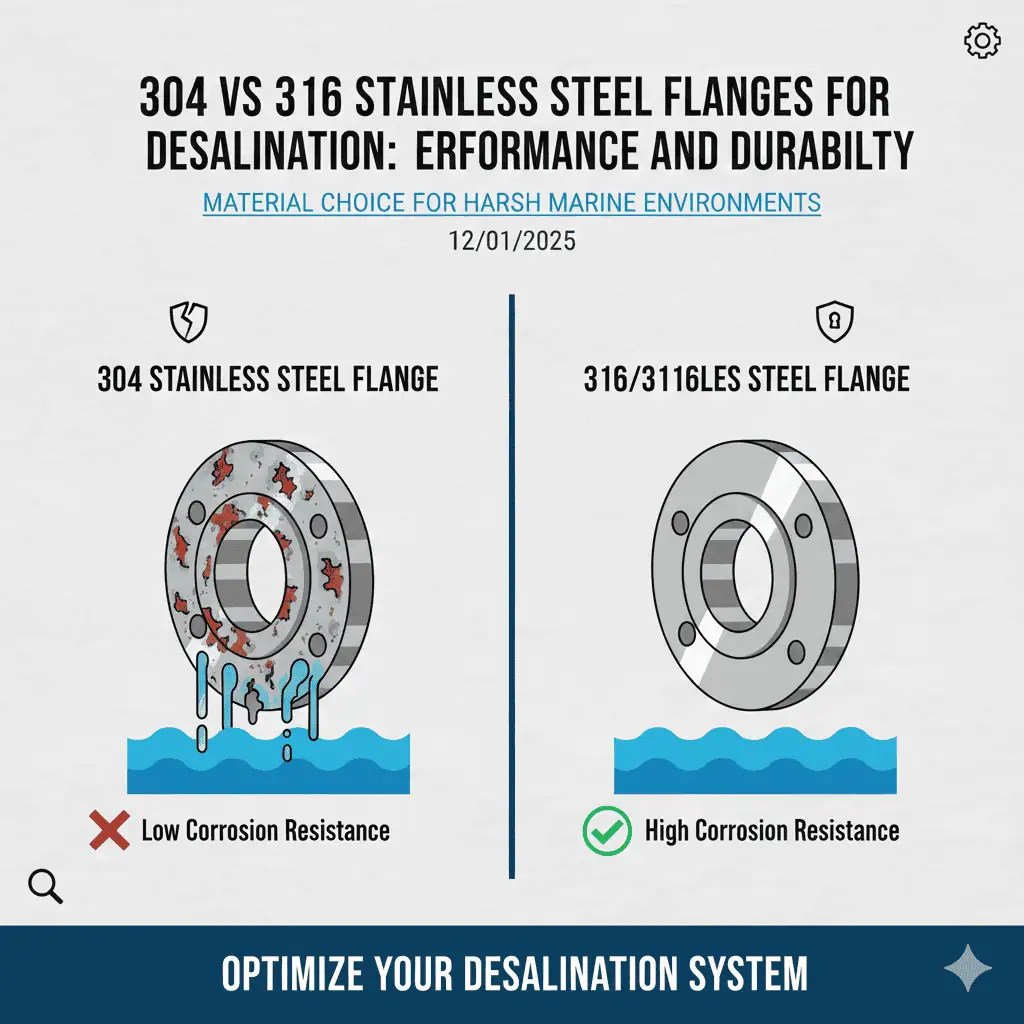
For continuously wetted seawater flange joints, 304 stainless steel is generally not the preferred choice, while 316/316L is the common baseline. The reason is not simply “better corrosion resistance” in a general sense. It is the specific combination of chloride-rich seawater, gasket crevice geometry, stagnant zones, and operating temperature that drives localized attack at flange sealing faces. In ambient seawater service, 316/316L is widely used as the entry-grade austenitic option. In hotter brine, poorly flushed crevices, or higher-stress service, engineers often move beyond 316L and evaluate Duplex grades instead.
In seawater desalination engineering, flange selection is a corrosion-control decision as much as a pressure-class decision. While 304 and 316 stainless steel flanges may look similar on a drawing, they do not behave the same way once chlorides concentrate under the gasket seating area. Seawater typically contains chloride concentrations above 19,000 mg/L, and reverse osmosis brine can be significantly more concentrated. That makes the flange face, especially the gasket crevice, one of the most critical corrosion locations in the system.
In practice, the engineering question is not “which grade is stronger?” It is which grade will maintain seal integrity at the flange face under the real chloride, temperature, and flow conditions of this system. For general ambient seawater service, 316/316L is usually the baseline. For warm brine, stagnant side branches, dead legs, or highly stressed joints, the decision often shifts toward Duplex or higher-alloy materials.
According to ISSF desalination guidance and practical material-selection experience, 316L is the common austenitic starting point for wetted seawater service, but it is not an unlimited solution. In higher-temperature sections or more aggressive brine conditions, even 316L can reach its practical limits and require an upgrade.
| Stainless Steel Grade | Chloride Resistance Mechanism | Typical Service Outcome in Seawater |
|---|---|---|
| 304 / 304L | Relies mainly on chromium oxide passivation. No molybdenum. | High risk: rapid pitting or crevice attack can start at gasket seats and stagnant zones. |
| 316 / 316L | 2–3% molybdenum improves passive-film stability in chloride service. | Common baseline: generally reliable in ambient seawater when crevices are controlled and surfaces stay clean and flushed. |
The operational advantage of 316 stainless steel comes directly from its molybdenum content, typically around 2.0–3.0%. This addition improves resistance to localized chloride attack and raises the margin before pitting or crevice corrosion starts. For critical areas involving hot brine, poor circulation, dead legs, or high residual stress, engineering teams should evaluate whether 316L is sufficient or whether Duplex 2205 or a higher-alloy alternative is the safer choice.
304 vs 316 Stainless Steel Flanges: Composition & Metallurgy
Alloying Elements: The Chemical Difference
The key metallurgical difference between 304 and 316 flange materials is the presence of molybdenum in 316. Both grades are chromium-nickel austenitic stainless steels, but 316 adds 2.00–3.00% molybdenum, which is highly relevant in chloride service. In flange applications, corrosion is rarely uniform. It tends to appear as localized attack on the gasket seating area, in crevices, or beneath deposits. That is why verifying the actual material grade through the Material Test Certificate (MTC) is not just a paperwork step. It is part of corrosion-risk control.
The World Stainless technical property tables and ASTM standards give the following typical composition ranges:
| ASTM A182 Grade | Chromium (%) | Nickel (%) | Molybdenum (%) |
|---|---|---|---|
| F304 / F304L | 18.0 – 20.0 | 8.0 – 11.0 | — |
| F316 / F316L | 16.0 – 18.0 | 10.0 – 14.0 | 2.00 – 3.00 |
- 304 stainless steel: often performs well in atmosphere, fresh water, and many general industrial environments, but it lacks molybdenum and is much less tolerant of chloride-rich crevice exposure.
- 316 stainless steel: the molybdenum addition improves resistance to localized chloride attack and is the main reason 316 is more suitable for corrosive-service flange duties.
- Dual-certified 316/316L: the low-carbon “L” grade helps protect welded zones from sensitization, which is especially relevant for welded piping systems using slip-on or weld-neck flanges.
In other words, the selection difference is not abstract metallurgy. It directly affects whether the gasket seating area and crevice zones remain passive or begin to pit in seawater service.
Impact of Molybdenum on Corrosion Resistance (PREN)
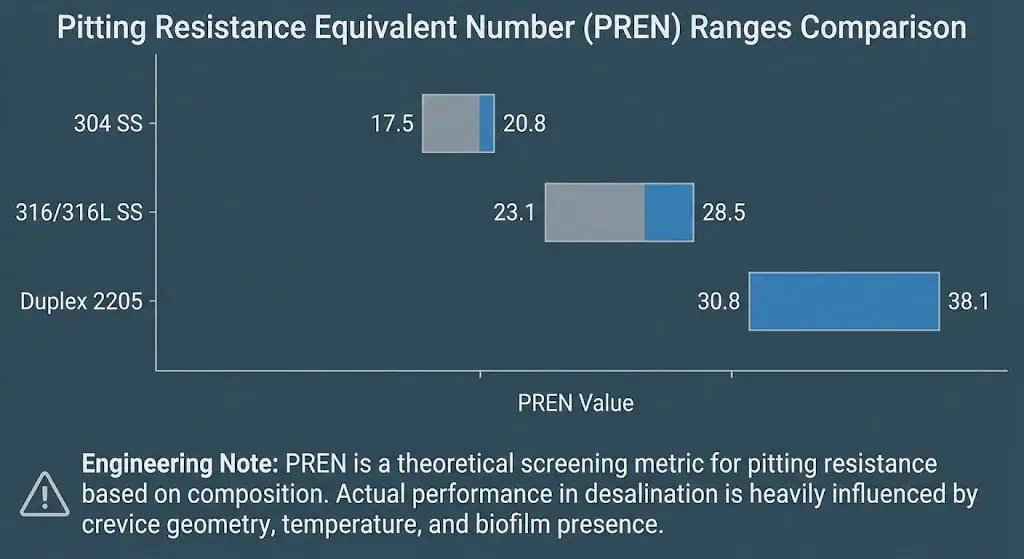
Molybdenum changes more than a catalog description. It changes the Pitting Resistance Equivalent Number (PREN), which is one of the most useful screening metrics for chloride service.
- Mechanism: molybdenum helps stabilize the passive layer and improves resistance to chloride-driven pit initiation and pit growth.
- The PREN formula: PREN = %Cr + 3.3(%Mo) + 16(%N). The multiplier on molybdenum is why a modest Mo addition makes such a large difference in seawater service.
- Practical comparison: standard 304 generally falls below the usual seawater starting point, while 316L sits closer to the entry range for ambient seawater applications.
| Material Grade | PREN Range | Engineering Implication for Flanges |
|---|---|---|
| 304 | ~17.5 – 20.8 | Not preferred for wetted seawater crevice service. The gasket region is especially vulnerable. |
| 316/316L | ~23.1 – 28.5 | Common baseline. Suitable for many ambient seawater applications when geometry and cleanliness are controlled. |
| Duplex 2205 | ~31.0 – 38.0 | Frequent upgrade choice. Often selected for higher temperature, higher stress, or more aggressive seawater/brine duty. |
Engineering insight: In seawater systems, the weakest location is often the gasket crevice. Even when the pipe wall looks fine, the stagnant shielded zone at the flange face may be the first place where corrosion begins.
Corrosion Resistance in Seawater and Desalination Environments
Corrosion Mechanisms in Seawater
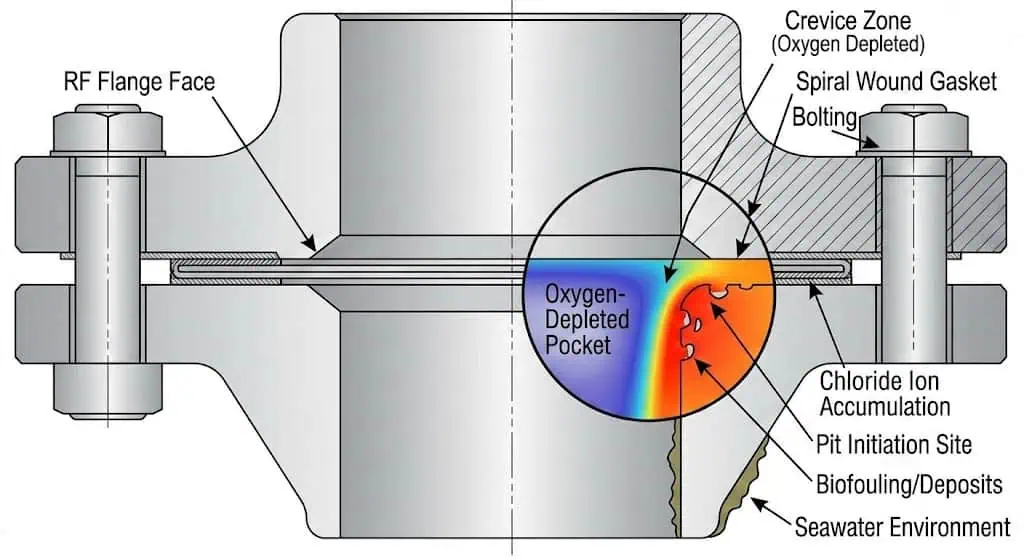
Seawater and desalination systems are aggressive because chlorides interact with flow conditions, deposits, and crevice geometry. For flanges, the gasket seating area creates exactly the kind of shielded zone where localized attack is most likely.
Three main corrosion mechanisms usually govern flange selection in marine and desalination service:
- Crevice corrosion: often the primary concern for flange joints. Shielded gasket areas become oxygen-depleted, chlorides concentrate, and the local environment becomes more aggressive.
- Chloride-induced pitting: can occur on open surfaces, especially when deposits, biofouling, or stagnant seawater remain on the flange.
- Stress corrosion cracking (SCC): becomes more important when tensile stress, chlorides, and elevated temperature combine.
| Mechanism | Engineering Description |
|---|---|
| Pitting | Localized penetration of the passive film, often starting under deposits or biological fouling. |
| Crevice Corrosion | Occurs in shielded areas such as gasket faces and thread roots, where chemistry can become much more aggressive than on open surfaces. |
| SCC | Cracking under tensile stress in chloride environments, with risk increasing as temperature rises. |
Note: Galvanic corrosion is also a real risk. If a stainless flange is mated to carbon steel without an isolation kit, the carbon steel side may deteriorate rapidly.
304 Flanges: Performance Analysis
304 stainless steel flanges are generally a high-risk choice for continuously wetted seawater service and are better limited to non-wetted, dry, or fresh-water utility duties.
The problem is not that 304 is a poor material in every environment. The problem is that its resistance margin is too low for chloride-rich crevice service at the flange face. In practice, 304 can perform acceptably in dry service, atmospheric exposure, or freshwater systems, but once seawater reaches the gasket crevice, the risk profile changes sharply.
- Application limit: best reserved for dry service, freshwater utility lines, or non-wetted structural duties.
- Main risk: pitting and crevice attack at the gasket seating area and stagnant wetted zones.
- Maintenance burden: early attack at the flange face can turn a lower purchase price into higher inspection, rework, and replacement cost.
Field example: A temporary seawater bypass line at an intake station used 304 slip-on flanges. After a relatively short service period, leakage appeared at the gasket area. Inspection showed localized pitting on the flange face, aggravated by stagnant deposits. The long-term corrective action was replacement with 316L flanges and an upgraded gasket specification.
316/316L Flanges: Durability & Limitations
316 stainless steel, especially dual-certified 316/316L, is the common baseline for wetted seawater flange service.
316/316L usually provides a workable balance of corrosion resistance, fabrication practicality, and cost for ambient seawater intake, pretreatment, and lower-stress piping zones. The “L” grade matters in welded systems because it reduces the risk of sensitization and helps preserve corrosion resistance through fabrication.
- Primary advantage: significantly better resistance to chloride-driven pitting and crevice corrosion than 304.
- Dual certification: supports both corrosion performance and fabrication flexibility.
- Limitation: in warmer brine, stagnant dead legs, or high-stress service, 316L may still be pushed beyond its safe margin.
| Material Type | Corrosion Resistance | Recommended Application Scope |
|---|---|---|
| 304 | Moderate | Dry service, freshwater, structural supports, non-wetted duties. |
| 316 / 316L | High | Ambient seawater intake, pretreatment, and many wetted low-to-moderate stress zones. |
| Duplex 2205 | Very High | Higher temperature, higher stress, warm brine, and more demanding seawater service. |
Tip: Material selection is only part of the decision. Flange-face cleanliness, gasket choice, and stagnant-zone control matter just as much.
Real-World Data and Case Patterns
Operational experience in desalination plants shows that 316L performs best when flow, flushing, and crevice control are handled correctly.
In seawater reverse osmosis plants, 316L is widely used in many intake and low-pressure sections. However, problems often appear where flow is poor, deposits remain, or a blind flange or dead-leg section traps stagnant chloride-rich liquid. That is why the success of 316L depends not only on alloy selection, but on geometry and housekeeping as well.
- Success factor: 316L performs more reliably in flowing, oxygenated systems where surfaces remain clean.
- Failure pattern: blind flanges, low-flow drains, and stagnant branches can become localized attack points even when the main system performs well.
- Engineering response: in those stagnant or hotter zones, engineers often move to Duplex or higher-alloy materials even if the main line remains 316L.
Lifecycle Cost Analysis (LCC)
Initial Investment vs. Operational Risk
316 stainless steel flanges usually cost more up front, but in seawater service they often reduce total lifecycle cost. The price difference is driven mainly by nickel and molybdenum content, while the cost of leakage is driven by downtime, joint disassembly, production loss, and safety risk.
- Price gap: 316 commonly carries an alloy premium over 304, but the exact gap depends on raw-material surcharges.
- Leakage cost: in desalination plants, a flange leak often means partial train shutdown, labor, consumables, and lost production.
- Risk margin: 316L usually provides a more predictable operating envelope in marine service than 304.
| Cost Metric | 304 Stainless Steel | 316 Stainless Steel |
|---|---|---|
| Initial Material Cost | Lower | Higher |
| Operational Expenditure (OPEX) | Higher in seawater due to greater corrosion risk and maintenance burden | Lower in many marine applications due to longer service life and lower repair frequency |
| Risk Profile | Higher and less predictable in wetted seawater | More manageable within its operating envelope |
Maintenance and Replacement Factors
Choosing 316L typically reduces the frequency of joint-related maintenance in wetted seawater service.
- Inspection intervals: 316L systems often support longer and more predictable inspection intervals than 304 in marine exposure.
- Consumables: every flange break means new gaskets, fastener checks, and labor. Reducing joint failures reduces all three.
- Uptime: plant availability is usually a more important KPI than the initial flange price.
Practical Selection for Marine Applications
Installation and Compatibility Best Practices
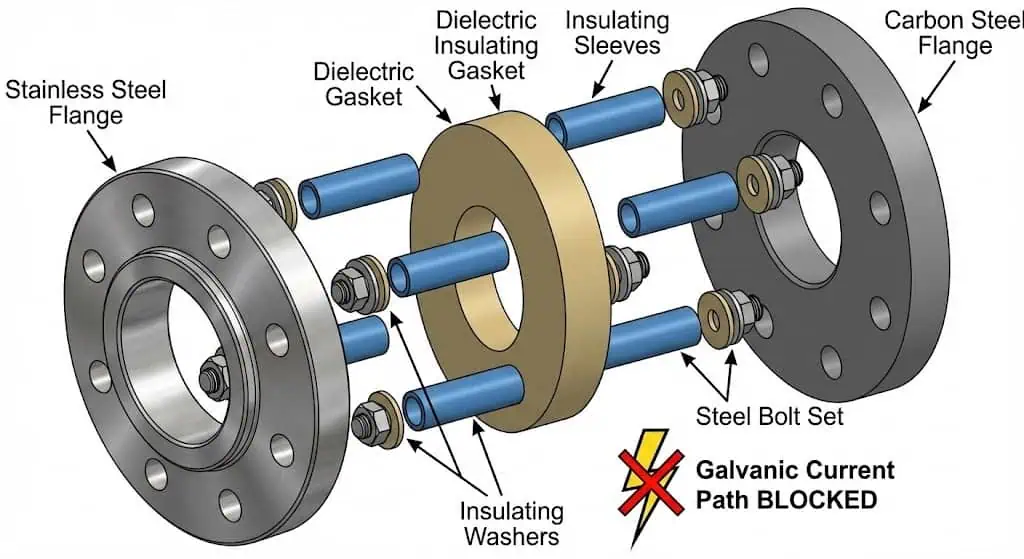
Even the right material can fail if the flange joint is installed poorly. Proper alignment, gasket compatibility, surface finish, and galvanic isolation are all part of successful seawater flange service. For assembly practice, see our guide to common flange leakage causes and prevention.
When installing stainless steel flanges in marine environments, pay attention to the following:
- Alignment: misalignment creates uneven gasket compression and local stress peaks that increase leakage and crevice risk.
- Surface finish: the flange face roughness must be compatible with the gasket type so the seal is tight without creating an unnecessary leak path.
- Galvanic isolation: when mating stainless to carbon steel, an isolation kit is often necessary to prevent galvanic attack on the less noble metal.
Industry Standards and Certifications
Procurement specifications should cite the correct dimensional and material standards so the flange is both interchangeable and chemically suitable.
Key standards used in desalination and marine projects include:
| Standard | Scope | Relevance to Seawater / Desalination Service |
|---|---|---|
| ASME B16.5 | NPS 1/2 to NPS 24 Flanges | Defines dimensions, pressure classes, and general interchangeability for common sizes. |
| ASME B16.47 | NPS 26 to NPS 60 Flanges | Used for large-diameter intake and outfall systems. |
| ASTM A182 | Forged Stainless Materials | Controls chemistry, heat treatment, and product quality for forged flange materials. |
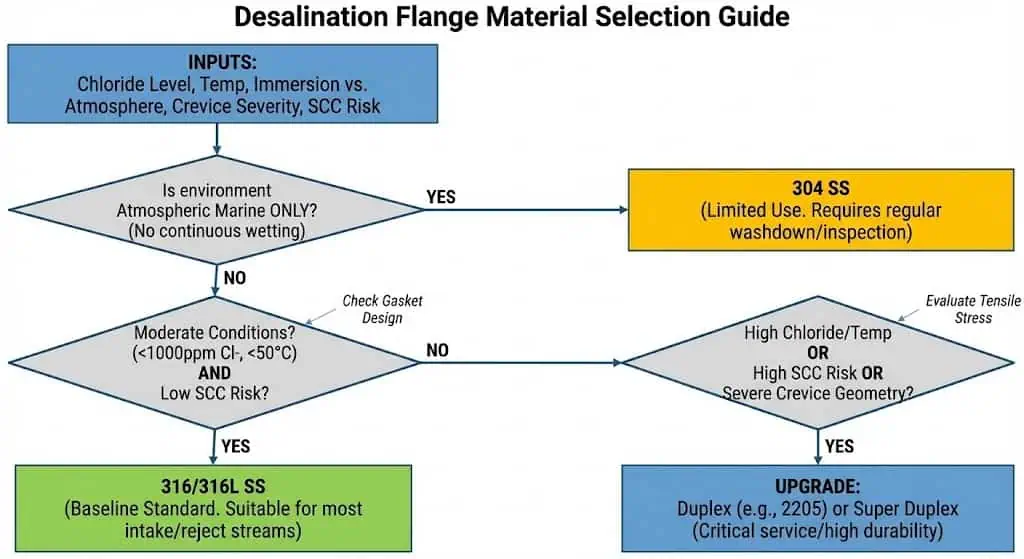
| Operating Condition | Selection Rule of Thumb |
|---|---|
| Continuous Wet Seawater (Ambient) | 316/316L is commonly the minimum starting point |
| Warm Brine (>40°C) or Higher Stress | Duplex 2205 is a common upgrade path |
| High Pressure Discharge (SWRO) | Higher-alloy options such as Duplex, Super Duplex, or 6Mo may be required |
| Dissimilar Metal Joint | Use galvanic isolation kits where appropriate |
Why Choose Sunhy Stainless Steel Flanges
Reliable marine-service flanges depend on controlled material verification and manufacturing discipline, not only on a grade marking.
Sunhy manufactures SS316/L and SS304/L flanges to ASTM A182 requirements. For engineering buyers, the most important controls include:
- Solution annealing: proper heat treatment helps restore corrosion resistance after forging or forming.
- PMI verification: Positive Material Identification helps confirm the required molybdenum content in 316L grades.
- Traceability: heat numbers stamped on the flange link to the Mill Test Certificate and material source.
Conclusion: For wetted seawater and desalination flange joints, 316/316L is usually the practical baseline, while 304 is generally limited to non-wetted or less aggressive service. In hotter, more stagnant, or more highly stressed conditions, engineers should evaluate Duplex or higher-alloy upgrades rather than assuming 316L is always enough.
| Sunhy Support Services | Value to EPC Contractors |
|---|---|
| Certified Documentation | EN 10204 3.1 certificates including chemical, mechanical, and heat-treatment data. |
| Technical Review | Review of piping specifications to confirm pressure class and schedule compatibility. |
| Specialized Machining | Custom facing finishes are available for specific gasket requirements. |
Technical FAQ
What is the technical difference between 304 and 316 flanges?
The key difference is molybdenum. 316 stainless steel contains 2.0–3.0% molybdenum, while 304 does not. That addition significantly improves resistance to chloride-driven pitting and crevice corrosion in seawater service.
Why is dual-certified 316/316L preferred for desalination?
It combines corrosion resistance with better fabrication confidence. The low-carbon “L” grade reduces sensitization risk during welding, while the 316 chemistry provides the molybdenum needed for chloride service.
Is 316L immune to corrosion in seawater?
No. 316L is more resistant than 304, but it can still suffer from crevice corrosion in stagnant zones and may become vulnerable in hotter brine or higher-stress service.
Can I use 304 flanges for seawater if they are coated?
This is usually a risky strategy. Coatings do not eliminate the basic crevice-risk problem at the flange face, and once chloride-rich seawater reaches exposed 304 beneath or near the gasket region, localized attack can begin quickly.
Technical Review Basis
Reviewed for: seawater piping, desalination material selection, flange corrosion risk, and marine-service gasket joint design.
Suggested reviewer title: Corrosion / Piping Application Engineer
Source basis: ASTM A182 material selection, ASME flange standards, ISSF desalination guidance, marine corrosion selection practice, and field flange-failure review logic.
Last updated: 2026-03-26