يُعد هذا التمييز مهمًا عندما يستبدل المشتري برغيًا تقليديًا من درجة A325 أو يدمج عدة أطوال براغي في صنف مخزون واحد. قد تبقى درجة الشد المطلوبة دون تغيير، إلا أن تكوين أسنان البرغي يمكن أن يغيّر افتراضات تصميم الوصلة المعتمدة. لذلك فإن A325T تكوين منتج محدد—وليس تفويضًا عامًا لاستبدال البراغي كاملة اللولبة في أي وصلة إنشائية.
ينبغي أن تحدد مواصفات الشراء إصدار ASTM F3125 الحاكم، وتكوين اللولبة الكاملة المطلوب، وأبعاد البرغي، والمكونات المطابقة، وأي متطلبات قبول خاصة بالمشروع. هذه التفاصيل أكثر فائدة من مجرد كتابة “A325، كامل اللولبة” في الاستفسار.
ماذا يعني A325T وفق ASTM F3125؟
تغطي ASTM F3125/F3125M البراغي والتجميعات الإنشائية عالية المقاومة، بما في ذلك عائلة براغي Grade A325 سداسية ثقيلة الرأس. وضمن تلك المواصفات، تصف الدرجة ونوع المادة والتكوين الأبعادي التكميلي خصائص منتج مختلفة.
تم تصميم الأسئلة الشائعة حول ربط AISC يوضح أن تحديد A325T يستدعي المتطلب التكميلي S1. يحمل برغي A325T المحدد بشكل مناسب علامة رأس A325T بحيث يمكن التعرف على التكوين بعد التركيب. لا يزال يتعين التحقق من مواصفات المنتج المعمول بها ومتطلبات وضع العلامات وفقًا للإصدار الحاكم للطلب ونوع المادة.
ليس كل برغي يبدو ملولبًا بالكامل يجب تصنيفه تلقائيًا على أنه A325T. فالمعيار الأبعادي ASME B18.2.6 ينص بالفعل على أن بعض أحجام براغي الإنشاءات القصيرة تكون ملولبة بالكامل. ويوضح RCSC هذا التمييز في مواصفاته لعام 2025: قد يكون للبراغي القصيرة القياسية ساق غير ملولبة قابلة للاستخدام قليلة أو معدومة حتى عندما لم يتم تحديد ملحق السن الكامل الاختياري.
هناك أيضًا مسألة تسمية منفصلة في الرسومات الإنشائية. يُستخدم الحرفان N وX عادةً لوصف ما إذا كانت أسنان البرغي مشمولة في مستوى القص أو مستبعدة منه لتصميم الوصلة. وهما ليسا درجتي تصنيع بديلتين ولا ينبغي الخلط بينهما وبين اللاحقتين T أو S المستخدمتين لتكوينات البراغي المحددة خصيصًا.
بالنسبة للمشتريات، القاعدة العملية هي تحديد كل من المنتج المطلوب و حالة الوصلة التي يجب أن يلبيها. لا يمكن لعلامة الدرجة وحدها أن تحل كلا السؤالين.
حد 4D: A325T مقابل A325 وA325S القياسيين
الفحص الأبعادي المحدد لـ A325T هو العلاقة بين القطر الاسمي للبرغي والطول الاسمي للبرغي:
L ≤ 4D
هنا،, L هو طول البرغي الاسمي و D هو قطر البرغي الاسمي، معبرًا عنه بنفس الوحدات. تصف إرشادات AISC المنشورة وتعليقات RCSC 2025 هذا الحد البالغ أربعة أضعاف القطر للتكوين الاختياري كامل اللولبة. هذا فحص لأهلية التطبيق، وليس فحصًا أبعاديًا كاملًا أو حساب تصميم إنشائي.
يكتسب التمييز بين A325 وA325T وA325S العادي أهمية خاصة عند تحديد براغي أطول من نطاق اللولبة الكاملة المعتاد.
| تعيين المنتج | تكوين اللولبة | الفرق الرئيسي في المشتريات |
|---|---|---|
| ASTM F3125 Grade A325 | ترتيب اللولبة القياسي وفقًا للمتطلبات الأبعادية المعمول بها؛ قد تكون بعض البراغي القصيرة ملولبة بالكامل مسبقًا | تحقق من الأبعاد القياسية وموضع اللولبة الفعلي |
| Grade A325T, S1 | تكوين اختياري ملولب بالكامل بطول اسمي محدود بـ 4D وفق الدليل المذكور | اطلب صراحةً ملحق اللولبة الكاملة وتحقق من الإصدار المرجعي المعتمد |
| الدرجة A325S، S2 | تكوين أبعادي خاص يُطلب بشكل منفصل، وقد يشمل أطوال لولبة غير قياسية | حدّد التباين الأبعادي واحصل على الموافقة الفنية والموافقة على المنتج اللازمة |
يُعد شرط S2 مهمًا لأن حد الأقطار الأربعة لا ينبغي تفسيره كدليل على استحالة كل تكوين أطول ملولب بالكامل من الدرجة A325. يصف RCSC أطوال لولبة خاصة تُطلب بشكل منفصل وتُعرَّف بعلامة S. غير أن S2 ليس إذنًا بأخذ منتج عادي وتمديد لولبته وإعلان مطابقته دون التحقق من المواصفة المعمول بها ومتطلبات المشروع.
مثال افتراضي: فحص طلب مسامير قطرها 3/4 بوصة
افترض أن جدول مشتريات الأعمال الفولاذية يتضمن مسماري ربط سداسيين ثقيلين مقترحين من الدرجة A325 وملولبين بالكامل، وكلاهما بقطر اسمي 3/4 in.:
- الخيار أ: قطر 3/4 in. × طول اسمي 3.00 in.
- الخيار ب: قطر 3/4 in. × طول اسمي 3.25 in.
فحص الأقطار الأربعة هو:
Lالحد = 4 × (0.75 in.) = 3.00 in.
المرشح A عند الحد المذكور تمامًا. يحقق طوله هذا الفحص الأولي S1، شريطة أن تسمح طبعة المعيار الحاكمة وظروف المنتج الأخرى بهذا التكوين.
Candidate B exceeds the limit by 0.25 in. Its nominal length-to-diameter ratio is:
3.25 / 0.75 ≈ 4.33
It should therefore not be ordered as an ordinary S1 A325T solely on the basis that the requested bolt is fully threaded. The purchaser should clarify whether a special configuration is required, whether it is permitted under the governing specification, and whether the structural engineer has approved the proposed arrangement.
These calculations establish only the nominal length relationship. They do not verify thread geometry, thread-start position, dimensional tolerances, nut engagement, product conformity or structural capacity.
That is why the inquiry should include the applicable dimensional standard or an approved drawing. A visually full-length thread is not sufficient evidence that the manufactured bolt satisfies every requirement of the specified supplementary configuration.
In an illustrative stock-consolidation request, a fully threaded bolt longer than the S1 length condition is described as ordinary A325T. The designation does not become valid because threads can be manufactured. Resolve the exact special configuration and applicable product requirements before quoting, then obtain the connection approval. The full- versus partial-thread comparison explains geometry without extending the A325T permission.
لماذا تغيّر براغي A325T كاملة اللولبة فحص مستوى القص
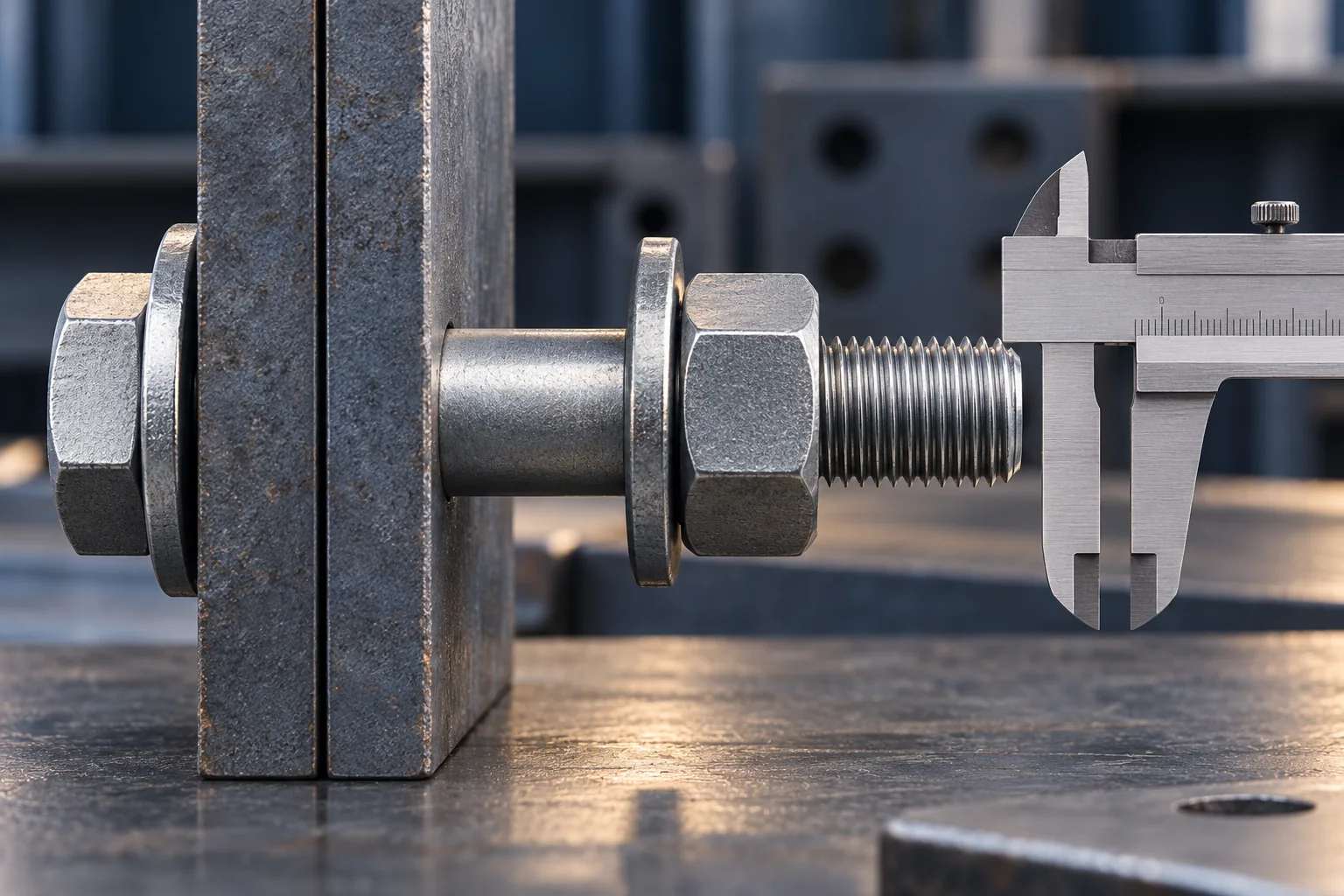
The main engineering consequence of A325T is not the ability to engage a nut anywhere along the shank. It is the location of the threaded section relative to the connection’s shear planes.
A conventional partially threaded structural bolt has a smooth shank and a threaded end. Depending on bolt length, connected plate thickness and installation arrangement, a connection can sometimes be detailed so that the relevant shear plane passes through the unthreaded shank.
When the shear plane crosses the threaded portion, the thread roots create a different local cross-section and shear-resistance condition from the full-diameter shank. Structural design provisions account for this distinction.
تم تصميم RCSC 2025 specification, Section 5.1 and Table 5.1, distinguishes nominal bolt shear strengths for threads included in and excluded from the shear plane. It does not treat the two configurations as interchangeable merely because the bolts share a strength grade and nominal diameter.
An A325T bolt is threaded along its shank, so a connection cannot rely on the threads-excluded condition for that bolt. AISC makes this implication explicit in its A325T guidance.
Consider a steel connection originally detailed with Grade A325 bolts under a threads-excluded shear assumption. A buyer receives a quotation offering A325T bolts of the same diameter, strength grade and nominal length. The two products may appear interchangeable on the purchasing schedule, but the replacement removes the unthreaded shank condition assumed in the design.
The correct response is not to calculate a universal percentage reduction or assume the change is harmless. The connection must be checked against its approved design basis, including the applicable shear strength, number of shear planes, bolt arrangement and other governing limit states. If the proposed configuration changes an approved design assumption, the responsible structural engineer must resolve that change.
The reverse distinction also matters: an ordinary A325 bolt is not necessarily designed with its threads excluded from the shear plane. The actual thread location and adopted connection design condition must be established from the drawing and joint geometry.
For joints with multiple shear planes, an apparently small change in grip or thread position can complicate the assumption further. The RCSC 2025 commentary takes a conservative approach when threads intersect a shear plane; it does not support simply assigning the threads-excluded condition to another plane without examining the relevant design provisions.
A325T can still be a sensible option where the approved connection is designed for the appropriate thread condition. The full-thread option may also simplify purchasing and inventory by reducing the need for several bolt lengths. RCSC recognizes that benefit, particularly where other connection limit states govern rather than the bolt’s shear strength.
It would be misleading, however, to describe full threading as a general improvement in load capacity. It offers procurement and assembly flexibility within a defined engineering boundary.
Pretensioning is a separate question. Whether a structural joint is specified as snug-tightened, pretensioned or slip-critical depends on the governing connection requirements. Choosing A325T does not automatically establish the required installation condition, and achieving a specified pretension does not turn a threads-included shear condition into a threads-excluded one.
The engineer determines the acceptable joint configuration. The purchaser ensures the supplied bolt and complete assembly correspond to that approved requirement.
A hypothetical site substitute keeps the A325 diameter and nominal length but replaces the smooth-shank configuration with A325T. If the drawing relies on threads excluded from a shear plane, that design assumption has changed. Hold the substitution and have the responsible engineer check the actual connection. A matching nut and head marking cannot restore an unavailable unthreaded shank.
علامات الرأس وهندسة الأسنان وفحوصات الاستلام
An incoming inspection should answer three different questions: Is this the product ordered? Does its physical configuration match the specification? Is there documentary evidence supporting the required conformity?
These checks overlap, but none replaces the others.
Start with product identification. For an S1 fully threaded Grade A325 bolt, check the required A325T designation and the applicable manufacturer identification. A special-dimensional S2 order requires its appropriate designation, such as A325S, rather than treating the T and S markings as interchangeable. Material-type identification and other marking details must also agree with the governing product requirements.
A bolt carrying an expected head marking is not automatically proven to meet its chemical, mechanical and dimensional requirements. Markings identify a claimed product classification; acceptance also depends on the relevant inspection evidence.
Next, check the ordered geometry. Compare nominal diameter and length with the purchase order. For a fully threaded bolt, examine thread coverage, thread runout and the transition near the under-head bearing surface against the specified requirement.
This is where photographs can be deceptive. A thread may appear to reach the head while the location of its first complete form or the applicable runout geometry differs from the dimensional acceptance requirement. Measurements and suitable thread gauges should be applied according to the governing specification or approved drawing.
Older manufacturer technical references discuss specific limits expressed as numbers of thread pitches from the bearing surface. Those figures should not be treated as verified acceptance values for ASTM F3125/F3125M-26 without confirming that edition’s requirements. A receiving checklist should instead identify the standard, drawing and applicable inspection method.
Then review the documentation. Where required by the order and governing specification, compare the supplier’s product test reports and conformity documents with the supplied grade, type, size, finish and identifiable lot or shipment records. A certificate of conformity, a material test report and a dimensional inspection report are different forms of evidence; one should not be assumed to contain every result provided by the others.
The associated nuts and washers deserve their own verification. Their specified grades, dimensions and finish must be compatible with the bolt and the applicable structural bolting requirements. Coated assemblies can introduce further conditions concerning nut fit, lubrication and assembly performance. For example, galvanized high-strength bolting components require more than independently selecting a galvanized bolt and a nominally matching nut.
The 2025 RCSC specification addresses matching components and relevant product-report requirements separately from joint installation verification. When a selected installation method requires pre-installation verification using representative bolting assemblies, that operation checks the assembly and installation process under specified conditions. It does not substitute for manufacturing test records or establish the chemical composition of a supplied bolt.
A receiving inspection should flag an unexplained marking difference, an out-of-scope length, an unspecified special thread configuration or mismatched assembly documents before the components are released for use.
كيف تحدد براغي A325T في طلب عرض السعر وأمر الشراء
An effective A325T request starts with the approved structural connection requirement, not with a supplier’s description of an available fully threaded bolt.
For a typical project-specific inquiry, the following fields give the manufacturer or distributor enough information to identify the intended configuration and raise any conflicts before an order is accepted:
| RFQ field | Information to provide | لماذا يهم |
|---|---|---|
| مواصفات المنتج | ASTM F3125/F3125M and governing edition | Identifies the contractual product requirements |
| Grade and material type | Grade A325 and the required Type 1 or Type 3 classification | Prevents confusion between strength classification and material type |
| تكوين اللولبة | S1/A325T or a separately specified S2 special configuration | Establishes which threading requirements apply |
| Bolt dimensions | Nominal diameter, nominal length and applicable dimensional reference | Allows the configuration and 4D eligibility to be checked |
| Threading detail | Required thread coverage, drawing and inspection criteria where applicable | Avoids vague “full thread” descriptions |
| Finish and matching parts | Coating, nut and washer requirements, with approved assembly specification | Prevents incompatible or incomplete bolting assemblies |
| Quantity and documentation | Quantity, drawing reference, identification and required product/inspection reports | Supports a clear quotation and receiving acceptance |
| Connection approval basis | Relevant structural drawing and any approved substitution requirements | Separates supplier product conformity from engineering authorization |
If the engineer has already approved A325T with threads included in the shear plane, the buyer can communicate that configuration directly. If the drawing instead specifies a conventional bolt arrangement or an excluded-thread shear condition, the inquiry should identify the difference and request engineering clarification before substitution.
A useful RFQ description for the hypothetical 3/4 in. × 3.00 in. candidate, after engineering selection, could be structured as follows:
Product: ASTM F3125 Grade A325 heavy hex structural bolt, Supplementary Requirement S1 (A325T), nominal diameter 3/4 in., nominal length 3.00 in., with the governing ASTM edition, material type, finish, matching components and inspection documentation stated in the purchase order. The specified thread configuration and structural connection design basis must agree with the approved project documents.
This wording illustrates the specification structure; it is not a claim that any supplier has manufactured, tested or stocked that particular item. It also does not replace verification of the current applicable supplementary requirement.
For a bolt longer than 4D with extended threading, do not simply change the description from A325T to A325S and proceed. The intended special dimensions must be confirmed, the applicable S2 requirements reviewed, and the change assessed against the connection design. A supplier’s ability to machine the requested threads does not establish its acceptability in the structure.
Before releasing the purchase order, the buyer should be able to answer two questions independently: Does the offered bolt meet the specified product requirements? And does that actual configuration match the approved structural connection?
Technical references: AISC Engineering FAQs — Bolting; RCSC Specification for Structural Joints Using High-Strength Bolts, 2025; ASTM F3125/F3125M-26 official catalog; Portland Bolt — What Is an A325T Bolt?.
الأسئلة المتكررة
ماذا يعني A325T؟
يحدد هذا التكوين التكميلي لبراغي A325 الملولبة بالكامل. تحقق من الإصدار المرجعي ومتطلبات الوسم والأبعاد بدلاً من التعرف عليه من المظهر فقط.
ما الذي يتحقق منه فحص حد 4D؟
يقارن طول البرغي الاسمي بأربعة أضعاف القطر الاسمي وفق تكوين S1 المذكور. اجتياز هذا الفحص لا يُثبت المطابقة الكاملة للمنتج أو للوصلة.
هل يمكن أن تحل A325T محل برغي مصمم باستثناء الأسنان اللولبية؟
ليس تلقائيًا. فالتكوين الملولب بالكامل يغيّر افتراض اللولب عند مستوى القص ويتطلب مراجعة واعتمادًا مناسبين للوصلة.