








Pipe Nipples (Barrel) | TBE Threaded Pipe Nipple (NPT/BSPT)
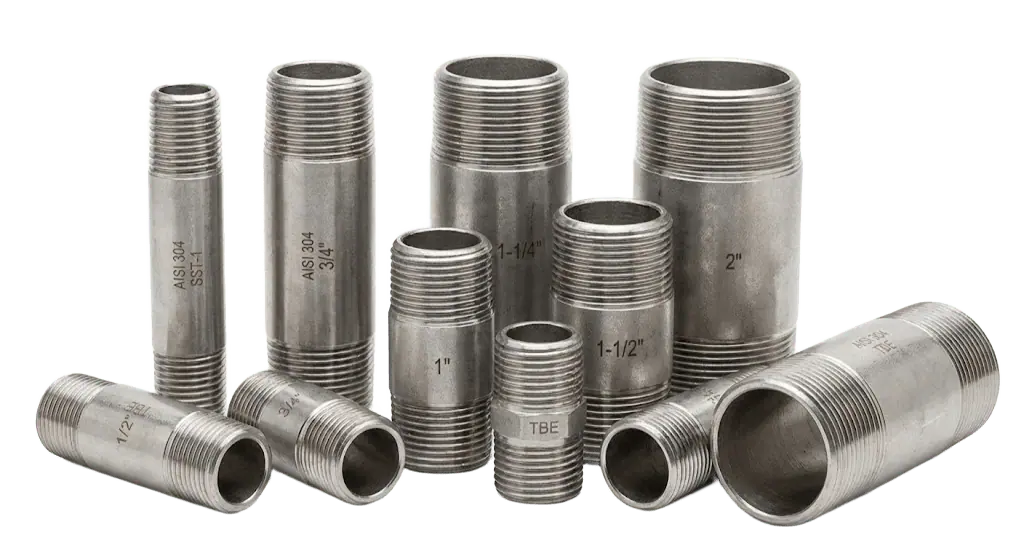
SUNHY supplies barrel nipples for extending or connecting threaded piping runs where serviceability and fast installation are required. A barrel nipple is a threaded pipe nipple with threaded ends and an unthreaded center section, commonly used for line extensions, equipment tie-ins, and maintenance-friendly modifications.
We offer TBE nipples (threaded both ends) in common schedules such as Sch 40 pipe nipple (standard wall) and Sch 80 pipe nipple (heavy wall), with NPT pipe nipple and BSP/BSPT nipple options. Material focus includes stainless steel pipe nipple grades (SS304/SS316) and carbon steel/galvanized options as specified. Custom length pipe nipples can be supplied to match your BOM and site take-offs.
- Fast line extension, simple install
- Barrel style, cleaner alignment
- Custom lengths, BOM ready
- Standard threading, reliable make-up
- Cut-and-thread control, stable fit
- Docs available, per project spec
Specification & Standard
Product
Barrel Nipple / Threaded Pipe Nipple / TBE Nipple
Size (NPS/DN)
Commonly 1/8″ – 4″ (DN6 – DN100); other sizes on request
Wall Thickness (Schedule)
Sch 40 (standard wall) / Sch 80 (heavy wall) / customized
Materials
Stainless steel: SS304 / SS316 common
Carbon steel / black steel / galvanized options as specified
Brass option on request (if applicable)
End Type
TBE (Threaded Both Ends); other end forms on request
Length
Standard lengths + custom length pipe nipple available (per BOM)
Thread Standard
NPT (ANSI/ASME B1.20.1)
BSP / BSPT (ISO 7-1) on request
Standards / Reference
Pipe material per applicable ASTM / project specification; threads per B1.20.1 (NPT) / ISO 7-1 (BSPT)
Barrel Nipples (TBE) for Threaded Line Extensions
A barrel nipple is a threaded pipe nipple with threads on both ends and a plain (unthreaded) center section. It is widely used as an extension nipple to connect or extend threaded piping runs where fast assembly and future maintenance access are important.
Common Use Functions
- Line extension: add length between fittings, valves, instruments, and equipment tie-ins.
- Serviceable modifications: support commissioning changes and later maintenance updates.
- Simple replacement: easier swap-out than cutting and re-welding spools.
Procurement Highlights
- TBE nipple configurations are standard for most threaded assemblies.
- Common selections include Sch 40 pipe nipple (standard wall) and Sch 80 pipe nipple (heavy wall).
- Thread options include NPT pipe nipple and BSP/BSPT nipple as specified on your BOM.
- Stainless options support corrosion-prone environments where a stainless steel pipe nipple is preferred.
Dimensions & Ordering Guide (Size, Schedule, Length)
Engineers often specify pipe nipples by NPS size, schedule, thread standard, and length. For barrel nipples, length is critical because the center section is unthreaded. Use the checklist below to align procurement with site take-offs.
| Item | What to Specify | Typical Options |
|---|---|---|
| Type | Pipe nipple style | Barrel nipple (TBE) |
| Size | NPS / DN | e.g., 1/2", 3/4", 1", 2" (as required) |
| Schedule | Wall thickness selection | Sch 40 (standard) / Sch 80 (heavy) |
| Length | Overall length for fit-up | Standard lengths / custom length pipe nipple |
| Thread | Thread standard to match mating pipe | NPT / BSP / BSPT |
| Material | Grade per service fluid/corrosion | SS304 / SS316 / carbon steel / galvanized (as specified) |
| Inspection | Acceptance scope | Dimensional check / thread gauging / PMI (stainless) as specified |
| Documents | Handover package | MTC (EN 10204 3.1) + traceability support |
Tip: When ordering a custom length pipe nipple, specify the required overall length and confirm thread standard (NPT vs BSPT) to avoid mismatch during installation.
Product Assembly | How to Install Barrel Pipe Nipples
Barrel nipples are installed by engaging tapered threads into mating female threads on fittings, valves, or equipment. Final procedures should follow your project specification and be performed by qualified personnel.
Recommended Assembly Steps
- Confirm the BOM — verify size, schedule (Sch 40/80), length, and thread standard (NPT/BSPT).
- Inspect threads — ensure clean, undamaged threads; reject cross-thread risk parts.
- Apply sealing method per spec — use approved tape or sealant compatible with service media.
- Align the run — maintain alignment to avoid side loading and thread damage.
- Tighten in control — avoid over-torque; check alignment after make-up.
- Leak test — perform system test per project requirement after installation.
Common procurement note: Barrel nipples differ from close nipples (fully threaded). If the project needs a plain center section for alignment or take-off length control, specify barrel nipple on the BOM.
Related Products
Butt Weld Tee (Equal / Reducing)
For branch connections in welded piping spools.
Concentric Reducer
Smooth centerline transition for vertical lines and pumps.
Eccentric Reducer
Flat side design to reduce air pockets in horizontal piping.
Butt Weld End Cap
Clean closure for pipe ends—ideal for test spools and headers.
Stub End (Lap Joint)
Common with lap joint flanges for frequent disassembly service.
FAQ
What is a barrel nipple?
A Barrel Nipple is a short length of pipe with tapered threads (usually NPT) on both ends and an unthreaded section (shoulder) in the center. Unlike a “Close Nipple,” which is threaded from end to end, the unthreaded shoulder on a barrel nipple provides a gripping surface for a pipe wrench, preventing damage to the threads during installation. It is the standard configuration for connecting pipe fittings.
Key Feature: Unthreaded “shoulder” for wrench grip.
Common Use: General plumbing and structural connections where spacing between fittings is required.
What does TBE mean for pipe nipples?
TBE stands for Thread Both Ends. It is the standard industry abbreviation indicating that the nipple has male threads on both ends, typically used to connect two female fittings. Other common end-finish abbreviations include:
TBE (Thread Both Ends): The default configuration for most piping systems.
TOE (Thread One End): Used as a transition fitting, often welded on the plain end and threaded on the other.
PBE (Plain Both Ends): No threads; used for socket-weld connections.
Sch 40 vs Sch 80 pipe nipple-how do l choose?
Choose Schedule 80 for high-pressure, industrial, or corrosive applications. Because cutting threads removes pipe wall material, Schedule 40 nipples can become structurally weak at the thread root. Schedule 80 has a thicker wall (e.g., 0.179″ vs 0.133″ for 1″ pipe), providing a “corrosion allowance” and retaining sufficient strength after threading to handle pressures up to 40-50% higher than Sch 40.
Rule of Thumb: Use Sch 80 for steam, gas, and industrial fluids. Use Sch 40 only for low-pressure water or residential applications.
Do you supply NPT and BSP/BSPT pipe nipples?
Yes, but they are not interchangeable. We supply both NPT (National Pipe Taper) for North American systems and BSPT (British Standard Pipe Taper) for international/ISO systems. You must specify the correct standard because they have different thread angles and pitches:
NPT: 60° thread angle, flattened peaks/valleys.
BSPT: 55° thread angle, rounded peaks/valleys.
Warning: Mixing NPT and BSPT creates a spiral leak path that sealant cannot fix. Always verify your equipment’s thread standard.
Can you supply custom length pipe nipples with documentation?
Yes. While ASTM A733 defines standard lengths (e.g., Close, 2″, 4″, up to 12″), we can manufacture custom lengths to your exact specification. For traceability, all industrial pipe nipples are backed by EN 10204 3.1 Material Test Certificates (MTC).
Required Documentation for Quality Assurance:
MTC (EN 10204 3.1): Verifies chemical composition and mechanical properties of the specific heat number.
Hydrostatic Test Report: Confirms pressure containment capability.
Heat Number Traceability: Hard-stamped on the nipple for matching with the MTC.