








Threaded Elbows | 90° / 45° / Street Elbows (NPT/BSPT)
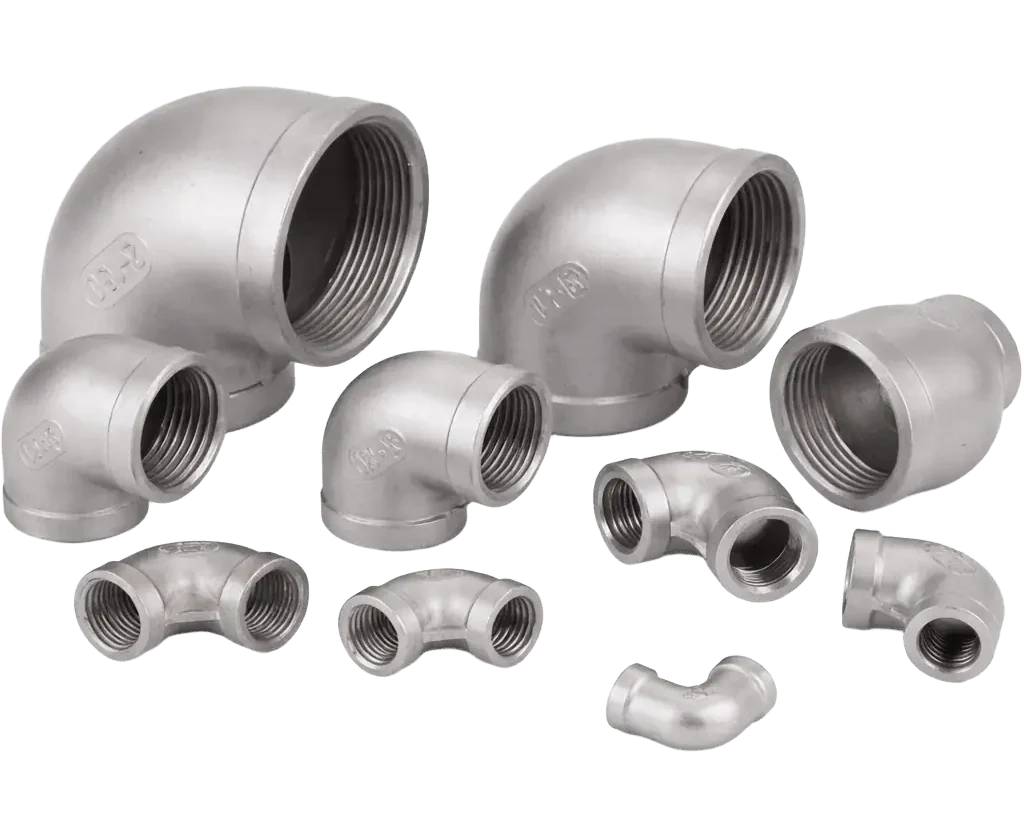
SUNHY supplies threaded elbows for clean, serviceable direction changes in low-pressure piping. They are commonly selected for projects that need fast installation, minimal site work, and convenient maintenance during commissioning or future line changes.
Our range includes 90° and 45° threaded elbows in F×F / M×F (street) and reducing patterns (as specified), with NPT/BSPT thread options. We focus on 304/316L stainless steel threaded elbows for corrosion-prone utility and process lines, and can support each lot with MTC (EN 10204 3.1) plus inspection level per project specification.
- Fast assembly, no welding needed
- Serviceable joints, easy access
- Standard thread fit, reliable make-up
- 45° & 90° options, layout ready
- Clear traceability, heat ID
- Docs available, per project spec
Specification & Standard
Nominal Size (NPS/DN)
Commonly 1/8″ – 4″ (larger sizes on request)
Pattern
Standard threaded elbow (F×F) / Street elbow (M×F) / Reducing pattern (when specified)
Pressure Rating
Low-pressure service (Class 150 applications common); confirm by piping code, temperature and media
Standards
Dimensions & tolerances per applicable ASME/ISO threaded fitting requirements and/or project drawings (as specified)
Elbow Angle
90° / 45° (as specified)
Thread Standard
NPT (ASME B1.20.1) / BSPT (ISO 7-1 / EN 10226) per project requirement
Materials
Stainless steel 304 / 316L common (other grades on request)
Documentation & Inspection
MTC (EN 10204 3.1), dimensional inspection; thread gauging; PMI for stainless upon request; NDT as specified
Threaded Elbows for Serviceable Pipe Turns
Threaded elbows are selected when projects need a clean direction change with quick assembly and straightforward maintenance. They are commonly used in utility and general industrial lines where on-site welding is not preferred or not available.
Common Configurations
- 90° threaded elbow — compact turn for tight layouts and equipment connections.
- 45° threaded elbow — smoother routing when offset space is available.
- Street elbow (F×M) — reduces adapter count in confined spools.
Procurement-Focused Advantages
- No hot work — supports faster site execution and simplified control.
- Service-friendly — easier disassembly for flushing, replacement, and future line changes.
- Thread fit consistency — thread standard (NPT/BSPT) and gauging scope can be aligned to your spec.
- Corrosion control — focus on 304/316L stainless threaded elbows for humid, coastal, and utility environments.
Dimension & Ordering Table (What to Specify on Your BOM)
Threaded elbow dimensions and site fit depend on the selected size, thread standard, and elbow type. To avoid mismatch, specify the items below directly on your BOM and inspection scope.
| Item | What to Specify | Typical Options |
|---|---|---|
| Size | NPS / DN | e.g., 1/2", 3/4", 1", 2" (as required) |
| Angle | Elbow angle | 90° / 45° |
| Type | End form | Standard (F×F) / Street (F×M) |
| Thread | Thread standard | NPT / BSPT (per region & mating pipe) |
| Material | Grade | 304 / 316L (common) + others on request |
| Inspection | Acceptance scope | Dimensional check / Thread gauging / PMI / NDT (as specified) |
| Documents | Handover package | MTC (EN 10204 3.1) + marking/traceability (as required) |
Product Assembly | How to Install a Threaded Elbow
Threaded elbows are assembled by engaging tapered threads to mating pipe threads. Final practices should follow your project specification and be performed by qualified personnel.
Recommended Assembly Steps
- Verify BOM match — confirm NPS/DN, angle (90°/45°), type (standard/street), and thread (NPT/BSPT).
- Check thread condition — ensure threads are clean and free of damage; reject cross-thread risk parts.
- Apply sealing method per spec — use approved PTFE tape or thread sealant compatible with the service fluid.
- Hand-tight then wrench-tighten — avoid over-torque; keep alignment to prevent stress on connected spools.
- Leak test — perform system test per project requirement after assembly and support installation.
Tip: For mixed regions, confirm whether the line is NPT or BSPT before procurement to avoid field rework.
Related Products
Butt Weld Tee (Equal / Reducing)
For branch connections in welded piping spools.
Concentric Reducer
Smooth centerline transition for vertical lines and pumps.
Eccentric Reducer
Flat side design to reduce air pockets in horizontal piping.
Butt Weld End Cap
Clean closure for pipe ends—ideal for test spools and headers.
Stub End (Lap Joint)
Common with lap joint flanges for frequent disassembly service.
FAQ
What is a threaded elbow and how is it used?
A threaded elbow is a forged pipe fitting with female threads that changes flow direction—most commonly 90° or 45°—by connecting to male-threaded pipe. It provides a compact turn without welding, making it ideal for small-bore utility and instrument lines where fast installation and easy disassembly are needed.
Common uses
Instrument & gauge lines where welding is impractical
Utility lines (air, water, non-critical services)
Maintenance zones requiring frequent removal/replacement
Sites where hot work (welding sparks) is restricted
Engineering note : Threaded joints can loosen or leak under vibration/cyclic loading. For pump discharge or high-vibration duty, socket weld is often the safer choice.
What materials and grades are available for your threaded elbows?
We supply threaded elbows in stainless steel and carbon steel grades commonly used in pressure piping.
| Material | ASTM Standard | Typical Grades | Best for |
|---|---|---|---|
| Carbon Steel | ASTM A105 | A105 | General high-strength service in oil & gas, petrochemical, utilities |
| Low-Temp Carbon Steel | ASTM A350 | LF2 | Low-temperature service where toughness is required |
| Stainless Steel | ASTM A182 | F304/F304L | General corrosion resistance, clean fluids |
| Stainless Steel | ASTM A182 | F316/F316L | Better resistance in chloride/chemical environments |
Custom materials (e.g., alloy steel, duplex) can be provided on request to match your media, temperature, and corrosion requirements.
Can I get threaded elbows with BSP (British) threads instead of NPT?
Yes. We can supply BSPT (tapered) or BSPP (parallel) threaded elbows for European/international specifications.
Important: BSP and NPT are not interchangeable due to different thread forms and angles. Please specify NPT / BSPT / BSPP at ordering to avoid sealing issues and thread damage.
What documents and inspections can be provided?
The standard documentation for high-pressure fittings is an EN 10204 Type 3.1 Material Test Certificate (MTC), which verifies chemical composition and mechanical properties. For sour gas applications, this must include an NACE MR0175 statement confirming hardness is controlled (≤ 22 HRC). Optional third-party verification (Type 3.2) and NDT reports (Ultrasonic/PMI) are available for critical safety checks.
Key Document Types:
-
EN 10204 Type 3.1: Validated by the manufacturer’s independent QA rep; standard for process piping.
-
EN 10204 Type 3.2: Validated by an independent Third-Party Inspector (TPI) (e.g., Lloyds, DNV); required for extreme hazards.
-
Positive Material Identification (PMI): On-site alloy verification (XRF/OES) to prevent material mix-ups.
What is the difference between a standard elbow and a street elbow?
The primary difference is the connection gender. A Standard Elbow has two internal (female) threads and requires a nipple to connect to a valve. A Street Elbow has one internal (female) and one external (male) thread, allowing it to connect directly to equipment. While Street Elbows save space, they cause significantly higher pressure drop due to a tighter flow radius.
Engineering Comparison:
| Feature | Standard Elbow (90°) | Street Elbow |
| Connections | Female x Female | Male x Female |
| Flow Efficiency | High (L/D Ratio ≈ 30) |
Low (L/D Ratio ≈ 50) 10 |
| Best Use | Pump suction, high-flow lines | Tight spaces, instrument air lines |
| Risk | Requires extra space for the nipple | Hard to align (rotational limit) |
Expert Tip: Avoid Street Elbows in high-vibration systems (e.g., compressor discharge). The root of the male thread is a stress concentration point prone to fatigue failure.