




Stainless Steel Butt Weld Tees | Equal Tee & Reducing Tee | 304 / 316L | ASME B16.9
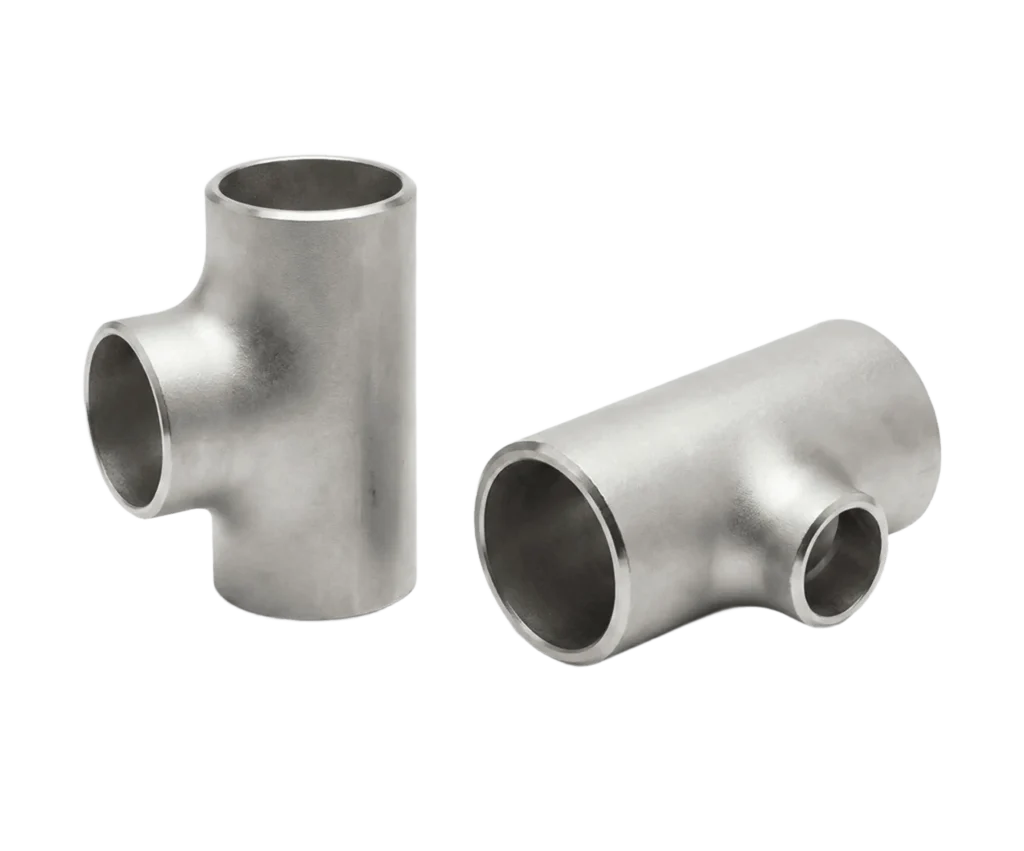
SUNHY supplies stainless steel butt weld tees in ASTM A403 304/316L for welded piping systems. Choose an equal tee (straight tee) for same-size branching, or a reducing tee (reducer tee) for a smaller branch outlet—built for clean flow, stable fit-up, and corrosion-resistant service.
- Reliable branching, stable geometry
- Easy alignment, less rework
- Equal/reducing types, BOM match
- Fit-up friendly, faster welding
- Lot traceability, heat ID
- Inspection optional, per spec
Specification & Standard
Tee Type
Branch Configuration
Process
Seamless (One-piece construction) or Welded
Standards & End Prep
Nominal Diameter
Wall Thickness (Schedule)
Sch 10 / Sch 40 / Sch 80 / STD / XS / customized thickness
Materials
Stainless: ASTM A403 WP304/304L, WP316/316L Duplex & Super Duplex available upon request
Documentation & Inspection
Stainless Steel Butt Weld Tee Manufacturer | ASME B16.9 | 304 / 316L | Equal Tee & Reducing Tee
As a professional butt weld fittings manufacturer, SUNHY supplies stainless steel butt weld tees designed for reliable branch connections in welded piping systems. We provide both equal tees (straight tees) for same-size branching and reducing tees (reducer tees) for smaller branch outlets—ideal for process lines, utilities, and industrial piping spools.
Our main materials include ASTM A403 WP304/304L and WP316/316L, offered in common schedules such as Sch 10, Sch 40, and Sch 80, with documentation support for project handover and QA audits.
Key Advantages
- Corrosion-Resistant Stainless Options — 304/316L selections for demanding service environments.
- Stable Welded Branch Connection — Butt weld ends create a continuous metal-to-metal joint for long-term integrity.
- Equal & Reducing Configurations — Run × Run × Branch sizes to match your line class and layout.
- Traceable Quality Documents — Heat number traceability and MTC/EN 10204 3.1 available upon request.
Technical Summary
| ITEM | SPECIFICATION |
|---|---|
| Product Type | Butt Weld Tee (Equal Tee / Reducing Tee), Run × Run × Branch |
| Nominal Size | DN 15 – DN 600 (NPS 1/2" – 24"); larger sizes available by request |
| Wall Thickness | Sch 10 / Sch 40 / Sch 80 / STD / XS (customized thickness available) |
| End Preparation | Beveled ends for butt welding (per project WPS) |
| Materials (Main) | ASTM A403 WP304/304L, WP316/316L (other grades by request) |
| Standards | ASME B16.9 / ASTM A403 / EN 10253 / GB/T 12459 (as specified) |
| Documentation | MTC (EN 10204 3.1), dimensional inspection; PMI/NDT available on request |
Butt Weld Tee Dimensions | Equal Tee vs Reducing Tee | ASME B16.9
For ASME-style piping, tee selection typically starts with the run size, branch size, and the center-to-end measurements defined by ASME B16.9. An equal tee uses the same size on all three outlets, while a reducing tee keeps the run size but reduces the branch outlet size.
What to Check Before Ordering
- Run × Run × Branch (e.g., 6" × 6" × 4")
- Schedule / wall thickness matched to the pipe (Sch 10/40/80, STD/XS, etc.)
- Weld-end bevel per project WPS for consistent fit-up
- Material grade (ASTM A403 304/316L) and required documentation
Quick Guide
| Type | Configuration | Dimensional Reference | Typical Use |
|---|---|---|---|
| Equal Tee | NPS X × X × X | Center-to-end dimensions per ASME B16.9 | Same-size branching from the main run |
| Reducing Tee | NPS X × X × Y | Run and branch dimensions per ASME B16.9 | Smaller branch outlet for compact layout |
Need a BOM-ready dimensional sheet? Send your NPS / schedule / type and we’ll confirm the applicable ASME B16.9 dimensions for your order.


Product Assembly | How to Install a Butt Weld Tee (Equal / Reducing)
A butt weld tee is installed by welding the beveled ends to the pipe. Proper fit-up, orientation control, and qualified welding procedures are critical for alignment, branch direction, and long-term leak tightness. Final steps should follow your project code/spec and be performed by qualified welders.
Recommended Assembly Steps
- Verify the fitting — Confirm run/branch size (DN/NPS), tee type (equal or reducing), schedule, and material grade (e.g., ASTM A403 304/316L) match the BOM.
- Check end bevel & cleanliness — Remove oil, paint, and oxidation; keep weld ends clean to avoid weld defects (especially for stainless).
- Mark branch orientation — Ensure the branch outlet direction matches the piping layout and required instrument/equipment tie-in.
- Fit-up & alignment — Align centerlines, control root gap, and confirm squareness before tacking.
- Tack welding — Use evenly spaced tacks to lock alignment and reduce distortion.
- Weld per qualified WPS — Typical practice: GTAW root + SMAW/GMAW fill/cap (or per WPS). Control heat input for stainless to protect corrosion resistance.
- Inspect & finish — Visual/dimensional checks; PMI/NDT if specified. Clean heat tint and restore surface condition when required.
For stainless systems, cleaning and post-weld surface condition management (as specified) help maintain corrosion performance in service.
Related Products
Butt Weld Tee (Equal / Reducing)
For branch connections in welded piping spools.
Concentric Reducer
Smooth centerline transition for vertical lines and pumps.
Eccentric Reducer
Flat side design to reduce air pockets in horizontal piping.
Butt Weld End Cap
Clean closure for pipe ends—ideal for test spools and headers.
Stub End (Lap Joint)
Common with lap joint flanges for frequent disassembly service.
FAQ
What is the difference between an equal tee and a reducing tee?
The core difference lies in the branch outlet diameter.
Equal Tee (Straight Tee): All three ports (Run and Branch) have the exact same nominal pipe size (e.g., 4″ x 4″ x 4″). It is designed to split fluid flow equally without changing the pipe diameter.
Reducing Tee: The branch port is smaller than the main run (e.g., 4″ x 4″ x 2″). This allows for a direct size reduction at the branch connection, eliminating the need for an additional reducer fitting. Reducing tees generally offer better flow hydrodynamics and lower turbulence compared to using an equal tee with a reducer.
Are “butt weld tees” and “butt weld pipe tees” the same?
Yes, they typically refer to the same product. In the industrial piping industry, these terms are used interchangeably to describe a T-shaped fitting manufactured to ASME B16.9 standards with beveled ends for welding.
“Butt Weld Tee”: The standard commercial term used in catalogs and engineering specs.
“Butt Weld Pipe Tee”: A descriptive variation often used in procurement lists or by searchers distinguishing them from “tube tees” (used in instrumentation) or “socket weld tees.”
Engineer’s Note: Always verify the standard (ASME B16.9) to ensure you are not buying a “fabricated tee” (stub-in) or a lower pressure rating component.
Do I need to match the tee schedule to the pipe schedule?
Not necessarily. The Wall Thickness must match, but the Schedule number might differ. While the Inner Diameter (ID) of the tee must align with the pipe to prevent flow turbulence, the Wall Thickness of the tee is often greater than the pipe.
Why? A tee introduces a structural weakness (a hole in the pipe). Under ASME B31.3 reinforcement rules, extra metal thickness is often required at the “crotch” area of the tee to compensate for pressure stresses.
Common Practice: It is standard engineering practice to use a heavier schedule tee (e.g., Schedule 80) on a lighter schedule pipe (e.g., Schedule 40) for added safety, provided the ends are taper bored to match the pipe ID.
Do you offer seamless butt weld tees?
Yes, typically for sizes up to 24 inches. Seamless tees are manufactured using Hydraulic Bulging (Cold Forming) or Hot Extrusion processes from a single piece of seamless pipe.
Size Limit: Due to the massive tonnage required for hydraulic presses, seamless tees are generally limited to NPS 24 and below.
Larger Sizes: For sizes above 24 inches (up to 72″+), tees are usually Welded (Seam), manufactured using the “Monaka” or “UO” method from steel plates, which includes X-ray tested weld seams.
Can I mix stainless tees with carbon steel pipe?
Direct connection is highly risky and generally discouraged. Connecting Stainless Steel (Cathode) directly to Carbon Steel (Anode) creates a Galvanic Corrosion cell if an electrolyte (like water or moisture) is present.
The Risk: The carbon steel pipe will corrode at an accelerated rate near the joint, leading to premature failure.
The Solution:
Flanged Connection: Use a Dielectric Flange Kit (insulating gasket, sleeves, and washers) to electrically isolate the two metals.
Welded Connection: If welding is necessary, use a transition spool piece or weld with a high-alloy filler metal like E309L, which is designed to bridge dissimilar metals.