








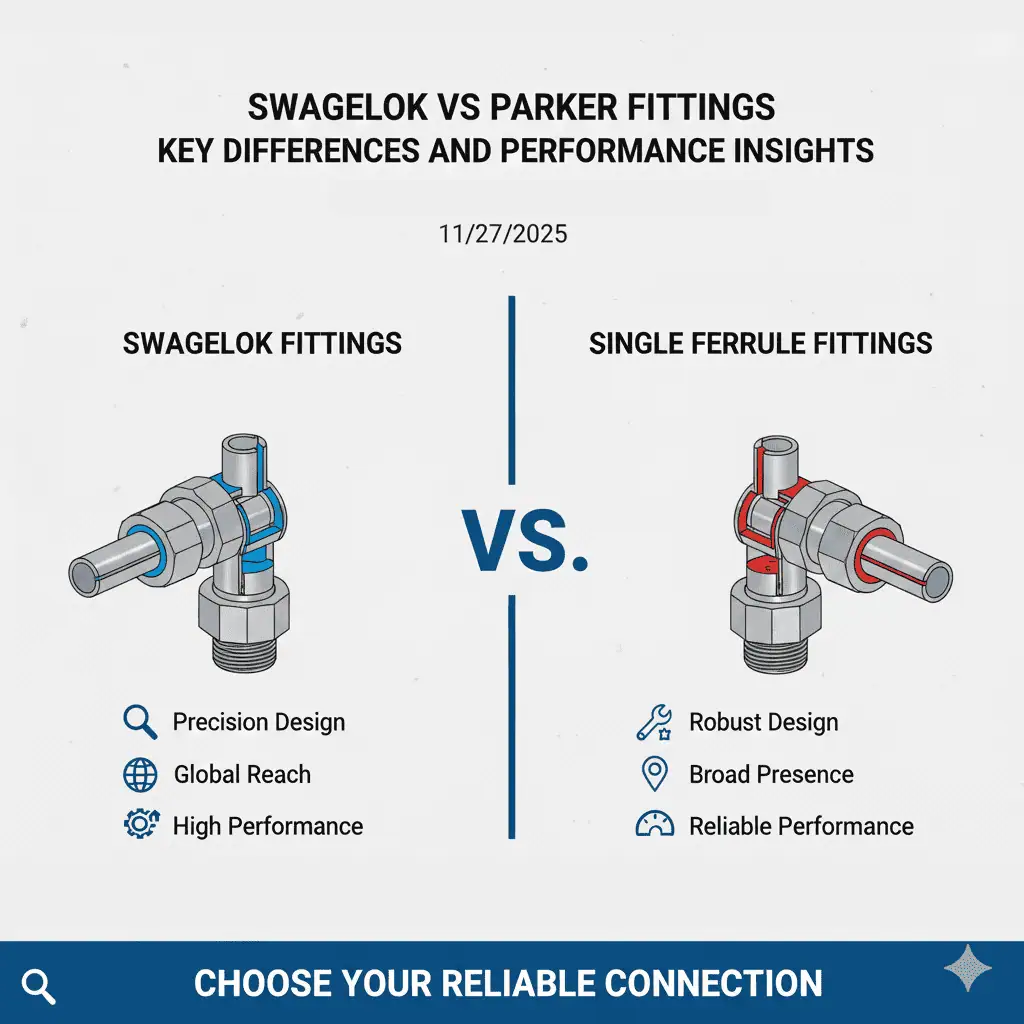
Swagelok vs Parker fittings differ in design details, documentation depth, and how consistently they perform across installers and sites. From a field-engineering standpoint, the practical question is: “Can I build a leak-tight tube system that stays tight after thermal cycling and vibration, and can I audit it with traceable documents?” That depends less on a logo and more on (1) correct tube selection and prep, (2) controlled assembly, and (3) staying inside a design code basis (commonly ASME B31.3 for process tubing) and the manufacturer’s published pressure tables.
You can still compare corporate footprint, because it affects availability of identical parts across sites and the speed of technical support. The table below uses publicly stated footprint indicators (not “fittings market share,” which is often not disclosed cleanly by segment):
| Company | Footprint Indicator | Global Presence |
|---|---|---|
| Parker Hannifin | Global operations (company fact sheet) | Global manufacturing / distribution network (verify local catalog and lead time by region) |
| Swagelok | Authorized sales & service centers across ~70 countries | Strong local center network for training, troubleshooting, and standardization programs |
Choosing the right fittings protects your system from leaks, unplanned shutdowns, and safety hazards. In most leak investigations I’ve supported, the root cause is not “bad stainless,” but a chain of small controllable errors: wrong tubing hardness, out-of-square tube cuts, shallow tube insertion, mixed-brand nuts/ferrules, or uncontrolled re-makes. If you are standardizing components across projects, use one manufacturer’s tubing + fitting rules, and document the installation method so it survives installer turnover. For reference, Swagelok publishes a clear position on avoiding intermix/interchange and why it introduces an untested joint design in practice. Why you should not intermix tube fitting components is a useful starting point for internal standards.
- Standardizing tube fittings from one manufacturer reduces rework because assembly rules, gauges, and remake guidance are consistent across the site.
- Quality shows up as fewer “nuisance leaks” after vibration/temperature cycles and fewer remakes during commissioning.
Swagelok vs Parker Fittings: Quick Comparison
Comparison Table
Here is a side-by-side look at common engineering factors for Swagelok and Parker A-LOK style double-ferrule tube fittings. Treat pressure ratings as “system ratings,” not brand badges: tube O.D., tube wall, end-connection type, material, and temperature govern the allowable working pressure.
| Feature | Swagelok® | Parker® A-LOK® |
|---|---|---|
| Design Type | Double Ferrule | Double Ferrule |
| Material Range | 316/316L SS, higher alloys available (verify heat/traceability requirements) | 316/316L SS, brass, and higher alloys (by catalog) |
| Pressure Rating | Tube-end ratings are based on tubing selection; NPT/ISO pipe-end pressure ratings are published (e.g., 316 SS 1/16 NPT is listed at 11,000 psig at ambient temperature). MS-01-140 (pipe ratings & basis) | Tube-end ratings are based on tubing selection; pipe-end pressure ratings are published (e.g., 316 SS 1/16 NPT male is listed at 10,000 psig; 1/2 NPT male listed at 6,600 psig). CAT4200-PC (pipe ratings) |
| Dimensional Compatibility | Do not assume cross-brand interchangeability; treat mixed components as an untested joint. | Some catalogs discuss “compatibility” in practice, but mixing brands still creates risk (geometry/tolerance/material differences). |
| Cost Efficiency | Typically higher initial price; value depends on downtime and rework avoidance. | Often competitive in large industrial supply chains; value depends on site standardization and training. |
| After-Sales Support | Strong training and field support via center network (region-dependent) | Strong industrial distribution footprint and catalog breadth (region-dependent) |
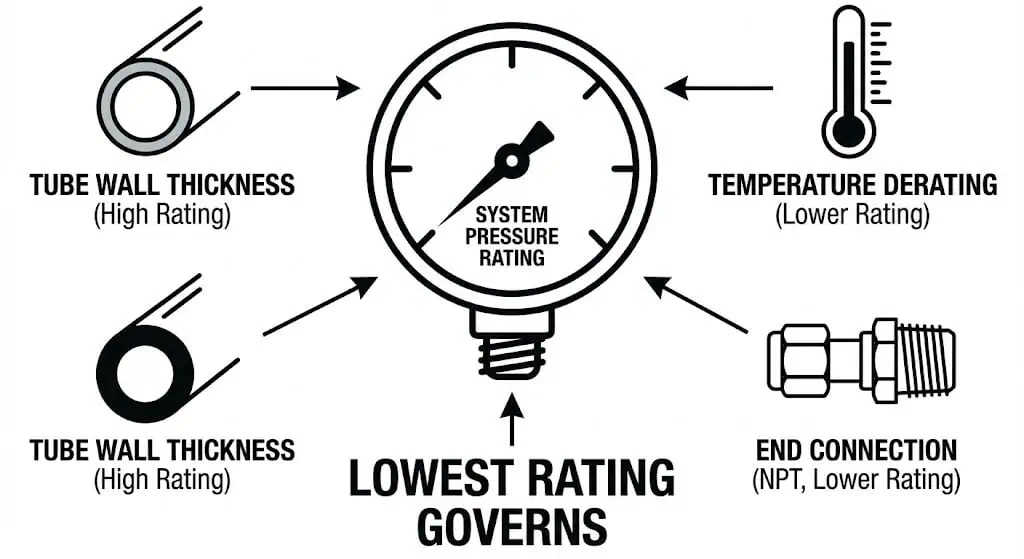
Tip: When comparing brands, verify three documents before you buy: (1) the pressure rating basis (tube and pipe ends), (2) tubing specification/hardness limits, and (3) assembly / remake guidance.
Key Distinctions
1. Ferrule Design:
Swagelok vs Parker fittings both use a double ferrule system, but each manufacturer controls ferrule geometry, surface finish, and heat treatment. Those details affect how the ferrules swage, how the back ferrule grips, and how tolerant the joint is to vibration and thermal cycling. Swagelok’s “gaugeable” approach (inspection by gap gauge after assembly) is widely referenced in its tube fitting literature. Swagelok gaugeable tube fitting catalog
2. Interchangeability:
Swagelok vs Parker fittings are not “safely interchangeable” in the engineering sense. Mixing brands can create inconsistent sealing surfaces and mismatched swaging mechanics. Swagelok explicitly states there is no industrywide commercial design standard for tube fittings and warns that intermix/interchange effectively creates a new, untested design—and can void warranty. Intermix/interchange explanation and risk list
3. Pressure Ratings:
Swagelok vs Parker fittings should be compared by the exact joint you are building. For tube-end compression fittings, allowable working pressure is typically tied to tubing O.D., wall thickness, material condition (fully annealed vs hardened), and temperature. For adapters with pipe threads, published tables can be compared directly—Swagelok lists NPT/ISO pipe ratings “based on ASME B31.3 … at ambient temperature,” and Parker notes that fittings with both tube and pipe ends are rated to the lower pressure. Swagelok pipe ratings (basis) | Parker pipe ratings (lower-pressure note)
4. Material Options:
Swagelok vs Parker fittings both commonly use 316/316L stainless for general chemical resistance, but “316L” alone does not guarantee performance. Verify the raw material spec (bar/forging spec) for the fitting body and the tubing spec for the tube. Parker’s catalog lists typical raw material specs and references ASTM tubing standards used with A-LOK systems. ASTM A269 is a common reference for austenitic stainless steel tubing (seamless and welded) for general service. Parker raw material table | ASTM A269 scope
5. Cost and Support:
Swagelok vs Parker fittings both sit in the “engineered component” category. If your site has high labor costs or frequent commissioning rework, the cheapest fitting is often the one that does not leak after the first thermal cycle. Support matters when you need an auditable training method for installers, a defined remake policy, and fast root-cause help during start-up.
Summary List:
- Both brands can be leak-tight when the tubing and assembly method match the published rules.
- Compare like-for-like: tube-end to tube-end, pipe-end to pipe-end, and always at the same temperature basis.
- Avoid mixed-brand components; treat that as an uncontrolled change to joint design.
- For multi-site projects, footprint influences standardization, support, and lead-time risk.
Note: When you compare swagelok vs parker fittings, focus on your system’s pressure basis, end connection type (tube vs NPT/BSPT), tubing spec, and installation controls. That is where leak performance is won or lost.
Why Brand Choice Matters
Reliability and Safety
Choosing the right brand directly impacts the reliability and safety of your fluid system. In the field, “reliability” means a joint stays tight after vibration, thermal cycling, and maintenance remakes—not only during a bench test. Reliability improves when the brand you standardize on provides:
- Clear tubing selection rules and limits (including hardness limits and surface condition guidance). For example, Swagelok tubing data references hardness limits and working pressure tables tied to a code basis. Swagelok Tubing Data (MS-01-107)
- Published pipe-thread pressure ratings and an explicit rating basis (temperature, code, safety factor). Parker CAT4200-PC (rating notes)
- A documented position against intermix/interchange, with reasons (tolerances, materials, swaging mechanics). Swagelok intermix/interchange risk list
Field example (leak after commissioning): A nitrogen purge header developed intermittent leaks at 1/2 in tube joints after start-up vibration. The initial build used one brand body with another brand’s ferrules on a “compatibility” assumption. The joints passed a soap-bubble check on day one, then leaked after a week of pump vibration. Root cause was mixed component geometry leading to inconsistent swaging and poor grip on the tube. Corrective action was to rebuild using one manufacturer’s complete fitting set and re-train installers with a defined “finger-tight + turns + gauge” method; leaks stopped and the site added a “no mixed ferrules/nuts” rule into the job spec.
Tip: During installation control, require a tube insertion check (bottoming), a witness mark, and a post-make-up inspection step (gauge or defined nut position) for every critical joint.
Compliance Factors
Brand choice affects your ability to meet industry safety standards and client documentation requirements. Instead of chasing a long list of logos, define the compliance questions your project actually needs:
- Which design code is the project using for process tubing/piping (commonly ASME B31.3 for process installations)?
- Do you need full heat/lot traceability and EN 10204 3.1 documentation for materials?
- Is the fluid service corrosive / sour / chloride-rich, requiring restrictions on hardness and material condition?
- Will the system see vibration, thermal cycling, or repeated remakes during maintenance?
Below is a “what to verify” table. Availability depends on the exact product line, material grade, and region—so treat this as a checklist, not an automatic “yes.”
| Standard/Certification | What to Verify in Supplier Documentation |
|---|---|
| ASME B31.3 (pressure rating basis) | Pressure rating basis, temperature basis, and whether ratings are tied to tubing selection tables (not just fitting body strength). Example basis statement in MS-01-140 |
| ASTM tubing specification (e.g., ASTM A269) | Tubing spec, condition (annealed), and dimensional tolerances; confirm the tubing spec matches the fitting manufacturer’s guidance. ASTM A269 scope |
| Material traceability | Heat code / lot traceability requirements for fittings and tubing; define in PO and inspection plan. |
| Intermix/interchange prohibition | Written policy that mixed-brand components are not allowed for safety/quality reasons. Example rationale |
Using fittings that come with clear rating basis and material documentation reduces rework during inspection and makes leak investigations easier when something goes wrong.
Design and Engineering
Ferrule Mechanism
Swagelok, Parker, and Sunhy fittings use double-ferrule mechanisms; performance depends on swaging consistency, tube prep, and vibration conditions.

You want your fittings to stay secure under pressure and vibration. The ferrule mechanism is the heart of a reliable connection. Swagelok’s catalog describes rating basis, thread standards, and assembly approach for gaugeable tube fittings and adapters. MS-01-140 (pressure rating basis and assembly context)
- Grip is not only a “seal”—the back ferrule’s mechanical hold helps resist tube pullout and cyclic movement when installed correctly.
- Vibration resistance improves when tubing is properly supported and the tube is fully inserted (bottomed) before tightening.
- Torque/turn control matters because under-tightening fails to swage; over-tightening can distort tubing or gall threads.
Field example (vibration + poor support): On a hydraulic test stand, repeated small leaks were traced to tube movement. The fitting design was not the limiting factor; the root cause was inadequate tube clamps within 2–3 tube diameters of the fitting. After adding supports and rebuilding the joints to the published make-up method, leaks stopped. Lesson: treat the fitting as part of a mechanical system—support and vibration control are design inputs.
Tip: If you see “random leaks” after a few days, inspect tube support spacing and look for witness marks indicating tube movement under vibration.
Manufacturing Precision
Precision in machining and consistent material condition drive leak-tight repeatability.
You need fittings that match exact specifications. Swagelok and Parker publish detailed catalogs including rating basis, materials, and dimensional standards; Parker also lists typical raw material specifications (bar/forging/tubing references) for A-LOK systems. Parker CAT4200-PC (raw material table)
- Tight tolerances help ferrules swage consistently across batches.
- Uniform material condition reduces variability (especially for stainless that can work-harden).
- For tubing-driven systems, tubing quality is as important as the fitting body—surface finish, ovality, and hardness affect swaging.
Practical audit point: Require incoming inspection on tubing (O.D., wall, ovality, surface finish), and verify tubing hardness or condition when the manufacturer specifies limits. Swagelok tubing data includes hardness guidance and ties working pressure to tubing selection and code basis. MS-01-107
Note: Consistent quality control is just as important as design. Always ask for documentation on material spec, heat/lot traceability (if needed), and published rating basis.
Compatibility Issues
Interchangeability Risks
Mixing Swagelok and Parker fitting components (nuts/ferrules/bodies) is unsafe and not recommended.
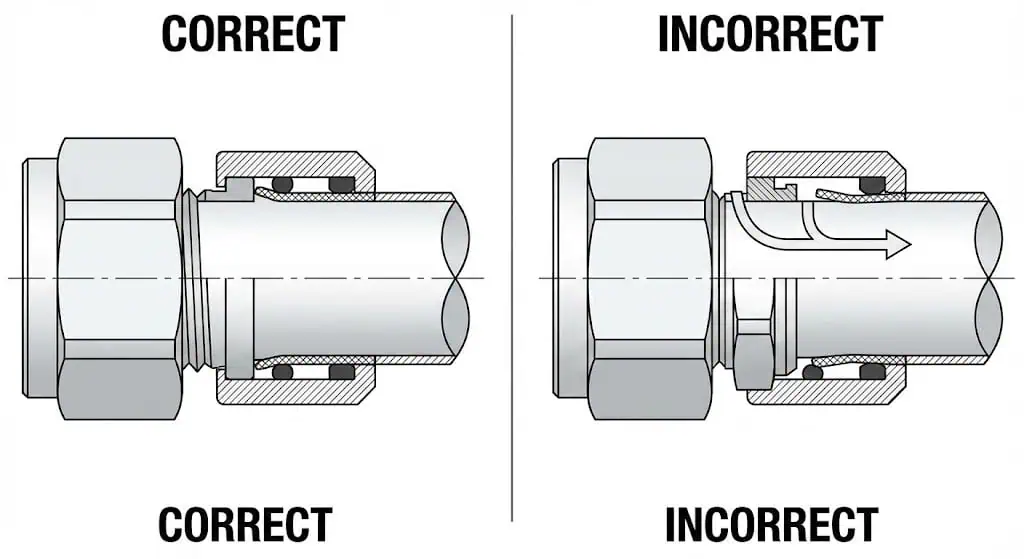
You face serious risks when you combine components from different brands. One manufacturer’s published position is clear: there is no industrywide commercial design standard for tube fittings, and intermix/interchange creates an untested joint with unpredictable performance. Swagelok also highlights that intermix/interchange can void warranty coverage. Swagelok: risks of intermix/interchange
| Risk Description | Impact |
|---|---|
| Inconsistent sealing surfaces due to design, geometry, tolerances, and material property differences | Increases leak probability; may appear fine at day-one leak check but fail after cycling. |
| Reduced sealing effectiveness from mismatched swaging mechanisms and torque/turn requirements | Creates uncontrolled joint behavior; higher risk of rework and downtime. |
| Fatigue failure from cyclic loading and tube movement | Higher risk when tubes are poorly supported or vibration is present; may progress to pullout or persistent seepage. |
| Compromised function from over-tightening during “trial-and-error” assembly | Can damage tube O.D., gall threads, or create a false seal that fails later. |
| Ineffective sealing from material variations (hardness, plating, surface finish) | May swage inconsistently, especially across different batch conditions. |
You should avoid intermixing brands because:
- Intermixing fittings can introduce new failure modes without any validated test basis.
- Variances in manufacturing and material condition can cause leaks that are difficult to troubleshoot.
- Warranty and compliance arguments become harder because the joint is no longer “as designed” by any one manufacturer.
Sizing and Standards
Swagelok and Parker fittings may look similar, but sizing, end-connection ratings, and assembly rules can differ.
You need to check sizing and standards before installing new fittings. Even small differences in geometry or tolerances can cause unpredictable performance. Switching between brands introduces technical challenges:
- Even when tube O.D. is nominally the same, assembly behavior can differ by ferrule geometry and nut travel.
- Adapters that combine tube ends with NPT/BSPT ends are rated to the lower pressure end (a published rule in Parker’s catalog). Parker rating note
- Pressure rating basis can be code- and temperature-dependent; Swagelok publishes NPT/ISO pipe ratings based on ASME B31.3 at ambient temperature. Swagelok pipe ratings basis
You should always match fittings to the original brand and specification. This practice helps you maintain system integrity and safety, and it keeps troubleshooting “clean” when leaks appear.
Material Quality
Stainless Steel Grades
Swagelok and Parker commonly use 316/316L stainless steel for tube fittings, but you must qualify the full system: fitting body + tubing + environment.
You often see SS316L and SS304/304L as common grades. These grades can perform well in many industrial services, but corrosion performance depends on chloride level, temperature, oxygen content, and whether the system is cleaned/pickled and kept dry between shutdowns. For tubing, ASTM A269 is a common general-service stainless tubing reference; confirm the exact tubing spec and condition the fitting manufacturer expects. ASTM A269 scope
- SS316L generally offers improved pitting resistance versus SS304/304L in chloride-bearing environments, but it is not “immune.”
- Many catalogs tie tube fitting performance to fully annealed tubing; Parker notes A-LOK tube fittings work on seamless and welded-redrawn, fully annealed 304/316/316L tubing. Parker tubing note
- Tube hardness and surface condition matter for swaging; consult the manufacturer’s tubing data and hardness limits. Swagelok Tubing Data (MS-01-107)
Tip: Specify both the fitting material and the tubing standard/condition on the PO. “316L fittings” without a tubing spec is an incomplete requirement for leak-tight systems.
Corrosion Resistance
Corrosion resistance is a system property, not a single material label.
You want your system to stay leak-free and safe, even in tough conditions. Stainless steel performance depends on environment (chlorides, temperature, wet/dry cycling), fabrication quality, and cleanliness.

- For tubing, confirm the correct spec (e.g., ASTM A269 for general-service austenitic stainless tubing) and verify test certificates when required. ASTM A269
- In chloride-rich wet environments, consider higher PREN alloys (e.g., duplex or 6Mo) if pitting/crevice corrosion risk is high—this is an engineering decision tied to water chemistry and temperature.
- Corrosion starts at weak spots: scratches on tube O.D., contamination, stagnant crevices, and poor drainage. Installation cleanliness and tubing handling matter.
Field example (chloride-driven pitting near fittings): A coastal water treatment skid experienced recurring “weep leaks” at stainless tube fittings. The fittings were not defective; the tube O.D. had handling scratches and the area saw salt spray plus wet/dry cycling. Corrective action included replacing scratched tube sections, adding shielding/drip control, and upgrading the tubing handling procedure (caps, clean gloves, no grit contact). Corrosion-driven leaks dropped sharply after procedural control.
Note: Corrosion resistance is not just about the material. Tubing condition, handling damage, and stagnant wet zones often decide whether leaks appear months later.
Swagelok Fittings: Performance
Pressure Handling
Swagelok fittings can support high-pressure systems when tubing selection and end connections support the same pressure basis.
Rather than quoting one number, check the exact configuration. Swagelok publishes (1) NPT/ISO pipe pressure ratings based on ASME B31.3 at ambient temperature and (2) tubing-driven working pressure tables in its tubing data. MS-01-140 | MS-01-107
In the field, pressure-related leaks are often “assembly-related” rather than “strength-related.” Before you blame pressure, check these common leak mechanisms:
| Common Leak / Failure Modes Seen in Tube Fitting Audits |
|---|
| Tube not fully inserted (not bottomed) before tightening |
| Out-of-square tube cut or burrs damaging ferrule swage |
| Over- or under-tightening (no controlled make-up method) |
| Tube movement from poor support (vibration/cyclic loading) |
| Mixed-brand components or uncontrolled remakes |

Pressure spikes and thermal cycling magnify these issues. If you stay within the published ratings and control assembly, tube fittings can be highly reliable.
Tip: If you need a high-pressure margin, verify both ends: tubing working pressure (OD/wall/material/temperature) and adapter end rating (NPT/BSPT tables) and take the lower value.
Installation Experience
Swagelok fittings are straightforward to install when you follow the published make-up method and inspection step.
You do not need special tools for most installations, but you do need controlled procedure. Swagelok’s catalog provides a clear initial make-up method (e.g., turn-to-9-o’clock guidance and different turns for small sizes). Assembly guidance example in MS-01-140
You will find these steps helpful:

- Cut the tube square and remove burrs (ID and OD). Clean the tube.
- Insert the tube fully into the fitting (bottom it), then mark the tube at the back of the nut as a witness mark.
- Tighten by hand to finger-tight, then follow the manufacturer’s prescribed additional turns (do not “feel-it-out”).
- For critical services, use the manufacturer’s inspection method (gap gauge / defined nut position) and document completion.
- Leak test using a method appropriate to the fluid and hazard (do not rely on a quick soap test for high-risk service).
Field example (over-tightened remake): A maintenance team disassembled and reassembled fittings multiple times during instrument replacement. Several joints began leaking because the remake procedure was uncontrolled and nuts were over-tightened “to stop seepage,” distorting the tube O.D. Corrective action was to replace short tube sections, then adopt a defined remake policy (limited remakes, inspect ferrules, replace if damaged) and a controlled make-up method. The failure mode looked like “bad fitting,” but it was controlled by procedure.
Note: Proper installation prevents many issues, including leaks and flow restrictions. Always follow the manufacturer’s instructions and define a remake policy for maintenance work.
Cost and Value
Price Comparison
Swagelok fittings usually cost more than many alternatives; Parker often competes strongly in industrial supply chains.
Price needs context: system criticality, cost of downtime, leak test burden, and rework labor. Use a total cost lens, not only unit cost.
| Brand | Average Price Level | Support Quality | Typical Application |
|---|---|---|---|
| Swagelok | $$$ | Strong training + local center support (region-dependent) | Critical process / analytical tubing, multi-site standards |
| Parker | $$ | Strong distribution + catalog breadth (region-dependent) | Industrial instrumentation / scalable procurement |
| Sunhy | $ | Evaluate by documentation, testing, and batch consistency | Cost-sensitive projects where qualification is performed |
- Swagelok often leads in standardized training and published procedures that reduce rework.
- Parker often leads in broad industrial availability and integration into supply chains.
- If you qualify an alternative supplier (including Sunhy), do it like an engineer: verify material certificates, dimensional checks, pressure rating basis, and a controlled assembly method—then validate with a pilot build and leak testing.
Tip: Define “acceptable leak rate” and test method in your project spec. The tighter your leak requirement, the more valuable standardized assembly + training becomes.
Long-Term Value
Long-term value is driven by reduced leak rework, predictable maintenance remakes, and procurement stability.
Two practical value drivers you can measure:
- Rework rate: How many joints require remake during commissioning and after the first thermal cycle?
- Auditability: Can you trace the tubing spec, rating basis, and assembly method used on critical joints?
- Intermix control: Does your site policy prevent mixed-brand components (a common source of unpredictable leaks)? Intermix/interchange discussion
Over time, fewer leaks reduces downtime and improves safety performance. That is where “value” shows up in real facilities.
Note: Investing in reliability pays off when your system is sensitive to leakage (hazardous media, purity requirements, environmental release limits, or costly shutdowns).
Sunhy vs Swagelok and Parker
Sunhy Stainless Steel Fittings
Direct Answer: Sunhy stainless steel fittings can be a cost-focused option if you qualify them with the same engineering controls you would apply to any supplier: material certs, dimensional checks, published rating basis, and controlled assembly.
You may see materials such as 316/316L stainless and duplex tubing/fittings offered by multiple suppliers. What matters is the verifiable package: (1) the exact material standard and heat traceability you require, (2) evidence of consistent manufacturing (dimensional tolerance control), and (3) how the fitting behaves on the tubing you will actually use. For tubing-driven systems, ASTM A269 is a common stainless tubing reference; confirm the tubing condition (fully annealed) matches the fitting manufacturer’s guidance. ASTM A269
Comparison Table:
| Brand | Material Quality | Manufacturing Methods | Documentation / Catalog Support |
|---|---|---|---|
| Swagelok | 316/316L SS + higher alloys (by line) | Precision machining; defined assembly + inspection approach | Extensive published rating basis and installation guidance |
| Parker | 316/316L SS, brass, higher alloys (by line) | Precision machining; broad industrial catalog | Extensive published rating basis, materials tables, and fitting families |
| Sunhy | 316/316L SS, duplex offerings (verify) | Supplier-specific; verify QC controls and test evidence | Evaluate by certificates, published ratings, and pilot testing results |
Note: If your system is safety-critical or leak-sensitive, procurement should require documentation and a validated assembly method, not only a material grade name.
Manufacturing and Quality Control
Direct Answer: Quality control is what makes fittings predictable across batches and installers.
You benefit from advanced processes only if they produce consistent dimensions and stable material condition. Regardless of brand, a practical QC checklist for tube fittings includes:
- Incoming material certificates (heat/lot traceability if required).
- Dimensional inspection plan (critical diameters, thread checks, surface finish where sealing is created).
- Tubing compatibility statement (seamless vs welded-redrawn; annealed condition). Parker explicitly notes compatibility with fully annealed 304/316/316L tubing. Parker tubing note
- Published pressure rating basis and temperature basis (ambient vs elevated temperature).
- Assembly instruction and remake policy (and training evidence).
Field example (qualification success): A project qualified a secondary fitting supplier by building a pilot panel, enforcing a controlled assembly method (witness marks + defined turns + inspection), and running a staged leak test after thermal cycling. The supplier passed only after tightening the tubing spec (ovalty limit, annealed condition) and adding incoming inspection. The win was not “cheap fittings,” it was an engineered qualification process.
Tip: Always review the manufacturing documentation and the tubing spec together. Most “mystery leaks” are tubing + assembly problems disguised as fitting problems.
Choosing the Right Fitting
Application Recommendations
Direct Answer: Match your fitting choice to your system’s pressure basis, environment, and installation controls—not a single headline number.
When you select fittings, review the variables that actually drive leak performance and safety:
- The outside diameter of your tubing affects the fitting size; verify insertion depth requirements and ensure tubes are fully bottomed.
- The wall thickness of the tubing determines pressure capability; working pressure tables are usually tubing-driven. Example tubing-driven tables (MS-01-107)
- The material of both tubing and fittings must be compatible with the fluid and the environment (chlorides, sour service, temperature).
- Tubing condition matters (fully annealed vs work-hardened); confirm the manufacturer’s recommended tubing condition.
- Gas vs liquid service affects leak test selection and risk controls (gas leaks are harder to detect and can be higher hazard).
- The temperature of your system influences allowable pressure; confirm the temperature basis of published ratings.
- Decide if you need seamless or welded-redrawn tubing; verify compatibility statements from the fitting manufacturer.
Tip: If your project involves multiple contractors, write the assembly method into the spec (tube prep, witness mark, make-up turns, inspection step). “Installer skill” is not a control plan.
Decision Factors
Direct Answer: Base your decision on performance, total cost, documentation, and whether you can enforce “no intermix” and a controlled assembly method.
You want to choose fittings that meet your technical requirements and budget. Use the table below to compare the main decision factors:
| Factor | Swagelok | Parker | Sunhy |
|---|---|---|---|
| Pressure Rating | Tube-end ratings tied to tubing selection; pipe-end ratings published (ASME B31.3 ambient basis in MS-01-140) | Tube-end ratings tied to tubing selection; pipe-end ratings published (catalog tables + lower-pressure rule) | Supplier-dependent; require published basis and validate via qualification test |
| Material Options | 316/316L and higher alloys (by line) | 316/316L, brass, higher alloys (by line) | 316/316L, duplex offerings (verify) |
| Certification Support | Strong documentation support (verify by product line and region) | Strong documentation support (verify by product line and region) | Verify by certificates, traceability, and inspection plan |
| Cost | Higher initial cost; value in reduced rework | Moderate; value in availability and supply chain integration | Cost-effective if qualification is performed |
| Manufacturing Quality | High consistency (by published procedures and training) | High consistency (by catalog family and QC controls) | Qualify batch consistency and tube compatibility |
You should review your system’s pressure basis, environment, and compliance needs. Swagelok can be strong for standardized methods and training. Parker can be strong where procurement scale and broad availability matter. If using a cost-focused alternative, apply a formal qualification plan (tubing + assembly + leak testing) and document it.
Note: Consult technical experts if you have special requirements (high vibration, high temperature, sour service, ultra-high purity) or if failures have high consequences.
You should choose fittings based on your system’s needs, budget, and reliability goals. Review the table below to compare key selection factors:
| Factor | What to Consider |
|---|---|
| Design | Tube-end vs pipe-end connections; rating basis and inspection approach |
| Compatibility | No intermix policy; tubing spec and condition match the fitting guidance |
| Material Quality | Material spec + environment compatibility + traceability needs |
| Performance | Vibration control, support spacing, thermal cycling, and controlled assembly |
| Cost | Total cost of ownership: leaks, downtime, rework labor, inspection burden |
- Use a documented selection and installation checklist (tubing spec, assembly method, inspection step, leak test method).
- Research vendor reliability and support before you decide, especially for multi-site or fast-turn projects.
- Consult experts for custom fitting solutions or high-risk media.
- For background reading on tube vs pipe fitting scope, see: SS Pipe Fittings vs SS Tube Fittings
FAQ
What is the main difference between Swagelok and Parker fittings?
The main difference is not a single pressure number—it’s the published method, documentation, and how you control installation across your site.
Both are double-ferrule designs. For many tube-end applications, allowable working pressure is tubing-driven (OD/wall/material/temperature). Compare (1) rating basis and temperature basis, (2) tubing specification/hardness limits, and (3) assembly and inspection method (gauge/turn guidance). For pipe-thread adapters, compare the published pipe-end tables directly.
Can you mix Swagelok, Parker, and Sunhy fittings in one system?
You should not mix brands at the component level (nuts/ferrules/bodies).
Mixing components can create inconsistent sealing surfaces and mismatched swaging mechanics. One manufacturer explicitly warns there is no industrywide commercial design standard for tube fittings and states that intermix/interchange can lead to unpredictable performance and may void warranty. Intermix/interchange explanation
How do Sunhy fittings compare in quality?
Quality must be qualified: material certificates, dimensional consistency, published rating basis, tubing compatibility, and a validated assembly method.
If you qualify Sunhy (or any alternative supplier), require the tubing spec/condition, define the assembly method, and validate via a pilot build and leak test after thermal cycling. Documented compatibility statements and tubing standards (e.g., ASTM A269 for stainless tubing scope) help anchor the qualification. ASTM A269
Which fitting brand is best for cost-sensitive projects?
A cost-sensitive project is best served by the option that you can qualify and control.
If the system is low consequence and you can run a qualification build, an alternative supplier may be acceptable. If the system is safety-critical or leak-sensitive, the cost of rework and downtime often exceeds the unit price difference—so standardized training, documented assembly, and a strict no-intermix policy become the economic choice.