








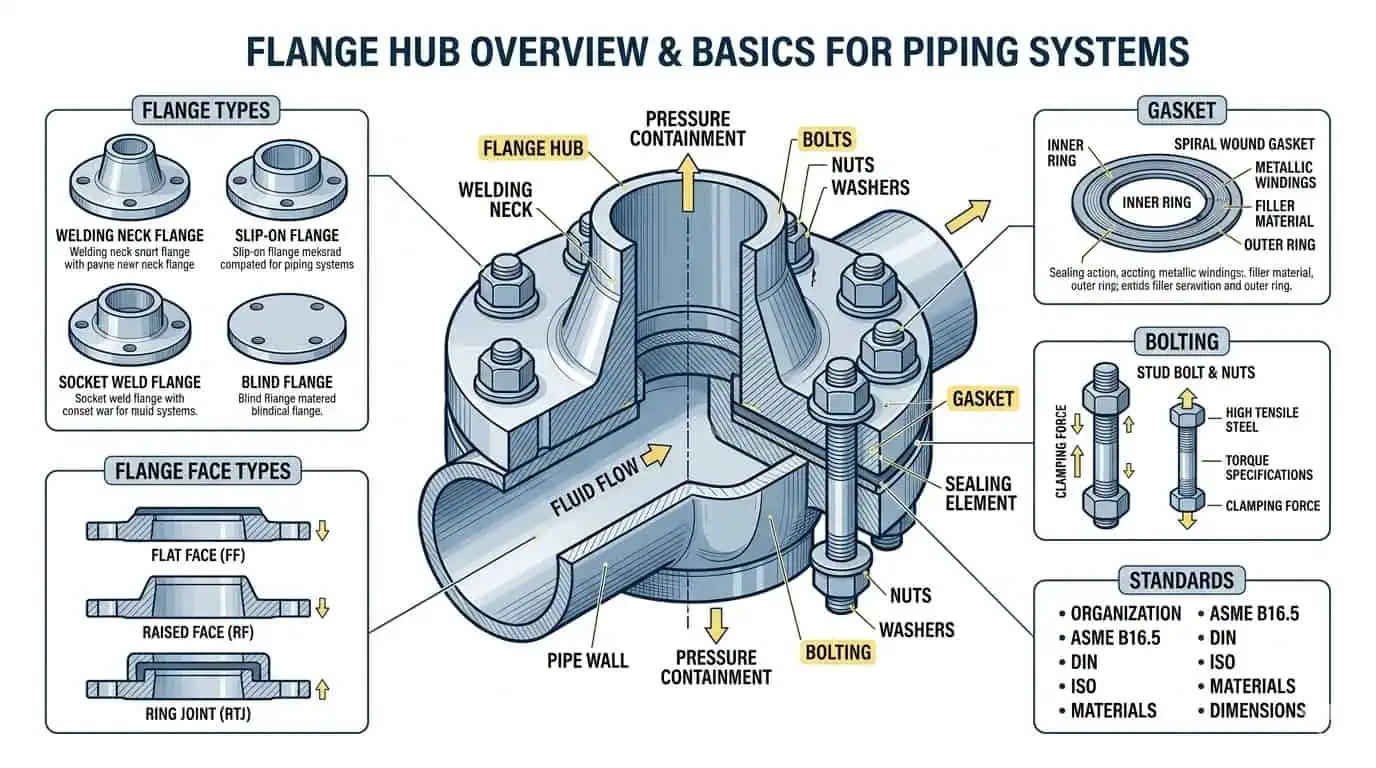
A flange is a bolted joint interface used to connect pipes, valves, pumps, and equipment by converting bolt preload into gasket seating stress to control leakage. In practical plant work, the “flange” is rarely the failure by itself. Leakage almost always traces back to face condition + gasket selection + bolt load control + alignment. In modern projects, flanges remain foundational because globally recognized dimensional standards and material specifications make the joint predictable when you assemble it correctly.
If you need a fast engineering answer before reading the full guide:
- Start from design conditions: pressure, temperature, and media chemistry define the standard, facing, gasket family, and bolting grade.
- Match the system standard end-to-end: ASME / ANSI Class systems are not dimensionally interchangeable with DIN / EN PN systems without adapters.
- Assume the joint lives or dies by bolt load control: torque is only a proxy; friction scatter and poor tightening sequence create uneven gasket stress and leakage paths.
- Never pull misaligned spools together with studs: misalignment loads the joint and relaxes bolt preload after thermal cycles.
| Priority Check | What to Confirm | Why It Matters |
|---|---|---|
| Standard match | ASME B16.5 / B16.47 vs EN / DIN / JIS / AWWA | Prevents bolt-hole mismatch and forced assembly |
| Face + gasket match | FF / RF / RTJ with the correct gasket family | Controls seating stress and leakage resistance |
| Bolting control | Stud grade, lubrication condition, staged tightening sequence | Reduces preload scatter and repeat leaks |
| Alignment + support | Natural fit-up, no external piping strain at the joint | Maintains gasket stress after startup and thermal cycling |
Field reality: if a flange keeps leaking, treat it as a joint-system problem. Start with face damage and alignment, then gasket type and bolt condition, then tightening method. Replacing gaskets repeatedly without correcting the root cause only burns downtime.
Reviewed for engineering clarity: this page is written as a practical hub for flange fundamentals, field selection, and troubleshooting. It is designed to help engineers, buyers, maintenance planners, and project teams choose the right flange logic before they commit to product details.
- Flanges overview: the fundamentals
- Flange structure and connection methods
- Detailed guide to types of flanges
- Flange face types
- Flange materials selection
- Standards and ratings
- Dimensions and measurement
- Gaskets, nuts, and bolts
- Manufacturing and quality control
- How to choose the right flange
- FAQ
Flanges Overview: The Fundamentals
What are flanges?
Simply put, flanges are disc-shaped interfaces that create a detachable pressure boundary between two components. Unlike welding, which is permanent, a flange joint is serviceable: you can open it for inspection, cleaning, or component replacement. The joint seals because bolt preload compresses a gasket against two flange faces. That means sealing performance depends on:
- Face condition: nicks, radial scratches across the seating area, or corrosion pitting create leak paths.
- Gasket family and thickness: the gasket must match face type and service.
- Controlled bolt load: uneven preload distorts flange faces and creates local under-compression.
- Alignment and support: piping loads can relax bolt preload after thermal cycling.
If you want a fast functional overview tied to plant decisions, see: what is the function of a flange and how does it work.
History and evolution
Flanges became reliable when standardization made dimensions and materials predictable—and when gasket and bolting practices matured. That matters because early flange work was often supplier-specific and hard to repair consistently. Standardized flange systems changed that by making interchangeability and maintenance planning much more reliable.
- Early flanges lacked standardization, so bolt patterns and face details varied between suppliers.
- Industrial development improved forged flange quality and gasket materials, raising allowable pressure and temperature.
- Mid-20th-century standards from ASME, API, and related bodies made flange dimensions and classes more consistent.
- Modern plants benefit from corrosion-engineered alloys, better inspection, calibrated tools, and documented tightening procedures.
Why flanges matter in modern industry
Flanges are critical because they provide a controlled, inspectable seal at equipment interfaces. In real maintenance work, flanges are selected not only for pressure and temperature, but also for how often you expect to open the joint and what happens if it leaks.
- Secure connections: predictable bolt pattern + gasket seating area = repeatable assembly when done correctly.
- Reliable sealing: correct face / gasket / bolting combination is essential for hazardous media and steam service.
- Maintenance access: you can isolate and open joints without cutting pipe, which reduces outage scope.
- Non-destructive disassembly: inspection and replacement without hot work.
- Adaptability: different flange types handle vibration, temperature gradients, and cyclic loads differently.
- Regulatory compliance: recognized standards and documented assembly practice improve auditability.
- Petrochemical plants and refineries
- Power generation systems
- Water and wastewater facilities
- Food, beverage, and pharmaceutical plants
- Marine, offshore, and utility infrastructure
Case file: a cooling water line showed persistent weeping after every gasket change. Cause: flange faces had radial scoring from aggressive scraping, and the gasket could not bridge the grooves. Fix: re-machine the face to the correct finish, replace the gasket with the correct thickness, and retighten per documented cross-pattern. The gasket itself was not the real root cause.
Flange Structure and Connection Methods
Basic flange design
A standard industrial flange includes the sealing face, bore, bolt holes, bolt circle, and—where applicable—a hub or neck that manages stress transfer. These details matter because if the geometry does not match the standard, you cannot guarantee bolt-up alignment, gasket seating area, or pressure-temperature rating behavior. For common Class-rated process flanges, refer to ASME B16.5.
| Flange Type | Structural Features | Sealing Faces |
|---|---|---|
| Weld Neck Flange | Tapered neck with V-groove for butt welding; neck transition disperses stress effectively | RF, RTJ |
| Slip-On Flange | Larger inner diameter than pipe; fixed by fillet welding | FF, RF |
| Socket Weld Flange | Pipe inserts into flange socket; requires a controlled gap | RF |
| Blind Flange | Solid flange without center hole; seals line or nozzle end | FF, RF, RTJ |
| Lap Joint Flange | Flange body plus stub end; rotatable for easy alignment | Uses stub end face |
| Threaded Flange | Internal threads; fits pipes with external threads | FF, RF |
We select flange type based on pressure, temperature, cyclic loading, corrosion allowance, and the need for repeatable maintenance access. A cheaper flange that forces frequent rework is not cheaper on an operating plant.
How flanges connect pipes and equipment
We connect flanges to pipes and equipment using methods that balance strength, inspectability, and assembly control. Each method has a typical failure mode you should plan for.
- Bolted connection: serviceable and common; failures usually come from uneven bolt load, gasket mismatch, or misalignment loads.
- Welded connection: strong and compact; failures often come from poor weld procedure control, lack of NDE where required, or thermal fatigue at transitions.
- Threaded connection: fast; failures often come from thread damage, sealant mismatch, or vibration loosening in cyclic service.
- Socket weld connection: strong for small bore; failures often come from crevice corrosion at the socket and lack of gap control.
- Lap joint connection: maintenance-friendly; failures often come from wrong stub end material or joint movement not considered in supports.
- Slip-on connection: cost-effective; failures often come from lower fatigue strength and weld quality variability.
Where joint integrity is critical, documented assembly practice matters as much as the flange type. A commonly referenced guideline for bolted flange joints is ASME PCC-1.
Flange assembly process (step-by-step)
A disciplined assembly sequence is the difference between a stable joint and a leak that returns after the first thermal cycle. The steps below are written the way they are usually executed in shutdown work.
- Inspection: inspect faces, studs, nuts, and ring grooves if applicable. Any scratch crossing the seating area is suspect.
- Preparation: remove old gasket material without scoring the face. Solvent clean and dry the joint.
- Alignment: align flanges so bolt holes match naturally. If you must lever flanges together, you have piping stress that will unload the gasket later.
- Gasket placement: center the gasket correctly; do not allow it to hang into the bore or sit off-center.
- Lubrication control: apply the specified lubricant consistently to threads and nut bearing surfaces.
- Hand-tightening: bring the joint together evenly before torqueing.
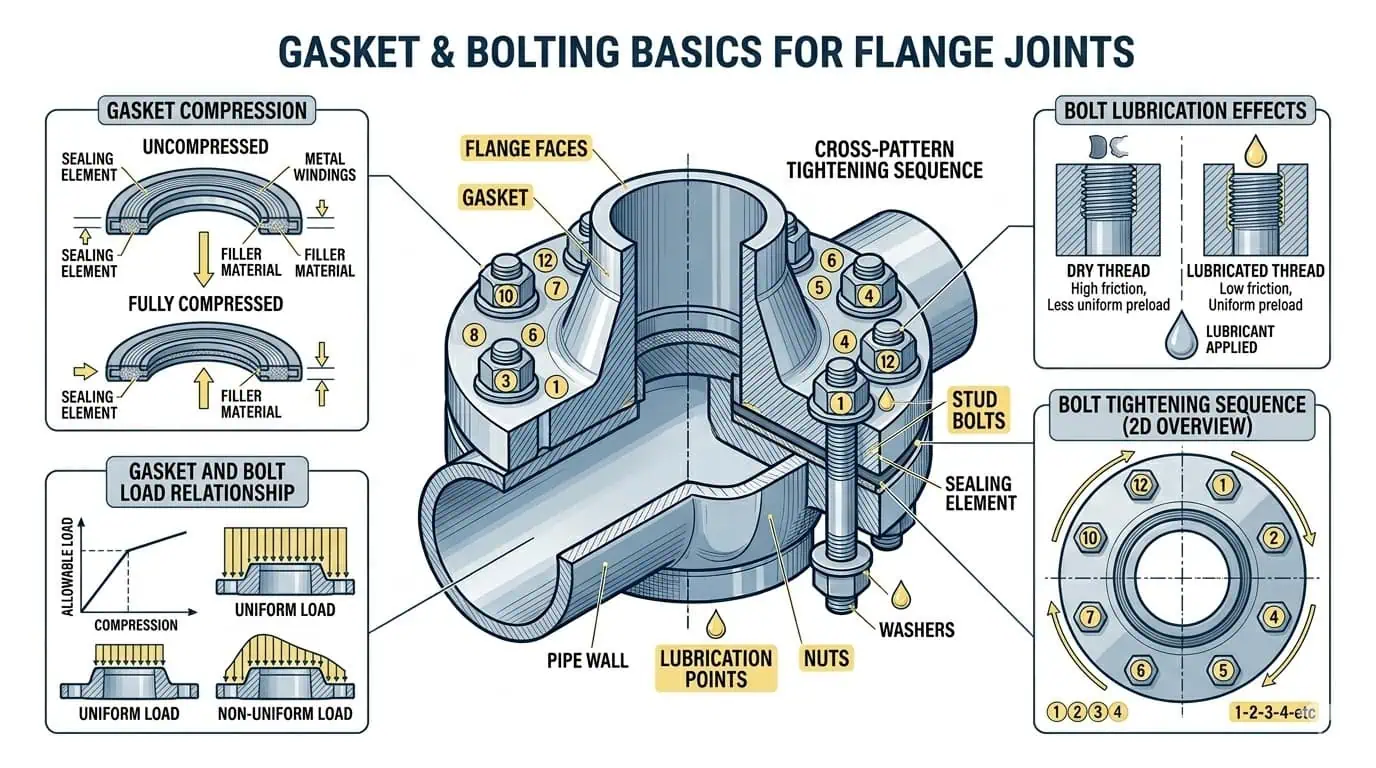
- Torquing: tighten in a star / cross pattern in multiple passes, commonly 30%, 60%, and 100%.
- Testing: pressurize slowly and observe. If a joint weeps under low pressure, diagnose the cause instead of simply adding more torque.
Case file: a Class-rated steam joint passed a cold hydrotest but leaked after heat-up. Cause: uneven bolt load from circular tightening and no re-check after the first thermal cycle; the gasket relaxed and the joint lost effective seating stress. Fix: reassemble with controlled cross-pattern staged tightening, verify stud condition and lubrication consistency, and perform a documented check pass after thermal stabilization.
Detailed Guide to Types of Flanges

Industrial piping uses many flange types. Each one serves a specific purpose and offers different advantages depending on stress level, inspection access, welding constraints, or maintenance strategy.
| Selection Question | What to Check | Why It Matters |
|---|---|---|
| Is the service cyclic or vibrating? | Prefer weld neck; avoid slip-on in severe cyclic duty unless engineered | Fatigue and weld toe cracking show up first where stress concentrates |
| Do you need frequent dismantling? | Lap joint + stub end can reduce outage time if materials and faces are correct | Rotation solves bolt-hole alignment without forcing pipes |
| Is welding restricted? | Threaded may be used only within its limits; verify thread standard and sealing method | Threaded leaks often come from vibration and improper sealant practice |
| Is the media corrosive or chloride-bearing? | Verify material compatibility and gasket chemistry resistance | Corrosion products damage faces and reduce bolt load over time |
Weld neck flanges
Weld neck flanges provide the highest joint reliability for critical piping systems because the tapered neck transfers stress smoothly into the pipe wall. They are butt-welded to the pipe and are often preferred where pressure class is high, thermal cycling is frequent, or vibration matters. See product detail: weld neck flanges.
- Common in oil and gas pipelines and processing plants
- Widely used in power generation steam and condensate service
- Useful where fatigue margin and inspection confidence matter
Tip: if a vibrating line keeps leaking at slip-on joints, the long-term fix is often better joint stiffness and stress distribution, not a different gasket brand.
Slip-on flanges
Slip-on flanges offer easier alignment and lower fabrication cost for general-purpose piping. They are slid over the pipe and secured with fillet welds. They can work well in utility systems, but they are not usually preferred for high cyclic stress or severe vibration duty. See: slip-on flanges.
| Advantages | Trade-Offs |
|---|---|
| Easier alignment during installation | Lower fatigue strength than weld neck flanges |
| Affordable and widely available | Not preferred for severe cyclic or high-vibration service |
| Useful in water treatment and utility lines | Weld quality variability can dominate long-term performance |
Socket weld flanges
Socket weld flanges suit small-diameter, higher-pressure piping where butt welding is difficult. The pipe inserts into a socket and is fillet-welded around the edge. In practice, insertion gap control and corrosion review matter. See: socket weld flanges.
Lap joint flanges
Lap joint flanges give flexibility and faster bolt-up when alignment is difficult. Used with a stub end, the ring can rotate freely, which helps maintenance teams avoid forcing misaligned spools with studs. For more detail, see: lap joint flanges.
Note: lap joints are maintenance-friendly, but they are not a shortcut around correct gasket selection and bolt load control.
Threaded flanges
Threaded flanges provide a weld-free connection for limited services where project standards allow it. They are useful in low-pressure / low-temperature lines or repair scenarios where hot work is restricted. Thread standard and sealant compatibility must be verified. See: threaded flanges.
Case file: a threaded flange on a vibrating utility header loosened repeatedly. Cause: vibration plus unsuitable sealant practice and weak thread control. Fix: upgrade to a welded joint or add vibration mitigation; if threaded must remain, enforce thread standard, engagement, sealant specification, and inspection.
Blind flanges
Blind flanges seal off the ends of piping systems or unused openings. They are used for maintenance, testing, isolation, or future expansion. Because they see high net force from internal pressure acting across the bore area, bolt condition, lubrication consistency, and tightening method are critical during isolation work. See: blind flanges.
Long weld neck and specialty flanges
Long weld neck flanges are chosen where nozzle reinforcement and smoother stress transition matter. Specialty flanges such as orifice flanges, spectacle blinds, anchor flanges, expander flanges, swivel flanges, and nipoflanges solve specific engineering problems. See: orifice flanges and custom flange solutions.
Flange Face Types: The Sealing Interface
Flange face type directly affects sealing performance and gasket compatibility. In many plant leaks, the problem is not the flange body but the wrong face/gasket combination or damaged face finish. For widely referenced gasket standards, see ASME B16.20 and ASME B16.21.

| Flange Face Type | Characteristics | Common Applications |
|---|---|---|
| Flat Face (FF) | Flat surface, full-face gasket, broad contact area | Water treatment, HVAC, cast iron pump / valve connections |
| Raised Face (RF) | Raised seating area concentrates gasket stress | Oil and gas, power generation, Class-rated process lines |
| Ring-Type Joint (RTJ) | Metal ring in machined groove for severe-duty sealing | Refineries, high-pressure and high-temperature services |
| Male-Female / Tongue-and-Groove | Controlled gasket positioning and protected gasket edges | Specialized services needing tighter gasket location control |
Flat face flanges (FF)
Flat face flanges are used for low-pressure systems and brittle mating materials. The flat surface increases gasket contact area and helps avoid overstressing cast iron or FRP equipment nozzles.
Case file: a steel RF flange was bolted directly to a cast iron FF pump nozzle. Cause: the RF geometry created a gap and concentrated load; tightening bridged the gap by bending the cast iron face until it fractured. Prevention: match face types, or use an engineered spacer/adaptation procedure if required by the project.
Raised face flanges (RF)
Raised face flanges are used in the majority of Class-rated process plant applications because they provide higher gasket seating stress for a given bolt load. RF joints are compatible with many gasket families when face finish and gasket choice match the service.
For practical face-selection logic, see: RF vs FF vs RTJ flanges.
Male-female and tongue-and-groove
Male-female and tongue-and-groove faces help control gasket positioning and protect the gasket from the media side. They are less forgiving than common RF joints if mating geometry is wrong, but they can perform well when engineered correctly.
Ring type joint flanges (RTJ)
RTJ flanges are specified for high-severity service where a metal ring in a machined groove provides a robust seal interface. Correct ring type, groove dimensions, ring material, and bolt load control are mandatory. RTJ joints are not forgiving.
Expert note: treat RTJ joints as engineered sealing systems, not general-purpose gasketed joints. Verify ring material, groove dimensions, bolt grade, lubrication, and tightening procedure together.
Flange Materials Selection
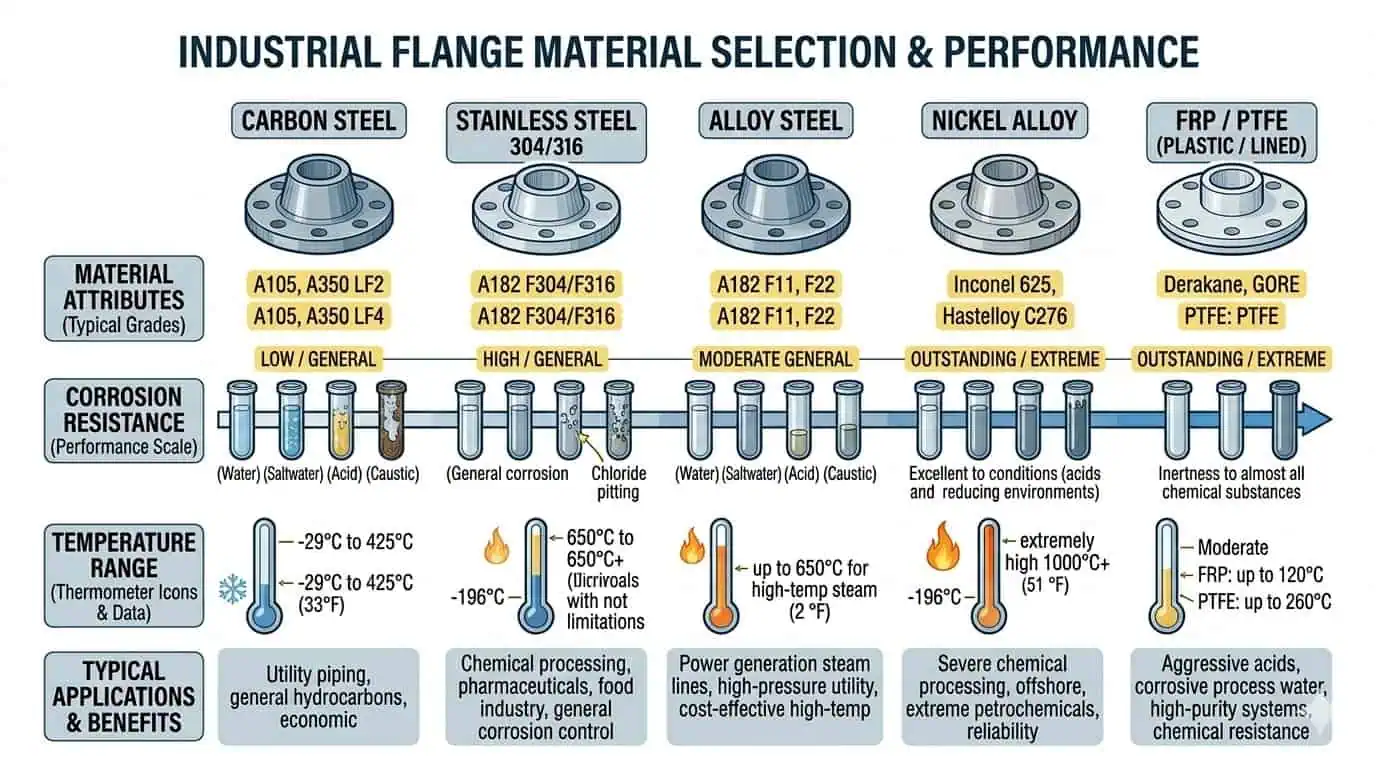
Selecting the right flange material is essential for safety and lifecycle cost. Mechanical strength, corrosion resistance, temperature tolerance, media chemistry, chlorides, acids, sour service, and cleaning agents all matter. Stainless is not one material; it is a family with different behaviors in chloride and high-temperature service.
Carbon steel flanges
Carbon steel flanges are chosen for many pressure and elevated-temperature applications because they provide strength and weldability at reasonable cost. Typical forged carbon and alloy steel flange materials should always be verified against the project specification.
| Common Material | Typical Use | Engineering Notes |
|---|---|---|
| ASTM A105 | General forged carbon steel flanges | Common for ambient to moderate high-temperature service |
| ASTM A350 LF2 | Low-temperature carbon steel flanges | Selected where low-temperature toughness matters |
| ASTM A694 F52 / F60 / F65 | Higher-strength pipeline flanges | Used where higher mechanical strength is needed |
Stainless steel flanges
Stainless steel flanges such as 304 / 304L and 316 / 316L are widely used where corrosion resistance and cleanliness matter. The practical selection rule is to match stainless grade to chloride level, temperature, and crevice conditions. 316 / 316L is commonly preferred over 304 / 304L in higher-chloride environments because molybdenum improves pitting resistance.
For recognized technical guidance, see the Nickel Institute guide on stainless steel in naturally occurring waters.
Case file: a 304L flange in warm chloride-bearing water developed localized pitting under the gasket seating area. Cause: crevice conditions + chloride + temperature. Fix: upgrade material, often to 316L or duplex depending on service, improve drainage / crevice conditions, and replace the gasket with one compatible with the media and cleaning regime.
Alloy steel, nickel alloy, and non-metallic flanges
Alloy steel flanges are used where elevated-temperature strength and creep resistance are required. Nickel alloy flanges are selected for aggressive corrosion environments and high-temperature oxidation resistance. PTFE, FRP, and reinforced polymer flanges are used in specialized, lower-pressure applications where corrosion immunity or low weight is the priority.
| Material Group | Main Strength | Typical Applications |
|---|---|---|
| Alloy Steel | Better elevated-temperature strength | High-temperature steam and boiler-related service |
| Nickel Alloy | Severe corrosion and oxidation resistance | Chemical, petrochemical, scrubber, and aggressive-duty systems |
| PTFE / FRP / Composite | Corrosion resistance and low weight in limited service | Chemical lines, water treatment, light industrial service |
Flange Standards and Ratings Explained
ASME and ANSI flanges
ASME standards are the main reference for most Class-rated process piping flanges. As a practical rule, use ASME B16.5 for common sizes and classes, and ASME B16.47 for large-diameter steel flanges. “ANSI flange” is still a common market term, but the actual applicable project standard should be ASME or another current code reference.
DIN, EN, JIS, GB/T flanges
DIN / EN, JIS, and GB/T systems are not automatically bolt-pattern interchangeable with ASME systems. The critical mismatch is usually bolt circle diameter and hole size / count conventions, not quality. This is one of the most common procurement mistakes in mixed-standard projects.
| Aspect | ASME / ANSI | DIN / EN |
|---|---|---|
| Bolt Circle Diameter | Imperial-based conventions are common | Metric-based conventions are common |
| Pressure Rating System | Class (150, 300, etc.) | PN (10, 16, 40, etc.) |
| Flange Thickness | Often heavier in comparable size ranges | Varies by PN and type |
API and AWWA flanges
API and AWWA standards are used for specialized industries where the design basis differs from general process piping. For example, API 6A applies to wellhead and tree equipment, while AWWA standards are common in water industry service.
Pressure classes and markings
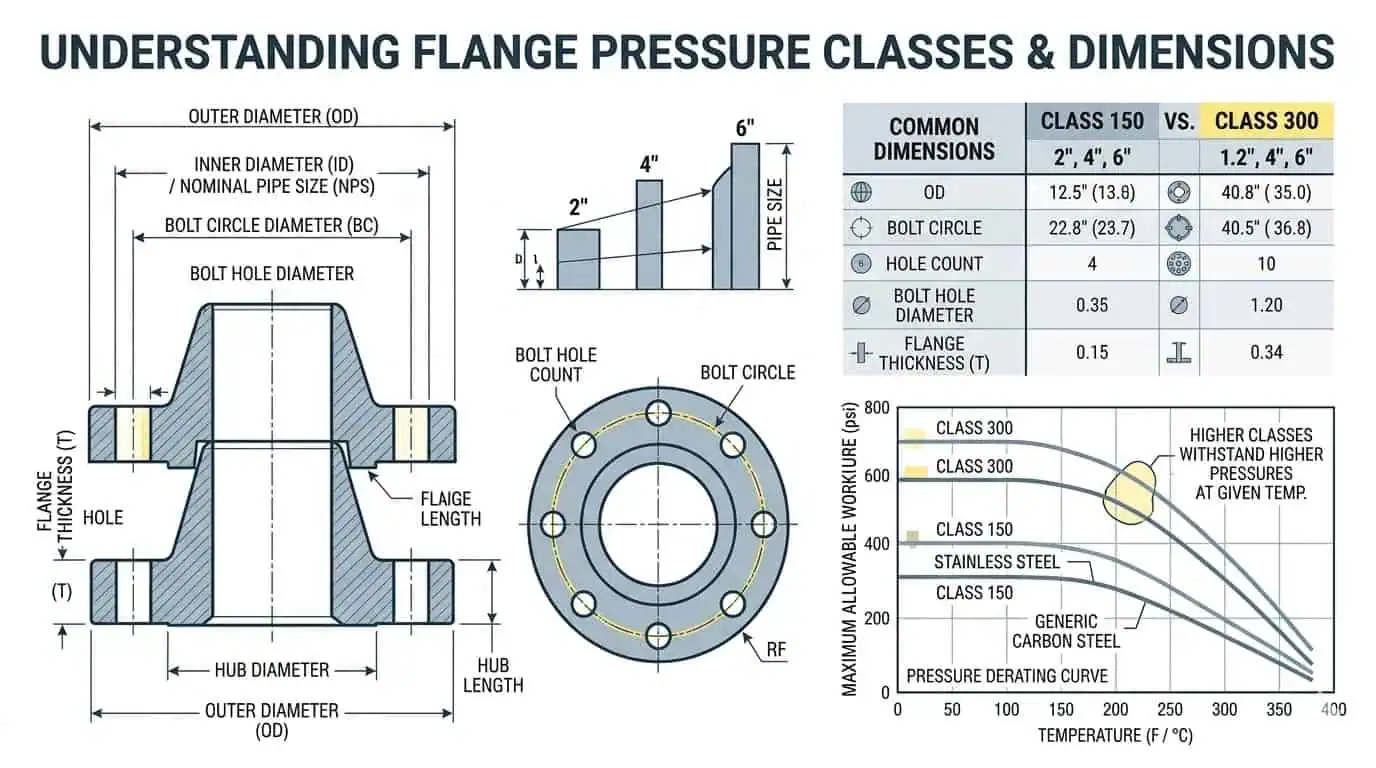
A flange’s pressure capacity is defined by class or PN rating as a function of temperature and material group. The same Class number does not mean the same allowable pressure across materials at elevated temperatures. Markings stamped on the flange rim usually identify type, size, material, pressure class, and heat number. Treat heat numbers as traceability keys.
Flange Dimensions and Measurement
Key flange dimensions
Critical dimensions must be verified to avoid almost-matching joints that fail during bolt-up. In shutdown work, verifying bolt circle diameter and hole size / count prevents rework and unsafe forcing.
- Outer diameter (OD)
- Inner diameter (ID / bore size)
- Bolt circle diameter (BCD)
- Bolt hole diameter and number of holes
- Hub diameter at base and weld end where applicable
- Flange thickness
Quick check: if two flanges almost align, stop. A few millimeters of mismatch is enough to load the joint and cause preload loss later.
Tools for measuring flanges
Precise tools are needed to verify flange fit-up. Tool selection depends on the tolerance you need and the joint risk profile.
| Tool | Use |
|---|---|
| Vernier calipers | OD, hub, and thickness measurements |
| Measuring tape | Quick checks of larger diameters |
| Bolt hole gauge | Bolt circle and hole spacing checks |
| Thread gauge | Thread identification on threaded flanges |
Weight and pricing factors
Flange weight and pricing depend on material volume, manufacturing route, machining complexity, and documentation requirements. In procurement, do not ignore documentation: EN 10204 3.1 certification, PMI, and project-specific testing can be mandatory in critical service.
Flange Gaskets, Nuts, and Bolts
Types of flange gaskets
The gasket must match face type, service media, temperature, pressure, and assembly method. Common references include:
- Nonmetallic flat gaskets: ASME B16.21
- Metallic and semi-metallic gaskets: ASME B16.20
- RTJ rings: verify ring type, material, and groove standard against the flange standard and service conditions.
Selecting nuts and bolts
Fasteners define achievable preload and temperature capability, so they are part of the engineered joint. Common industrial references include ASTM A193 / A193M for bolting and ASTM A194 / A194M for nuts.
| Fastener Type | Application Area | Selection Note |
|---|---|---|
| Stud Bolts (Full Thread) | Common for industrial flanges | Verify project spec and preload requirement |
| Machine Bolts | Low-pressure or limited-space applications | Confirm head clearance and strength adequacy |
| Heavy Hex Nuts | High-load joints | Match nut grade to stud specification |
For bolt-up planning, bolt length matters. If you need a practical sizing approach, see: how to calculate flange bolt length.
Ensuring proper sealing
Proper sealing comes from controlling the variables that actually change preload and gasket stress. Clean the faces, center the gasket, control lubrication, use calibrated tools, and tighten in a cross pattern with staged passes. If your procedure requires it, perform a verification pass after stabilization because gasket relaxation and embedment can reduce effective seating stress.
Flange Manufacturing and Quality Control
Forging, casting, and rolling
Flanges are manufactured by forging, casting, or rolling, and each route affects grain structure, defect risk, dimensional control, and inspection expectations. In critical pressure-boundary service, forged flanges are common because aligned grain flow improves toughness and fatigue resistance compared with poorly controlled cast alternatives.
| Manufacturing Route | Main Benefit | Main Risk to Control |
|---|---|---|
| Forging | Better structural continuity and toughness | Heat treatment and dimensional control |
| Casting | Complex shapes and possible cost advantage | Porosity, shrinkage, and defect control |
| Rolled / Plate / Fabricated | Useful in large diameters or special applications | Weld quality and geometry control |
Procurement note: buyers should confirm material certificates, heat traceability, dimensional inspection, markings, any required PMI or NDE, and face finish protection before release.
A flange that is dimensionally “close enough” but undocumented is usually more expensive in the long run than a flange bought correctly with proper certification and traceability.
How to Choose the Right Flange
The best flange is the one that matches service conditions, sealing logic, and maintenance needs together. Use this practical sequence:
- Start with design conditions: pressure, temperature, and media chemistry narrow the standard, class, and material family.
- Confirm the system standard end-to-end: ASME / ANSI, DIN / EN, JIS, API, or AWWA systems should not be mixed casually.
- Choose the flange type: weld neck, slip-on, socket weld, threaded, blind, lap joint, or specialty.
- Choose the facing: FF, RF, RTJ, or another sealing interface as required.
- Match gasket family and bolting: they complete the joint, not just the flange body.
- Review maintenance needs: will this joint be opened often, isolated for shutdown, or kept permanently closed?
- Verify documentation: material certs, markings, traceability, dimensional checks, and any specified testing.
Practical selection rule: if the service is severe, simplify the decision: match standard first, then class, then material, then type, then facing, then gasket and bolting. If you reverse that order and start from appearance or price, you usually increase rework risk.
Common selection mistakes
- Mixing ASME and DIN / EN systems without dimensional verification
- Choosing slip-on flanges where cyclic or vibrating service really requires weld neck stiffness
- Using 304 by habit where chloride-bearing service suggests 316 / 316L review
- Ignoring face/gasket compatibility and focusing only on nominal flange type
- Treating torque as the real preload instead of a friction-dependent estimate
- Forcing misaligned piping together with studs
If your next step is project-specific selection, continue with:
- ASME B16.5 flange basics and dimensions
- RF vs FF vs RTJ flange faces
- stainless steel flange types and selection
- how to calculate flange bolt length
If you need product-level detail, see:
- Weld neck flanges
- Slip-on flanges
- Socket weld flanges
- Threaded flanges
- Blind flanges
- Lap joint flanges
- Orifice flanges
- Custom flange solutions
FAQ
What is a flange in simple terms?
A flange is a bolted connection used to join piping or equipment with a gasketed, serviceable seal. It allows inspection, maintenance, and equipment replacement without cutting pipe.
Which flange type is best for high-pressure service?
Weld neck flanges are often the preferred starting point for high-pressure, high-temperature, and cyclic service. Final selection still depends on the standard, class, material, facing, gasket, and actual service conditions.
What is the difference between RF, FF, and RTJ flanges?
RF provides raised seating stress for common process service, FF spreads load across a full-face gasket for lower-severity or brittle mating equipment, and RTJ uses a metal ring in a groove for severe service. They are not interchangeable without checking the full joint design.
How do I choose flange material?
Start with media chemistry, chloride exposure, temperature, pressure, and fabrication method. For many general environments 304 / 304L may be adequate, while 316 / 316L is more often reviewed for chloride-bearing duty.
Why do flange joints leak even after gasket replacement?
Because the leak root cause is often not the gasket alone. Common causes include damaged faces, poor alignment, wrong gasket type, uneven bolt preload, bad lubrication consistency, or wrong tightening sequence.