For purchasing, the distinction matters: SAE J429 Grade 8 identifies a mechanical and material grade, not a complete orderable bolt configuration. A buyer must also define the dimensions, thread, head style, finish, applicable specification edition and any required inspection records. A correctly marked Grade 8 bolt can still be the wrong part for an assembly.
How to Identify a Grade 8 Bolt—and When the Mark Is Not Enough
On a typical SAE Grade 8 hex-head bolt, look for six radial lines arranged around the head. These indicate the strength grade under the familiar SAE identification system. Where applicable, a separate manufacturer identification mark helps identify the producer.
The two markings serve different purposes. The grade symbol indicates the claimed fastener classification; the manufacturer’s symbol identifies its source. Neither is a record of the actual chemical analysis, heat treatment or mechanical tests performed on the delivered material.
The identification method also has limits. In its technical explanation of SAE Grade 8 markings, Portland Bolt notes that SAE J429 does not require the usual grade markings on certain product forms, including studs and slotted or cross-recessed head products. This is useful manufacturer-published guidance, but the governing SAE edition and exact product form must control a formal conformity decision.
A fully threaded stud therefore should not be rejected solely because it lacks six radial lines. Conversely, a headed bolt that is expected to carry a grade marking should not be accepted as Grade 8 merely because its packaging says so.
This distinction is especially important when purchasing replacement parts. A maintenance buyer may have a sample bolt with an identifiable head but no original specification. The marking helps narrow the possible grade; it does not reveal the required thread pitch, dimensional tolerance, original coating or approved service conditions.
What SAE J429 Grade 8 Specifies—and What It Leaves to Other Standards
SAE J429 covers mechanical and material requirements for specified inch-series steel externally threaded fasteners, including bolts, screws and studs. Its published 2014 scope covers nominal sizes through 1-1/2 inches and explains that the listed mechanical properties were established at approximately 20°C (68°F).
Grade 8 is commonly associated with quenched-and-tempered medium-carbon alloy steel fasteners. Its designation refers to a defined mechanical and material classification, not merely an appearance or color.
The precise mechanical acceptance requirements must be taken from the SAE edition governing the order. Manufacturer technical tables can help explain the grade, but a published minimum tensile-strength figure is not evidence that a particular shipment passed the required tests. It also cannot be used directly as the allowable load, specified joint pretension or installation torque.
The published SAE scope expressly distinguishes these mechanical properties from other application concerns. Fatigue behavior, corrosion resistance and impact performance are outside its stated scope. Strength properties established near room temperature also should not be assumed to apply unchanged at elevated or reduced service temperatures.
A buyer specifying a fastener for a vibrating machine, outdoor installation or temperature-sensitive assembly therefore needs more than a Grade 8 designation. The responsible engineer must confirm that the material and complete joint are appropriate for those service conditions.
Grade, dimensions and thread specifications are different requirements
For relevant inch-series hex-head bolts and screws, ASME B18.2.1 provides dimensional requirements for specified head and product configurations. Heavy-hex structural bolts are addressed separately under ASME B18.2.6.
ASME B1.1 addresses unified-inch-thread geometry, series, classes and tolerances. The designation must identify the intended thread, not simply the nominal outside diameter.
These requirements answer separate questions:
- SAE J429 Grade 8: What material and mechanical grade is required?
- Applicable dimensional standard: What head and body geometry must the fastener have?
- Applicable thread standard and designation: What external thread must mate with the specified internal thread?
- Project or application specification: What finish, joint conditions and acceptance evidence are required?
A bolt can meet the requested Grade 8 classification while having the wrong thread series or head dimensions. This is why matching grade alone is not enough when replacing an existing fastener.
The grade designation also does not authorize substitution for a structural fastener specified under ASTM F3125. Structural connection design, installation and acceptance involve additional requirements. Apparent similarities in tensile strength do not establish interchangeability.
Finish and matching components need separate decisions
A plain-finish Grade 8 fastener and a zinc-coated Grade 8 fastener should not automatically be treated as interchangeable for every order. A coating may affect corrosion protection, thread fit and manufacturing-process requirements. Depending on the fastener and treatment, hydrogen-embrittlement risk also needs evaluation.
Where electrodeposited or hot-dip zinc coatings are specified, the applicable coating specification and its permitted use must be confirmed. Specifying only a visual finish such as “yellow zinc” may leave important manufacturing and acceptance details undefined.
The mating nut requires its own specification. SAE J995 addresses mechanical and material requirements for steel nuts, but the appropriate nut grade, dimensions, thread fit and finish depend on the actual joint. The same nominal thread diameter does not automatically establish a suitable bolted assembly.
These decisions should be resolved before ordering, rather than left to whichever nut or coated bolt happens to be available.
A hypothetical buyer retains an old tightening instruction after changing the Grade 8 coating. The material grade may be unchanged while thread and bearing friction differ. Review the actual mating components and finish, then validate the approved assembly procedure where necessary. The hydrogen-embrittlement discussion also explains why process evidence is separate from an attractive surface finish.
How to Write a Complete Grade 8 Bolt Purchase Order
An RFQ stating only “SAE Grade 8 hex bolts” is incomplete. It communicates a grade but leaves the supplier to interpret the dimensions and configuration.
A purchasing specification should identify the required fastener closely enough that quotations can be compared and incoming goods can be checked against the same requirements.
Use the following checklist as a starting point, with the engineering drawing and governing project specification taking precedence.
| Purchase-order field | What to specify | Por que é importante |
|---|---|---|
| Especificação do produto | SAE J429 Grade 8 and the governing edition | Establishes the intended mechanical and material requirements |
| Forma do Produto | Hex-head bolt, hex cap screw, stud or another exact form | Determines geometry and which identification rules apply |
| Norma dimensional | Applicable ASME standard or approved drawing | Prevents selection by grade and nominal size alone |
| Diameter and length | Exact inch designation, required length and measurement basis | Distinguishes parts that cannot fit the same assembly |
| Tópico | UNC/UNF or other approved designation, pitch and class where specified | Establishes compatibility with the mating internal thread |
| Threaded configuration | Full or partial threading and required thread length, if relevant | Controls available engagement and unthreaded shank position |
| Head configuration | Head style and applicable dimensions | Confirms tool clearance, bearing surface and assembly fit |
| Acabamento | Plain finish or specified coating system and relevant requirements | Controls corrosion and process-related expectations |
| Mating components | Required nut, washer and assembly specification, if applicable | Avoids assuming that any matching-diameter hardware is suitable |
| Inspection and records | Requested declaration, test results, lot identification and inspection scope | Establishes what the buyer will require before accepting delivery |
| Commercial details | Quantity, packaging, labeling and delivery requirements | Makes the order unambiguous and supports receiving identification |
Not every project needs an elaborate inspection package. A low-risk OEM purchase and a critical engineered assembly may justify different verification requirements. The essential point is to decide what evidence is required before placing the order, not after a discrepancy occurs.
Hypothetical example: the correct grade, but the wrong thread
Assume an OEM requires SAE J429 Grade 8 hex-head bolts with a nominal 1/2-inch diameter and an assumed 2-inch under-head length. The original purchasing description omits the thread designation.
Two possible configurations are:
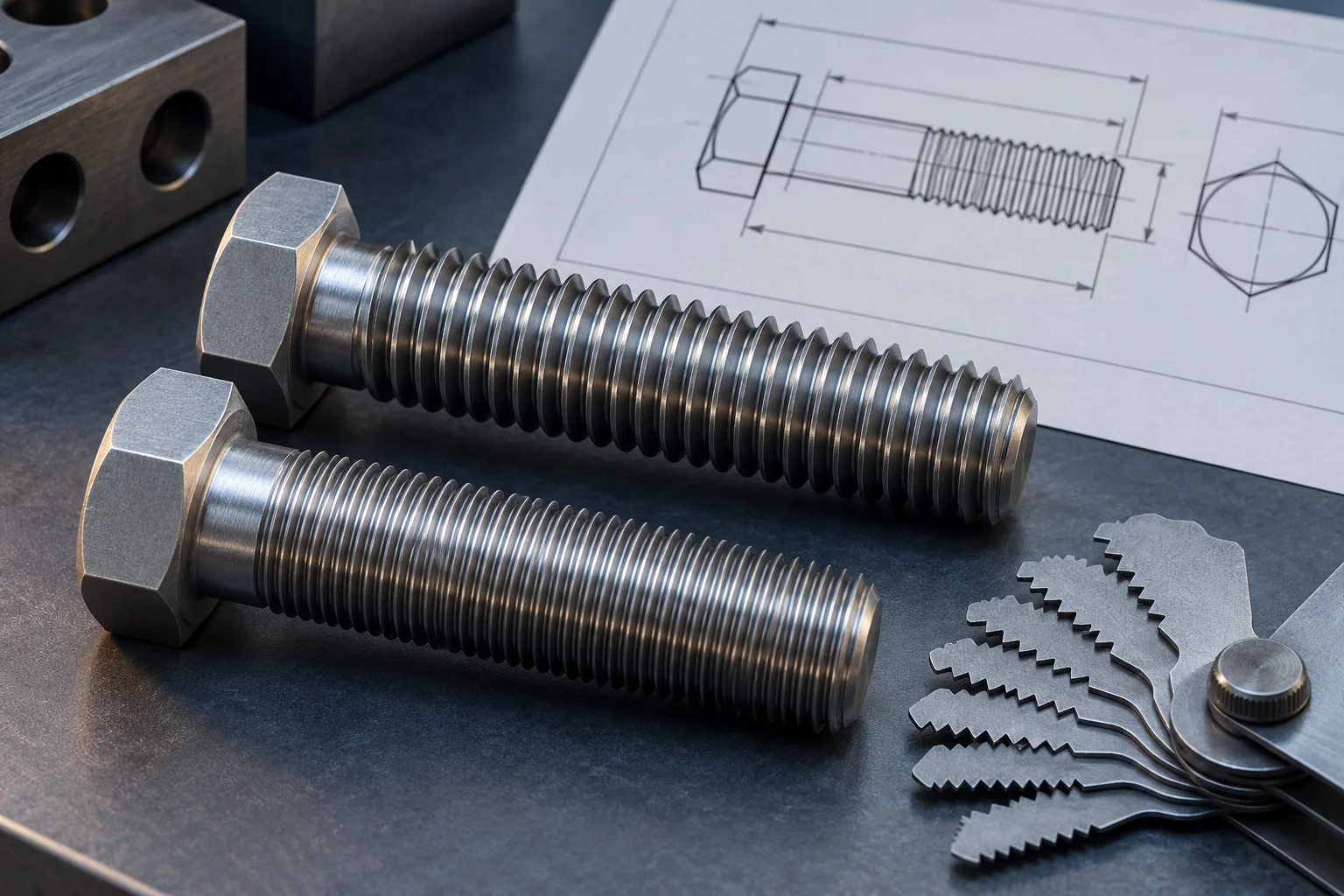
- 1/2-13 UNC, with 13 threads per inch.
- 1/2-20 UNF, with 20 threads per inch.
Both share a nominal 1/2-inch diameter, but their thread pitches are different. Expressed in metric units, the nominal pitch is approximately 1.95 mm for 13 TPI and 1.27 mm for 20 TPI, using 25.4 mm per inch.
That difference is enough to prevent a correct threaded fit with a nut intended for the other series. Forcing engagement risks damaging the threads and does not create a valid connection.
The correct purchasing action is to check the engineering drawing and specify the approved thread designation and fit requirements. The two options must not be treated as alternatives simply because both are described as Grade 8.
The 2-inch length in this example is an assumption, not a recommendation for an actual joint. The real application must also establish the required grip, thread position, engagement and mating hardware.
Define the documents before ordering
A supplier declaration of conformity, a material record and a mechanical test report are not necessarily equivalent documents.
A declaration may state that supplied goods conform to a named specification. A test report may provide actual results from specified samples or production lots. A material record may establish information about the steel from which the fasteners were produced, without by itself proving every property of the finished bolts.
If the purchase requires mechanical test evidence, identify the applicable specification and edition, tests, acceptance criteria and necessary relationship between the report and delivered material. ASTM F606/F606M describes relevant fastener test methods, but the existence of a test method does not mean every SAE J429 purchase automatically requires every possible test.
Likewise, do not assume that an EN 10204 3.1 certificate, third-party inspection or a specific sampling frequency is universally mandatory for Grade 8 fasteners. Such requirements must come from the governing specification, contractual agreement or an approved quality plan.
Receiving Grade 8 Bolts: Physical Checks, Records and Discrepancy Decisions
Receiving inspection should answer two related questions: Did the supplier deliver the product described in the purchase order? And is there sufficient evidence to accept it under the agreed requirements?
Those questions are connected, but they are not identical. A visually correct product may lack required documents. Conversely, an apparently unusual marking may be permissible for its product form and can require clarification rather than rejection.
A practical receiving sequence is:
- Confirm the order and delivery identity. Match the purchase-order specification, quantity, product description and package labeling. If lot identification is required, ensure it is available before mixing or distributing the material.
- Check the relevant markings. Examine the grade symbol and manufacturer identification where applicable. For studs or other forms with possible exceptions, determine the governing rule before declaring nonconformity.
- Verify physical configuration. Check diameter, length, head style and thread designation using suitable inspection methods. Where a thread class or dimensional tolerance has been specified, use an appropriate inspection basis rather than judging fit by appearance.
- Check the finish and mating hardware. Compare the coating or surface condition, nuts and washers with the ordered configuration. Any relevant coating damage, thread damage or inconsistent component identification needs evaluation.
- Review the required records. Confirm that the documents identify the correct product and specification, contain the agreed evidence and can be related to the delivered lot or shipment where required.
These checks do not all establish the same thing.
| Evidência | What it helps establish | O que ele não estabelece por si só |
|---|---|---|
| Grade and manufacturer head marks | Preliminary identification of a marked fastener | Actual tested properties of the delivered lot |
| Diameter and thread inspection | Conformity to the checked geometry and thread requirements | Material grade or heat-treatment compliance |
| Package and lot identification | Relationship between delivery units and supplier records | Mechanical performance without supporting evidence |
| Declaration of conformity | Supplier’s stated conformity to identified requirements | Independent measurement of every declared property |
| Applicable mechanical test report | Reported results under the stated test and sampling conditions | That every delivered fastener was individually tested, or that unrelated service requirements are satisfied |
The strength of a test report depends on what was tested, which requirements applied, how the results were evaluated and whether the reported material can be connected to the goods being received. A report from an unrelated production lot cannot substantiate the delivered lot merely because the grade designation matches.
What to do when something does not agree
Consider three receiving situations.
The thread is wrong. The purchase order calls for 1/2-13 UNC, but the delivered fasteners have a different thread designation. The grade marking cannot correct that mismatch. The affected items should be held for an authorized decision, with replacement or a formally approved specification change considered as appropriate.
The expected grade marking is absent. Determine the exact product form and applicable marking requirement before reaching a conclusion. A marking exception may be relevant to a stud, while an ordinary headed product might require further manufacturer clarification. Neither automatic acceptance nor automatic rejection is justified without resolving the applicable rule.
The test report cannot be linked to the shipment. If lot-linked evidence is required by the order, the presence of a report bearing “Grade 8” is insufficient without the required identification relationship. Request clarification or replacement documentation and retain the affected material under the appropriate quality-control hold until the discrepancy is resolved.
For an accepted delivery, the receiving record should show what was checked and which criteria were applied. The scope of inspection and any sampling plan must follow the governing purchase and quality requirements; checking a sample does not establish that every individual fastener was tested.
A useful Grade 8 purchasing decision therefore has three parts: identify the claimed grade, specify the exact fastener and verify the delivered product against the ordered requirements. Keeping those parts separate prevents a familiar head marking from concealing a dimensional mistake or an unresolved documentation gap.
Perguntas frequentes
Como um parafuso sextavado típico de grau 8 é marcado?
Seis linhas radiais normalmente identificam o grau, com a identificação do fabricante quando aplicável. Verifique a forma exata do produto e os requisitos de marcação aplicáveis.
Todo prisioneiro Grau 8 deve ter seis linhas radiais?
Não aplique automaticamente as regras de marcação de parafusos com cabeça a todos os formatos. Verifique os requisitos SAE aplicáveis e quaisquer exceções permitidas.
Does specifying Grade 8 define dimensions and coating?
No. Add the product form, dimensional and thread requirements, finish, mating components and any required inspection records to the order.