Um parafuso Grau 8 pode atender a uma classificação de resistência semelhante, mas ter uma configuração de cabeça, comprimento de rosca ou base de inspeção diferente do parafuso A490 especificado. Essas diferenças podem ser relevantes mesmo quando o diâmetro nominal é idêntico.
Resistência semelhante não torna o Grau 8 um parafuso estrutural A490
A SAE J429 estabelece requisitos mecânicos e de material para elementos de fixação de aço com rosca externa da série em polegadas, incluindo parafusos, parafusos de máquina e prisioneiros. O Grau 8 identifica uma classificação de propriedade mecânica dentro dessa especificação. Por si só, ele não estabelece as dimensões da cabeça nem a configuração do comprimento da rosca exigidas para um parafuso estrutural Grau A490.
A ASTM F3125/F3125M tem uma finalidade diferente de especificação de produto. Ela abrange parafusos e conjuntos estruturais de alta resistência, incluindo parafusos de cabeça sextavada pesada Grau A490 destinados a ligações estruturais. A ASTM F3125 incorpora requisitos para o produto de fixação estrutural, enquanto as normas dimensionais aplicáveis e a especificação de juntas RCSC tratam de partes adicionais de seu uso.
A atual ASTM F3125/F3125M-26 identifica o Grau A490 como um grau de parafuso estrutural sextavado pesado. A Especificação RCSC 2025 classifica o Grau A490 em seu Grupo 150.
A AISC descreve o SAE J429 Grau 8 como equivalente em resistência ao Grau A490, mas também aponta diferenças no tamanho da cabeça, no comprimento da rosca e nos requisitos de garantia da qualidade. Portanto, uma classificação de resistência equivalente estabelece apenas uma similaridade limitada, e não conformidade com a mesma especificação de produto para parafusos estruturais.
| Comparação | SAE J429 Grau 8 | ASTM F3125 Grau A490 |
|---|---|---|
| Função principal da especificação | Requisitos mecânicos e de material para elementos de fixação com rosca externa | Requisitos de produto para parafusos estruturais de alta resistência |
| Configuração da cabeça | Deve ser estabelecido pela especificação dimensional do produto real | Estilo estrutural sextavado pesado |
| Requisitos de rosca e dimensionais | Dependem da configuração de fixação especificada e da norma dimensional aplicável | Sujeito aos requisitos dimensionais aplicáveis a parafusos estruturais |
| Verificação do produto | Evidência de conformidade com os requisitos do produto SAE especificados | Evidência de conformidade com os requisitos ASTM especificados para parafusos estruturais |
| Uso direto conforme especificado A490 | Não estabelecido pela designação Grau 8 | O produto especificado, sujeito ao pedido completo e aos requisitos do projeto |
A distinção torna-se importante quando uma especificação de compra indica ASTM F3125 Grau A490 e um fornecedor oferece um elemento de fixação SAE Grau 8 com o mesmo diâmetro nominal.
O fornecedor pode estar descrevendo um produto legítimo Grau 8. Seu relatório de propriedades mecânicas também pode ser válido para esse produto. Nenhum dos dois fatos estabelece que o elemento de fixação fornecido atende ao requisito de compra do Grau A490.
O comprador deve distinguir um produto que atende ao seu próprio padrão de um produto que atende ao padrão especificado para a conexão estrutural.
Em um exemplo ilustrativo de escassez, um fornecedor oferece parafusos de cabeça sextavada SAE Grau 8 no lugar dos parafusos estruturais A490 especificados. Um valor de resistência semelhante não estabelece a mesma geometria, os mesmos ensaios de produto ou a mesma base de instalação. Mantenha a substituição em espera, liste as diferenças propostas e obtenha uma disposição de engenharia. A comparação de graus de parafusos em polegadas apoia a terminologia, não a intercambialidade.
O tamanho da cabeça e o comprimento da rosca alteram a ligação física
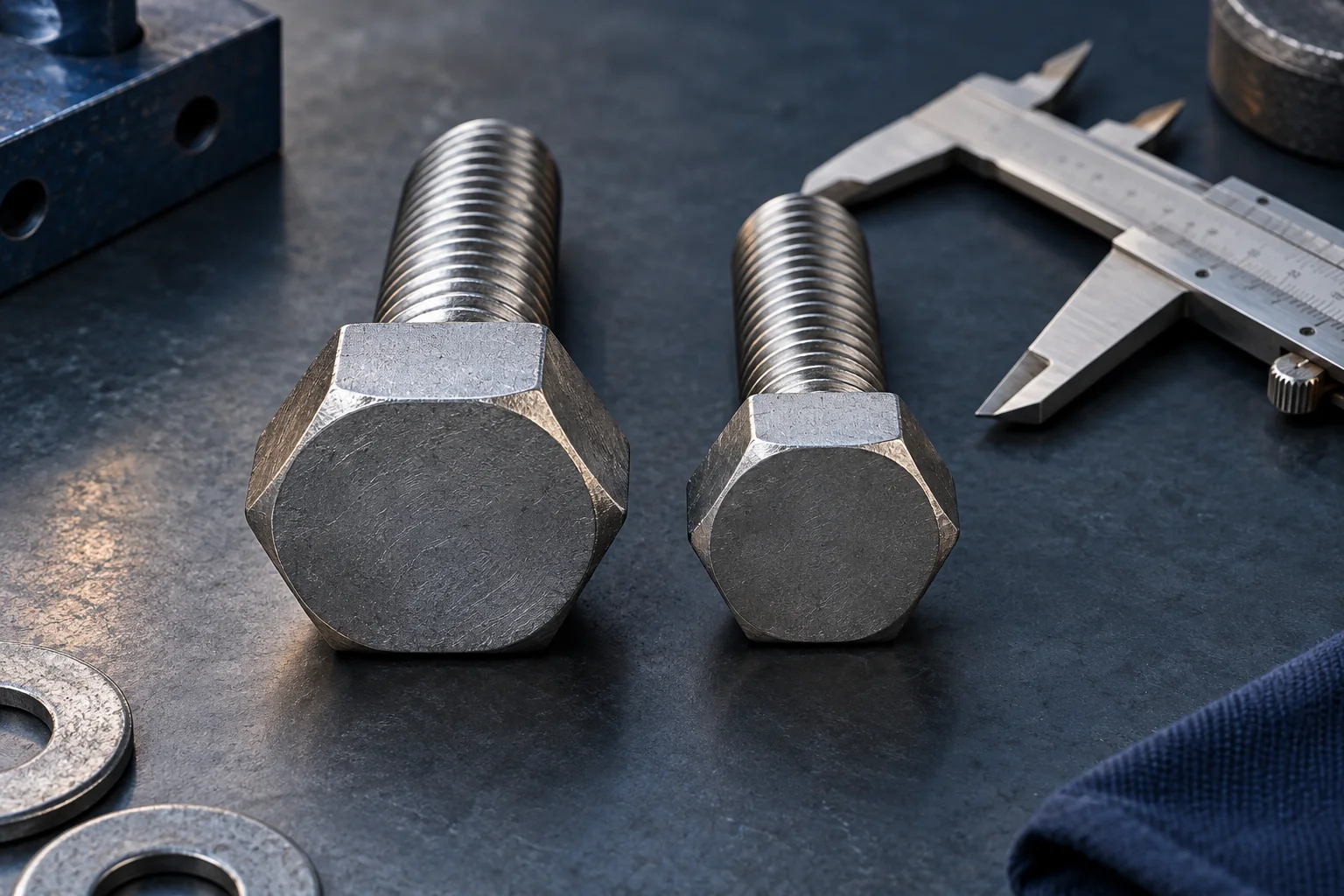
Dois elementos de fixação podem compartilhar um diâmetro nominal e resistência de material semelhante sem apresentar a mesma geometria ao aço conectado.
Para conexões estruturais, a cabeça, o corpo do parafuso, a porção roscada e a posição das roscas em relação às chapas conectadas podem afetar se o elemento de fixação fornecido corresponde às premissas de projeto.
A geometria da cabeça faz parte da especificação estrutural
Parafusos estruturais A490 de cabeça sextavada pesada seguem os requisitos dimensionais aplicáveis a elementos de fixação estruturais, incluindo os abordados pela ASME B18.2.6. Parafusos de cabeça sextavada Grau 8 comuns podem, em vez disso, seguir uma especificação dimensional geral da série em polegadas, como a ASME B18.2.1.
Essa comparação deve ser feita usando o produto Grau 8 efetivamente proposto. A SAE J429 não exige que todo elemento de fixação Grau 8 tenha uma configuração de cabeça universal.
As dimensões da cabeça afetam a geometria de contato sob a cabeça do parafuso. A área de apoio influencia como a força é transferida para a arruela ou para o aço conectado, e se o elemento de fixação proposto atende à geometria exigida pelo sistema de fixação especificado.
Uma cabeça menor ou com formato diferente não prova, por si só, que uma conexão irá falhar. Significa que um requisito de parafuso estrutural não pode ser considerado atendido apenas porque o parafuso passa pelo furo.
This distinction is recognized in RCSC 2025 Section 2.12.4. For alternative-design bolting components, the specification addresses the bolt body diameter and the bearing area beneath the head relative to the corresponding specified bolt.
The practical purchasing consequence is straightforward: nominal diameter and tensile strength are insufficient for a head-geometry comparison. The actual bolt drawing and its dimensional standard are required.
The shear plane may intersect a different part of the bolt
Thread length can create a more consequential difference.
In a shear-loaded structural connection, the shear plane passes through the joint at the interface between connected parts. Depending on the bolt length, grip, and threaded configuration, that plane may intersect either the unthreaded body or the threaded portion.
These are not necessarily equivalent design conditions.
The threaded portion has a different cross-sectional geometry from the unthreaded body. The RCSC 2025 specification therefore distinguishes between threads included in and excluded from a shear plane when establishing the applicable nominal shear-strength provisions for the bolt groups it covers.
For a specified Grade A490 connection, the designer must use the appropriate provisions for its actual configuration. A Grade 8 substitution cannot simply inherit the Group 150 design values without establishing an approved alternative design basis.
Hypothetical example: Assume a structural connection drawing specifies Grade A490 bolts and its shear-strength calculation is based on the threads being excluded from the shear plane.
A supplier offers an SAE Grade 8 fastener with the same nominal diameter. However, its documented thread length would place part of the threaded section through one of the connection’s shear planes.
The proposed bolt no longer matches the original thread-position assumption.
Even if its minimum tensile-strength classification is comparable, the original shear-strength calculation cannot simply be carried over unchanged. The engineer would need to verify the alternative fastener’s actual geometry, establish an applicable design basis, and determine whether the proposed change can be accepted.
This is an illustrative procurement situation, not a reported failure or a calculation of actual connection capacity.
The reverse assumption also deserves attention. Not every A490 bolt should automatically be treated as having threads excluded from the shear plane. RCSC addresses short bolts and special configurations, including conditions in which the specified bolt is treated as fully threaded for shear-design purposes.
The relevant check is the actual installed configuration against the design drawing—not a general assumption that one bolt grade always has more favorable thread placement than another.
Certificação de material não é aceitação da junta estrutural
A second substitution problem arises when the supplier provides a mechanical test report for Grade 8 and considers the matter resolved.
A valid report demonstrating that a bolt satisfies its SAE mechanical requirements does not demonstrate that the bolt complies with ASTM F3125 Grade A490. Nor does it establish that the assembled structural joint satisfies the project requirements.
There are three separate verification questions.
First, does the bolt meet its specified product standard? For an A490 order, the relevant product conformity evidence must address the specified ASTM grade and applicable edition. Identification markings and manufacturing or test records are useful for establishing product identity, but a marking alone is not a complete conformity assessment.
Second, are the associated components compatible with the specified structural bolting system? Nuts, washers, finishes, and any required matched assemblies must be evaluated under the applicable product and structural-joint requirements. A high-strength bolt installed with an unsuitable component does not become an acceptable structural assembly simply because the bolt itself meets a strength requirement.
Third, was the structural joint installed and inspected as required? This is a separate responsibility governed by the connection type and the applicable RCSC and project provisions.
For example, snug-tightened, pretensioned, and slip-critical joints do not all have identical installation and verification requirements. Where pretensioning and pre-installation verification are required, product tensile-strength results cannot substitute for those activities. Similarly, an arbitrary tightening torque cannot establish the required installed bolt condition.
RCSC 2025 Section 2.9 requires applicable product-conformity test reports for bolting components and matched assemblies to be available to the Engineer of Record and inspector before structural steel assembly or erection. These records serve a different function from installation verification records.
The buyer should therefore avoid treating a material test report, certificate of conformity, head marking, and installation inspection report as interchangeable documents. Each is relevant to a different acceptance question.
Coating compatibility is another specification check
Coatings further illustrate why a strength comparison is incomplete.
Under the 2025 RCSC specification, Group 150 bolts and assemblies are not permitted to use hot-dip or mechanical galvanizing. The document nevertheless permits zinc-flake coating systems that meet its specified ASTM F3393 requirements and associated conditions.
It would therefore be inaccurate to state that every protective coating on an A490 bolt is prohibited.
For purchasing, the correct questions concern the specified coating process, compatibility with the bolt and mating components, and the relevant assembly requirements. A coating designation alone does not establish adequate corrosion protection for every environment or guarantee satisfactory installation behavior.
A proposed Grade 8 replacement with a different finish cannot be approved merely because both products are described as high-strength steel bolts. The coating and assembly requirements are part of the technical review.
E se um engenheiro propuser o Grau 8 como alternativa?
The AISC position against direct substitution and the existence of an engineering alternative-design process are not contradictory.
AISC’s FAQ addresses whether SAE Grade 8 can simply replace a specified Grade A490 bolt as an equivalent product. The answer is no.
RCSC 2025 Section 2.12 addresses a different situation: appropriately evaluated alternative-design bolting components, assemblies, or installation methods that have been approved by the Engineer of Record.
This route does not automatically qualify SAE J429 Grade 8. It requires assessment of the specific proposed alternative against the applicable requirements.
For alternative-design components, RCSC addresses manufacturing, material, and mechanical properties, along with relevant dimensions and assembly conditions. Among its geometric requirements, the bolt body diameter and under-head bearing area are controlled relative to the specified bolting components. Different thread lengths must be identified and communicated to the Engineer of Record.
Where pretensioned or slip-critical joints are involved, the applicable pretensioning, installation, and verification provisions must also be satisfied. Alternative installation and inspection procedures cannot be presumed equivalent merely because the same tools can engage the fastener.
The engineering review must therefore answer more than whether the proposed Grade 8 fastener reaches a particular tensile-strength level.
It must establish the proposed product’s actual dimensions, applicable manufacturing and mechanical-property basis, effect on the structural connection, mating-component compatibility, installation requirements, and the evidence supporting acceptance.
Only the appropriate engineering authority can determine whether the documented alternative is suitable for the particular project under its governing requirements.
That approval, if granted, would authorize a defined alternative. It would not convert SAE J429 Grade 8 into ASTM F3125 Grade A490 or make the grades generally interchangeable for other projects.
For a buyer, this distinction prevents a common purchasing error: accepting an alternative designation in the quotation without a corresponding approved deviation in the engineering documents.
O que verificar antes de solicitar parafusos estruturais A490
When the drawings or purchase documents specify ASTM F3125 Grade A490, the supplier should quote against that specification rather than substitute SAE Grade 8 based on a strength comparison.
A hypothetical receiving team checks the head mark and diameter but overlooks a different thread configuration and washer requirement. The fastener may fit while the scheduled assembly remains unresolved. Compare the actual product form, dimensions and matched components with the approved order. Record the product identity and supporting evidence before deciding release.
Before the purchase order is finalized, confirm the following:
- Product specification and edition. Identify ASTM F3125/F3125M, Grade A490, the required type and heavy-hex style, and the edition governing the project. The latest published edition is not automatically the contractual edition.
- Bolt dimensions and configuration. Specify nominal diameter, length, applicable dimensional standard, and relevant thread configuration. Check the actual bolt against the connection drawing where grip length or shear-plane position matters.
- Nuts, washers, and assembly requirements. Identify compatible components and whether the specified finish or installation system requires a matched assembly.
- Finish and coating. State the permitted coating specification and any project-specific requirements. Do not replace one coating method with another without checking the applicable structural-bolting provisions.
- Product acceptance records. Request the test reports and identification records needed to establish conformity with the specified product and assembly requirements. Distinguish product records from field installation records.
- Proposed deviations. If a supplier offers Grade 8 or another alternative, obtain the actual product specification, drawings, supporting evidence, and the required engineering disposition before treating the offer as acceptable.
This verification is especially important when a quotation describes a fastener only by nominal diameter, strength grade, or a broad term such as high-strength hex bolt. Such descriptions do not establish full conformity with a Grade A490 structural-bolt requirement.
The default purchasing decision is to retain the specified A490 product and its associated requirements. If an alternative is genuinely necessary, the correct next step is a documented engineering review—not an informal substitution based on tensile strength.
Perguntas frequentes
O SAE Grau 8 é o mesmo que A490?
Não. Eles pertencem a especificações de produto diferentes. Descrições comparáveis de resistência à tração não estabelecem intercambialidade estrutural.
Um engenheiro pode aprovar um elemento de fixação diferente?
Qualquer alternativa proposta precisa da base aplicável de aprovação de projeto, produto, instalação e do projeto. Uma tabela de resistência do fornecedor, isoladamente, é insuficiente.
O que deve incluir uma solicitação de substituição?
Identifique a especificação proposta exata, o grau, a geometria, as roscas, o acabamento, os componentes de acoplamento, as evidências do produto e as diferenças em relação ao conjunto estrutural aprovado.