Isso faz do A490 o produto de maior resistência, mas não automaticamente a melhor escolha para uma ligação metálica. A diferença de 25% entre as designações de grupo não se traduz em um aumento geral de 25% na capacidade da ligação. A325 e A490 também devem ser comparados com o projeto estrutural, os requisitos de proteção contra corrosão, as disposições de instalação aplicáveis e as porcas e arruelas compatíveis.
A325 e A490 segundo a ASTM F3125: o que as designações significam
A325 e A490 foram originalmente identificados por especificações ASTM separadas. Seus requisitos de parafusamento estrutural agora são tratados na ASTM F3125/F3125M, que consolida várias categorias de produtos de parafusos estruturais de alta resistência.
Na linguagem de especificação atual, um engenheiro pode identificar um parafuso como ASTM F3125 Grau A325 ou ASTM F3125 Grau A490. O grau identifica uma categoria de resistência mecânica especificada, enquanto o tipo trata da composição química do material e características relacionadas. Essas distinções são importantes porque um pedido de compra que mencione apenas “parafusos A490” pode deixar indefinidos detalhes relevantes de material e revestimento.
Ambos os graus estão associados às classificações de material Tipo 1 e Tipo 3, quando aplicável. O Tipo 1 representa a classificação de material não resistente à intempérie correspondente. O Tipo 3 identifica uma composição química de aço resistente à corrosão atmosférica, destinada a melhorar a resistência à corrosão atmosférica em condições de exposição adequadas. O Tipo 3 não é um grau separado de resistência à tração, e sua designação não significa que um revestimento protetivo aplicado seja sempre desnecessário.
O estilo do produto e as dimensões são elementos de especificação distintos. Um parafuso estrutural de cabeça sextavada pesada deve atender aos requisitos dimensionais aplicáveis à sua configuração de produto especificada; um parafuso sextavado padrão visualmente semelhante não é necessariamente um substituto em conformidade. O diâmetro nominal, o comprimento, a configuração da rosca e a norma de produto aplicável devem ser confirmados antes que os componentes sejam aceitos como equivalentes.
A edição vigente também é importante. O catálogo de 2026 do editor da ASTM identifica a ASTM F3125/F3125M-26, mas um projeto pode exigir contratualmente uma edição anterior. Um engenheiro ou comprador não deve combinar propriedades mecânicas, permissões de revestimento ou procedimentos de aceitação de edições diferentes sem estabelecer quais requisitos regem o pedido.
A ASTM F3125 trata do produto parafuso; a junta estrutural instalada deve atender separadamente aos seus requisitos de projeto e instalação aplicáveis. Para estruturas de aço que utilizam o referencial RCSC, esses requisitos incluem o tipo de junta pertinente, a montagem, a instalação e as disposições de inspeção.
Comparação de resistência: por que um parafuso mais resistente não significa automaticamente uma junta mais resistente
A principal diferença mecânica é direta: ao A490 é atribuído um grupo de resistência mínima à tração superior ao do A325.
A comparação a seguir utiliza os grupos de parafusos e as disposições de revestimento da RCSC 2025. Não se trata de uma reprodução das tabelas completas de aceitação mecânica da ASTM F3125.
| Característica | Grau A325 | Grau A490 |
|---|---|---|
| Especificação de produto ASTM | ASTM F3125/F3125M | ASTM F3125/F3125M |
| Grupo de parafusos RCSC 2025 | Grupo 120 | Grupo 150 |
| Nível mínimo de resistência à tração do grupo | 120 ksi | 150 ksi |
| Agrupamento por resistência relativa à tração | Nível de referência | 25% superior |
| Galvanização por imersão a quente ou mecânica conforme RCSC 2025 | Permitido para configurações compatíveis aplicáveis | Proibido para o Grupo 150 |
| Revestimento de zinco lamelar | Os requisitos de elegibilidade e montagem devem ser verificados | Determinados sistemas ASTM F3393 são permitidos condicionalmente |
| Capacidade da junta estrutural | Deve ser estabelecido pelo projeto da conexão | Deve ser estabelecido pelo projeto da conexão |
O agrupamento de resistência mínima à tração descreve o requisito do material do parafuso. Ele não estabelece quanta carga uma conexão montada pode suportar.
Considere dois parafusos do mesmo diâmetro nominal, um A325 e o outro A490. Se suas áreas efetivas de tração forem comparáveis, o parafuso de maior resistência oferece maior resistência potencial em uma condição controlada pela tração do parafuso. Essa observação isolada não diz nada conclusivo sobre a capacidade da conexão completa.
Uma conexão metálica pode, em vez disso, ser governada pelo esmagamento da chapa, pela deformação do furo do parafuso, pela distância de borda, pela resistência do material conectado, pelo cisalhamento em bloco ou por outro estado limite aplicável. Aumentar a resistência do material do parafuso não aumenta a espessura da chapa, não altera as distâncias de borda nem melhora a resistência do material conectado ao redor.
A posição da rosca também importa. O fato de as roscas estarem incluídas em um plano de cisalhamento pode influenciar a resistência ao cisalhamento do parafuso atribuída pelo método de projeto aplicável. Simplesmente alterar a classe sem revisar a geometria especificada do parafuso e os detalhes da conexão pode deixar uma premissa de projeto importante sem solução.
A protensão não é o mesmo que resistência à tração
Outra fonte frequente de confusão é a relação entre a resistência à tração do parafuso e a protensão instalada.
A resistência à tração é uma propriedade do material estabelecida pela especificação de produto e pelos requisitos de ensaio aplicáveis. A protensão é a força de aperto desenvolvida em um conjunto de parafuso instalado quando a conexão exige protensão.
Para uma conexão resistente ao deslizamento, a resistência ao deslizamento depende da relação de projeto aplicável que envolve a protensão do parafuso, a condição das superfícies de contato, o número de planos de deslizamento e outros fatores prescritos. Um parafuso de maior resistência pode permitir uma protensão especificada diferente, mas seu efeito sobre a resistência da conexão deve ser avaliado com base nos requisitos de projeto aplicáveis.
O revestimento do parafuso e o tratamento das superfícies de contato também são distintos. A aprovação de um revestimento protetor no parafuso não estabelece que uma determinada superfície de contato revestida ou não revestida atenda à classificação de resistência ao deslizamento exigida.
Em uma conexão do tipo por contato, as verificações de projeto aplicáveis podem ser diferentes. Dependendo do detalhe real, aumentar a resistência do parafuso pode oferecer um benefício de engenharia, não proporcionar aumento útil na resistência controladora da conexão ou exigir que outras partes da conexão sejam reconsideradas.
A decisão de seleção, portanto, não é “150 ksi é melhor que 120 ksi”. É se a classe de maior resistência atende a um requisito estrutural documentado do qual a conexão completa possa se beneficiar.
Considere uma análise ilustrativa de conexão em que o A490 é proposto para corrigir movimentação em uma junta A325. Se a causa for um procedimento de instalação não verificado ou superfícies de contato inadequadas, um grau de parafuso mais alto não resolve o problema. Identifique o estado limite real e as evidências de instalação antes de redimensionar a conexão. Use terminologia de resistência de parafusos to keep product properties separate from joint performance.
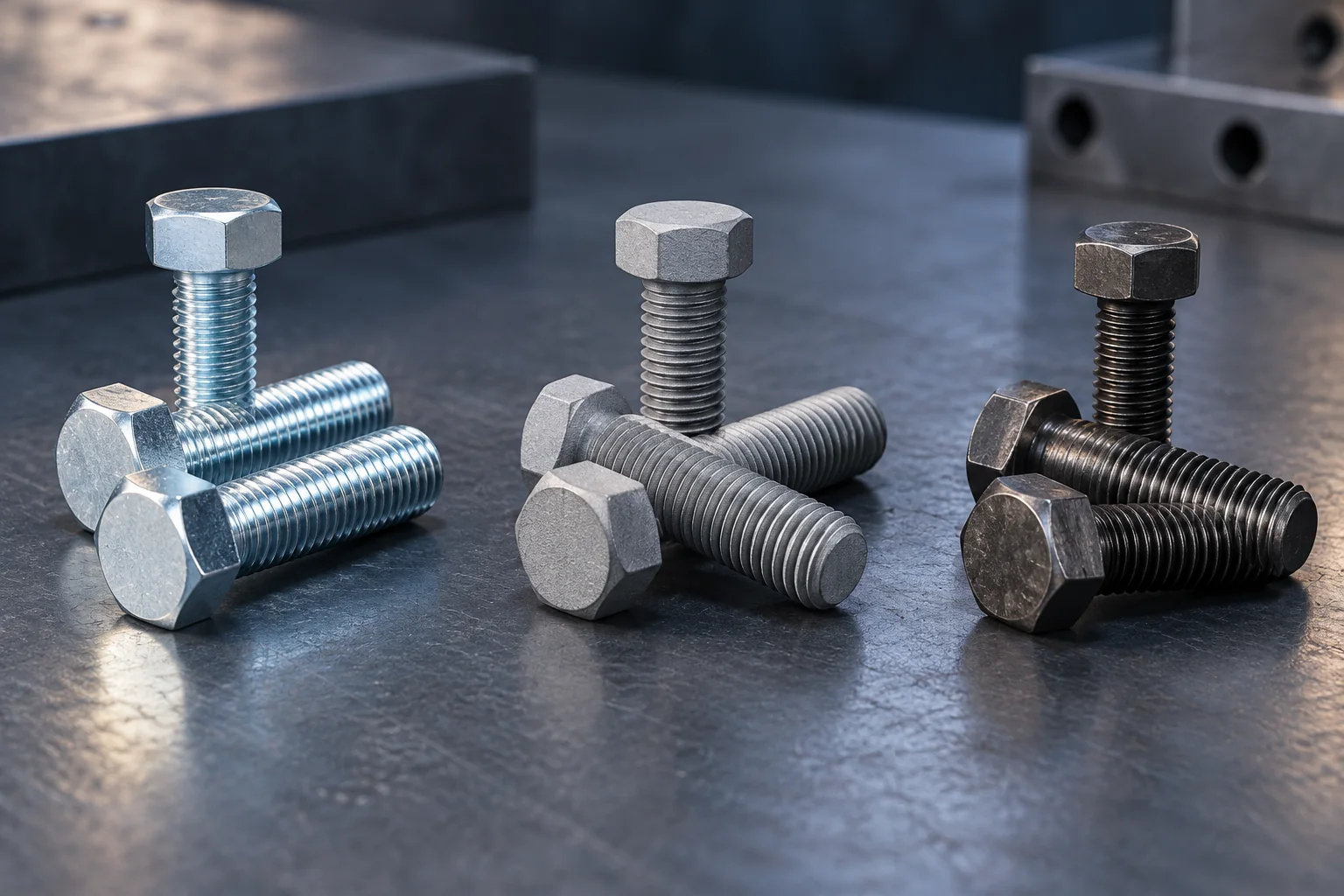
Diferenças de revestimento: galvanização, revestimentos aprovados e proteção contra corrosão
Coating selection is one of the clearest practical differences between A325 and A490 structural bolts.
Steel structural bolts may require corrosion protection when used outdoors, in industrial atmospheres or in other environments where unprotected steel is unsuitable. However, an acceptable coating must be evaluated as part of the specified bolt assembly. Its chemistry, application process, interaction with the fastener material and effect on installation can all matter.
Why hot-dip galvanizing and zinc-flake coatings must be distinguished
Hot-dip galvanizing and mechanical galvanizing are established zinc-coating processes, but their acceptance is not identical across the two structural bolting groups.
Conforme a Especificação RCSC 2025, Group 150 bolting cannot be hot-dip galvanized or mechanically galvanized; specified ASTM F3393 zinc-flake systems are a separate, conditional route.
This distinction prevents two opposite specification errors.
The first error is ordering hot-dip galvanized A490 bolts because galvanized A325 bolts were previously accepted in a similar application. The higher-strength grade does not inherit the lower-strength group’s coating permissions.
The second error is rejecting every zinc-based coating for A490. Certain ASTM F3393 zinc-flake coating systems are permitted within the applicable RCSC requirements. That permission is not a blanket approval for any commercial zinc-flake coating, arbitrary application process or unverified bolt-and-nut combination.
The applicable coating specification, bolting grade, component configuration and qualification requirements must all agree.
Why high-strength bolt coatings receive special scrutiny
High-strength steel fasteners can be susceptible to hydrogen-assisted cracking under unfavorable combinations of material condition, applied stress and hydrogen exposure.
Coating and surface-treatment processes may introduce or influence that risk. Its significance depends on the strength and material characteristics of the fastener and the specific processing route.
This is one reason coating suitability cannot be judged solely by the appearance or nominal corrosion resistance of the finished bolt. A process that produces acceptable corrosion protection does not necessarily satisfy the requirements applicable to a particular high-strength structural bolt grade.
Measures intended to control hydrogen-related risks also do not override explicit prohibitions in the governing structural bolting specification.
There is an additional assembly consequence. Protective coatings can alter thread dimensions and frictional behavior. Galvanized or otherwise coated fasteners may require specific matching nut conditions and lubrication provisions. Combining a coated bolt with an unrelated nut is not equivalent to procuring a compliant structural bolting assembly.
When pretensioning is required, the specified assembly and installation procedure must also be capable of satisfying the applicable verification requirements. Coating qualification, product testing and field installation verification are related but separate responsibilities.
Type 3 weathering steel is another selection route
Type 3 structural bolts use weathering-steel material characteristics rather than relying exclusively on a subsequently applied protective coating.
In suitable atmospheric exposure, weathering steels can develop a protective corrosion-product layer that reduces further atmospheric corrosion compared with conventional unprotected steel. Their effectiveness depends on the environment and the conditions that allow the protective layer to develop.
Persistent wetness, aggressive chloride exposure, contaminated runoff and sheltered moisture-retaining details can change that behavior. A weathering designation alone does not establish acceptable corrosion performance in every outdoor location.
Where Type 3 bolts are specified, matching nuts and washers must also satisfy the applicable assembly requirements. Combining weathering and non-weathering components without checking the specified configuration can create an unintended materials mismatch.
The real decision is between approved protection systems for the actual service environment, not between a supposedly corrosion-proof bolt and one that always needs coating.
In a hypothetical outdoor order, the buyer changes A325 to A490 while retaining the hot-dip-galvanized finish line. The original coating permission cannot be carried across automatically. Hold the revised order, check the permitted coating route and confirm the corresponding nuts, washers and assembly evidence. Compare coating processes without treating a finish name as structural approval.
Quando os engenheiros devem especificar A325 ou A490?
A325 is a reasonable selection when the governing structural design permits Group 120 bolting and its available, compliant corrosion-protection options satisfy the project requirements.
A490 becomes relevant when the engineer specifies Group 150 bolting or establishes that the higher-strength product offers a useful advantage for the actual connection design. That decision must still account for coating restrictions, assembly requirements and installation conditions.
The comparison becomes more useful when applied to specific purchasing situations.
A connection already designed and approved for A325
If an approved connection specifies Grade A325, purchasing should follow that designation unless a formal substitution is accepted. A490 should not be treated as an automatic upgrade merely because it has a higher minimum tensile-strength level.
Changing the grade may alter design assumptions, pretension requirements, coating eligibility and matching component selection. Even when the proposed bolt has the same nominal diameter and thread, those differences require review.
A connection where higher-strength bolting is specified
If the structural design specifically requires Grade A490, substituting A325 because it is more readily available or easier to galvanize is not acceptable without an engineering review.
The lower-strength grade may not satisfy the design basis. Where corrosion protection is also required, the coating system must be compatible with the specified higher-strength bolting group rather than selected independently.
An outdoor connection requiring corrosion protection
For an outdoor structural assembly, the designer must establish whether an appropriately galvanized Group 120 assembly, an approved coated Group 150 assembly or a suitable weathering-steel configuration fulfills the combined structural and exposure requirements.
The environmental requirement cannot be separated from the mechanical requirement. A coating acceptable on one grade is not necessarily transferable to the other, while a weathering material may be unsuitable for particular wet or chloride-rich conditions.
Hypothetical selection example: a proposed bolt upgrade
Consider a hypothetical outdoor steel connection whose approved documents specify ASTM F3125 Grade A325 Type 1 bolts with a compliant hot-dip galvanized assembly.
A purchaser proposes replacing the specified bolts with Grade A490 of the same nominal diameter, also hot-dip galvanized, on the assumption that stronger bolts provide a greater safety margin.
That substitution has two separate problems.
First, the stronger bolt does not automatically increase the approved connection resistance. The design would need to be checked against the relevant limit states and installation assumptions.
Second, the proposed hot-dip galvanized Group 150 configuration conflicts with the 2025 RCSC coating restriction. Matching the original bolt diameter cannot resolve a coating prohibition.
The appropriate response is to retain the specified compliant A325 assembly unless the engineer approves a different design and matching bolting configuration. If A490 is genuinely required, the protection system must be selected from the options permitted by the governing project requirements, with any applicable ASTM F3393 qualification independently confirmed.
This is an illustrative engineering scenario, not a SUNHY customer project, test result or approval of a particular product.
Como especificar e verificar conjuntos de parafusos A325/A490
A structural bolt order should identify more than the grade printed on the drawing.
The buyer needs sufficient information to distinguish the specified bolt product from visually similar fasteners, confirm the correct corrosion-protection system and ensure that the matching components meet the project requirements.
A practical purchasing specification should establish the following:
- Product identity: ASTM F3125/F3125M, the governing edition, Grade A325 or A490, applicable Type, product style, nominal diameter, length and thread configuration.
- Coating and exposure: Required surface protection, the exact coating specification, its eligibility for the selected grade and the relevant corrosion environment.
- Componentes correspondentes: Applicable nut and washer product specifications, their grades or types, coating compatibility and any specified lubrication or assembly conditions.
- Joint requirements: The approved structural design basis, whether pretensioning is required, applicable installation method and any project-specific inspection requirements.
- Acceptance documents: Manufacturer identification, product and lot traceability, required material or mechanical test records, coating documentation and any additional project inspection evidence.
ASTM A563 nuts and ASTM F436 washers are commonly referenced in structural bolting assemblies, but their acceptable grades, types and coating combinations depend on the applicable specifications. A purchaser should not select a nut solely by nominal thread size or assume that any hardened washer satisfies every structural connection requirement.
The same principle applies to testing and documentation. A manufacturer may provide test records showing that a production lot was evaluated against specified product requirements. Those records do not by themselves demonstrate that a field-installed joint achieved the required pretension or that its installation inspection was completed correctly.
Product qualification and joint acceptance therefore require different evidence.
Bolt head markings can help identify the declared grade and manufacturer, but visual markings alone do not establish material chemistry, tensile-test compliance, coating qualification or full lot traceability. Receiving inspection should reconcile the actual components with the purchase order, applicable standard and supplied documentation.
For pretensioned assemblies, preinstallation verification and installation inspection must follow the governing requirements. A generic torque chart is not an adequate substitute for those procedures, since the torque needed to develop a particular clamp load can vary with the fastener assembly and its frictional condition.
There is also a difference between a supplier offering a nominally matching bolt and supplying a documented assembly acceptable for the specified structural work. If the requested grade, coating or matching components cannot be supported by appropriate records, the discrepancy should be resolved before substitution or installation.
The final choice should preserve the engineer’s approved connection requirements. Material strength determines only part of what a structural bolt can do; coating eligibility, matched components and verified installation requirements determine whether that bolt can be used as specified.
Perguntas frequentes
O A490 é sempre o melhor parafuso estrutural?
Não. A classe correta deve seguir os requisitos aprovados de projeto da conexão, instalação e proteção contra corrosão. Um grupo de maior resistência à tração não melhora automaticamente todas as juntas.
Os parafusos A490 podem ser galvanizados por imersão a quente conforme a RCSC 2025?
Não. A especificação citada proíbe essa rota para parafusos do Grupo 150. Outras rotas de revestimento qualificadas têm condições separadas e devem ser verificadas.
Posso reutilizar a especificação da porca A325 após a mudança para A490?
Verifique novamente. As classes de porca permitidas dependem do Grupo, Tipo e condição de revestimento do parafuso; a correspondência do tamanho nominal da rosca não é suficiente.