








PPAP Nível 3 é um escopo de submissão definido pelo cliente ou projeto, não uma promessa de produto padrão. Para porcas especiais, deve estar vinculado à revisão do desenho, função da porca, processo de produção, método de inspeção, amostras, evidências de suporte e requisito de aprovação do cliente.
- Entenda o que o PPAP Nível 3 significa para porcas de solda, porcas de travamento, porcas de auto-fixação e porcas fabricadas sob desenho.
- Identifique quando o Nível 3 pode ser necessário antes do RFQ, amostragem ou aprovação de produção.
- Prepare entradas de desenho, material, revestimento, teste funcional e rastreabilidade antes de solicitar o Nível 3.

Imagem conceitual de educação do comprador. Não representa um pacote PPAP certificado ou aprovação do cliente.
Resposta rápida: O que o PPAP Nível 3 significa para porcas especiais
O PPAP Nível 3 para porcas especiais geralmente se refere a uma submissão mais completa de aprovação de peça de produção, que pode incluir um Warrant de Submissão de Peça, peças amostra e dados de suporte, com o escopo exato definido pelo cliente e requisitos do projeto. Para projetos automotivos e de fixadores fabricados sob desenho, ajuda o comprador e o fornecedor a confirmar se o processo de produção, plano de inspeção e evidências de qualidade estão alinhados com o desenho aprovado e os requisitos do cliente.
Para porcas especiais, o Nível 3 não deve ser tratado como um rótulo genérico de produto. Uma porca de solda, porca de travamento, porca auto-encaixante ou porca flangeada personalizada pode precisar de evidências diferentes dependendo de sua função na montagem. O tamanho da rosca por si só não comprova o desempenho da junta, e a capacidade IATF não significa automaticamente que o PPAP Nível 3 está incluído em cada pedido.
O que o PPAP Nível 3 Significa para Porcas Especiais
Para porcas especiais, o PPAP Nível 3 é melhor compreendido como um escopo de submissão para um projeto definido. Ajuda a organizar as evidências de aprovação em torno de um número de peça específico, revisão de desenho, processo de fabricação, método de inspeção e requisito do cliente.
Uma porca especial pode ser fabricada corretamente e ainda assim exigir documentação diferente dependendo do processo de aprovação do cliente. O Nível 3 descreve quanta evidência pode ser submetida para aprovação. Ele não descreve a porca física em si.
Por exemplo, duas porcas flangeadas de solda podem parecer semelhantes, mas uma pode ser usada em um suporte não crítico e outra em uma estrutura onde a resistência da solda, torque de saída, resistência ao arrancamento e rastreabilidade são revisados. O segundo projeto pode exigir mais evidências mesmo que o tamanho básico da rosca seja o mesmo.
Nível 3 é um Escopo de Submissão, Não uma Especificação de Porca
Os compradores devem evitar tratar o Nível 3 como uma frase de caixa de seleção. Uma pergunta mais útil é: o fornecedor pode preparar as evidências de Nível 3 necessárias para esta revisão de desenho, processo de produção, material, revestimento e aplicação?
Por que Porcas Especiais Precisam de Evidências de Aprovação Específicas do Projeto
Porcas especiais geralmente incluem geometria não padrão ou recursos específicos de função. Estes podem incluir projeções de solda, serrilhados, zonas de torque predominante, anéis de auto-fixação, formatos especiais de flange, alturas reduzidas, profundidades de rosca personalizadas, buchas, pilotos ou formas anti-rotação.
Para um contexto mais amplo do produto, revise as páginas de capacidade da porcas especiais personalizadas e SUNHYINGS fabricante de porcas personalizadas.
Quando o Nível 3 Não é a Primeira Pergunta Correta
Muitas equipes de sourcing começam perguntando se um fornecedor pode fornecer “PPAP Nível 3”. Essa pergunta é útil, mas pode ser prematura. Para um projeto de porca especial, a primeira pergunta deve ser se o desenho, a aplicação e as evidências de qualidade são claros o suficiente para definir um escopo de Nível 3.
| Pergunta Prematura | Por que é Incompleta | Melhor Pergunta de Engenharia |
|---|---|---|
| Você pode fornecer PPAP Nível 3? | Não define o número da peça, revisão do desenho, rota de produção ou formato de submissão do cliente. | Quais evidências de Nível 3 são necessárias para esta revisão de desenho e processo de aprovação do cliente? |
| Você pode cotar esta amostra? | Uma amostra pode não mostrar o material, revestimento, tratamento térmico, dimensões críticas ou histórico de revisão. | A amostra pode ser vinculada a um desenho controlado antes da definição do escopo do PPAP? |
| Você pode fornecer todos os relatórios de teste? | Os testes exigem métodos definidos, critérios de aceitação e condições de aplicação. | Quais testes são necessários: torque de saída, arrancamento, empuxo, carga de prova, torque predominante, espessura de revestimento ou corrosão? |
| Sua fábrica é capacitada para IATF? | A capacidade do sistema de qualidade não substitui a evidência PPAP específica do projeto. | Quais documentos, registros e amostras do projeto podem ser preparados para o nível de submissão solicitado? |
Como o PPAP Nível 3 Difere de Outros Níveis de Submissão PPAP
Os níveis de submissão PPAP são usados para definir quanta evidência é submetida ou retida para revisão do cliente. O Nível 3 é comumente descrito como uma submissão mais completa que pode incluir um Warrant de Submissão de Peça, peças amostra e dados de suporte, mas o pacote de evidências exato deve seguir o requisito do cliente, revisão do desenho, risco do projeto e instrução de aprovação aplicável.

O diagrama é simplificado para educação do comprador e não substitui as instruções oficiais do manual PPAP.
| Nível de Submissão PPAP | Escopo Típico de Submissão | Interpretação do Comprador | Cuidado Especial com Porca |
|---|---|---|---|
| Nível 1 | Garantia de Submissão de Peça focada na submissão. | Menor ônus de submissão. | Pode não ser suficiente para projetos de porcas especiais personalizadas ou críticas para a função, a menos que aceito pelo cliente. |
| Nível 2 | PSW com amostras do produto e dados de suporte limitados. | Evidência moderada. | Pode não cobrir todos os riscos de desenho, processo ou teste funcional. |
| Nível 3 | PSW com amostras de produto e dados de suporte, com escopo exato definido pelos requisitos do cliente e do projeto. | Pacote de submissão completo. | O escopo ainda depende dos requisitos do cliente, revisão do desenho e risco do projeto. |
| Nível 4 | PSW e outros requisitos definidos pelo cliente. | Submissão específica do cliente. | O comprador deve seguir exatamente as instruções do cliente. |
| Nível 5 | PSW, amostras de produtos e dados de suporte disponíveis no local de fabricação do fornecedor. | Revisão mais aprofundada no local do fornecedor quando necessário. | Pode exigir maior visibilidade do processo e controle de registros. |
Por que o Nível 3 é Frequentemente Tratado como uma Submissão Mais Completa
Para muitas equipes de sourcing automotivo, o Nível 3 é o nível mais associado a um pacote de aprovação mais completo. Pode envolver registros de desenhos, resultados dimensionais, evidências de material, evidências de revestimento, documentos de processo, documentos de controle, registros de teste e peças de amostra quando necessário.
Por que o Cliente Ainda Decide o Nível Exigido
Os compradores não devem presumir que o Nível 3 é sempre exigido. Alguns projetos podem exigir o Nível 1, Nível 2, Nível 4 ou Nível 5. O cliente, nota de desenho, requisito de qualidade do fornecedor ou plano de aprovação do projeto deve definir o nível exigido.
Quando o PPAP Nível 3 Pode Ser Exigido
O PPAP Nível 3 pode ser solicitado quando o cliente ou projeto exige um pacote de aprovação mais completo antes da liberação da produção. Para porcas especiais, isso é mais provável quando a peça é personalizada, automotiva, específica de desenho, sensível ao processo ou crítica para a função.
| Condição do Projeto | Por que o Nível 3 Pode Ser Solicitado | Comprador Deve Confirmar | Risco se Não Atendido |
|---|---|---|---|
| Nova porca especial personalizada | Novo desenho e rota de produção podem precisar de evidência de aprovação. | Última revisão do desenho e características especiais. | As amostras podem não atender ao requisito de aprovação de produção. |
| Nova revisão do desenho | Notas sobre geometria, rosca, projeção, flange ou revestimento podem ser alteradas. | Histórico de revisão e dimensões alteradas. | O fornecedor pode cotar ou amostrar o projeto errado. |
| Novo fornecedor | O cliente pode precisar de evidências de que a nova fonte pode produzir de forma consistente. | Nível de PPAP exigido e processo de aprovação do fornecedor. | Atraso na aprovação do fornecedor. |
| Novo ferramental ou rota de fabricação | A mudança de processo pode afetar a consistência dimensional e o desempenho. | Rota de amostra versus rota de produção. | O pacote PPAP pode não representar a produção em massa. |
| Mudança de material ou revestimento | Resistência, dureza, comportamento de corrosão, ajuste de rosca ou comportamento de torque podem mudar. | Grau do material, dureza, tipo de revestimento, espessura e tolerância de rosca pós-revestimento. | Evidências funcionais ou de inspeção podem não suportar a aprovação. |
| Função de solda, travamento ou cravação | O desempenho funcional pode precisar de evidências. | Torque de saída, arrancamento, empuxo, torque predominante ou outro escopo de teste. | O pacote de documentos pode não abordar o risco real de montagem. |
| Requisito automotivo específico do cliente | O cliente OEM ou Tier pode definir o Nível 3 como parte da aprovação. | Formulários e prazos de submissão específicos do cliente. | Submissão rejeitada ou atrasada. |
Obrigatório, Possível ou Evidência Insuficiente?
Os compradores costumam usar “obrigatório” cedo demais. A tabela abaixo ajuda a separar requisitos confirmados de possíveis gatilhos e suposições incompletas.
| Status da Decisão | O que significa | Exemplo para porcas especiais | Próximo passo |
|---|---|---|---|
| Requisito de Nível 3 confirmado | O cliente, nota no desenho, instrução do SQE ou plano de aprovação do projeto especifica Nível 3. | Uma nova porca de solda fabricada sob desenho para um suporte automotivo recebe Nível 3 pela equipe de qualidade do fornecedor do cliente. | Cotações de amostras, inspeção, documentos, testes e cronograma de submissão como parte do escopo do projeto. |
| Possível gatilho de Nível 3 | A peça ou alteração pode exigir evidências mais completas, mas o nível ainda não foi confirmado. | Alterações de revestimento em uma porca de travamento totalmente metálica que podem afetar o ajuste da rosca e o torque de travamento. | Pergunte ao cliente ou SQE se esta alteração requer Nível 3 ou outro nível de submissão. |
| Evidências insuficientes | O comprador possui uma amostra, foto ou nome da peça, mas nenhuma base de aprovação controlada. | Uma amostra de porca de auto-fixação é fornecida sem espessura da chapa, dureza do painel ou requisito de resistência ao arrancamento. | Colete desenho, dados de aplicação e critérios de teste antes de definir o nível PPAP. |
Para contexto de desenvolvimento de porca personalizada automotiva, consulte porcas especiais personalizadas para OEMs automotivos. Para fornecimento baseado em desenho, veja porcas especiais fabricadas sob desenho.
Por que Porcas Especiais Frequentemente Precisam de Mais Evidências do que Porcas Padrão
Porcas padrão são geralmente selecionadas a partir de dimensões conhecidas, materiais padrão e requisitos de desempenho estabelecidos. Porcas especiais são diferentes porque sua geometria ou função é modificada para uma montagem específica.
Para uma definição mais ampla antes de comparar evidências PPAP, veja o que são porcas especiais.
Uma porca especial pode ser usada como âncora de solda, rosca de pressão, elemento anti-afrouxamento, espaçador, componente de alinhamento ou ponto de fixação de suporte de carga. Nestes casos, o PPAP Nível 3 pode ser solicitado porque o comprador precisa de evidências de que o processo de produção pode controlar as características que importam.
Geometria e Características da Rosca
Os compradores devem revisar profundidade da rosca, tolerância, margem de revestimento, diâmetro do flange, geometria de projeção, forma de serrilhado, anel de cravação e área de apoio, quando aplicável.
Funções de Soldagem, Travamento e Cravação
Porcas de solda, porcas de travamento e porcas autoperfurantes frequentemente precisam de evidências que correspondam à sua função real de montagem, não apenas ao tamanho da rosca.
Revestimento, Tratamento Térmico e Estabilidade do Processo
O revestimento e o tratamento térmico podem afetar a resistência à corrosão, o ajuste da rosca, o comportamento do torque, a conformabilidade e os resultados de inspeção.
O que os Compradores Podem Esperar em uma Submissão de Nível 3
Uma submissão PPAP de Nível 3 pode incluir várias categorias de evidências. O pacote exato depende do cliente e do projeto. Os compradores não devem solicitar um pacote genérico de Nível 3 sem definir a peça, revisão, processo e escopo de teste.
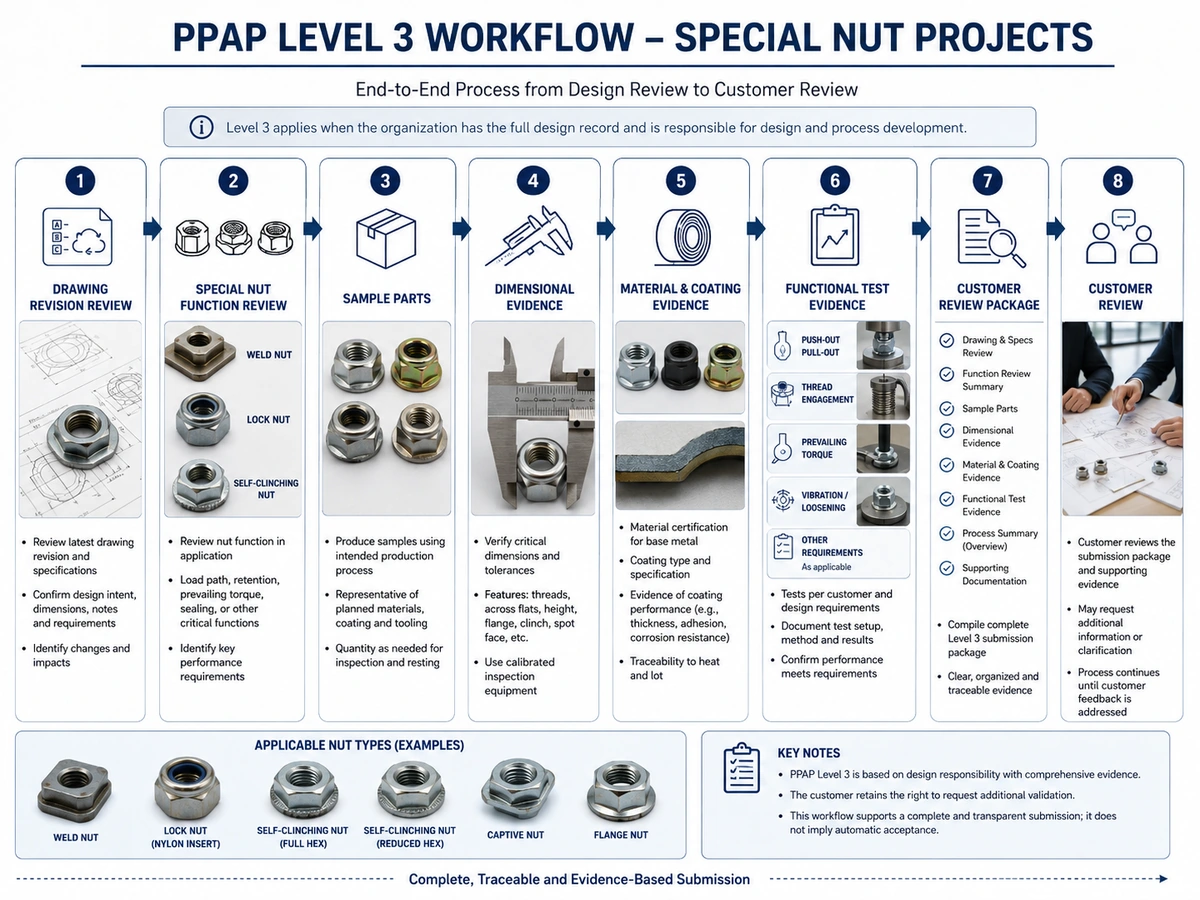
O fluxo de trabalho é uma ferramenta de planejamento simplificada. Os requisitos reais de submissão devem seguir as instruções do cliente.
| Categoria de Evidência | Finalidade | Entrada do Comprador Necessária | Relevância da Porca Especial |
|---|---|---|---|
| Garantia de Submissão de Peça | Resume a peça submetida e a solicitação de aprovação. | Número da peça, revisão e motivo da submissão. | Conecta a porca especial a um evento de aprovação específico. |
| Amostras do produto | Permite que o cliente revise as peças submetidas. | Quantidade de amostras e prazo de submissão. | As amostras devem representar a rota de produção pretendida, quando necessário. |
| Registro de projeto / desenho | Define geometria, material, revestimento e observações. | Última revisão do desenho. | Crítico para geometria de porca personalizada e fabricação sob desenho. |
| Resultados dimensionais | Mostra conformidade medida com os requisitos do desenho. | Dimensões críticas e método de inspeção. | Importante para rosca, projeção, altura do flange e recursos personalizados. |
| Evidência de material / revestimento | Suporta rastreabilidade de material, tratamento de superfície e requisitos de corrosão quando necessário. | Grau do material, dureza, tipo de revestimento, espessura e alvo de corrosão. | Importante para conformação, tratamento térmico, ajuste de rosca e comportamento de torque. |
| Evidência de teste funcional | Suporta desempenho específico da aplicação. | Testes de torque de saída, resistência ao arrancamento, resistência ao empuxo, carga de prova, torque predominante ou outros. | Crítico para porcas de solda, porcas de travamento e porcas auto-encaixáveis. |
| Rastreabilidade / Suporte IMDS | Atende aos requisitos automotivos de material e controle de lote quando necessário. | Requisitos de IMDS, etiqueta de lote, embalagem e retenção. | Importante para aprovação automotiva e controle de produção. |
Evidências de Peça, Desenho e Dimensional
O desenho é a base do PPAP Nível 3. Os compradores devem fornecer a revisão mais recente do desenho e identificar quaisquer características especiais ou notas específicas do cliente. Os resultados dimensionais devem estar vinculados ao desenho e incluir as características que afetam a função.
Evidência de Material, Revestimento e Teste Funcional
A evidência de material pode comprovar grau, dureza, tratamento térmico e rastreabilidade. A evidência de revestimento pode comprovar acabamento superficial, espessura ou expectativas de corrosão quando necessário. Testes funcionais devem ser definidos pelo desenho, requisito do cliente ou risco da aplicação.
Evidência de Processo e Controle
O Nível 3 também pode exigir evidências relacionadas ao processo, como fluxo de processo, PFMEA, plano de controle, análise de sistema de medição ou evidência de capacidade, quando exigido pelo cliente. O comprador deve confirmar quais itens são esperados, em vez de assumir que todo projeto usa o mesmo conjunto de documentos.
Responsabilidade pela Evidência de Nível 3: Comprador, Fornecedor e Cliente
Um pacote de Nível 3 se torna difícil quando as responsabilidades não são claras. Os compradores não devem esperar que um fornecedor defina critérios de aceitação que pertencem ao desenho, norma do cliente ou plano de validação de montagem. O fornecedor pode preparar a evidência somente após a base de aprovação estar clara.
| Área de Evidência | Comprador / Cliente Deve Definir | Fornecedor pode preparar | Atraso comum |
|---|---|---|---|
| Desenho e revisão | Último desenho, número da peça, nível de revisão e características especiais. | Revisão do desenho, desenho com balões se necessário, plano de inspeção dimensional. | Desenho antigo ou características críticas não marcadas. |
| Rosca e ajuste. | Tamanho da rosca, passo, classe de tolerância, parafuso de acoplamento e condição do calibre pós-revestimento. | Registros do calibre de rosca, resultados dimensionais e método de inspeção. | Revestimento alterado sem confirmar a folga da rosca. |
| Material e dureza | Grau do material, classe de propriedade, tratamento térmico e requisito de dureza. | Certificado de material, registro de dureza e rastreabilidade de lote quando exigido. | O grau do material é assumido a partir de uma amostra sem confirmação de desenho. |
| Revestimento e corrosão | Tipo de revestimento, espessura, requisito de corrosão e requisito de substâncias restritas. | Relatório de revestimento, registro de espessura, relatório de névoa salina quando especificado e rastreabilidade de lote. | O requisito de revestimento é adicionado após a aprovação das amostras. |
| Desempenho funcional | Método de teste, critério de aceitação, condição da junta e quantidade de amostras. | Registros de teste de torque, tração, compressão, carga de prova ou torque predominante, quando necessário. | A solicitação de teste é feita sem valor alvo ou método definido. |
| Formato de submissão | Nível PPAP exigido, formulários do cliente, cronograma de submissão e processo de aprovação. | Pacote de documentos organizado e registros do fornecedor dentro do escopo acordado. | Formulários específicos do cliente são solicitados após o orçamento. |
Por que a Rota de Amostra e a Rota de Produção são importantes para o Nível 3
Para porcas especiais, a rota de amostra pode não ser sempre a rota final de produção. Amostras iniciais podem ser usinadas em CNC para verificar a geometria, enquanto a produção em massa pode posteriormente usar recartilhamento a frio, forjamento a frio, estampagem, rosqueamento, laminação de rosca, tratamento térmico, revestimento e classificação. Se a rota mudar, as evidências de aprovação podem precisar ser revisadas novamente.
| Rota do Processo | Por que é Importante | Risco Nível 3 | O Comprador Deve Perguntar |
|---|---|---|---|
| Amostra CNC, produção por recalcagem a frio | A amostra pode verificar a geometria, mas não a capacidade do processo produtivo. | A evidência dimensional pode não representar a produção em massa. | A produção usará a mesma rota de processo das amostras do PPAP? |
| Fornecedor ou lote de revestimento diferente | O revestimento afeta a corrosão, o ajuste da rosca e o comportamento do torque. | Os registros de calibre de rosca ou teste funcional podem precisar de atualização. | Como serão controlados a rastreabilidade do lote de revestimento e a inspeção da rosca pós-revestimento? |
| Tratamento térmico adicionado após revisão do projeto | O tratamento térmico pode afetar a dureza, a resistência e o risco de distorção. | Os registros de material e dimensionais podem não representar mais o processo final. | O desenho requer tratamento térmico ou evidência de classe de propriedade? |
| Teste funcional adicionado após amostras | Testes exigem método, dispositivo, critérios e peças representativas. | As amostras podem ser insuficientes para testes de torque de extração, arrancamento, empuxo ou torque predominante. | Qual método de teste e critérios de aceitação são necessários antes da amostragem? |
Tipo Especial de Porca vs Foco em Evidências de Nível 3
O foco das evidências deve mudar conforme o tipo de porca. Uma submissão de Nível 3 para uma porca de solda não deve ser idêntica a uma submissão para uma porca de auto-fixação ou porca de travamento totalmente metálica.

Os exemplos de porcas são conceituais e devem ser verificados contra o desenho real e o requisito do cliente.
| Tipo de Porca | Risco de Montagem | Evidência para Discussão | Entrada do Comprador Necessária |
|---|---|---|---|
| Porcas para solda de flange | Soldagem de ancoragem, distribuição de carga e interação com o painel. | Geometria da saliência, calibre de rosca, torque de arrancamento, resistência ao arrancamento e revisão de revestimento quando necessário. | Espessura da chapa, processo de soldagem, aplicação e requisito de teste. |
| Porcas sextavadas para solda | Controle da saliência, acesso para soldagem e alinhamento da rosca. | Forma da saliência, inspeção da rosca e evidência de desempenho da solda quando necessário. | Desenho padrão ou desenho personalizado, condição do painel e requisito de torque de arrancamento. |
| Porcas autotravantes totalmente metálicas | Controle de afrouxamento por vibração e torque de atrito. | Torque predominante, ajuste de rosca, tratamento térmico e influência do revestimento. | Requisito de torque, premissa de reutilização e condição de vibração da aplicação. |
| Porcas flangeadas serrilhadas | Comportamento de assentamento, engajamento das serrilhas e interação superficial. | Geometria do serrilhado, superfície de apoio, revestimento e comportamento do torque. | Superfície de contato, requisito de anti-afrouxamento e risco de danos à superfície. |
| Porcas auto-encaixáveis | Instalação em chapa fina, resistência ao arrancamento e ao torque. | Característica de clinchagem, espessura da chapa, evidência de arrancamento e torque quando necessário. | Material da chapa, espessura do painel, processo de instalação e dureza do painel. |
| Porcas especiais sob medida conforme desenho | Geometria personalizada e requisitos específicos do desenho. | Resultados dimensionais, evidência de material/revestimento e confirmação da rota de processo. | Última revisão do desenho, características especiais e escopo de inspeção. |
Porcas de Solda e Conjuntos Soldados por Projeção
Para porcas de solda, a evidência de Nível 3 pode precisar suportar mais do que a conformidade da rosca. A forma da projeção, área de apoio, revestimento, espessura da chapa e desempenho da solda podem afetar a aprovação. Se for necessário torque de torção ou arrancamento, isso deve ser declarado antes da amostragem.
Porcas de Travamento e Juntas Suscetíveis a Vibração
Para porcas de travamento totalmente metálicas, a característica de torque predominante pode ser um ponto crítico de aprovação. Revestimento, tratamento térmico e controle de rosca podem afetar o comportamento do torque. Os compradores devem esclarecer se o torque inicial, torque predominante, condição de reutilização ou requisitos relacionados à vibração fazem parte do escopo de aprovação.
Porcas Auto-rosqueantes e Painéis de Chapa Metálica
Para porcas auto-rosqueantes, o material do painel e a espessura da chapa fazem parte da decisão de engenharia. Uma porca que se instala bem em um material de chapa pode não ter o mesmo desempenho em outro. Os requisitos de resistência ao arrancamento e ao torque devem ser definidos quando necessário.
O que os Compradores Devem Confirmar Antes de Solicitar o Nível 3
Uma solicitação de Nível 3 deve fazer parte da conversa do RFQ, não um complemento tardio após o preço e o cronograma de amostras serem acordados. O fornecedor precisa de informações suficientes do projeto para confirmar o que pode ser preparado, o que deve ser testado e o que pode afetar o prazo de entrega.
| Entrada | Por que é Importante | Necessário Antes do RFQ? | Efeito no Custo / Prazo de Entrega / Aprovação |
|---|---|---|---|
| Última revisão do desenho | Define a peça a ser aprovada. | Sim | Revisão incorreta pode causar rejeição da amostra ou retrabalho. |
| Tipo e função da porca | Define o principal risco de engenharia. | Sim | Funções de solda, travamento, cravação e flange exigem verificações diferentes. |
| Tamanho da rosca, passo e tolerância | Controla o ajuste e a inspeção. | Sim | Problemas de rosca pós-revestimento podem atrasar a aprovação. |
| Material e dureza | Afeta a resistência, conformação e tratamento térmico. | Sim | Suposição incorreta de material afeta o processo e os documentos. |
| Requisito de revestimento | Afeta a corrosão, o ajuste da rosca e o comportamento do torque. | Sim | Alterações no revestimento podem gerar revisão adicional. |
| Espessura da chapa ou do parafuso de acoplamento | Determina a interação da montagem. | Frequentemente sim | Importante para porcas de solda e porcas auto-estampáveis. |
| Requisito de teste funcional | Define o que deve ser comprovado. | Sim, se aplicável | Solicitações de teste tardias podem atrasar o PPAP. |
| Nível PPAP solicitado | Define o escopo de submissão. | Sim | O Nível 3 pode exigir mais tempo e evidências de suporte. |
| IMDS e rastreabilidade | Atende às necessidades automotivas de material e controle de lote. | Se necessário | Solicitações tardias podem afetar o cronograma de aprovação. |
Entradas de Teste Funcional que Devem Ser Definidas
Testes funcionais não devem ser solicitados sem método e critérios de aceitação. Um fornecedor só pode preparar evidências significativas quando o comprador ou cliente define a condição de montagem e a base de aprovação/reprovação.
| Área de Teste | Frequentemente Relevante Para | Comprador Deve Definir | Evidência do Fornecedor Pode Incluir |
|---|---|---|---|
| Torque-out | Porcas de solda, porcas auto-fixantes e conjuntos de porcas cativas. | Material do painel, espessura da chapa, condição de instalação ou soldagem e critérios de aceitação. | Registro de teste de torque-out quando necessário. |
| Arrancamento / expulsão | Porcas de solda e porcas auto-estampáveis. | Direção da carga, condição do dispositivo, espessura da chapa, quantidade de amostras e requisito alvo. | Registro de arrancamento ou expulsão quando necessário. |
| Torque predominante | Porcas de trava totalmente metálicas e outras porcas anti-afrouxamento. | Parafuso de acoplamento, condição de lubrificação, regra de reuso, faixa de torque e método de teste. | Registro do teste de torque predominante quando necessário. |
| Calibrador de rosca após revestimento | Porcas especiais revestidas e porcas de travamento. | Tolerância de rosca, tipo de revestimento, condição do calibrador pós-revestimento e requisito do parafuso de acoplamento. | Registro do calibrador de rosca passa/não passa e evidência da espessura do revestimento. |
Entradas para RFQ a Preparar
- Último desenho e nível de revisão
- Foto de amostra, se disponível
- Tamanho da rosca, passo e tolerância
- Tipo de porca e função de montagem
- Classe de material, dureza ou propriedade
- Tolerância de rosca para revestimento e pós-galvanização
- Espessura da chapa ou do parafuso de acoplamento
- Requisito de teste funcional
- Nível PPAP solicitado
- Requisito IMDS, se aplicável
- Requisito de rastreabilidade e embalagem
- Volume anual e cronograma de aprovação
O que o PPAP Nível 3 Não Comprova
O PPAP Nível 3 é útil, mas não deve ser mal interpretado. Ele é uma evidência para um escopo de aprovação definido, não uma garantia de que a porca funcionará em todas as condições possíveis.
Ele Não Substitui a Validação da Aplicação
Uma submissão de Nível 3 não substitui a validação conjunta, estratégia de torque, validação do processo de soldagem, teste de vibração, validação de corrosão ou aprovação técnica específica do cliente quando estas são necessárias.
Isso não torna alterações futuras automaticamente aprovadas
Se houver alteração na revisão do desenho, material, revestimento, ferramental, local de produção ou rota do processo, o status de aprovação pode precisar ser revisado novamente.
Isso não elimina a revisão em nível de desenho
Um fornecedor ainda deve revisar o desenho, condição de montagem, tolerância da rosca, material, revestimento e testes funcionais antes da cotação.
Isso não garante zero defeitos
O Nível 3 pode apoiar a evidência de aprovação de produção, mas não justifica alegações de zero defeito ou 0 PPM.
Lista de Verificação de Prontidão do Fornecedor para PPAP Nível 3
A prontidão de Nível 3 de um fornecedor não é comprovada dizendo “podemos fornecer PPAP”. Os compradores devem perguntar se o fornecedor entende o desenho, processo, inspeção e escopo do documento. Para uma lógica mais ampla de seleção de fornecedores, revise fornecedor especializado em porcas para aplicações automotivas.
| Pergunta de Prontidão | Boa Resposta do Fornecedor | Sinal de Alerta |
|---|---|---|
| Você pode revisar a última revisão do desenho antes de cotar? | O fornecedor identifica dimensões críticas, material, revestimento e notas especiais. | O fornecedor cotar apenas a partir de uma foto sem listar premissas. |
| Você pode explicar a rota da amostra e a rota de produção? | Fornecedor informa se amostras e produção seguirão o mesmo processo ou precisam de revisão. | Fornecedor não consegue explicar a diferença entre amostra CNC e produção por conformação a frio. |
| Você pode preparar evidências dimensionais? | Fornecedor confirma método de inspeção e características medidas. | Fornecedor dá um “sim” genérico sem verificar os requisitos do desenho. |
| Você pode apoiar a rastreabilidade de material e revestimento? | Fornecedor discute certificados, registros de revestimento e controle de lote quando necessário. | Fornecedor trata a evidência de material ou revestimento como algo secundário. |
| Você pode identificar os requisitos de teste funcional? | Fornecedor pergunta sobre torque de saída, tração, empuxo, carga de prova ou torque predominante quando relevante. | O fornecedor assume que a inspeção de rosca é suficiente para cada porca especial. |
| Você pode discutir o escopo Nível 3 antes da cotação? | O fornecedor separa documentos incluídos, testes opcionais e requisitos específicos do cliente. | O fornecedor promete todos os documentos sem revisar o projeto. |
Como o Nível 3 Pode Afetar o Custo e o Prazo de Entrega
O Nível 3 pode afetar o custo e o prazo de entrega porque inspeção, amostras, preparação de documentos, testes, registros de rastreabilidade e formulários específicos do cliente exigem coordenação. Uma cotação que exclui testes funcionais, IMDS, etiquetas de embalagem especiais ou formulários do cliente pode não representar o escopo final de aprovação.
| Requisito Adicionado Tardiamente | Possível Impacto | Como Prevenir |
|---|---|---|
| Relatório de teste funcional | Amostras adicionais, dispositivos, tempo de teste ou coordenação com laboratório externo podem ser necessários. | Definir método de teste e critérios de aceitação antes da amostragem. |
| Suporte IMDS | A coleta de dados de materiais e o relatório ao cliente podem afetar o cronograma. | Informar o requisito IMDS no RFQ. |
| Evidência de produção em série | A evidência apenas de amostras pode não ser suficiente se o cliente precisar de registros do processo produtivo. | Confirmar se as amostras devem representar a produção em massa pretendida. |
| Embalagem especial e etiquetas de rastreabilidade | Etiqueta, lote e requisitos de embalagem podem alterar o trabalho de preparação. | Fornecer instruções de embalagem e rastreabilidade antes da cotação. |
Cenários de Engenharia Compostos para Treinamento
Os cenários a seguir são combinações hipotéticas usadas para explicar a lógica de engenharia. Não são casos de clientes, comprovantes de produto ou registros de aprovação.
Cenário 1: Porca de solda com flange com solicitação tardia de Nível 3
Um comprador envia um desenho de uma porca de solda com flange e solicita amostras rapidamente. O RFQ inicial inclui tamanho da rosca, material e revestimento, mas não menciona torque de saída, resistência ao arrancamento, espessura da chapa ou PPAP Nível 3. Após a fabricação das amostras, o cliente solicita evidências de Nível 3 e dados de desempenho de solda. O projeto é atrasado porque os requisitos funcionais não foram definidos antes da amostragem.
Cenário 2: Porca de trava totalmente metálica com alteração de revestimento
Um comprador valida uma amostra de porca de travamento totalmente metálica com um revestimento e depois muda para outro revestimento antes da produção. O novo revestimento pode afetar o ajuste da rosca e o comportamento do torque de aperto. Evidências atualizadas do revestimento, inspeção da rosca e teste de torque podem precisar de revisão antes da submissão.
Cenário 3: Porca Autoperfurante para um Novo Painel
Um comprador deseja uma porca autoperfurante para um novo painel de chapa metálica, mas a espessura da chapa e a dureza do painel não estão confirmadas. Posteriormente, são solicitadas evidências de resistência ao arrancamento e ao torque. O fornecedor precisa dos dados da chapa metálica antes de confirmar o escopo do teste.
Precisa de uma Revisão PPAP Nível 3 para um Projeto de Porca Especial?
Se o seu projeto exigir PPAP Nível 3, envie o desenho e o requisito de documento de qualidade antes da cotação. A SUNHYINGS pode revisar o tipo de porca, revisão do desenho, material, revestimento, rota de fabricação, necessidades de inspeção e escopo documental do projeto antes do desenvolvimento da amostra.
Para tornar a revisão mais precisa, inclua tamanho e passo da rosca, material, dureza ou classe de propriedade, revestimento, local de aplicação, espessura do parafuso ou chapa de acoplamento, requisitos de teste funcional, volume anual, nível PPAP, requisito IMDS, necessidades de rastreabilidade, embalagem e cronograma de aprovação.
PPAP Nível 3, IMDS e outros documentos de qualidade devem ser confirmados por projeto, revisão de desenho e requisitos do cliente. Eles não devem ser assumidos como padrão para cada produto de porca especial ou pedido.

A lista de verificação é apenas para preparação de RFQ. O escopo final do PPAP deve seguir os requisitos do cliente e do projeto.
Nota de Referências Técnicas e Limitação
Este artigo fornece um guia de preparação para o comprador. Ele não reproduz conteúdo proprietário do manual PPAP e não deve ser usado como substituto para instruções PPAP específicas do cliente, requisitos de desenho ou procedimentos formais de aprovação.
Os elementos exatos de submissão do Nível 3 devem seguir o requisito aplicável do cliente, revisão do desenho, processo de aprovação e instrução formal de PPAP para o projeto.
- Página oficial do Manual PPAP AIAG — direção de referência oficial para o Processo de Aprovação de Peças de Produção.
- Ferramentas da Qualidade AIAG — contexto para APQP, Plano de Controle, FMEA, MSA, SPC e PPAP.
- Visão geral da AIAG IATF 16949:2016 — contexto do sistema de gestão da qualidade automotiva.
- Site oficial do IMDS — contexto de relatório de dados de materiais automotivos.
FAQ: PPAP Nível 3 para Porcas Especiais
O que é PPAP Nível 3?
O PPAP Nível 3 é comumente descrito como um escopo de submissão PPAP mais completo, que pode incluir um Warrant de Submissão de Peça, amostras do produto e dados de suporte. Para porcas especiais, a evidência exata depende do desenho, requisito do cliente, risco da aplicação e processo de aprovação.
O PPAP Nível 3 é necessário para cada porca especial?
Não. O PPAP Nível 3 não é exigido para todo pedido de porca especial. Pode ser solicitado quando o cliente, desenho, aplicação automotiva, processo de aprovação de fornecedor ou risco do projeto exigir um pacote de submissão mais completo.
Quem decide se o Nível 3 é necessário?
O cliente, o processo de aprovação do projeto, as notas do desenho, o requisito de qualidade do fornecedor ou o requisito de compra geralmente definem o nível de PPAP necessário. O fornecedor não deve assumir o Nível 3 sem confirmação.
Quais documentos geralmente são incluídos em um PPAP Nível 3?
Uma submissão de Nível 3 pode incluir uma Garantia de Submissão de Peça, amostras, registros de desenho, resultados dimensionais, evidência de material, evidência de revestimento, documentos de processo, documentos de controle, resultados de teste funcional, suporte IMDS e registros de rastreabilidade quando necessário. O pacote exato é específico do projeto e deve seguir o requisito de aprovação do cliente.
O PPAP Nível 3 comprova que a porca não falhará?
O Nível 3 do PPAP fornece evidências de aprovação para um escopo definido, mas não substitui a validação da aplicação, testes conjuntos, validação de solda, estratégia de torque, revisão de corrosão ou aprovação do cliente.
O IATF 16949 significa que o PPAP Nível 3 está automaticamente incluído?
Não. A capacidade IATF 16949 e o PPAP Nível 3 não são a mesma coisa. Um fornecedor pode apoiar processos de qualidade automotiva, mas o escopo de submissão do Nível 3 ainda deve ser confirmado para cada projeto.
Quando devo solicitar o Nível 3 antes do RFQ?
Solicite o Nível 3 antes que o cronograma de amostras, preço e prazo de aprovação sejam finalizados. Se o Nível 3 exigir inspeção adicional, testes, IMDS, rastreabilidade ou formulários específicos do cliente, isso pode afetar o custo e o prazo de entrega.
O Nível 3 pode ser aplicado a porcas de solda, porcas de trava ou porcas autoperfurantes?
Sim. O Nível 3 pode ser aplicado a porcas de solda, porcas de travamento, porcas autoperfurantes e outras porcas especiais quando exigido pelo cliente ou projeto. O foco da evidência muda conforme a função da porca.
O que devo enviar para a SUNHYINGS antes de solicitar o PPAP Nível 3?
Envie o desenho, foto da amostra se disponível, tamanho da rosca, material, revestimento, função da porca, aplicação, espessura do parafuso ou chapa de acoplamento, testes necessários, nível de PPAP, requisito de IMDS, requisito de rastreabilidade, volume anual e cronograma de aprovação.
Autor e Revisão Técnica
Escrito por: Equipe de Conteúdo de Engenharia de Fixadores SUNHYINGS
Foco da revisão técnica: Revisado para engenharia de fixadores, linguagem de limite PPAP e lógica de documentação de qualidade de porcas especiais.
Última revisão: Junho de 2026
Este artigo tem como objetivo ajudar gerentes de sourcing, engenheiros de compras, SQEs e engenheiros de fixadores a preparar discussões de PPAP Nível 3 para projetos de porcas especiais. Ele não substitui manuais oficiais de PPAP, normas específicas do cliente, revisão formal de desenho, validação de engenharia qualificada ou aprovação do cliente.