L'A490 est donc le produit de plus haute résistance, mais pas automatiquement le meilleur choix pour un assemblage acier. La différence de 25% entre les désignations de groupe ne se traduit pas par une augmentation globale de 25% de la capacité de l'assemblage. Les A325 et A490 doivent également être comparés au dimensionnement de la structure, aux exigences de protection contre la corrosion, aux dispositions d'installation applicables et aux écrous et rondelles compatibles.
A325 et A490 selon l'ASTM F3125 : signification des désignations
Les A325 et A490 étaient à l'origine identifiés par des spécifications ASTM distinctes. Leurs exigences de boulonnage de structure sont désormais traitées sous ASTM F3125/F3125M, qui regroupe plusieurs catégories de produits de boulons de structure à haute résistance.
Dans le langage des spécifications actuelles, un ingénieur peut identifier un boulon comme ASTM F3125 Grade A325 ou ASTM F3125 Grade A490. La nuance identifie une catégorie de résistance mécanique spécifiée, tandis que le type concerne la chimie du matériau et les caractéristiques associées. Ces distinctions sont importantes car un bon de commande mentionnant uniquement “ boulons A490 ” peut laisser indéfinis des détails pertinents sur le matériau et le revêtement.
Les deux nuances sont associées aux classifications de matériaux Type 1 et Type 3 lorsqu'applicable. Le Type 1 représente la classification de matériau non auto-patinable correspondante. Le Type 3 identifie une chimie d'acier auto-patinable destinée à améliorer la résistance à la corrosion atmosphérique dans des conditions d'exposition appropriées. Le Type 3 n'est pas une nuance distincte de résistance à la traction, et sa désignation ne signifie pas qu'un revêtement protecteur appliqué est toujours inutile.
Le style de produit et les dimensions sont des éléments de spécification distincts. Un boulon structural à tête hexagonale lourde doit satisfaire aux exigences dimensionnelles applicables à sa configuration de produit spécifiée ; un boulon hexagonal standard visuellement similaire n'est pas nécessairement un substitut conforme. Le diamètre nominal, la longueur, la configuration du filetage et la norme de produit applicable doivent être confirmés avant que les composants ne soient acceptés comme équivalents.
L'édition en vigueur importe également. Le catalogue 2026 de l'éditeur ASTM identifie l'ASTM F3125/F3125M-26, mais un projet peut contractuellement exiger une édition antérieure. Un ingénieur ou un acheteur ne doit pas combiner des propriétés mécaniques, des autorisations de revêtement ou des procédures d'acceptation issues de différentes éditions sans établir quelles exigences régissent la commande.
L'ASTM F3125 traite du produit boulon ; l'assemblage structural installé doit satisfaire séparément à ses exigences de conception et d'installation en vigueur. Pour la construction en acier structural utilisant le référentiel RCSC, ces exigences comprennent le type d'assemblage pertinent, le montage, l'installation et les dispositions d'inspection.
Comparaison de résistance : pourquoi un boulon plus résistant ne signifie pas automatiquement un assemblage plus résistant
La principale différence mécanique est simple : l'A490 se voit attribuer un groupe de résistance à la traction minimale plus élevé que l'A325.
La comparaison suivante utilise les groupes de boulonnage RCSC 2025 et les dispositions relatives aux revêtements. Il ne s'agit pas d'une reproduction des tableaux complets d'acceptation mécanique de l'ASTM F3125.
| Caractéristique | Nuance A325 | Nuance A490 |
|---|---|---|
| Spécification de produit ASTM | ASTM F3125/F3125M | ASTM F3125/F3125M |
| Groupe de boulonnage RCSC 2025 | Groupe 120 | Groupe 150 |
| Niveau minimal de résistance à la traction du groupe | 120 ksi | 150 ksi |
| Classement relatif par résistance à la traction | Niveau de référence | 25% supérieur |
| Galvanisation à chaud ou mécanique selon RCSC 2025 | Autorisé pour les configurations conformes applicables | Interdit pour le groupe 150 |
| Revêtement à base de paillettes de zinc | Les conditions d'éligibilité et de montage doivent être vérifiées | Certains systèmes ASTM F3393 sont autorisés sous conditions |
| Capacité de l'assemblage structural | Doit être établie par le dimensionnement de l'assemblage | Doit être établie par le dimensionnement de l'assemblage |
Le groupe de résistance à la traction minimale décrit l'exigence relative au matériau de la vis. Il n'établit pas la charge qu'un assemblage peut supporter.
Considérez deux vis de même diamètre nominal, l'une A325 et l'autre A490. Si leurs sections résistantes en traction sont comparables, la vis à plus haute résistance offre une résistance potentielle supérieure dans un cas où la traction de la vis est déterminante. Cette observation seule ne dit rien de concluant sur la capacité de l'assemblage complet.
Un assemblage en acier peut plutôt être régi par la pression diamétrale de la platine, la déformation des trous de vis, la distance aux bords, la résistance du matériau assemblé, le cisaillement de bloc ou un autre état limite applicable. Augmenter la résistance du matériau de la vis n'augmente pas l'épaisseur de la platine, ne modifie pas les distances aux bords et n'améliore pas la résistance du matériau assemblé environnant.
L'emplacement du filetage compte également. Le fait que les filets soient inclus ou non dans un plan de cisaillement peut influencer la résistance au cisaillement de la vis attribuée par la méthode de calcul applicable. Changer simplement la nuance sans revoir la géométrie de vis spécifiée et les détails de l'assemblage peut laisser une hypothèse de calcul importante non résolue.
La précontrainte n'est pas la résistance à la traction
Une autre source fréquente de confusion est la relation entre la résistance à la traction de la vis et la précontrainte installée.
La résistance à la traction est une propriété du matériau établie par la spécification produit applicable et les exigences d'essai. La précontrainte est l'effort de serrage développé dans un assemblage de vis installé lorsque l'assemblage exige une précontrainte.
Pour un assemblage à frottement, la résistance au glissement dépend de la relation de calcul applicable impliquant la précontrainte de la vis, l'état des surfaces de contact, le nombre de plans de glissement et d'autres facteurs prescrits. Une vis à plus haute résistance peut permettre une précontrainte spécifiée différente, mais son effet sur la résistance de l'assemblage doit être évalué selon les exigences de calcul applicables.
Le revêtement de la vis et le traitement des surfaces de contact sont également distincts. L'approbation d'un revêtement protecteur sur la vis n'établit pas qu'une surface de contact revêtue ou non revêtue particulière satisfait à la classification de résistance au glissement requise.
Dans un assemblage de type portant, les vérifications de calcul applicables peuvent être différentes. Selon le détail réel, l'augmentation de la résistance de la vis peut apporter un bénéfice technique, n'apporter aucune augmentation utile de la résistance déterminante de l'assemblage, ou exiger de reconsidérer d'autres parties de l'assemblage.
La décision de sélection n'est donc pas “ 150 ksi est mieux que 120 ksi ”. Il s'agit de savoir si la nuance à plus haute résistance satisfait à une exigence structurelle documentée dont l'assemblage complet peut tirer parti.
Considérez une revue d'assemblage illustrative où l'A490 est proposée pour remédier au mouvement d'un joint A325. Si la cause est une procédure d'installation non vérifiée ou des surfaces de contact inadaptées, une nuance de vis plus élevée ne résout pas le problème. Identifiez l'état limite réel et les preuves d'installation avant de reconcevoir l'assemblage. Utilisez terminologie de résistance des boulons pour distinguer les propriétés du produit des performances du joint.
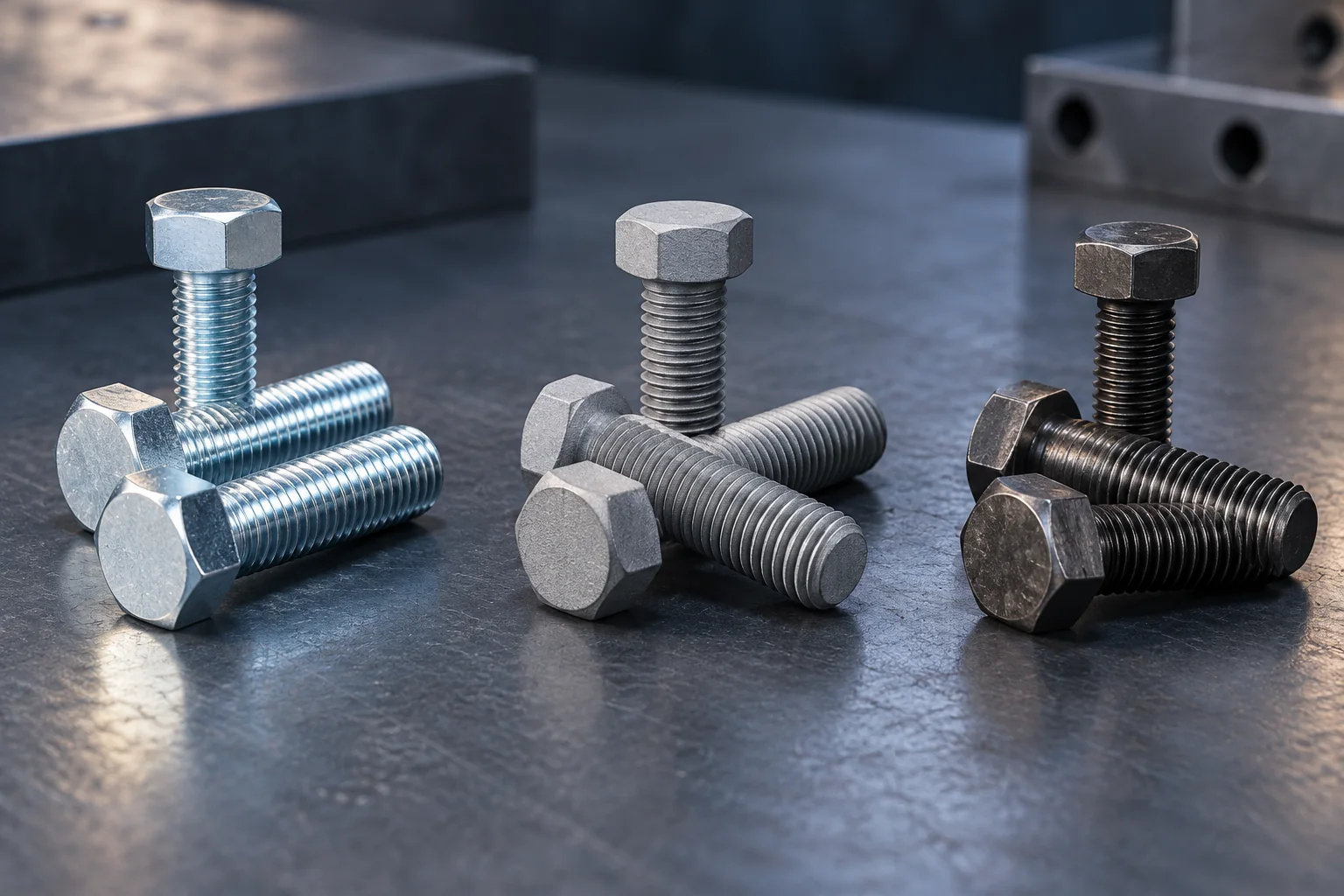
Différences de revêtement : galvanisation, revêtements approuvés et protection contre la corrosion
Coating selection is one of the clearest practical differences between A325 and A490 structural bolts.
Steel structural bolts may require corrosion protection when used outdoors, in industrial atmospheres or in other environments where unprotected steel is unsuitable. However, an acceptable coating must be evaluated as part of the specified bolt assembly. Its chemistry, application process, interaction with the fastener material and effect on installation can all matter.
Why hot-dip galvanizing and zinc-flake coatings must be distinguished
Hot-dip galvanizing and mechanical galvanizing are established zinc-coating processes, but their acceptance is not identical across the two structural bolting groups.
Selon la 2025 RCSC Specification, Group 150 bolting cannot be hot-dip galvanized or mechanically galvanized; specified ASTM F3393 zinc-flake systems are a separate, conditional route.
This distinction prevents two opposite specification errors.
The first error is ordering hot-dip galvanized A490 bolts because galvanized A325 bolts were previously accepted in a similar application. The higher-strength grade does not inherit the lower-strength group’s coating permissions.
The second error is rejecting every zinc-based coating for A490. Certain ASTM F3393 zinc-flake coating systems are permitted within the applicable RCSC requirements. That permission is not a blanket approval for any commercial zinc-flake coating, arbitrary application process or unverified bolt-and-nut combination.
The applicable coating specification, bolting grade, component configuration and qualification requirements must all agree.
Why high-strength bolt coatings receive special scrutiny
High-strength steel fasteners can be susceptible to hydrogen-assisted cracking under unfavorable combinations of material condition, applied stress and hydrogen exposure.
Coating and surface-treatment processes may introduce or influence that risk. Its significance depends on the strength and material characteristics of the fastener and the specific processing route.
This is one reason coating suitability cannot be judged solely by the appearance or nominal corrosion resistance of the finished bolt. A process that produces acceptable corrosion protection does not necessarily satisfy the requirements applicable to a particular high-strength structural bolt grade.
Measures intended to control hydrogen-related risks also do not override explicit prohibitions in the governing structural bolting specification.
There is an additional assembly consequence. Protective coatings can alter thread dimensions and frictional behavior. Galvanized or otherwise coated fasteners may require specific matching nut conditions and lubrication provisions. Combining a coated bolt with an unrelated nut is not equivalent to procuring a compliant structural bolting assembly.
When pretensioning is required, the specified assembly and installation procedure must also be capable of satisfying the applicable verification requirements. Coating qualification, product testing and field installation verification are related but separate responsibilities.
Type 3 weathering steel is another selection route
Type 3 structural bolts use weathering-steel material characteristics rather than relying exclusively on a subsequently applied protective coating.
In suitable atmospheric exposure, weathering steels can develop a protective corrosion-product layer that reduces further atmospheric corrosion compared with conventional unprotected steel. Their effectiveness depends on the environment and the conditions that allow the protective layer to develop.
Persistent wetness, aggressive chloride exposure, contaminated runoff and sheltered moisture-retaining details can change that behavior. A weathering designation alone does not establish acceptable corrosion performance in every outdoor location.
Where Type 3 bolts are specified, matching nuts and washers must also satisfy the applicable assembly requirements. Combining weathering and non-weathering components without checking the specified configuration can create an unintended materials mismatch.
The real decision is between approved protection systems for the actual service environment, not between a supposedly corrosion-proof bolt and one that always needs coating.
In a hypothetical outdoor order, the buyer changes A325 to A490 while retaining the hot-dip-galvanized finish line. The original coating permission cannot be carried across automatically. Hold the revised order, check the permitted coating route and confirm the corresponding nuts, washers and assembly evidence. Compare coating processes without treating a finish name as structural approval.
Quand les ingénieurs doivent-ils spécifier A325 ou A490 ?
A325 is a reasonable selection when the governing structural design permits Group 120 bolting and its available, compliant corrosion-protection options satisfy the project requirements.
A490 becomes relevant when the engineer specifies Group 150 bolting or establishes that the higher-strength product offers a useful advantage for the actual connection design. That decision must still account for coating restrictions, assembly requirements and installation conditions.
The comparison becomes more useful when applied to specific purchasing situations.
A connection already designed and approved for A325
If an approved connection specifies Grade A325, purchasing should follow that designation unless a formal substitution is accepted. A490 should not be treated as an automatic upgrade merely because it has a higher minimum tensile-strength level.
Changing the grade may alter design assumptions, pretension requirements, coating eligibility and matching component selection. Even when the proposed bolt has the same nominal diameter and thread, those differences require review.
A connection where higher-strength bolting is specified
If the structural design specifically requires Grade A490, substituting A325 because it is more readily available or easier to galvanize is not acceptable without an engineering review.
The lower-strength grade may not satisfy the design basis. Where corrosion protection is also required, the coating system must be compatible with the specified higher-strength bolting group rather than selected independently.
An outdoor connection requiring corrosion protection
For an outdoor structural assembly, the designer must establish whether an appropriately galvanized Group 120 assembly, an approved coated Group 150 assembly or a suitable weathering-steel configuration fulfills the combined structural and exposure requirements.
The environmental requirement cannot be separated from the mechanical requirement. A coating acceptable on one grade is not necessarily transferable to the other, while a weathering material may be unsuitable for particular wet or chloride-rich conditions.
Hypothetical selection example: a proposed bolt upgrade
Consider a hypothetical outdoor steel connection whose approved documents specify ASTM F3125 Grade A325 Type 1 bolts with a compliant hot-dip galvanized assembly.
A purchaser proposes replacing the specified bolts with Grade A490 of the same nominal diameter, also hot-dip galvanized, on the assumption that stronger bolts provide a greater safety margin.
That substitution has two separate problems.
First, the stronger bolt does not automatically increase the approved connection resistance. The design would need to be checked against the relevant limit states and installation assumptions.
Second, the proposed hot-dip galvanized Group 150 configuration conflicts with the 2025 RCSC coating restriction. Matching the original bolt diameter cannot resolve a coating prohibition.
The appropriate response is to retain the specified compliant A325 assembly unless the engineer approves a different design and matching bolting configuration. If A490 is genuinely required, the protection system must be selected from the options permitted by the governing project requirements, with any applicable ASTM F3393 qualification independently confirmed.
This is an illustrative engineering scenario, not a SUNHY customer project, test result or approval of a particular product.
Comment spécifier et vérifier les assemblages de boulons A325/A490
A structural bolt order should identify more than the grade printed on the drawing.
The buyer needs sufficient information to distinguish the specified bolt product from visually similar fasteners, confirm the correct corrosion-protection system and ensure that the matching components meet the project requirements.
A practical purchasing specification should establish the following:
- Product identity: ASTM F3125/F3125M, the governing edition, Grade A325 or A490, applicable Type, product style, nominal diameter, length and thread configuration.
- Coating and exposure: Required surface protection, the exact coating specification, its eligibility for the selected grade and the relevant corrosion environment.
- Matching components: Applicable nut and washer product specifications, their grades or types, coating compatibility and any specified lubrication or assembly conditions.
- Joint requirements: The approved structural design basis, whether pretensioning is required, applicable installation method and any project-specific inspection requirements.
- Acceptance documents: Manufacturer identification, product and lot traceability, required material or mechanical test records, coating documentation and any additional project inspection evidence.
ASTM A563 nuts and ASTM F436 washers are commonly referenced in structural bolting assemblies, but their acceptable grades, types and coating combinations depend on the applicable specifications. A purchaser should not select a nut solely by nominal thread size or assume that any hardened washer satisfies every structural connection requirement.
The same principle applies to testing and documentation. A manufacturer may provide test records showing that a production lot was evaluated against specified product requirements. Those records do not by themselves demonstrate that a field-installed joint achieved the required pretension or that its installation inspection was completed correctly.
Product qualification and joint acceptance therefore require different evidence.
Bolt head markings can help identify the declared grade and manufacturer, but visual markings alone do not establish material chemistry, tensile-test compliance, coating qualification or full lot traceability. Receiving inspection should reconcile the actual components with the purchase order, applicable standard and supplied documentation.
For pretensioned assemblies, preinstallation verification and installation inspection must follow the governing requirements. A generic torque chart is not an adequate substitute for those procedures, since the torque needed to develop a particular clamp load can vary with the fastener assembly and its frictional condition.
There is also a difference between a supplier offering a nominally matching bolt and supplying a documented assembly acceptable for the specified structural work. If the requested grade, coating or matching components cannot be supported by appropriate records, the discrepancy should be resolved before substitution or installation.
The final choice should preserve the engineer’s approved connection requirements. Material strength determines only part of what a structural bolt can do; coating eligibility, matched components and verified installation requirements determine whether that bolt can be used as specified.
Questions fréquemment posées
Le A490 est-il toujours la meilleure vis de structure ?
Non. La nuance correcte dépend de la conception de l'assemblage approuvée ainsi que des exigences d'installation et de protection contre la corrosion. Un groupe de résistance à la traction plus élevé n'améliore pas automatiquement chaque assemblage.
Les boulons A490 peuvent-ils être galvanisés à chaud selon la RCSC 2025 ?
Non. La spécification citée interdit cette voie pour les boulons du Groupe 150. D'autres voies de revêtement admissibles ont des conditions distinctes et doivent être vérifiées.
Puis-je réutiliser la spécification d'écrou A325 après être passé à l'A490 ?
Vérifiez à nouveau. Les grades d'écrous autorisés dépendent du groupe, du type et de l'état de revêtement du boulon ; un diamètre nominal de filetage correspondant ne suffit pas.