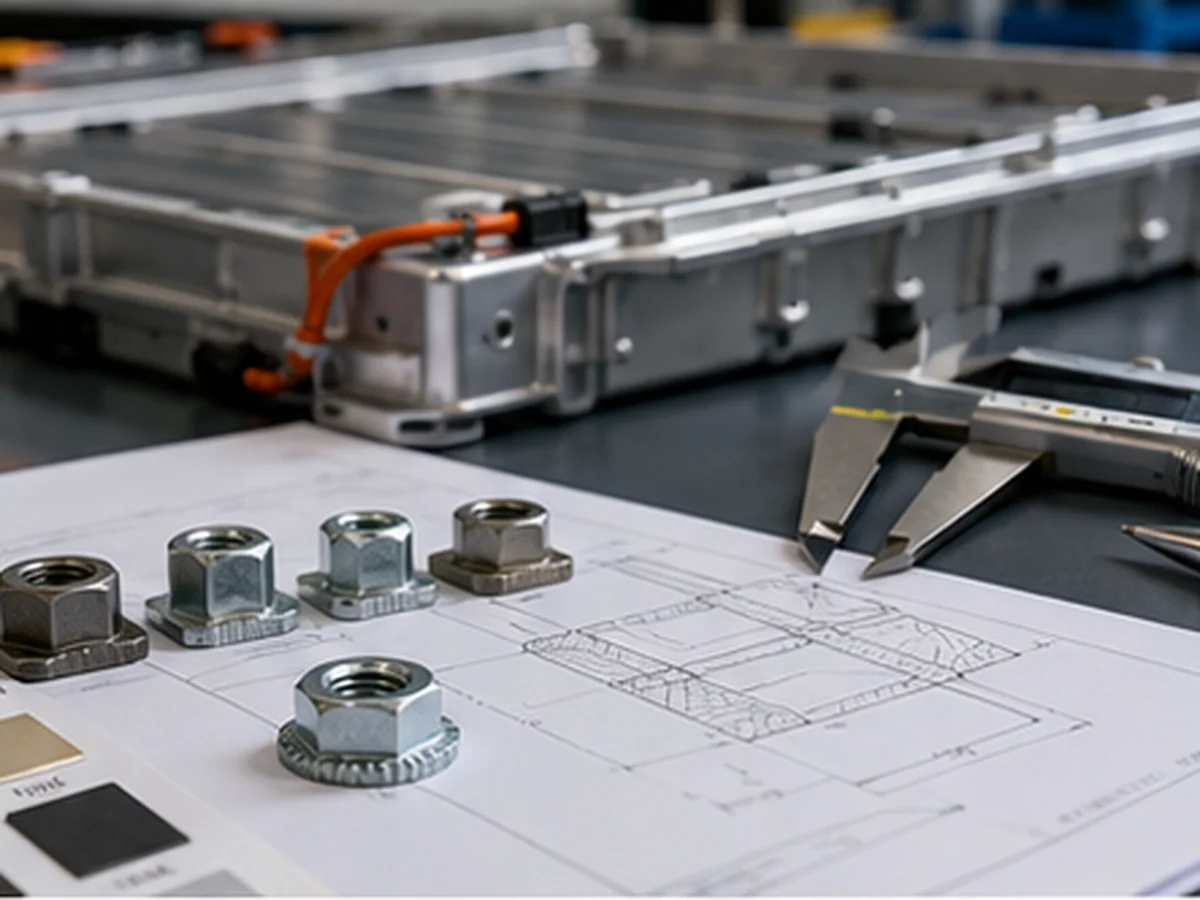
Ingeniería de sujetadores para paquetes de baterías de vehículos eléctricos
Tuercas especiales para paquetes de baterías de vehículos eléctricos: consideraciones sobre recubrimiento, aislamiento eléctrico y trazabilidad
Las tuercas especiales para paquetes de baterías de vehículos eléctricos no deben seleccionarse únicamente por el tamaño de rosca. Una rosca M6, M8 o M10 puede coincidir con el perno de acoplamiento, pero no garantiza la idoneidad del recubrimiento, el ajuste de la rosca después del galvanizado, el comportamiento de par, la resistencia al arrancamiento, la resistencia al desprendimiento por torsión, el aislamiento eléctrico, el rendimiento frente a la corrosión ni la preparación para la trazabilidad.
Antes de la cotización, los compradores deben confirmar la ubicación de la unión, la función de la tuerca, el apilamiento de la unión, el material, el recubrimiento, la secuencia de recubrimiento, el requisito de par o precarga, el requisito de aislamiento (si lo hay), el alcance de la trazabilidad y los documentos de aprobación del cliente.
Las tuercas especiales para paquetes de baterías de vehículos eléctricos deben revisarse según la ubicación de la unión, el recubrimiento, el ajuste de la rosca, el límite de aislamiento eléctrico, la trazabilidad y los requisitos de aprobación del cliente.
Imagen de ingeniería conceptual únicamente; la selección final depende del dibujo, el apilamiento de la unión, la especificación del recubrimiento, el método de inspección y la norma del cliente.
Respuesta rápida: ¿Qué deben confirmar los compradores para las tuercas especiales de paquetes de baterías de vehículos eléctricos?
Las tuercas especiales para paquetes de baterías de vehículos eléctricos deben revisarse como parte del conjunto completo, no como un componente de rosca aislado. Para bandejas de baterías, carcasas de baterías, placas de cubierta, soportes de módulos y estructuras de soporte de chapa metálica, los compradores deben confirmar la ubicación de la unión, la función de la tuerca, las piezas de acoplamiento, el material, el recubrimiento, el proceso de ensamblaje, el método de inspección y la norma del cliente.
Si se requiere aislamiento eléctrico, debe tratarse como un requisito de pila de unión completa, no como una característica solo de la tuerca. La tuerca, el perno, la arandela, el casquillo, el recubrimiento, el material del panel, la condición de compresión, el par de apriete y el método de prueba pueden afectar el resultado.
Preocupación por el paquete de baterías de vehículos eléctricos
Por qué es importante
El comprador debe confirmar
Revestimiento
Afecta la protección contra la corrosión, el ajuste de la rosca, el comportamiento del par y el riesgo de instalación
Tipo de recubrimiento, espesor si se especifica, secuencia de recubrimiento e inspección de rosca posterior al recubrimiento
Aislamiento eléctrico
No se puede asumir solo por el recubrimiento
Conjunto completo de la junta, requisito de aislamiento, método de prueba y norma del cliente
Trazabilidad
Apoya el control de calidad y la contención en la industria automotriz
Número de lote, certificado de material, informe de recubrimiento, registro de inspección y etiqueta de embalaje
Resistencia
Controla la fiabilidad del montaje
Requisito de par, precarga, par de salida, extracción, empuje y aflojamiento si se especifica
Ruta de fabricación
Afecta la consistencia, el costo, el plazo de entrega y la aprobación
Ruta de conformado en frío, mecanizado, roscado, formación de rosca, soldadura, engrapado, tratamiento térmico y recubrimiento
Documentos de aprobación
Requerido para programas automotrices cuando se especifique
PPAP, IMDS, informe dimensional, certificado de material, informe de recubrimiento y plan de control si es necesario
Lo que se debe saber antes de que un proveedor pueda confirmar el ajuste
Un proveedor solo puede hacer una recomendación responsable cuando se conocen la revisión del dibujo, la ubicación de la aplicación, el espesor de la junta, el requisito de rosca, el material, la dureza, el recubrimiento, la ruta de instalación, la condición de par, el método de inspección y el alcance de la aprobación del cliente. Los datos faltantes de recubrimiento, aislamiento, par de salida, extracción o trazabilidad deben tratarse como necesita confirmación, no asumido de la frase “tuerca de paquete de batería EV”.”
Por qué las tuercas de los paquetes de baterías EV necesitan más que una coincidencia de rosca estándar
Los ensamblajes de paquetes de baterías EV a menudo combinan chapa metálica, piezas fundidas, cubiertas, soportes, bandejas, piezas de aislamiento, sellos y componentes recubiertos. Una tuerca utilizada en este entorno puede necesitar soportar fijación mecánica, protección contra la corrosión, resistencia a las vibraciones, par de apriete controlado, capacidad de servicio y trazabilidad de calidad.
El ajuste de la rosca es solo una parte de esta decisión. Una tuerca con la rosca correcta puede seguir siendo inadecuada si el recubrimiento cambia la tolerancia de la rosca, si la unión requiere aislamiento eléctrico, si el proceso de ensamblaje daña el recubrimiento, si la tuerca no puede resistir el torque de extracción, o si el proyecto requiere documentos de trazabilidad que el proveedor no puede proporcionar.
El ajuste de la rosca es solo un requisito
El tamaño, paso y tolerancia de la rosca deben confirmarse con el perno de acoplamiento y el dibujo. Sin embargo, el ajuste de la rosca no demuestra la resistencia al arranque, la resistencia al torque de extracción, el rendimiento contra la corrosión, el comportamiento eléctrico o la aprobación de producción. La condición de la rosca después del recubrimiento debe verificarse con el calibre de rosca o método de inspección requerido, especialmente cuando el espesor del recubrimiento o la acumulación del recubrimiento pueden afectar el ajuste.
Las uniones del paquete de baterías pueden tener requisitos eléctricos, de corrosión y de trazabilidad
En un paquete de baterías EV, algunas uniones atornilladas pueden estar cerca de áreas sensibles eléctricas, térmicas o críticas para la corrosión. La tuerca puede no ser el único componente que controla el requisito. Los compradores deben revisar el conjunto completo de la unión, incluido el perno de acoplamiento, la arandela, el manguito aislante, el casquillo, el panel, el recubrimiento, el adhesivo, el sello o el tratamiento superficial si está presente.
Tipos comunes de tuercas utilizadas en ensamblajes de paquetes de baterías EV
Los ensamblajes de paquetes de baterías EV pueden utilizar diferentes tuercas especiales personalizadas según la ubicación de la junta, el espesor de la chapa, el acceso, la autorización de soldadura, la dirección de la carga y la secuencia de ensamblaje. El tipo de tuerca debe seguir el diseño de la junta validado y el plano, no solo una descripción general del paquete de baterías.
Diferentes ubicaciones del paquete de baterías EV pueden requerir tuercas de soldadura, tuercas autoperforantes o tuercas especiales personalizadas según la condición de la chapa, el acceso, el recubrimiento y la dirección de la carga.
Los ejemplos de tipos de tuercas no reemplazan la revisión del plano ni la validación del ensamblaje.
Tuercas de soldadura para soldadura de bandeja de batería o soporte
Tuercas de soldadura para brida, tuercas de soldadura hexagonales u otros diseños de tuercas de soldadura pueden revisarse cuando la bandeja de batería, el soporte o la estructura de chapa metálica están diseñados para soldadura. El comprador debe confirmar el acceso de soldadura, el diseño de la proyección, la soldabilidad de la chapa, la condición del recubrimiento, el método de inspección de soldadura y la protección de la rosca.
Tuercas autoperforantes para carcasas de chapa metálica
Tuercas autoperforantes pueden revisarse para carcasas de chapa metálica, placas de cubierta o soportes cuando se dispone de acceso a prensa y no se prefiere la soldadura. Dependen del espesor de la chapa, la dureza de la chapa, el diámetro del agujero, la tolerancia del agujero y la instalación controlada.
Tipo de tuerca vs Ubicación del paquete de baterías
Ubicación del paquete de baterías
Tipo de tuerca frecuentemente revisada
Riesgo principal a confirmar
Datos necesarios para RFQ
Bandeja de batería o soporte soldado
Tuerca de soldadura o tuerca de proyección personalizada
Calidad de soldadura, secuencia de recubrimiento, protección de rosca y par de torsión
Acceso de soldadura, material de chapa, requisito de proyección, ruta de recubrimiento y método de inspección
Carcasa o cubierta de chapa metálica
Tuerca de auto-clinchado o tuerca personalizada de presión
Deformación de chapa, mal clinchado, daño en recubrimiento y extracción
Espesor de chapa, dureza, tolerancia de agujero, dirección de instalación y dirección de carga
Soporte o pieza de montaje para módulo
Tuerca personalizada, tuerca de brida o tuerca de soldadura según plano
Limitación de espacio, carga de sujeción, vibración y trazabilidad
Plano, función de unión, perno de acoplamiento, requisito de par y alcance del documento
Junta adyacente a aislamiento
El tipo de tuerca depende del apilamiento completo de la junta
Suposición falsa de que el recubrimiento equivale a aislamiento eléctrico
Apilamiento de junta, componentes aislantes, condición de torque, método de prueba y norma del cliente
Tuercas personalizadas cuando el espacio, el recubrimiento o la trazabilidad están controlados por plano
Pueden ser necesarias tuercas personalizadas cuando la junta del paquete de baterías tiene espacio limitado, profundidad de rosca especial, geometría de brida especial, recubrimiento controlado, características antigiro, interfaz de sellado, marcado de trazabilidad, requisitos de embalaje o documentos de aprobación específicos del cliente. En estos casos, un tuercas especiales fabricadas según plano enfoque suele ser más seguro que seleccionar una tuerca estándar por apariencia.
Consideraciones sobre recubrimientos: protección contra corrosión, ajuste de rosca y riesgo de montaje
El recubrimiento es una de las consideraciones más importantes para las tuercas de paquetes de baterías de vehículos eléctricos, ya que puede afectar la protección contra la corrosión, el ajuste de la rosca, el comportamiento de instalación, la respuesta de torque y la inspección. Los compradores deben definir el requisito de recubrimiento a partir del plano, la norma del cliente o la especificación del proyecto.
Ejemplos comunes de recubrimiento o tratamiento superficial pueden incluir galvanizado, zinc-níquel, fosfatado, óxido negro, pasivación u otros acabados especificados por el cliente. La elección correcta depende del material, el requisito de corrosión, el proceso de ensamblaje, la exposición ambiental, las piezas de acoplamiento y la aprobación del cliente. No existe un “mejor recubrimiento” universal para todas las tuercas de paquetes de baterías de vehículos eléctricos.
El recubrimiento puede afectar la protección contra la corrosión, el ajuste de la rosca, el comportamiento de torque y el riesgo de instalación, por lo que se debe confirmar la inspección de la rosca después del recubrimiento cuando sea requerido.
La imagen no implica ningún espesor de recubrimiento, valor de niebla salina o resultado de aprobación.
El tipo de recubrimiento debe seguir el plano o la norma del cliente
El tipo de recubrimiento debe especificarse claramente en la solicitud de cotización. Los compradores deben confirmar si el recubrimiento es necesario para protección contra la corrosión, apariencia, control de fricción, comportamiento de ensamblaje o compatibilidad con materiales cercanos. Si se requiere rendimiento de niebla salina, espesor de recubrimiento o coeficiente de fricción, el valor y el método de prueba deben provenir del plano o de la norma del cliente.
El ajuste de la rosca después del recubrimiento necesita inspección
El recubrimiento puede cambiar el ajuste de la rosca. Si el recubrimiento o tratamiento superficial se acumula en la rosca, el perno de acoplamiento puede sentirse apretado, cruzarse, agarrotarse, atascarse o fallar la inspección. Se debe definir la tolerancia de la rosca después del recubrimiento y la inspección con calibre de rosca cuando el plano o la norma del cliente lo requieran.
La secuencia de recubrimiento puede cambiar el riesgo
La secuencia de recubrimiento e instalación puede cambiar el perfil de riesgo. Una tuerca puede recubrirse antes de la instalación, recubrirse después del conformado, soldarse antes del recubrimiento, soldarse después del recubrimiento o ensamblarse en un panel recubierto. Cada ruta puede afectar la protección contra la corrosión, la soldabilidad, el marcado superficial, el estado de la rosca o el comportamiento eléctrico.
Problema relacionado con el recubrimiento
Riesgo posible
El comprador debe confirmar
Espesor de recubrimiento
Interferencia de rosca o cambio de ajuste
Tolerancia de rosca posterior al recubrimiento y método de calibre
Daño del recubrimiento durante la soldadura
Riesgo de corrosión o calidad de la soldadura
Secuencia de soldadura y protección post-soldadura
Daño del recubrimiento durante el prensado
Riesgo de marcado superficial o corrosión local
Método de instalación y área de inspección
Requisito de corrosión
Selección incorrecta del recubrimiento
Norma del cliente, método de ensayo y criterios de aceptación
Comportamiento de fricción
Variación de par
Perno de acoplamiento, arandela, lubricación y método de apriete
Comportamiento eléctrico
Suposición de aislamiento falsa
Método de prueba de junta completa y eléctrica
Si faltan datos de recubrimiento: el proveedor no debe inferir el rendimiento en niebla salina, espesor de recubrimiento, comportamiento de fricción, tolerancia de rosca después del recubrimiento ni comportamiento eléctrico. Estos deben provenir del plano, la especificación de recubrimiento, la norma del cliente o un método de prueba aprobado.
Aislamiento eléctrico: por qué una tuerca recubierta no es automáticamente una junta aislada
Una tuerca recubierta no debe describirse como una tuerca eléctricamente aislada a menos que el diseño completo de la junta, el método de prueba y el requisito del cliente respalden dicha afirmación. El aislamiento eléctrico es un requisito a nivel de junta. No se demuestra solo con el recubrimiento de la tuerca.
El comportamiento eléctrico final puede depender de la tuerca, el perno, la arandela, el casquillo, el recubrimiento, el daño del recubrimiento, el panel de acoplamiento, la capa aislante, la fuerza de compresión, el par de apriete, la humedad, la contaminación, la temperatura, la vibración y la condición de servicio. Si alguno de estos elementos se desconoce, la respuesta correcta es necesita confirmación.
El aislamiento eléctrico debe evaluarse a nivel del conjunto completo de la junta, no solo basándose en una tuerca recubierta.
Esta imagen no representa un resultado de prueba de aislamiento; los valores de aislamiento y los métodos de prueba deben provenir de los requisitos del cliente.
El aislamiento depende del conjunto completo de la junta
Una junta de paquete de baterías puede incluir componentes metálicos y no metálicos. Incluso si una tuerca tiene recubrimiento, el perno puede cortar el recubrimiento, la arandela puede crear contacto metálico, el recubrimiento puede dañarse durante la instalación o la compresión puede cambiar la trayectoria eléctrica. Por lo tanto, el aislamiento eléctrico debe especificarse y probarse a nivel del conjunto.
Tabla de límites de aislamiento eléctrico
Declaración del comprador
Respuesta segura de ingeniería
Datos requeridos antes de la confirmación
“Necesitamos tuercas recubiertas para paquetes de baterías.”
Revise el recubrimiento, la corrosión, el ajuste de la rosca y la ruta de montaje; no asuma aislamiento.
Tipo de recubrimiento, piezas de acoplamiento, ubicación de aplicación y requisito de inspección
“La tuerca debe estar aislada eléctricamente.”
Trate el aislamiento como un requisito completo de la junta.
Conjunto de la junta, piezas aislantes, método de prueba, condición de par y criterios de aceptación
“¿Puede el recubrimiento de zinc-níquel proporcionar aislamiento?”
No confirme sin validación a nivel de junta.
Especificación del cliente, sistema de recubrimiento, superficies de contacto y método de prueba eléctrica
“El dibujo solo muestra el tamaño de la rosca.”
Solicitar datos de aplicación y rendimiento faltantes antes de la cotización.
Revisión del dibujo, función de la junta, recubrimiento, carga, par y alcance del documento
Lo que los compradores deben especificar si se requiere aislamiento eléctrico
Ubicación del ensamblaje y última revisión del dibujo.
Conjunto completo de la junta, incluyendo arandela, buje, manguito o capa aislante si se utiliza.
Material de la tuerca, perno, panel y pieza de acoplamiento.
Requisito de capa de recubrimiento o aislamiento.
Condición de par, compresión o precarga.
Requisito de resistencia de aislamiento si lo especifica el cliente.
Método de prueba, tensión de prueba y criterios de aceptación si se especifican.
Especificación interna o norma del cliente.
Requiere confirmación: Sin el conjunto de la junta, el método de prueba eléctrica y el requisito del cliente, un proveedor puede revisar la fabricabilidad y la viabilidad del recubrimiento, pero no debe garantizar el rendimiento de aislamiento eléctrico.
Requisitos de trazabilidad para tuercas especiales de paquete de baterías EV
La trazabilidad es importante en proyectos automotrices y de paquetes de baterías para vehículos eléctricos porque un problema con un sujetador puede afectar la contención, el retrabajo, la investigación de campo o la auditoría del cliente. La trazabilidad no demuestra que la tuerca sea adecuada para la aplicación, pero ayuda a identificar el historial de material, producción, recubrimiento, inspección y entrega cuando ocurre un problema de calidad.
La trazabilidad puede incluir lote de material, lote de producción, lote de recubrimiento, registros de inspección, etiquetas de embalaje y documentos de aprobación cuando sea requerido.
Los documentos visuales son genéricos y no representan la certificación real ni la aprobación del cliente.
¿Qué Debe Ser Trazable?
Los requisitos de trazabilidad pueden incluir lote de materia prima, número de colada, lote de producción, lote de tratamiento térmico, lote de recubrimiento, registro de inspección, etiqueta de embalaje y lote de envío. El alcance exacto depende del estándar del cliente, dibujo, RFQ y acuerdo de calidad.
¿Qué Documentos Pueden Ser Requeridos?
Los documentos comunes pueden incluir un certificado de material, informe de recubrimiento, informe de inspección dimensional, registro de inspección de rosca, informe de dureza si se especifica, informe de torque de extracción o prueba de extracción si se especifica, certificado de conformidad, registro de etiqueta de embalaje, documentos PPAP o envío IMDS si lo requiere el cliente o el programa.
Aislamiento eléctrico a menos que se pruebe y especifique
Informe dimensional
Control de dimensiones según plano
Resistencia al par de torsión o extracción a menos que se pruebe
Inspección de rosca
Verificación de ajuste de rosca
Durabilidad del recubrimiento o rendimiento anticorrosión
Etiqueta de lote
Identificación de lote
Aprobación de aplicación
Paquete PPAP
Documentación de aprobación automotriz cuando sea requerida
Idoneidad universal para todas las uniones de paquetes de baterías
La trazabilidad no equivale a la aprobación de aplicación
La trazabilidad ayuda a identificar qué material, recubrimiento, lote de producción y registro de inspección están vinculados a un envío. No demuestra que la tuerca esté aislada eléctricamente, calificada contra la corrosión, estable en el par de apriete o aprobada para cada unión del paquete de baterías. La aprobación de la aplicación aún depende del plano, la norma del cliente y el plan de validación.
Verificaciones de resistencia y montaje: par de torsión de extracción, resistencia a la extracción, carga de rosca y riesgo de aflojamiento
Las tuercas para paquetes de baterías de vehículos eléctricos pueden necesitar soportar el par de montaje, la carga de sujeción, las cargas de servicio, la vibración y la exposición a la corrosión. Los compradores deben definir qué rendimiento mecánico es relevante para la unión.
El par de apriete, la precarga, el par de giro y la resistencia al arrancamiento son diferentes. Un valor de par de apriete no demuestra automáticamente que la tuerca pueda resistir la rotación en chapa metálica. Un tamaño de rosca no demuestra automáticamente que la tuerca pueda resistir el arrancamiento. Un requisito de recubrimiento no demuestra automáticamente la estabilidad del par.
El par y la precarga no son lo mismo que el par de giro
El par de apriete se utiliza durante el montaje para crear la carga de sujeción, pero el par de giro mide si la tuerca resiste la rotación respecto a la chapa o el soporte. Una tuerca autoperforante puede necesitar validación de par de giro si se instala en chapa fina. Una tuerca soldada puede necesitar validación de par de giro si la calidad de la soldadura o la alineación son críticas.
La resistencia al arrancamiento y al empuje dependen de la dirección de la carga
La resistencia al arrancamiento y al empuje deben revisarse según la dirección de la carga. En ensamblajes de chapa metálica, la tuerca puede cargarse desde diferentes direcciones durante la instalación, el servicio, la deformación por impacto, el mantenimiento o la vibración. La dirección de ensayo requerida y el valor de aceptación deben provenir del plano o de la norma del cliente.
El riesgo de aflojamiento requiere revisión a nivel de unión
Si la unión es propensa a vibraciones o crítica para el servicio, el riesgo de aflojamiento debe revisarse con el conjunto completo. El tipo de tuerca, el perno de acoplamiento, la arandela, el recubrimiento superficial, la longitud de sujeción, el método de apriete, la retención de precarga y el entorno de servicio afectan el comportamiento de aflojamiento. Cuando se requiere una función de par resistente, los compradores pueden necesitar comparar diseños de tuercas como tuercas autoblocantes totalmente metálicas solo después de confirmar la unión y el requisito del plano.
Comprobación del montaje
Por qué es importante
Datos necesarios
Tamaño y paso de rosca
Compatibilidad del perno de acoplamiento
Designación de rosca, tolerancia y acoplamiento
Par de apriete
Control del proceso de montaje
Método de par, lubricación y piezas de acoplamiento
Precarga
Retención de la junta
Perno, arandela, condición superficial y relación par-tensión
Torque-out
Resistencia a la rotación de la tuerca
Tipo de tuerca, condición de la chapa, calidad de soldadura o engrapado y método de ensayo
Extracción / empuje
Resistencia a la carga axial o inversa
Dirección de la carga, espesor de la chapa y criterios de aceptación
Riesgo de aflojamiento
Estabilidad ante vibraciones o servicio
Apilamiento de la junta, longitud de sujeción, recubrimiento, arandela y condición de servicio
No utilice un solo ensayo como prueba de todo el rendimiento. La inspección con calibre de rosca no garantiza la resistencia al par de torsión. La resistencia al par de torsión no garantiza la resistencia a la extracción. La trazabilidad no garantiza la durabilidad del recubrimiento. El aislamiento eléctrico requiere una prueba definida a nivel de unión cuando se especifique.
Ruta de fabricación: tuercas soldadas, clinchadas, conformadas en frío o mecanizadas
La ruta de fabricación de la tuerca y la ruta de instalación en el ensamblaje del paquete de baterías deben estar separadas. Una tuerca puede ser conformada en frío, mecanizada, roscada, con formación de rosca, tratada térmicamente, recubierta e inspeccionada antes de su instalación. La instalación puede implicar soldadura, clinchado, atornillado u otro proceso de ensamblaje.
Ruta de fabricación de tuercas
La ruta de fabricación de la tuerca depende de la geometría, el material, el volumen anual, la tolerancia, el requisito de rosca y la complejidad del dibujo. El conformado en frío puede ser adecuado para piezas de mayor volumen con geometría estable. El mecanizado puede considerarse para prototipos, características complejas, volúmenes más bajos o detalles personalizados más ajustados. El roscado, la formación de rosca, el tratamiento térmico, el recubrimiento y la clasificación dependen del dibujo y del requisito de calidad.
Ruta de instalación en el ensamblaje del paquete de baterías
La ruta de instalación afecta la unión final. Una tuerca de soldadura depende del acceso de soldadura, los parámetros de soldadura, el diseño de la proyección y la inspección de soldadura. Una tuerca de auto-clinchado depende de la tolerancia del agujero, el espesor de la chapa, la dureza de la chapa y la configuración de la prensa. Una tuerca personalizada puede requerir embalaje especial, orientación, utillaje de ensamblaje o protección de la rosca.
Tabla de ruta de fabricación e instalación
Artículo de ruta
Qué controla
El comprador debe confirmar
Conformado en frío / encabezado en frío
Geometría del cuerpo de la tuerca y flujo de material adecuados para alto volumen
Volumen anual, material, estabilidad geométrica y viabilidad de utillaje
Mecanizado CNC
Características complejas, prototipos, menor volumen o detalles personalizados más ajustados
Tolerancia, geometría, objetivo de costo, cronograma de muestras y revisión de planos
Roscado / conformado de rosca
Función y ajuste de la rosca interna
Tamaño de rosca, paso, tolerancia, método de calibración y tolerancia post-recubrimiento
Tratamiento térmico
Resistencia, dureza y comportamiento de la rosca cuando se especifica
Grado de material, rango de dureza y estándar del cliente
Revestimiento / baño
Protección anticorrosión, apariencia, ajuste de rosca y comportamiento de ensamblaje
Tipo de recubrimiento, secuencia, espesor si se especifica y método de inspección
Soldadura o engrapado en el ensamblaje
Retención final de la junta instalada y riesgo del proceso
Acceso de soldadura, acceso de prensa, datos de chapa, fijación y responsabilidad de validación
Datos de ruta de proceso necesarios antes de la solicitud de cotización
Antes de la cotización, el comprador debe aclarar si la tuerca se suministra suelta, preinstalada en un panel, soldada por el comprador, soldada por un proveedor, prensada en una chapa o ensamblada más tarde en la línea de paquetes de baterías. Esto afecta la responsabilidad de inspección, embalaje, trazabilidad y alcance de aprobación.
Documentos de inspección y calidad que los compradores deben confirmar
La inspección debe seguir el dibujo, el estándar del cliente y el modo de fallo. Para las tuercas especiales de paquetes de baterías de vehículos eléctricos, el plan de inspección puede incluir controles dimensionales, inspección de calibre de rosca, inspección de recubrimiento, pruebas de dureza, pruebas de par de torsión, pruebas de extracción, verificación de etiqueta de trazabilidad y revisión de documentos.
Elementos de inspección
Los compradores deben confirmar qué elementos de inspección son necesarios para la tuerca en sí y cuáles son necesarios para la unión instalada. Un proveedor de tuercas puede inspeccionar las dimensiones de la tuerca suelta, la rosca y el recubrimiento. El rendimiento de la unión instalada puede requerir pruebas a nivel de ensamblaje por parte del comprador o del propietario del proceso aprobado.
Ejemplos de documentos
Informe de inspección dimensional.
Certificado de material.
Informe de recubrimiento.
Registro de inspección de rosca.
Informe de dureza si se especifica.
Informe de par de torsión si se especifica.
Informe de extracción o empuje si se especifica.
Certificado de conformidad.
Registro de trazabilidad de lote.
Registro de embalaje y etiquetado.
Paquete PPAP si se requiere.
Presentación IMDS si se requiere.
Los compradores también pueden revisar SUNHYINGS guías técnicas para temas relacionados con la ingeniería de fijaciones.
Requisito
Inspección de tuerca suelta
Validación de junta instalada
Se necesita información del comprador
Ajuste de rosca
Sí
A veces
Tamaño de rosca, paso, tolerancia y requisito de calibre
Revestimiento
Sí
A veces
Tipo de recubrimiento, espesor si se especifica y requisito de prueba de corrosión
Torque-out
Condicional
A menudo requerido para junta instalada
Método de prueba y valor de aceptación
Extracción / empuje
Condicional
A menudo requerido para junta de chapa metálica
Dirección de carga y valor de aceptación
Aislamiento eléctrico
No, no solo con la tuerca
Sí, prueba a nivel de junta
Apilamiento de junta, método de prueba y norma del cliente
Trazabilidad
Sí
Sí si es necesario
Alcance del lote y del documento
PPAP / IMDS
Condicional
Condicional
Requisito del cliente o del programa
Escenario de ingeniería compuesta: tuerca recubierta cerca de una junta de carcasa de batería de vehículo eléctrico
Escenario de ingeniería compuesta solo para capacitación: Un comprador solicita una tuerca especial recubierta para la tapa de la carcasa de una batería de vehículo eléctrico. El dibujo muestra el tamaño de rosca y la geometría general de la tuerca, pero la solicitud de cotización no define si el recubrimiento es para protección contra la corrosión, control de fricción, aislamiento eléctrico o apariencia. El comprador también menciona que la junta puede estar cerca de componentes aislados, pero no proporciona el apilamiento completo de la junta.
En esta situación, el proveedor no debe afirmar que la tuerca recubierta proporciona aislamiento eléctrico. La respuesta correcta es solicitar el apilamiento de la junta, el requisito de recubrimiento, el método de prueba, la condición de torque, el perno de acoplamiento, los detalles de la arandela o buje, y la norma del cliente. El proveedor puede revisar si la tuerca puede fabricarse con el recubrimiento y la tolerancia de rosca solicitados, pero el comportamiento de aislamiento debe validarse a nivel de la junta.
Este escenario no representa un caso específico de cliente, programa de vehículo o resultado de prueba aprobado. Se incluye para mostrar cómo deben manejarse los límites de la RFQ antes de la cotización o la aprobación de la muestra.
Lista de verificación de RFQ para tuercas especiales de paquete de baterías EV
Un RFQ sólido reduce la comunicación de ida y vuelta y evita suposiciones inseguras. Si el comprador solo envía un tamaño de rosca y dice “tuerca para paquete de baterías”, el proveedor no puede confirmar con precisión el recubrimiento, el aislamiento eléctrico, la trazabilidad o el rendimiento instalado.
Un RFQ completo debe incluir la revisión del dibujo, el apilamiento de la junta, el requisito de rosca, el recubrimiento, el requisito de aislamiento si lo hay, el alcance de la trazabilidad, el volumen anual y los documentos de aprobación.
La imagen de la lista de verificación es solo para la preparación del RFQ y no reemplaza la revisión del dibujo ni la validación del cliente.
Datos mínimos de RFQ
Revisión del dibujo.
Foto de muestra si el dibujo está incompleto.
Ubicación del paquete de baterías EV.
Tipo de junta y apilamiento de la junta.
Material de acoplamiento o material de chapa.
Tamaño de rosca, paso y tolerancia.
Geometría de la tuerca o solicitud de selección abierta.
Requisito de material.
Requisito de dureza o tratamiento térmico si se especifica.
Tipo de recubrimiento y secuencia de recubrimiento.
Requisito de rosca posterior al recubrimiento.
Requisito de par de apriete o precarga.
Requisito de par de torsión, extracción o empuje si se especifica.
Preocupación por aflojamiento o vibración si se especifica.
Método de inspección y criterios de aceptación.
Requisito de trazabilidad.
Volumen anual.
Plan de aprobación de muestras.
Requisitos de embalaje y etiquetado.
Requisito de PPAP o IMDS si aplica.
Datos adicionales si se requiere aislamiento eléctrico
Si se requiere aislamiento eléctrico, los compradores deben agregar el conjunto completo de la junta, componentes aislantes, tratamientos superficiales, condición de compresión o par, tensión de prueba o método si se especifica, condición ambiental si se especifica y criterios de aceptación.
Datos adicionales si se requiere trazabilidad
Si se requiere trazabilidad, los compradores deben indicar el nivel de trazabilidad requerido, formato de etiqueta, método de control de lote, requisito de certificado de material, requisito de informe de recubrimiento, requisito de registro de inspección, requisito de etiqueta de embalaje y requisito de retención de documentos.
Campo de RFQ
Requerido / Condicional
Por qué cambia la cotización
Revisión del plano
Requerido
Define geometría, rosca, tolerancia y base de aprobación
Conjunto de junta
Requerido cuando existe aislamiento o función especial
Controla la revisión de riesgos eléctricos, mecánicos y de montaje
Revestimiento y secuencia
Requerido
Afecta la corrosión, el ajuste de la rosca, la soldadura, el engrapado y el comportamiento del par
Par / precarga / par de extracción / resistencia a la extracción
Condicional
Define si se requiere una prueba adicional o una revisión de diseño
Alcance de la trazabilidad
Condicional
Afecta el control de lotes, la documentación, el embalaje y la preparación para la auditoría
Volumen anual
Requerido
Afecta la ruta de fabricación, la decisión de herramientas y el costo unitario.
Cómo SUNHYINGS revisa las solicitudes de cotización de tuercas para paquetes de baterías EV.
SUNHYINGS puede revisar las solicitudes de cotización de tuercas para paquetes de baterías EV desde la perspectiva de la integridad del dibujo, tipo de tuerca, requisito de rosca, material, dureza, recubrimiento, ruta de fabricación, método de inspección y requisitos de trazabilidad.
Para aplicaciones de tuercas de soldadura, la revisión puede incluir la geometría de la tuerca de soldadura, diseño de proyección, acceso de soldadura, secuencia de recubrimiento y protección de rosca. Para aplicaciones de tuercas de auto-clinchado, la revisión puede incluir espesor de chapa, dureza de chapa, diámetro del agujero, tolerancia del agujero, característica de clinchado, acceso de instalación y verificaciones de empuje, tracción o torsión requeridas.
Como un fabricante de tuercas personalizadas, SUNHYINGS puede revisar si el dibujo y la solicitud de cotización contienen suficiente información para la cotización, preparación de muestras y planificación de documentos de calidad. Sin embargo, la aprobación final de la aplicación debe seguir el diseño del paquete de baterías del comprador, el estándar del cliente, la prueba de validación y el proceso de aprobación específico del proyecto.
Lo que SUNHYINGS puede revisar
Integridad del dibujo y fabricabilidad.
Tipo de tuerca, geometría y requisito de rosca.
Requisitos de material, dureza y tratamiento térmico.
Necesidades de inspección de roscas después del recubrimiento y galvanizado.
Viabilidad de la ruta de fabricación y preparación de muestras.
Documento de inspección y planificación de trazabilidad.
Qué necesita confirmación del cliente
Función de la junta del paquete de baterías y ubicación de aplicación.
Requisito de aislamiento eléctrico y método de prueba.
Criterios de aceptación de par, precarga, extracción por tracción, empuje o torsión.
Revisión del estándar y dibujo del cliente.
Ruta de validación y aprobación del ensamblaje final.
Requisito PPAP / IMDS y alcance del documento.
Tabla resumen: Consideraciones para la selección de tuercas en paquetes de baterías EV
Consideración
Por qué es importante
Requiere confirmación
Ubicación de aplicación
La bandeja, carcasa, soporte o cubierta de la batería pueden tener diferentes riesgos
Posición de montaje y función de la unión
Tipo de tuerca
La tuerca soldada, tuerca autoperforante o tuerca personalizada depende del proceso y la carga
Plano y ruta de montaje
Hilo
El ajuste de la rosca no garantiza el rendimiento
Tamaño, paso, tolerancia, acoplamiento y perno de acoplamiento
Material / dureza
Afecta la resistencia, el conformado, la soldadura, el engrapado y el comportamiento de la rosca
Grado de material, dureza y tratamiento térmico
Revestimiento
Afecta la corrosión, el ajuste de la rosca, el par de apriete y el riesgo del proceso
Tipo de recubrimiento, secuencia, espesor si se especifica e inspección
Aislamiento eléctrico
No se puede comprobar solo con el recubrimiento
Conjunto completo de la junta, método de ensayo y requisito del cliente
Trazabilidad
Apoya el control de calidad automotriz
Registros de lote, material, recubrimiento, inspección y etiquetado
Documentos
El alcance requerido depende del programa
PPAP / IMDS / informes solo si se requiere
Antes de enviar una solicitud de cotización
Prepare la última revisión del plano, ubicación de la aplicación, junta apilada, tamaño y tolerancia de la rosca, requisito de material y dureza, recubrimiento y secuencia de recubrimiento, condición de par de apriete o precarga, requisito de extracción o torsión si se especifica, alcance de trazabilidad, volumen anual, plan de aprobación de muestras y requisito de PPAP / IMDS si corresponde. Si se requiere aislamiento eléctrico, incluya el requisito de prueba completo a nivel de junta en lugar de describir la tuerca como aislada solo por el recubrimiento.
Páginas relacionadas de SUNHYINGS
Revise las páginas relacionadas de SUNHYINGS para tuercas personalizadas, tuercas de soldadura, tuercas de autoajuste, abastecimiento controlado por plano y evaluación de proveedores automotrices.
Las siguientes fuentes se proporcionan solo para contexto técnico. No reemplazan el plano del comprador, la norma del cliente, la especificación de recubrimiento, el plan de validación eléctrica o el requisito de aprobación específico del programa.
¿Las tuercas especiales para paquetes de baterías de vehículos eléctricos son diferentes de las tuercas estándar?
Pueden ser diferentes cuando el dibujo requiere geometría especial, recubrimiento controlado, trazabilidad, resistencia al par de torsión, rendimiento de extracción, consideración de aislamiento eléctrico o documentos de aprobación automotriz. El tamaño de la rosca por sí solo no demuestra la idoneidad para una junta de paquete de baterías de vehículo eléctrico.
¿Pueden las tuercas recubiertas proporcionar aislamiento eléctrico?
No automáticamente. El aislamiento eléctrico es un requisito a nivel de junta. Depende de la tuerca, el perno, la arandela, el casquillo, el recubrimiento, el panel, la compresión, el par de apriete, el entorno y el método de prueba. Una tuerca recubierta no debe tratarse como una junta aislada a menos que el requisito del cliente y la prueba de validación respalden esa afirmación.
¿Qué recubrimiento es mejor para las tuercas de los paquetes de baterías de vehículos eléctricos?
No existe un recubrimiento universal óptimo. El recubrimiento correcto depende del requisito de estirado, el objetivo de corrosión, el ajuste de la rosca, la ruta de montaje, los materiales de acoplamiento, la secuencia de recubrimiento y la norma del cliente. Las horas de niebla salina o el espesor del recubrimiento no deben inventarse sin la especificación real.
¿Las tuercas de los paquetes de baterías EV requieren PPAP?
Solo si el cliente o el programa automotriz requiere PPAP. No se debe asumir PPAP para cada pedido de tuercas. El nivel requerido y el alcance de los documentos deben confirmarse en la RFQ.
¿Qué trazabilidad deben solicitar los compradores?
Los compradores pueden solicitar trazabilidad del lote de material, lote de producción, lote de tratamiento térmico, lote de recubrimiento, informe dimensional, registro de inspección de roscas, informe de recubrimiento, etiqueta de embalaje y lote de envío. El alcance exacto depende del plano, la norma del cliente y el acuerdo de calidad.
¿Se pueden usar tuercas soldables en bandejas de baterías de vehículos eléctricos?
Las tuercas de soldadura pueden usarse cuando el diseño permite la soldadura y el proyecto confirma la soldabilidad de la chapa, la secuencia de recubrimiento, el acceso de soldadura, el diseño de proyección, la inspección de soldadura y la protección de la rosca. No deben seleccionarse únicamente por el tamaño de la rosca.
¿Se pueden usar tuercas autoclincantes en carcasas de baterías de vehículos eléctricos?
Las tuercas autoclincantes pueden utilizarse cuando el espesor de la chapa, la dureza, la ductilidad, la tolerancia del agujero y el acceso a la prensa admiten el proceso de clincado. Pueden ser necesarias comprobaciones de empuje, extracción o torsión según el plano o la norma del cliente.
¿Qué debe incluirse en una solicitud de cotización de tuercas para paquetes de baterías de vehículos eléctricos?
La solicitud de cotización debe incluir la revisión del dibujo, la ubicación de la aplicación, la pila de juntas, el tamaño de la rosca y la tolerancia, el material, la dureza, el recubrimiento, la secuencia del recubrimiento, el requisito de aislamiento eléctrico si lo hubiera, el requisito de par de apriete o precarga, el requisito de extracción por torsión o extracción por tracción, el alcance de la trazabilidad, el volumen anual, la aprobación de muestras y el requisito de PPAP / IMDS si corresponde.
Nota de revisión técnica
Esta guía fue preparada para ingenieros de diseño de paquetes de baterías de vehículos eléctricos, ingenieros de compras, equipos SQE y compradores de sujetadores automotrices que revisan tuercas especiales para bandejas de baterías, carcasas, soportes y ensamblajes de chapa metálica.
Alcance revisado: tipo de tuerca especial, ajuste de rosca, recubrimiento, inspección de rosca después del galvanizado, límite de aislamiento eléctrico, trazabilidad, datos de RFQ, documentos de inspección y consideraciones de aprobación del cliente.
Este artículo no es un documento de diseño de seguridad eléctrica de paquetes de baterías de vehículos eléctricos. El aislamiento eléctrico, la seguridad de alto voltaje y la aprobación final de la aplicación del paquete de baterías deben ser validados por el diseño completo del ensamblaje del comprador, la norma del cliente y el proceso de validación calificado.
Nota sobre normas y limitaciones: Este artículo es una guía práctica de ingeniería y abastecimiento. No reemplaza el plano del cliente, la especificación de diseño del paquete de baterías de vehículos eléctricos, la norma de seguridad eléctrica, la especificación de recubrimiento, el proceso de ensamblaje validado, la aprobación PPAP ni el requisito específico del cliente. El aislamiento eléctrico debe validarse a nivel de la junta completa cuando sea necesario. Los datos de recubrimiento faltantes, el requisito de aislamiento, el valor de par, el valor de extracción, el alcance de trazabilidad o la norma del cliente deben tratarse como necesita confirmación, no asumirse como hecho.