هناك فرق آخر مهم عند الطلب: فبرغي التثبيت السداسي الثقيل العام وبرغي التثبيت السداسي الثقيل الإنشائي ليسا بالضرورة مصممين وفقًا للمعيار نفسه من حيث الأبعاد. بالنسبة للمثبتات ذات السلسلة البوصية الأمريكية، يغطي ASME B18.2.1 منتجات البراغي السداسية العامة والثقيلة، بينما يتناول ASME B18.2.6 المثبتات الإنشائية المحددة. كما يجب تحديد درجة المنتج المطبقة ومواصفات التوصيل.
لذلك فإن المقارنة الصحيحة تتطلب أكثر من مجرد تحديد أي رأس يبدو أكبر. يحتاج المشتري إلى التحقق من الأبعاد الفعلية للرأس، والمعيار البعدي الحاكم، ودرجة المنتج المطلوبة، وما إذا كان برغي مختلف سيلائم ويؤدي وظيفته كما هو مقصود في التجميع.
كيف تختلف أبعاد الرأس السداسي الثقيل عن الرأس السداسي القياسي
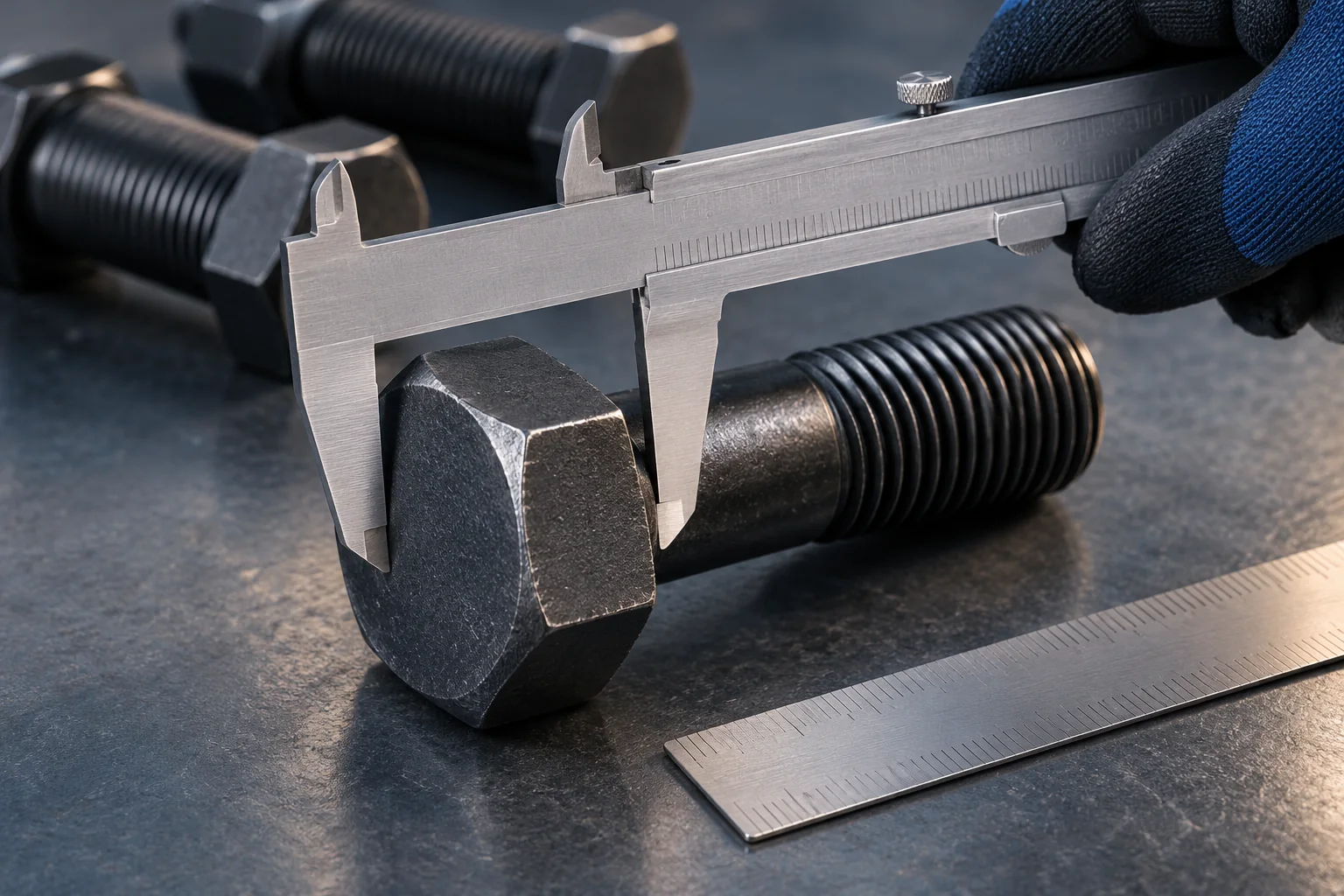
الفرق الأكثر وضوحًا هو عرض الرأس عبر الأسطح المستوية، ويُختصر غالبًا بـ AF. هذه هي المسافة بين وجهين مستويين متقابلين من السداسي، وهي البعد المستخدم لتحديد فتحة مفتاح الربط المقابلة.
For several common inch-series nominal diameters, a heavy hex head has a basic across-flats width 1/8 inch (0.125 in) greater than a standard hex head. The nominal diameter still refers to the bolt’s threaded shank, not its head.
توضح القيم التالية الفرق.
| قطر البرغي الاسمي | عرض السداسي القياسي (in) | عرض السداسي الثقيل العام (in) | عرض السداسي الثقيل الإنشائي (in) |
|---|---|---|---|
| 1/2 in | 0.750 | 0.875 | 0.875 |
| 3/4 in | 1.125 | 1.250 | 1.250 |
| 1 in | 1.500 | 1.625 | 1.625 |
الأساس البُعدي: أبعاد مرجعية منشورة وفق ASME B18.2.1 لمنتجات المسامير السداسية العامة، تمت مقارنتها بأبعاد مرجعية للمسامير السداسية الثقيلة الإنشائية المحددة وفق ASME B18.2.6-2019. القيم هي أبعاد أساسية/مرجعية عبر الأوجه (across-flats)، وليست حدود تفاوت تصنيعي كاملة ولا جدول فحص استلام. تحكم نسخة المعيار المعمول بها ورسم المنتج عملية القبول.
لمسمار مقاس 3/4 بوصة، يكون العرض السداسي المرجعي القياسي 1.125 بوصة، بينما يكون عرض السداسي الثقيل 1.250 بوصة. يتطلب هذا الاختلاف فتحة مفتاح مختلفة، حتى لو كان لكلا المسمارين نفس القطر الاسمي للساق.
يصبح هذا التمييز مهمًا عندما يكون المسمار قريبًا من مبيت أو عنصر إنشائي أو دعامة أنبوب أو مثبت آخر. قد يتناسب الرأس السداسي الثقيل مع المساحة المتاحة بينما يترك مساحة صغيرة جدًا لأداة التركيب.
هناك ثلاثة أبعاد تحتاج إلى اهتمام منفصل:
المسافة بين السطوح المتقابلة يحدد فتحة المفتاح الاسمية. قد لا تناسب أداة السداسي القياسية الرأس السداسي الثقيل الأوسع، حتى عندما يتطابق قطر المسمار والسن.
العرض عبر الزوايا هو أقصى غلاف قطري للسداسي. وهو مهم عند التحقق من الخلوص بالقرب من المكونات المجاورة أو السماح للجريب (socket) بالمرور إلى مساحة ضيقة. قد يتطلب القطر الخارجي للجريب مساحة أكبر بكثير من رأس المسمار نفسه.
ارتفاع الرأس يحدد المساحة المحورية التي يشغلها الرأس ويؤثر على إمكانية الوصول بأداة مناسبة. ولا ينبغي استنتاجه ببساطة من كلمة ثقيل.
الرأس السداسي الثقيل ليس دائمًا أطول
لا يعني بُعد المسافة بين الأضلاع الأكبر أن كل رأس سداسي ثقيل له ارتفاع أكبر.
على سبيل المثال، تعطي الأبعاد المرجعية المنشورة لمنتجات الرأس السداسي القياسي 3/4 بوصة والرأس السداسي الثقيل العام نطاق ارتفاع رأس قدره 0.455–0.524 بوصة لكليهما. ويعطي مرجع ASME B18.2.6-2019 المقابل للرأس السداسي الثقيل الإنشائي 0.455–0.483 بوصة.
توضح هذه القيم تمييزًا مهمًا: يمكن أن تشترك براغي الرأس السداسي الثقيل العامة وبراغي الرأس السداسي الثقيل الإنشائية في نفس عرض المسافة بين الأضلاع الأساسي مع اختلاف حدود ارتفاع الرأس.
النطاقات هي بيانات مرجعية لفئات المنتجات والإصدارات المحددة، وليست تفاوتات عالمية لكل مثبت برأس سداسي.
لهذا السبب ينبغي أن تحدد مواصفات الشراء نمط الرأس الدقيق والمعيار الأبعادي بدلًا من طلب “رأس سداسي كبير” أو افتراض أن أي برغي سداسي ثقيل يلبي الأبعاد الإنشائية.
ASME B18.2.1 مقابل B18.2.6: أي معيار ينطبق؟
يخدم المعياران نطاقات منتجات مختلفة، ويؤثر هذا التمييز على متطلبات التصنيع والمشتريات معًا.
ASME B18.2.1: منتجات سداسية عامة من سلسلة البوصة
ASME B18.2.1-2012 (R2021) يغطي أبعاد عدة أنواع من البراغي واللوالب المربعة والسداسية، بما في ذلك التكوينات السداسية العامة والسداسية الثقيلة.
يوفر إطارًا بعديًا لتحديد أنواع المنتجات ذات الصلة ومتطلباتها البعدية للرأس والجسم والأجزاء المرتبطة.
ومع ذلك، يجب أن تحدد المواصفة شكل المنتج المقصود. لا ينبغي معاملة البرغي السداسي واللولب السداسي ذي الرأس تلقائيًا على أنهما متطابقان لمجرد أن كليهما له رأس سداسي.
لا ينبغي افتراض أن البرغي السداسي الثقيل العام المُصنَّع وفق B18.2.1 يلبي كل متطلبات الأبعاد للبرغي السداسي الثقيل الإنشائي وفق B18.2.6.
ASME B18.2.6: البراغي السداسية الثقيلة الإنشائية
ASME B18.2.6-2019 يغطي مثبتات إنشائية محددة، بما في ذلك براغي إنشائية سداسية ثقيلة ومكونات تثبيت إنشائية ذات صلة ضمن نطاقه المحدد.
يجب تطبيق متطلبات البراغي الإنشائية الخاصة به على فئة المنتج الصحيحة. قد يختلف ارتفاع الرأس وتكوين البرغي وأحكام طول اللولب عن منتجات البراغي السداسية الثقيلة العامة المقابلة.
For an engineer reviewing replacement hardware, this matters beyond the visible head width. A replacement may accept the correct wrench but have a different threaded portion or other dimensional feature that affects the specified assembly.
The dimensional standard is only one part of the product identity. It does not establish the material’s tensile strength, the specified bolt grade, or the installed joint’s required pretension.
ASTM F3125 and RCSC have different responsibilities
For applicable high-strength structural bolts, ASTM F3125/F3125M addresses product requirements, including the relevant grade, type, style, and mechanical or material characteristics within its scope.
The ASTM F3125/F3125M-26 standard catalog identifies structural bolt product categories including Grade A325 and Grade A490. Where that edition is applicable, the precise product classification still matters. A head described as heavy hex does not independently establish its ASTM grade or type.
RCSC’s 2025 مواصفات الوصلات الإنشائية باستخدام البراغي عالية المقاومة addresses the design, installation, and inspection of qualifying structural bolted joints.
These documents should not be substituted for one another:
- The ASME dimensional standard establishes the relevant bolt geometry.
- The ASTM product specification establishes applicable requirements for the specified fastener product.
- The RCSC specification governs qualifying structural connections, including relevant installation and inspection provisions.
A purchase order may need all three levels of identification, depending on the application. Passing a head-dimension check alone is not proof that a bolt meets the required ASTM product specification or that its installation satisfies the joint design.
The applicable editions should come from the governing project documents. The latest published edition is not automatically the edition incorporated into an existing contract.
هل يجعل الرأس السداسي الثقيل البرغي أقوى؟
Not necessarily. A larger hex head does not establish a higher tensile-strength grade or greater allowable bolt load.
Bolt tensile behavior is associated with properties such as the specified material and mechanical grade, the effective tensile-stress area, and the requirements of the applicable product specification. The width of the wrenching head is not a substitute for those properties.
A wider head can change the geometry of the bearing interface. Depending on the actual under-head bearing surface, washer arrangement, and mating material, this may affect how compressive contact forces are distributed.
But a larger head does not guarantee lower bearing stress throughout the entire joint. The effective contact area depends on the actual surfaces in contact, not simply the hexagon’s overall width.
The same limitation applies to bolt pretension.
Pretension is produced by the specified installation process and the resulting bolt elongation. It is affected by the fastener assembly, joint conditions, and installation method. Increasing the head width alone does not establish a higher pretension.
For a structural connection requiring pretension, the installation and verification method must follow the applicable project and RCSC requirements. A wider head or a larger wrench cannot replace those requirements.
Consider two bolts with matching nominal diameters but different head styles. If their product grades, material requirements, or specified assembly conditions differ, their suitability cannot be established by comparing head dimensions. Conversely, two bolts with similar mechanical-strength designations are not necessarily interchangeable if their geometric or assembly requirements differ.
The useful engineering distinction is that head geometry affects tool engagement and local fit, while product grade and the complete connection design determine whether the bolt is acceptable for the intended service.
A hypothetical buyer selects a wider head to obtain a stronger bolt while leaving the product grade unspecified. Head geometry cannot establish material or mechanical conformity. Define the required grade separately, confirm the dimensional product standard and review the mating parts. The bolt-grade guide is background for the grade terminology, not approval of the proposed joint.
متى تُستخدم البراغي السداسية الثقيلة أو القياسية
The correct selection begins with the assembly specification, not the assumption that one head style is universally better.
For general mechanical equipment, a standard hex bolt or hex cap screw may be suitable when it satisfies the specified product requirements and provides the required installation access. Its smaller head envelope can be useful where fasteners are close to surrounding equipment, guards, brackets, or other components.
This does not mean a standard hex bolt is appropriate for every mechanical connection, or that it is inherently weaker than a heavy hex bolt. The specified grade, dimensions, and service requirements remain decisive.
Heavy hex bolts are relevant where the equipment specification, original design, or mating hardware calls for that geometry. Their wider heads require a corresponding wrench or socket, and the surrounding structure must provide adequate installation clearance.
For structural steel connections requiring heavy hex structural bolts, selection is more restrictive. The engineer and buyer must confirm the specified structural bolt product, applicable grade and style, dimensional requirements, and compatible assembly components.
It is not sufficient to replace a specified structural bolt with a general-purpose heavy hex bolt solely because both use the same nominal diameter and wrench size.
Example: A 3/4-inch replacement bolt in a confined assembly
Illustrative hypothetical example — not a SUNHY customer installation or test result.
Suppose a machine assembly originally uses a 3/4-inch standard hex bolt with a 1.125-inch basic across-flats head width. A replacement supplier proposes a 3/4-inch heavy hex bolt with a 1.250-inch basic across-flats width.
The nominal diameter remains 3/4 inch, but the head is 0.125 inch wider across flats.
That creates an immediate tooling difference. The original 1-1/8-inch nominal wrench opening is not appropriate for the proposed 1-1/4-inch heavy hex head.
If the bolt is recessed or near another component, the installer must also check the outside diameter of the larger socket and the space needed to position and operate it. The 0.125-inch difference between basic across-flats dimensions is not itself the total additional installation clearance required.
There is a second, less visible question: does the proposed replacement satisfy the original bolt’s product and dimensional requirements?
The buyer would need to compare the material or product grade, thread series and class, required threaded length, applicable dimensions, and any relevant washer or nut requirements. If the original bolt belongs to a structural connection, the governing structural design and substitution approval requirements also apply.
The example demonstrates why a replacement can appear dimensionally similar at the threaded shank while still being unsuitable for the original installation.
The same reasoning works in reverse. Replacing a specified heavy hex structural bolt with a smaller standard hex bolt should not be approved merely because it passes through the same bolt hole.
ما يجب التحقق منه قبل الاستبدال أو الشراء
An RFQ that requests only “3/4-inch hex bolts” leaves the supplier to infer several important specifications.
The order should establish the required fastener identity before price or availability is compared.
For a general hex or heavy hex fastener, the essential information includes the nominal diameter, thread series and class, bolt length, head style, governing dimensional standard and edition, and applicable material or mechanical grade.
Where the head geometry is important to installation, the buyer should identify the required across-flats dimension or provide the applicable controlled drawing. A drawing becomes particularly useful for restricted-access assemblies or replacements involving older equipment.
For heavy hex structural bolts, the specification should also identify the relevant ASTM F3125 grade, type and style as applicable, together with the project-governing structural bolting requirements.
Nuts and washers must be considered as part of the specified assembly, not selected only because their nominal threads appear to match. Coating, thread fit, and lubrication requirements may also affect whether the supplied components form an acceptable assembly.
These considerations become especially important for coated structural fasteners, where the governing product and installation requirements may address compatible nuts, washers, and preparation conditions.
What should the buyer request for inspection?
The inspection requirements should follow the purchase specification rather than an arbitrary list of documents.
Relevant evidence may include dimensional inspection records, material or mechanical-test documentation, manufacturer identification, product marking verification, and records supporting the required batch or lot traceability.
A certificate of conformity, material test report, dimensional inspection record, and installed-joint inspection report serve different purposes. None automatically replaces the others.
For example, a report identifying a steel heat does not by itself establish that finished bolt heads comply with the specified dimensional tolerances. Similarly, a compliant finished product does not prove that the installed structural joint received the required pretension.
Before accepting a proposed substitute, the engineer or buyer should be able to answer a few concrete questions: Does the new bolt comply with the specified dimensional standard? Does its product grade meet the governing requirements? Is the head and thread configuration correct? Can the existing tools and mating components accommodate it? If the assembly is structurally controlled, has the substitution been reviewed under the applicable design and project requirements?
If any of these questions remain unresolved, matching nominal diameter alone is not an adequate basis for approval.
For buyers preparing a structural-bolt RFQ, SUNHY’s Structural Bolts product category provides the relevant commercial starting point. Supply scope, required grades, actual dimensions, and supporting documentation should be confirmed against the specific inquiry rather than inferred from a general technical article.
When requesting a dimensional or purchasing review, provide the governing specification, required head style, bolt size and length, product grade, coating, quantity, and any available assembly drawing. This gives the supplier enough information to identify potential dimensional or specification conflicts before an order is placed.
الأسئلة المتكررة
هل يعني الرأس السداسي الثقيل قوة أعلى؟
لا. حجم الرأس بُعدي. أما درجة المادة والدرجة الميكانيكية ومواصفات المنتج المعمول بها والسجلات الداعمة فتُحدد متطلبات منفصلة.
هل يكون الرأس السداسي الثقيل دائمًا أطول؟
لا تفترض ذلك. قارن حدود الأبعاد المعمول بها للمنتج والمقاس والمعيار المحددين بدقة؛ فالعرض والارتفاع لا يتغيران بالطريقة نفسها.
هل يمكن أن تشترك البراغي السداسية القياسية والثقيلة في نفس المقبس؟
تحقق من أبعاد المسافة بين الأضلاع الفعلية. تساوي القطر الاسمي للسن لا يضمن تساوي مقاس مفتاح الربط أو توفر خلوص التركيب.