C'è un'altra distinzione importante quando si effettua un ordine: un bullone esagonale pesante generico e un bullone esagonale strutturale pesante non sono necessariamente dimensionati secondo lo stesso standard. Per gli elementi di fissaggio in serie in pollici statunitensi, ASME B18.2.1 copre i prodotti esagonali generici e esagonali pesanti, mentre ASME B18.2.6 riguarda gli elementi di fissaggio strutturali designati. Devono essere inoltre identificati la classe di prodotto applicabile e la specifica di connessione.
Un confronto corretto implica quindi più che decidere quale testa sembra più grande. L'acquirente deve verificare le dimensioni effettive della testa, lo standard dimensionale di riferimento, la classe di prodotto richiesta e se un bullone diverso si adatterà e funzionerà come previsto nel montaggio.
Differenze dimensionali tra teste heavy hex e teste esagonali standard
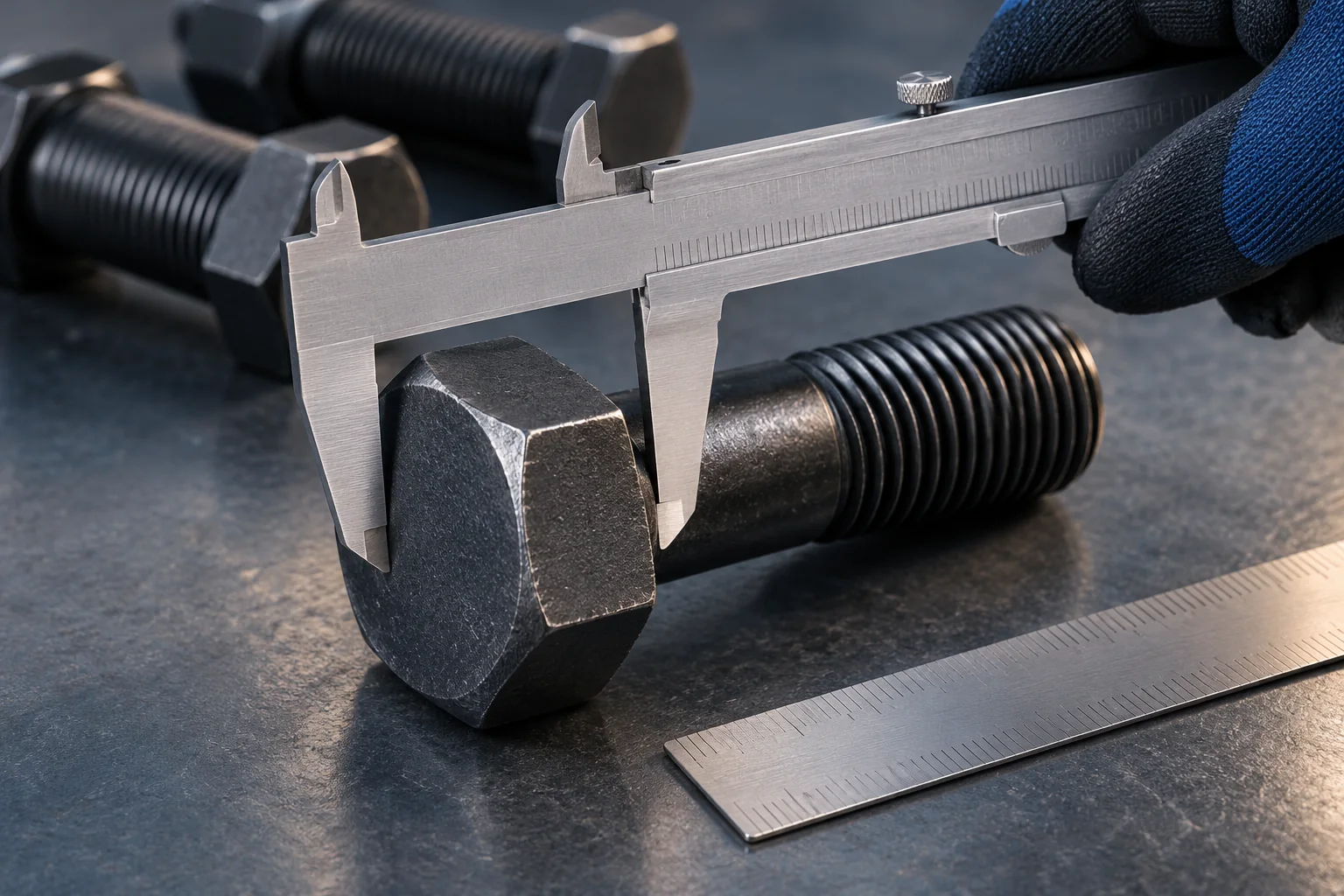
La differenza più riconoscibile è la larghezza della testa tra i lati piatti, spesso abbreviata come AF. Questa è la distanza tra due facce piatte opposte dell'esagono ed è la dimensione utilizzata per identificare l'apertura della chiave corrispondente.
For several common inch-series nominal diameters, a heavy hex head has a basic across-flats width 1/8 inch (0.125 in) greater than a standard hex head. The nominal diameter still refers to the bolt’s threaded shank, not its head.
I seguenti valori illustrano la differenza.
| Diametro nominale del bullone | AF esagono standard (in) | AF esagono pesante generale (in) | AF esagono pesante strutturale (in) |
|---|---|---|---|
| 1/2 in | 0.750 | 0.875 | 0.875 |
| 3/4 in | 1.125 | 1.250 | 1.250 |
| 1 in | 1.500 | 1.625 | 1.625 |
Base dimensionale: dimensioni di riferimento ASME B18.2.1 pubblicate per i prodotti a esagono standard, verificate incrociando le dimensioni di riferimento dell'esagono pesante strutturale identificate con ASME B18.2.6-2019. I valori sono dimensioni AF di base/di riferimento, non limiti completi di tolleranza di fabbricazione né una tabella per l'ispezione all'accettazione. L'edizione applicabile della norma e il disegno del prodotto determinano l'accettazione.
Per un bullone da 3/4 di pollice, la larghezza di riferimento dell'esagono standard è 1.125 pollici, mentre la larghezza dell'esagono pesante è 1.250 pollici. Questa differenza richiede un'apertura chiave diversa, anche se entrambi i bulloni possono avere lo stesso diametro nominale del gambo.
La distinzione diventa importante quando il bullone è vicino a una carcassa, a un elemento strutturale, a un supporto di tubazione o a un altro elemento di fissaggio. Una testa esagonale pesante può inserirsi nello spazio disponibile lasciando però troppo poco spazio per l'utensile di installazione.
Tre dimensioni richiedono attenzione separata:
Larghezza tra le facce determina l'apertura nominale della chiave. Un utensile per esagono standard può non adattarsi alla testa esagonale pesante più larga, anche quando il diametro del bullone e la filettatura coincidono.
Larghezza tra gli angoli è l'ingombro diagonale massimo dell'esagono. È importante quando si verifica lo spazio libero vicino a componenti adiacenti o si consente a una bussola di passare in uno spazio confinato. Il diametro esterno della bussola può richiedere molto più spazio della testa del bullone stessa.
Altezza della testa determina lo spazio assiale occupato dalla testa e influenza l'accesso per un utensile adeguato. Non deve essere dedotta semplicemente dalla parola pesante.
Un dado esagonale pesante non è sempre più alto
La dimensione maggiore tra i piani non significa che ogni testa esagonale pesante abbia altezza maggiore.
For example, published reference dimensions for 3/4-inch standard hex and general heavy hex products both give a head-height range of 0.455–0.524 inches. A corresponding ASME B18.2.6-2019 heavy hex structural reference gives 0.455–0.483 inches.
Questi valori illustrano una distinzione importante: i bulloni esagonali pesanti generici e i bulloni strutturali esagonali pesanti possono condividere la stessa larghezza di base tra i lati, pur avendo limiti diversi di altezza della testa.
Gli intervalli sono dati di riferimento per le specifiche categorie di prodotto e le edizioni indicate, non tolleranze universali per ogni elemento di fissaggio con testa esagonale.
Per questo motivo una specifica di acquisto dovrebbe identificare l'esatto stile della testa e la norma dimensionale, invece di richiedere una “testa esagonale grande” o presumere che qualsiasi bullone esagonale pesante soddisfi le dimensioni strutturali.
ASME B18.2.1 vs B18.2.6: quale norma si applica?
Le due norme coprono ambiti di prodotto diversi, e questa distinzione influisce sia sui requisiti di produzione sia sull'approvvigionamento.
ASME B18.2.1: prodotti esagonali generici in serie in pollici
ASME B18.2.1-2012 (R2021) copre le dimensioni di diversi tipi di bulloni e viti quadri ed esagonali, comprese le configurazioni esagonali generiche e heavy hex.
Fornisce un quadro dimensionale per identificare i tipi di prodotto pertinenti e i relativi requisiti dimensionali di testa, gambo e componenti correlati.
Tuttavia, la specifica deve comunque identificare la forma di prodotto prevista. Un bullone esagonale e una vite esagonale a testa cilindrica non devono essere automaticamente considerati identici solo perché entrambi hanno teste a sei lati.
Un bullone esagonale heavy hex generico dimensionato secondo la B18.2.1 non deve essere ritenuto idoneo a soddisfare ogni requisito dimensionale di un bullone strutturale esagonale heavy hex secondo la B18.2.6.
ASME B18.2.6: bulloni strutturali esagonali heavy hex
ASME B18.2.6-2019 copre gli elementi di fissaggio strutturali designati, inclusi i bulloni strutturali a testa esagonale pesante e i relativi componenti di fissaggio strutturali nell'ambito dichiarato.
I requisiti relativi ai bulloni strutturali devono essere applicati alla corretta categoria di prodotto. L'altezza della testa, la configurazione del bullone e le prescrizioni sulla lunghezza della filettatura possono differire dai corrispondenti prodotti generali a testa esagonale pesante.
For an engineer reviewing replacement hardware, this matters beyond the visible head width. A replacement may accept the correct wrench but have a different threaded portion or other dimensional feature that affects the specified assembly.
The dimensional standard is only one part of the product identity. It does not establish the material’s tensile strength, the specified bolt grade, or the installed joint’s required pretension.
ASTM F3125 and RCSC have different responsibilities
For applicable high-strength structural bolts, ASTM F3125/F3125M addresses product requirements, including the relevant grade, type, style, and mechanical or material characteristics within its scope.
The ASTM F3125/F3125M-26 standard catalog identifies structural bolt product categories including Grade A325 and Grade A490. Where that edition is applicable, the precise product classification still matters. A head described as heavy hex does not independently establish its ASTM grade or type.
RCSC’s 2025 Specifica per giunti strutturali con bulloni ad alta resistenza addresses the design, installation, and inspection of qualifying structural bolted joints.
These documents should not be substituted for one another:
- The ASME dimensional standard establishes the relevant bolt geometry.
- The ASTM product specification establishes applicable requirements for the specified fastener product.
- The RCSC specification governs qualifying structural connections, including relevant installation and inspection provisions.
A purchase order may need all three levels of identification, depending on the application. Passing a head-dimension check alone is not proof that a bolt meets the required ASTM product specification or that its installation satisfies the joint design.
The applicable editions should come from the governing project documents. The latest published edition is not automatically the edition incorporated into an existing contract.
Una testa heavy hex rende il bullone più resistente?
Not necessarily. A larger hex head does not establish a higher tensile-strength grade or greater allowable bolt load.
Bolt tensile behavior is associated with properties such as the specified material and mechanical grade, the effective tensile-stress area, and the requirements of the applicable product specification. The width of the wrenching head is not a substitute for those properties.
A wider head can change the geometry of the bearing interface. Depending on the actual under-head bearing surface, washer arrangement, and mating material, this may affect how compressive contact forces are distributed.
But a larger head does not guarantee lower bearing stress throughout the entire joint. The effective contact area depends on the actual surfaces in contact, not simply the hexagon’s overall width.
The same limitation applies to bolt pretension.
Pretension is produced by the specified installation process and the resulting bolt elongation. It is affected by the fastener assembly, joint conditions, and installation method. Increasing the head width alone does not establish a higher pretension.
For a structural connection requiring pretension, the installation and verification method must follow the applicable project and RCSC requirements. A wider head or a larger wrench cannot replace those requirements.
Consider two bolts with matching nominal diameters but different head styles. If their product grades, material requirements, or specified assembly conditions differ, their suitability cannot be established by comparing head dimensions. Conversely, two bolts with similar mechanical-strength designations are not necessarily interchangeable if their geometric or assembly requirements differ.
The useful engineering distinction is that head geometry affects tool engagement and local fit, while product grade and the complete connection design determine whether the bolt is acceptable for the intended service.
A hypothetical buyer selects a wider head to obtain a stronger bolt while leaving the product grade unspecified. Head geometry cannot establish material or mechanical conformity. Define the required grade separately, confirm the dimensional product standard and review the mating parts. The bolt-grade guide is background for the grade terminology, not approval of the proposed joint.
Quando utilizzare bulloni esagonali heavy hex o standard
The correct selection begins with the assembly specification, not the assumption that one head style is universally better.
For general mechanical equipment, a standard hex bolt or hex cap screw may be suitable when it satisfies the specified product requirements and provides the required installation access. Its smaller head envelope can be useful where fasteners are close to surrounding equipment, guards, brackets, or other components.
This does not mean a standard hex bolt is appropriate for every mechanical connection, or that it is inherently weaker than a heavy hex bolt. The specified grade, dimensions, and service requirements remain decisive.
Heavy hex bolts are relevant where the equipment specification, original design, or mating hardware calls for that geometry. Their wider heads require a corresponding wrench or socket, and the surrounding structure must provide adequate installation clearance.
For structural steel connections requiring heavy hex structural bolts, selection is more restrictive. The engineer and buyer must confirm the specified structural bolt product, applicable grade and style, dimensional requirements, and compatible assembly components.
It is not sufficient to replace a specified structural bolt with a general-purpose heavy hex bolt solely because both use the same nominal diameter and wrench size.
Example: A 3/4-inch replacement bolt in a confined assembly
Illustrative hypothetical example — not a SUNHY customer installation or test result.
Suppose a machine assembly originally uses a 3/4-inch standard hex bolt with a 1.125-inch basic across-flats head width. A replacement supplier proposes a 3/4-inch heavy hex bolt with a 1.250-inch basic across-flats width.
The nominal diameter remains 3/4 inch, but the head is 0.125 inch wider across flats.
That creates an immediate tooling difference. The original 1-1/8-inch nominal wrench opening is not appropriate for the proposed 1-1/4-inch heavy hex head.
If the bolt is recessed or near another component, the installer must also check the outside diameter of the larger socket and the space needed to position and operate it. The 0.125-inch difference between basic across-flats dimensions is not itself the total additional installation clearance required.
There is a second, less visible question: does the proposed replacement satisfy the original bolt’s product and dimensional requirements?
The buyer would need to compare the material or product grade, thread series and class, required threaded length, applicable dimensions, and any relevant washer or nut requirements. If the original bolt belongs to a structural connection, the governing structural design and substitution approval requirements also apply.
The example demonstrates why a replacement can appear dimensionally similar at the threaded shank while still being unsuitable for the original installation.
The same reasoning works in reverse. Replacing a specified heavy hex structural bolt with a smaller standard hex bolt should not be approved merely because it passes through the same bolt hole.
Cosa verificare prima della sostituzione o dell'acquisto
An RFQ that requests only “3/4-inch hex bolts” leaves the supplier to infer several important specifications.
The order should establish the required fastener identity before price or availability is compared.
For a general hex or heavy hex fastener, the essential information includes the nominal diameter, thread series and class, bolt length, head style, governing dimensional standard and edition, and applicable material or mechanical grade.
Where the head geometry is important to installation, the buyer should identify the required across-flats dimension or provide the applicable controlled drawing. A drawing becomes particularly useful for restricted-access assemblies or replacements involving older equipment.
For heavy hex structural bolts, the specification should also identify the relevant ASTM F3125 grade, type and style as applicable, together with the project-governing structural bolting requirements.
Nuts and washers must be considered as part of the specified assembly, not selected only because their nominal threads appear to match. Coating, thread fit, and lubrication requirements may also affect whether the supplied components form an acceptable assembly.
These considerations become especially important for coated structural fasteners, where the governing product and installation requirements may address compatible nuts, washers, and preparation conditions.
What should the buyer request for inspection?
The inspection requirements should follow the purchase specification rather than an arbitrary list of documents.
Relevant evidence may include dimensional inspection records, material or mechanical-test documentation, manufacturer identification, product marking verification, and records supporting the required batch or lot traceability.
A certificate of conformity, material test report, dimensional inspection record, and installed-joint inspection report serve different purposes. None automatically replaces the others.
For example, a report identifying a steel heat does not by itself establish that finished bolt heads comply with the specified dimensional tolerances. Similarly, a compliant finished product does not prove that the installed structural joint received the required pretension.
Before accepting a proposed substitute, the engineer or buyer should be able to answer a few concrete questions: Does the new bolt comply with the specified dimensional standard? Does its product grade meet the governing requirements? Is the head and thread configuration correct? Can the existing tools and mating components accommodate it? If the assembly is structurally controlled, has the substitution been reviewed under the applicable design and project requirements?
If any of these questions remain unresolved, matching nominal diameter alone is not an adequate basis for approval.
For buyers preparing a structural-bolt RFQ, SUNHY’s Structural Bolts product category provides the relevant commercial starting point. Supply scope, required grades, actual dimensions, and supporting documentation should be confirmed against the specific inquiry rather than inferred from a general technical article.
When requesting a dimensional or purchasing review, provide the governing specification, required head style, bolt size and length, product grade, coating, quantity, and any available assembly drawing. This gives the supplier enough information to identify potential dimensional or specification conflicts before an order is placed.
Domande frequenti
Un bullone esagonale a testa alta indica una resistenza superiore?
No. La dimensione della testa è dimensionale. Il grado del materiale e meccanico, la specifica di prodotto applicabile e i documenti di supporto stabiliscono requisiti separati.
Un bullone esagonale pesante è sempre più alto?
Non darlo per scontato. Confronta i limiti dimensionali applicabili per il prodotto, la misura e lo standard esatti; larghezza e altezza non variano in modo identico.
I bulloni esagonali standard e quelli esagonali pesanti possono utilizzare la stessa bussola?
Verificare le dimensioni effettive da chiave (across-flats). Un diametro nominale della filettatura uguale non garantisce la stessa dimensione della chiave né lo spazio di installazione disponibile.