Le zingage électrolytique n'est pas non plus automatiquement inadapté aux boulons de grade 8. La possibilité de le spécifier dépend des exigences de revêtement applicables, de la sensibilité de l'élément de fixation à la fragilisation par l'hydrogène, des contrôles de procédé documentés et des preuves disponibles pour justifier l'acceptation.
La décision pratique ne se résume donc pas à un choix entre zingage électrolytique et revêtement zinc-lamellaire. Il s'agit de savoir si le procédé de revêtement complet produit un boulon protégé contre la corrosion qui conserve les propriétés mécaniques requises, s'adapte à ses composants d'assemblage et se comporte comme prévu lors du montage et en service.
Ici, Classe 8 signifie SAE J429 Grade 8 inch-series fasteners. It does not mean metric property class 8.8, and its coating requirements should not be inferred from ASTM F3125 structural bolt grades. SAE J429 establishes material and mechanical requirements for its covered fasteners; specifying Grade 8 alone does not define or approve a protective coating.
Zingage électrolytique vs zinc lamellaire : qu'est-ce qui change réellement ?
La différence fondamentale réside dans la manière dont le revêtement contenant du zinc est déposé sur l'acier.
Zinc électroplaqué utilise un procédé électrochimique pour déposer du zinc sur l'élément de fixation. Selon la finition spécifiée, le système complet peut également comprendre un traitement de conversion, une passivation ou un scellement. Le nettoyage et la préparation de surface font partie du procédé et ne sont pas des détails facultatifs à ignorer lors de l'évaluation de la fragilisation par l'hydrogène.
Revêtements à base de paillettes de zinc sont des systèmes appliqués par voie non électrolytique contenant des paillettes de zinc, souvent en combinaison avec d'autres composants, au sein d'une matrice de revêtement. Selon le procédé qualifié, l'application peut faire appel à une centrifugation par immersion ou à une pulvérisation, suivie d'un durcissement. Des couches de finition supplémentaires peuvent conférer une friction spécifiée ou d'autres caractéristiques de performance.
Comme le dépôt ne repose pas sur une réaction de galvanoplastie électrolytique, les paillettes de zinc évitent cette voie particulière de génération d'hydrogène. Cependant, un fournisseur peut toujours recourir à un prétraitement chimique avant le revêtement. Une finition non électrolytique ne permet donc pas d'établir que toutes les opérations antérieures étaient exemptes de risque lié à l'hydrogène.
| Point de comparaison | Zinc électroplaqué | Paillettes de zinc non électrolytiques |
|---|---|---|
| Dépôt | Zinc déposé par voie électrochimique | Système à base de paillettes contenant du zinc appliqué sans électrolyse |
| Préoccupation liée à l'hydrogène | Les opérations de nettoyage et d'électrodéposition concernées peuvent introduire de l'hydrogène | Pas d'étape de dépôt électrolytique, mais le prétraitement et l'exposition ultérieure nécessitent tout de même une évaluation |
| Protection contre la corrosion | Dépend de la spécification de revêtement, de l'épaisseur, des traitements complémentaires et de l'environnement | Dépend du système de revêtement lamellaire complet, de la qualité d'application, de la couche de finition et de l'environnement |
| Traitement thermique | Peut inclure un traitement de dégazage de l'hydrogène le cas échéant | Inclut des conditions de cuisson qui doivent être compatibles avec le matériau de la fixation |
| Comportement d'assemblage | L'état de surface et tout produit d'étanchéité ou lubrifiant peuvent affecter l'ajustement du filetage et le frottement | L'épaisseur du revêtement et les couches de finition de contrôle du frottement peuvent affecter l'ajustement du filetage et le comportement au serrage |
| Acceptation | Nécessite les exigences applicables au produit et aux revêtements électrolytiques | Nécessite les exigences applicables au produit et au système de revêtement lamellaire au zinc |
Ces comparaisons identifient les points nécessitant une analyse d'ingénierie ; elles ne constituent pas un classement universel des performances des revêtements.
Les normes de revêtement ne sont pas des homologations interchangeables
ASTM F1941/F1941M couvre les revêtements électrolytiques pour éléments de fixation mécaniques. L'ISO 4042 est une autre spécification de revêtement électrolytique pour éléments de fixation, avec un amendement publié à son édition 2022 en 2026.
Les systèmes à lamelles de zinc appliqués par voie non électrolytique sont traités par des spécifications telles que ASTM F3393 et ISO 10683. Leur domaine d'application, leurs classifications et leurs critères d'acceptation doivent être vérifiés par rapport au produit réel et à l'édition applicable.
La mention de l'une de ces normes dans un bon de commande n'établit pas automatiquement la conformité aux autres. Pas plus qu'une désignation de norme de revêtement ne prouve qu'un boulon SAE Grade 8 donné a satisfait à toutes les exigences mécaniques, dimensionnelles ou de fragilisation par l'hydrogène applicables.
Pour l'approvisionnement, la question utile est : Quel système de revêtement complet, selon quelle spécification et quel procédé de traitement approuvé, sera fourni ? Un fini décrit uniquement comme " zinc argent " ou " lamelles de zinc " ne suffit pas à répondre à cette question.
Où le risque de fragilisation par l'hydrogène intervient dans le processus de revêtement
La fragilisation par l'hydrogène est particulièrement importante lorsqu'un élément de fixation en acier à haute résistance combine une sensibilité du matériau, de l'hydrogène disponible et une contrainte de traction.
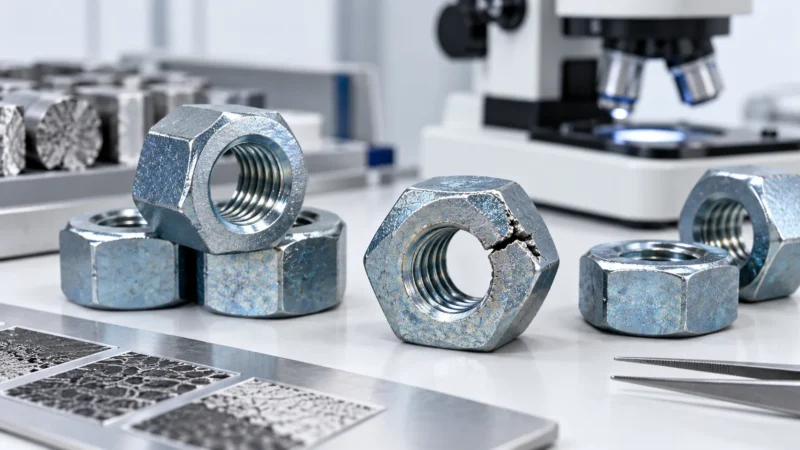
L'hydrogène introduit lors de la fabrication peut contribuer à la fissuration après la mise en charge du boulon. La défaillance peut être différée plutôt que survenir lors du revêtement, de la manutention ou du montage initial.
C'est ce qui distingue la fragilisation par l'hydrogène d'un défaut de revêtement évident. Un boulon zingué peut présenter des dimensions acceptables et ne montrer aucun dommage de surface visible alors qu'un risque de traitement pertinent reste non résolu.
Pourquoi l'état du matériau et les contraintes importent
Not every steel fastener responds identically to hydrogen exposure.
Strength level, hardness, heat treatment and microstructure influence susceptibility. The relevant stress state also matters: an installed bolt can experience tensile loading from tightening and additional service loading, while manufacturing operations may leave residual stresses.
Hydrogen can diffuse within susceptible steel and participate in mechanisms that reduce resistance to cracking under certain stress conditions. Whether delayed fracture occurs depends on the interaction of these factors, not on the coating name alone.
Consequently, the Grade 8 marking is an important material-identification starting point, but it is not a substitute for the actual material condition and the coating-process qualification.
A supplier cannot establish suitability merely by stating that the bolt meets SAE J429 or that the coating has been used successfully on other fastener grades.
Internal hydrogen and service-related hydrogen are different questions
Two exposure paths need to remain separate.
Internal hydrogen embrittlement (IHE) concerns hydrogen introduced during manufacturing processes, including relevant cleaning and coating operations.
Environmental hydrogen embrittlement (EHE) concerns hydrogen associated with exposure during service. Depending on the environment and corrosion processes, hydrogen may become available at the steel surface even after a fastener has passed its manufacturing acceptance checks.
The distinction matters when comparing coatings.
A non-electrolytic zinc flake system may reduce exposure associated with electrolytic deposition, but that says little by itself about a damaged coating operating in a corrosive environment. Likewise, successful process qualification for electroplated zinc does not establish indefinite resistance to environmentally assisted cracking.
The 2026 research Understanding hydrogen permeation in zinc flake coatings for hydrogen embrittlement mitigation helps explain why formulation and corrosion-related hydrogen transport deserve attention. However, its experimental substrate was interstitial-free steel sheet, not a heat-treated SAE Grade 8 bolt. Its results should not be represented as Grade 8 product qualification or a measured field-failure probability.
What process controls and baking can—and cannot—establish
For electroplated high-strength fasteners, the evaluation should begin before the plating bath.
Relevant information includes the surface-cleaning method, whether acid treatment is used, the deposition route and any specified hydrogen-relief procedure. Where relief baking is required, its timing and conditions must follow the applicable specification and approved process.
Baking can be part of a qualified risk-reduction process. It is not a universal remedy that makes every previously hydrogen-exposed fastener safe. The appropriate procedure depends on the material and coating system, and its effectiveness must be supported by the applicable qualification and control requirements.
An unsupported instruction to bake all Grade 8 bolts for one fixed number of hours would therefore be inappropriate.
ASTM F1940 addresses process-control verification for limiting internal hydrogen embrittlement associated with manufacturing. Other methods, including ASTM F519 and ASTM F1624, address defined hydrogen-embrittlement evaluation questions.
These methods are not interchangeable certificates. One may be relevant to process control, another to a specified susceptibility or delayed-failure assessment. The governing requirements determine which evidence is necessary and how it is accepted.
For a production order, distinguish three questions:
- Has the coating process been appropriately qualified for the specified application?
- Is the approved process being maintained, with relevant records and controls?
- Does the delivered lot have the product, coating and inspection evidence required by the purchase specification?
A successful process-qualification result does not automatically supply every required lot-level record.
Zinc flake also has a material-processing consideration that should not be overlooked: curing exposes the fastener to heat. Its temperature and duration should be evaluated against the qualified heat-treated substrate and any required post-coating property verification. Without the actual curing schedule and material history, it would be unjustified to claim either that mechanical properties are unchanged or that curing has degraded them.
In an illustrative coating review, a supplier calls zinc flake hydrogen-free but does not identify the pretreatment. Avoiding electrolytic deposition does not describe every earlier processing step. Request the actual preparation, substrate condition and qualification basis, then assess the unresolved risk. The high-strength fastener embrittlement guide separates process-control evidence from a finish description.

Résistance à la corrosion, ajustement du filetage et comportement à l'assemblage
Hydrogen embrittlement is a critical distinction, but it is not the only basis for coating selection.
A coating that reduces a manufacturing hydrogen concern may still be unsuitable if it does not meet the application’s corrosion requirements, interferes with thread engagement or produces unacceptable assembly behavior.
These are separate qualification questions.
Corrosion performance depends on the complete system
Zinc-containing coatings protect steel through mechanisms associated with the coating’s composition and its interaction with the environment. Their performance can differ substantially with coating formulation, thickness, supplemental layers, surface preparation and application quality.
That is why comparing a basic electroplated zinc finish with a fully specified zinc flake system containing a protective topcoat is not necessarily a like-for-like comparison.
The actual exposure also changes what constitutes adequate protection. Outdoor wetting and drying, road-salt exposure, sheltered condensation and contact with aggressive process chemicals are not equivalent service conditions.
A supplier’s corrosion report should therefore identify the tested coating system, relevant test procedure, acceptance endpoint and specimen condition. The report should be applicable to the specified fastener or an appropriately qualified representative configuration.
Salt-spray testing is a common source of misunderstanding. ASTM B117 defines a controlled salt-fog test environment, but test duration by itself is not a reliable conversion to natural service life.
Even when one coating survives a longer specified laboratory exposure than another, that does not prove a corresponding improvement in years of actual service. The interpretation also depends on what was measured, such as coating corrosion products or corrosion reaching the steel substrate.
For procurement, a corrosion-performance requirement is useful only when the test method and acceptance criterion are clearly stated. "Excellent corrosion resistance" is not a measurable substitute.
Coating thickness can change whether the threads assemble correctly
Threads are not exempt from coating build.
A threaded fastener must remain compatible with its specified mating nut after the coating process. The relevant dimensions depend on the thread form and class, the coating allowance, the applied coating thickness and the condition of the mating component.
A coating system that satisfies a general surface-finish description can still present a functional-fit problem if the thread allowances and final dimensions are not controlled.
This is particularly important when a buyer changes an existing bolt from electroplated zinc to zinc flake while retaining the same nut specification.
The fact that the bolts share the same nominal thread designation does not demonstrate that the coated assemblies will have equivalent fit. The purchaser should verify the required after-coating dimensional acceptance and functional gaging or mating checks applicable to the order.
A coating change may therefore require confirmation of the mating hardware and inspection method, even when the underlying bolt grade and nominal dimensions are unchanged.
Friction affects the relationship between torque and clamp force
A coating’s topcoat, sealer and lubrication system can change friction at the threads and bearing surfaces.
During tightening, applied torque is consumed partly by friction rather than being converted entirely into bolt tension. If the surface condition changes, the clamp force produced by an otherwise identical tightening procedure may change as well.
This is why two Grade 8 bolts with the same dimensions and mechanical grade cannot automatically share a tightening instruction merely because both finishes contain zinc.
Zinc flake systems may be supplied with friction-control topcoats, while electroplated zinc systems can also include lubricants or sealers. Neither route has one universal friction coefficient.
An assembly-sensitive application requires confirmation of the actual bolt, nut, washer, coating and lubrication combination under an appropriate approved test or tightening-validation procedure.
ISO 16047 provides a torque/clamp-force test framework for its specified scope, but its applicability should not be assumed for every SAE inch-series assembly. The method and acceptance criteria must match the product and project requirements.
Corrosion protection, functional thread fit and repeatable clamp-force behavior should therefore be evaluated as distinct properties. Passing one does not prove the others.
A hypothetical buyer changes an approved plated Grade 8 assembly to a zinc-flake topcoat but retains its old torque instruction and nut. The finish may alter friction and final thread fit. Confirm the exact coated combination and required assembly validation before release. Use coating-system comparisons for process questions, not a universal service-life or clamp-force prediction.
Comment choisir un revêtement adapté aux conditions réelles de service
A useful coating decision starts with the application and then works backward to the processes and evidence capable of satisfying it.
For a Grade 8 bolt whose material condition and specified application make hydrogen introduction a significant concern, non-electrolytic zinc flake is a reasonable candidate to evaluate. The expected advantage is the absence of electrolytic deposition, not a guarantee that every preparation step or subsequent exposure is harmless.
Before approving it, the engineer still needs the actual pretreatment process, curing conditions, coating-system designation and relevant qualification evidence. Thread fit and assembly behavior must also remain acceptable.
Electroplated zinc may remain a candidate where the applicable specification permits it and a qualified supplier can demonstrate appropriate process control, hydrogen-embrittlement risk management and required acceptance evidence for the fastener condition.
If those records are unavailable, an attractive finish or lower quoted price would not resolve the technical uncertainty.
For an application dominated by external corrosion exposure, the selection may instead depend primarily on the complete coating system and its demonstrated performance under relevant test conditions. Zinc flake may offer advantages in a particular qualified configuration, but the category name alone does not support a universal corrosion-performance ranking.
Where tightening consistency is critical, the decisive evidence may be the qualified friction or torque–clamp-force behavior of the actual coated assembly. A coating change that improves corrosion protection but changes the installed clamp force cannot simply be accepted without considering the fastening design and assembly procedure.
These considerations can be reduced to four conditional decisions:
| Application priority | Coating-selection implication | Evidence needed before approval |
|---|---|---|
| Minimize manufacturing hydrogen introduction | Consider a qualified non-electrolytic route; do not ignore pretreatment | Material condition, pretreatment records, process qualification and applicable embrittlement controls |
| Use an established electroplated finish | Retain as a candidate only where its use is permitted and qualified | Approved coating procedure, relevant hydrogen controls and acceptance records |
| Meet demanding corrosion exposure | Compare specified complete coating systems, not generic finish names | Applicable corrosion test, acceptance endpoint and service-environment basis |
| Maintain thread fit and tightening behavior | Verify the coating as part of the assembled fastener system | Final dimensions, mating hardware, lubricant/topcoat and relevant assembly-test evidence |
No row automatically approves a coating. Each identifies what must be established for that selection to become defensible.
If an existing approved part is being changed from zinc plating to zinc flake, the change should be treated as a coating-system substitution requiring review, not merely a cosmetic finish update. The appropriate review considers the same fastener material and heat treatment, the new process route, dimensional effects, corrosion acceptance and any tightening requirements.
The engineer responsible for the application must determine which differences require requalification or formal approval under the governing specification.
Que spécifier et vérifier avant de commander des boulons de grade 8 revêtus
An RFQ that specifies only "Grade 8 bolts, zinc plated" leaves several important decisions to the supplier. In an application where hydrogen embrittlement, corrosion or controlled tightening matters, those omissions can lead to non-comparable quotations or a delivered coating that has not been approved for the intended use.
A practical purchasing specification should identify the following information.
Bolt identity and mechanical requirements. State SAE J429 with the governing edition, the exact bolt form, diameter, length, thread designation and class, and the relevant drawing requirements. Where traceable material and mechanical evidence is required, identify the associated documentation and lot-acceptance basis.
Coating system. Specify the applicable coating standard and edition, coating classification or designation, supplementary treatment, topcoat or lubricant, and the required finish characteristics. The choice between ASTM F1941/F1941M, ASTM F3393, ISO 4042 or ISO 10683 should follow the actual product and project requirements; these designations are not interchangeable by default.
Surface preparation and hydrogen controls. Identify the approved preparation and coating process, the hydrogen-embrittlement prevention or control requirements applicable to that fastener condition, and the records needed to demonstrate compliance. If testing, monitoring or relief treatment is specified, define it by the applicable requirement rather than inserting an arbitrary generic procedure.
Corrosion acceptance. Specify the environment or service requirement that drives coating selection. Where laboratory testing is required, identify the test method, exposure conditions, evaluation endpoint and acceptance criteria. A test report without an agreed criterion may not resolve whether the finish is suitable.
Mating components and installation. Identify the nut and washer requirements, thread-fit and coating-build acceptance, lubricant or topcoat requirements and any necessary assembly qualification. If tightening performance is controlled, the required test or verification method should refer to the actual fastener combination.
Inspection and traceability. State which records are expected with delivery: for example, a product certificate of conformity, applicable material or mechanical test reports, coating-process records, qualification evidence or specified inspection results.
These documents serve different purposes. A material test report does not by itself prove coating-process qualification. A coating certificate does not replace mechanical-property acceptance, and a successful corrosion test does not establish the installed clamp force.
For clarity, an illustrative procurement request might read:
Supply SAE J429 Grade 8 bolts to the specified drawing and governing edition, with the purchaser-approved coating system, thread-fit requirements and mating components. Submit the applicable coating designation, approved process and hydrogen-embrittlement control evidence, corrosion acceptance documentation and required lot traceability records for review before acceptance.
This is a hypothetical RFQ framework, not a quotation, an approved project specification or a statement that any particular supplier has met these requirements.
The most useful next step is to obtain two things from each prospective supplier: a precisely defined coating system and evidence that its actual process has been qualified for the specified fastener and application.
Only then can zinc plating and zinc flake be compared on an equivalent engineering basis rather than by finish name, appearance or unsupported performance claims.
Questions fréquemment posées
Les revêtements en lamelles de zinc sont-ils automatiquement exempts de fragilisation par l'hydrogène ?
Non. Cela évite le dépôt électrolytique, mais le prétraitement, la sensibilité du matériau, la mise en œuvre et l'hydrogène lié au service nécessitent encore une vérification.
Le dégazage garantit-il la sécurité des boulons de classe 8 galvanisés ?
Non. Lorsque requis, le traitement de détente fait partie d'un procédé qualifié spécifié. Il ne peut pas remplacer les contrôles de procédé applicables ni les preuves d'acceptation.
Le couple de serrage d'origine peut-il être conservé après un changement de revêtement ?
Ne le supposez pas. Vérifiez l'ajustement final du filetage, les composants d'accouplement, la couche de finition ou le lubrifiant et les exigences approuvées de validation du serrage.