Ciò rende A490 il prodotto a resistenza più elevata, ma non automaticamente la scelta migliore per un collegamento in acciaio. La differenza del 25% tra le designazioni di gruppo non si traduce in un aumento generalizzato del 25% della capacità del collegamento. A325 e A490 devono essere confrontati anche con la progettazione strutturale, i requisiti di protezione dalla corrosione, le disposizioni di installazione applicabili e i dadi e le rondelle compatibili.
A325 e A490 secondo ASTM F3125: cosa significano le designazioni
A325 e A490 erano originariamente identificati da specifiche ASTM separate. I loro requisiti per il bullonaggio strutturale sono ora trattati nella norma ASTM F3125/F3125M, che consolida diverse categorie di prodotti per bulloni strutturali ad alta resistenza.
Nel linguaggio di specifica corrente, un ingegnere può identificare un bullone come ASTM F3125 Grade A325 o ASTM F3125 Grade A490. Il grado identifica una categoria di resistenza meccanica specificata, mentre il tipo riguarda la chimica del materiale e le caratteristiche correlate. Queste distinzioni sono importanti perché un ordine di acquisto che riporta solo “bulloni A490” può lasciare indefiniti i dettagli rilevanti su materiale e rivestimento.
Entrambi i gradi sono associati alle classificazioni di materiale Type 1 e Type 3, ove applicabili. Type 1 rappresenta la corrispondente classificazione di materiale non resistente agli agenti atmosferici. Type 3 identifica una chimica in acciaio resistente agli agenti atmosferici (weathering steel) intesa a migliorare la resistenza alla corrosione atmosferica in condizioni di esposizione adeguate. Type 3 non è un grado separato di resistenza alla trazione e la sua designazione non significa che un rivestimento protettivo applicato sia sempre superfluo.
Lo stile del prodotto e le dimensioni sono elementi di specifica distinti. Un bullone strutturale a testa esagonale maggiorata (heavy-hex) deve soddisfare i requisiti dimensionali applicabili alla configurazione di prodotto specificata; un bullone esagonale standard visivamente simile non è necessariamente un sostituto conforme. Diametro nominale, lunghezza, configurazione della filettatura e standard di prodotto applicabile devono essere confermati prima che i componenti siano accettati come equivalenti.
Anche l'edizione di riferimento è importante. Il catalogo 2026 dell'editore ASTM identifica ASTM F3125/F3125M-26, ma un progetto può richiedere contrattualmente un'edizione precedente. Un ingegnere o un acquirente non dovrebbe combinare proprietà meccaniche, autorizzazioni sui rivestimenti o procedure di accettazione da edizioni diverse senza stabilire quali requisiti disciplinano l'ordine.
ASTM F3125 riguarda il prodotto bullone; il giunto strutturale installato deve soddisfare separatamente i propri requisiti di progettazione e installazione applicabili. Per le strutture in acciaio che utilizzano il quadro RCSC, tali requisiti includono il tipo di giunto pertinente, il montaggio, l'installazione e le disposizioni di ispezione.
Confronto di resistenza: perché un bullone più resistente non significa automaticamente un giunto più resistente
La principale differenza meccanica è semplice: ad A490 è assegnato un gruppo di resistenza alla trazione minima superiore rispetto ad A325.
Il seguente confronto utilizza i gruppi di bulloneria e le disposizioni sui rivestimenti RCSC 2025. Non è una riproduzione delle tabelle complete di accettazione meccanica ASTM F3125.
| Caratteristica | Grade A325 | Grade A490 |
|---|---|---|
| Specifica di prodotto ASTM | ASTM F3125/F3125M | ASTM F3125/F3125M |
| Gruppo di bulloneria RCSC 2025 | Group 120 | Gruppo 150 |
| Livello minimo di resistenza a trazione del gruppo | 120 ksi | 150 ksi |
| Raggruppamento relativo per resistenza a trazione | Livello di riferimento | 25% superiore |
| Zincatura a caldo o meccanica secondo RCSC 2025 | Ammesso per le configurazioni conformi applicabili | Vietato per il Gruppo 150 |
| Rivestimento a scaglie di zinco | Verificare i requisiti di idoneità e di assemblaggio | Alcuni sistemi ASTM F3393 sono ammessi a determinate condizioni |
| Capacità del giunto strutturale | Deve essere stabilito dalla progettazione del collegamento | Deve essere stabilito dalla progettazione del collegamento |
Il raggruppamento per resistenza minima a trazione descrive il requisito del materiale del bullone. Non stabilisce quanta sollecitazione può sopportare un collegamento assemblato.
Si considerino due bulloni dello stesso diametro nominale, uno A325 e l'altro A490. Se le loro aree resistenti a trazione sono comparabili, il bullone a resistenza più elevata offre una maggiore resistenza potenziale in una condizione controllata dalla trazione del bullone. Questa sola osservazione non dice nulla di conclusivo sulla capacità del collegamento completo.
Un collegamento in acciaio può invece essere governato dalla resistenza a rifollamento della piastra, dalla deformazione del foro del bullone, dalla distanza dal bordo, dalla resistenza del materiale collegato, dalla rottura per taglio a blocco o da un'altra condizione limite applicabile. Aumentare la resistenza del materiale del bullone non aumenta lo spessore della piastra, non modifica le distanze dal bordo né migliora la resistenza del materiale collegato circostante.
Anche la posizione della filettatura è importante. Se le filettature sono comprese in un piano di taglio può influenzare la resistenza a taglio del bullone assegnata dal metodo di progettazione applicabile. Cambiare semplicemente la classe senza riesaminare la geometria specificata del bullone e i dettagli del collegamento può lasciare irrisolta un'ipotesi di progetto importante.
La pretensione non è la stessa cosa della resistenza a trazione
Un'altra frequente fonte di confusione è il rapporto tra la resistenza a trazione del bullone e la pretensione installata.
La resistenza a trazione è una proprietà del materiale stabilita tramite la specifica di prodotto applicabile e i requisiti di prova. La pretensione è la forza di serraggio sviluppata in un assemblaggio di bulloni installato quando il collegamento richiede la pretensione.
Per un collegamento a attrito, la resistenza allo scorrimento dipende dalla relazione di progetto applicabile che coinvolge la pretensione del bullone, la condizione delle superfici di contatto, il numero di piani di scorrimento e altri fattori prescritti. Un bullone a resistenza più elevata può consentire una pretensione specificata diversa, ma il suo effetto sulla resistenza del collegamento deve essere valutato utilizzando i requisiti di progetto applicabili.
Anche il rivestimento del bullone e il trattamento delle superfici di contatto sono distinti. L'approvazione di un rivestimento protettivo sul bullone non stabilisce che una particolare superficie di contatto rivestita o non rivestita soddisfi la classificazione di resistenza allo scorrimento richiesta.
In un collegamento di tipo a rifollamento, le verifiche di progetto applicabili possono essere diverse. A seconda del dettaglio effettivo, aumentare la resistenza del bullone può offrire un beneficio ingegneristico, non fornire alcun aumento utile della resistenza controllante del collegamento, oppure richiedere di riconsiderare altre parti del collegamento.
La decisione di selezione quindi non è “150 ksi è meglio di 120 ksi”. È se la classe a resistenza più elevata soddisfa un requisito strutturale documentato di cui il collegamento completo può avvalersi.
Considera una verifica illustrativa della connessione in cui si propone l'A490 per eliminare il movimento in un giunto A325. Se la causa è una procedura di installazione non verificata o superfici di contatto inadeguate, un grado di bullone superiore non risolve il problema. Identifica lo stato limite effettivo e le evidenze di installazione prima di riprogettare la connessione. Usa terminologia della resistenza dei bulloni to keep product properties separate from joint performance.
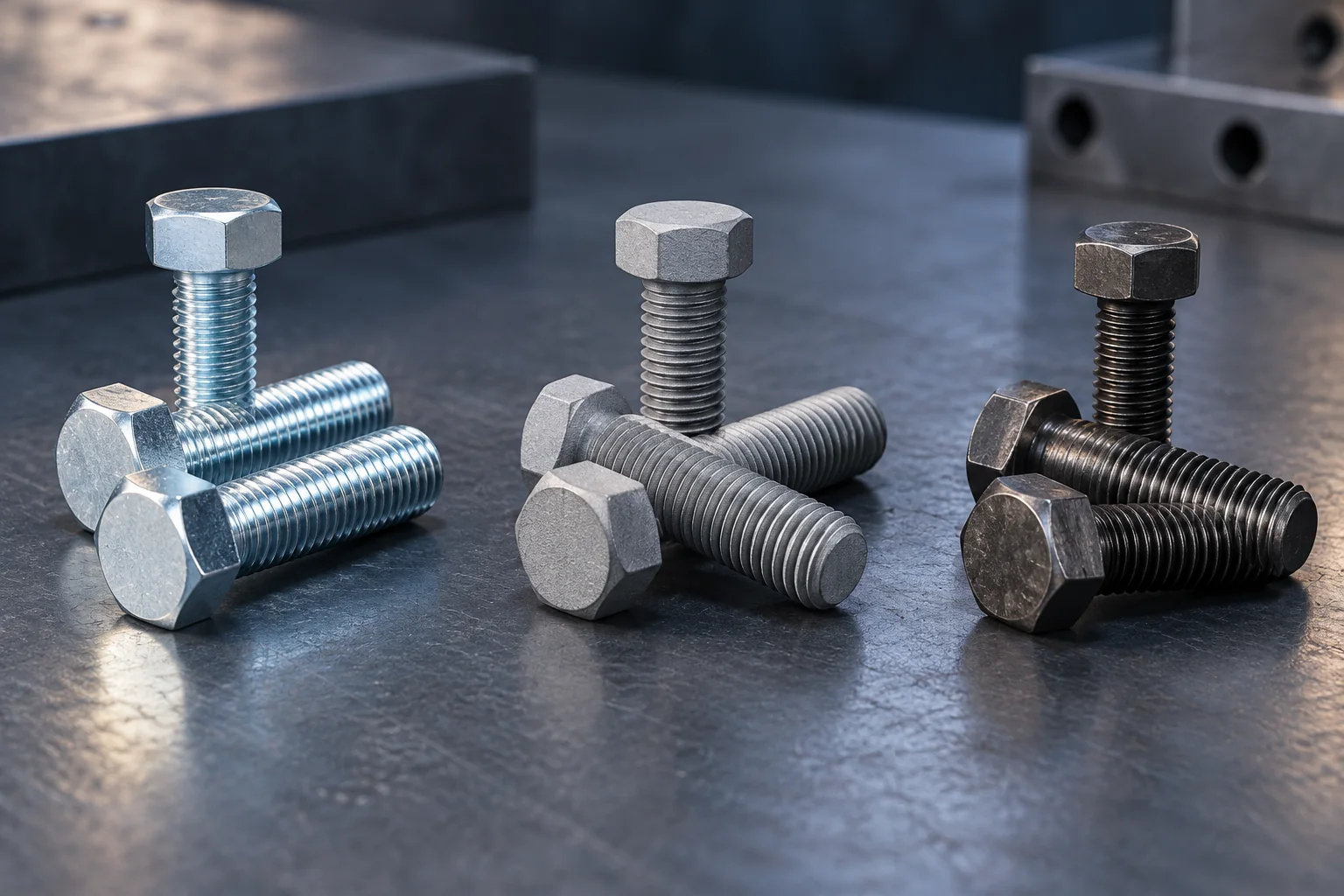
Differenze di rivestimento: zincatura a caldo, rivestimenti approvati e protezione dalla corrosione
Coating selection is one of the clearest practical differences between A325 and A490 structural bolts.
Steel structural bolts may require corrosion protection when used outdoors, in industrial atmospheres or in other environments where unprotected steel is unsuitable. However, an acceptable coating must be evaluated as part of the specified bolt assembly. Its chemistry, application process, interaction with the fastener material and effect on installation can all matter.
Why hot-dip galvanizing and zinc-flake coatings must be distinguished
Hot-dip galvanizing and mechanical galvanizing are established zinc-coating processes, but their acceptance is not identical across the two structural bolting groups.
Secondo la 2025 RCSC Specification, Group 150 bolting cannot be hot-dip galvanized or mechanically galvanized; specified ASTM F3393 zinc-flake systems are a separate, conditional route.
This distinction prevents two opposite specification errors.
The first error is ordering hot-dip galvanized A490 bolts because galvanized A325 bolts were previously accepted in a similar application. The higher-strength grade does not inherit the lower-strength group’s coating permissions.
The second error is rejecting every zinc-based coating for A490. Certain ASTM F3393 zinc-flake coating systems are permitted within the applicable RCSC requirements. That permission is not a blanket approval for any commercial zinc-flake coating, arbitrary application process or unverified bolt-and-nut combination.
The applicable coating specification, bolting grade, component configuration and qualification requirements must all agree.
Why high-strength bolt coatings receive special scrutiny
High-strength steel fasteners can be susceptible to hydrogen-assisted cracking under unfavorable combinations of material condition, applied stress and hydrogen exposure.
Coating and surface-treatment processes may introduce or influence that risk. Its significance depends on the strength and material characteristics of the fastener and the specific processing route.
This is one reason coating suitability cannot be judged solely by the appearance or nominal corrosion resistance of the finished bolt. A process that produces acceptable corrosion protection does not necessarily satisfy the requirements applicable to a particular high-strength structural bolt grade.
Measures intended to control hydrogen-related risks also do not override explicit prohibitions in the governing structural bolting specification.
There is an additional assembly consequence. Protective coatings can alter thread dimensions and frictional behavior. Galvanized or otherwise coated fasteners may require specific matching nut conditions and lubrication provisions. Combining a coated bolt with an unrelated nut is not equivalent to procuring a compliant structural bolting assembly.
When pretensioning is required, the specified assembly and installation procedure must also be capable of satisfying the applicable verification requirements. Coating qualification, product testing and field installation verification are related but separate responsibilities.
Type 3 weathering steel is another selection route
Type 3 structural bolts use weathering-steel material characteristics rather than relying exclusively on a subsequently applied protective coating.
In suitable atmospheric exposure, weathering steels can develop a protective corrosion-product layer that reduces further atmospheric corrosion compared with conventional unprotected steel. Their effectiveness depends on the environment and the conditions that allow the protective layer to develop.
Persistent wetness, aggressive chloride exposure, contaminated runoff and sheltered moisture-retaining details can change that behavior. A weathering designation alone does not establish acceptable corrosion performance in every outdoor location.
Where Type 3 bolts are specified, matching nuts and washers must also satisfy the applicable assembly requirements. Combining weathering and non-weathering components without checking the specified configuration can create an unintended materials mismatch.
The real decision is between approved protection systems for the actual service environment, not between a supposedly corrosion-proof bolt and one that always needs coating.
In a hypothetical outdoor order, the buyer changes A325 to A490 while retaining the hot-dip-galvanized finish line. The original coating permission cannot be carried across automatically. Hold the revised order, check the permitted coating route and confirm the corresponding nuts, washers and assembly evidence. Compare coating processes without treating a finish name as structural approval.
Quando gli ingegneri devono specificare A325 o A490?
A325 is a reasonable selection when the governing structural design permits Group 120 bolting and its available, compliant corrosion-protection options satisfy the project requirements.
A490 becomes relevant when the engineer specifies Group 150 bolting or establishes that the higher-strength product offers a useful advantage for the actual connection design. That decision must still account for coating restrictions, assembly requirements and installation conditions.
The comparison becomes more useful when applied to specific purchasing situations.
A connection already designed and approved for A325
If an approved connection specifies Grade A325, purchasing should follow that designation unless a formal substitution is accepted. A490 should not be treated as an automatic upgrade merely because it has a higher minimum tensile-strength level.
Changing the grade may alter design assumptions, pretension requirements, coating eligibility and matching component selection. Even when the proposed bolt has the same nominal diameter and thread, those differences require review.
A connection where higher-strength bolting is specified
If the structural design specifically requires Grade A490, substituting A325 because it is more readily available or easier to galvanize is not acceptable without an engineering review.
The lower-strength grade may not satisfy the design basis. Where corrosion protection is also required, the coating system must be compatible with the specified higher-strength bolting group rather than selected independently.
An outdoor connection requiring corrosion protection
For an outdoor structural assembly, the designer must establish whether an appropriately galvanized Group 120 assembly, an approved coated Group 150 assembly or a suitable weathering-steel configuration fulfills the combined structural and exposure requirements.
The environmental requirement cannot be separated from the mechanical requirement. A coating acceptable on one grade is not necessarily transferable to the other, while a weathering material may be unsuitable for particular wet or chloride-rich conditions.
Hypothetical selection example: a proposed bolt upgrade
Consider a hypothetical outdoor steel connection whose approved documents specify ASTM F3125 Grade A325 Type 1 bolts with a compliant hot-dip galvanized assembly.
A purchaser proposes replacing the specified bolts with Grade A490 of the same nominal diameter, also hot-dip galvanized, on the assumption that stronger bolts provide a greater safety margin.
That substitution has two separate problems.
First, the stronger bolt does not automatically increase the approved connection resistance. The design would need to be checked against the relevant limit states and installation assumptions.
Second, the proposed hot-dip galvanized Group 150 configuration conflicts with the 2025 RCSC coating restriction. Matching the original bolt diameter cannot resolve a coating prohibition.
The appropriate response is to retain the specified compliant A325 assembly unless the engineer approves a different design and matching bolting configuration. If A490 is genuinely required, the protection system must be selected from the options permitted by the governing project requirements, with any applicable ASTM F3393 qualification independently confirmed.
This is an illustrative engineering scenario, not a SUNHY customer project, test result or approval of a particular product.
Come specificare e verificare gli assiemi di bulloni A325/A490
A structural bolt order should identify more than the grade printed on the drawing.
The buyer needs sufficient information to distinguish the specified bolt product from visually similar fasteners, confirm the correct corrosion-protection system and ensure that the matching components meet the project requirements.
A practical purchasing specification should establish the following:
- Product identity: ASTM F3125/F3125M, the governing edition, Grade A325 or A490, applicable Type, product style, nominal diameter, length and thread configuration.
- Coating and exposure: Required surface protection, the exact coating specification, its eligibility for the selected grade and the relevant corrosion environment.
- Matching components: Applicable nut and washer product specifications, their grades or types, coating compatibility and any specified lubrication or assembly conditions.
- Joint requirements: The approved structural design basis, whether pretensioning is required, applicable installation method and any project-specific inspection requirements.
- Acceptance documents: Manufacturer identification, product and lot traceability, required material or mechanical test records, coating documentation and any additional project inspection evidence.
ASTM A563 nuts and ASTM F436 washers are commonly referenced in structural bolting assemblies, but their acceptable grades, types and coating combinations depend on the applicable specifications. A purchaser should not select a nut solely by nominal thread size or assume that any hardened washer satisfies every structural connection requirement.
The same principle applies to testing and documentation. A manufacturer may provide test records showing that a production lot was evaluated against specified product requirements. Those records do not by themselves demonstrate that a field-installed joint achieved the required pretension or that its installation inspection was completed correctly.
Product qualification and joint acceptance therefore require different evidence.
Bolt head markings can help identify the declared grade and manufacturer, but visual markings alone do not establish material chemistry, tensile-test compliance, coating qualification or full lot traceability. Receiving inspection should reconcile the actual components with the purchase order, applicable standard and supplied documentation.
For pretensioned assemblies, preinstallation verification and installation inspection must follow the governing requirements. A generic torque chart is not an adequate substitute for those procedures, since the torque needed to develop a particular clamp load can vary with the fastener assembly and its frictional condition.
There is also a difference between a supplier offering a nominally matching bolt and supplying a documented assembly acceptable for the specified structural work. If the requested grade, coating or matching components cannot be supported by appropriate records, the discrepancy should be resolved before substitution or installation.
The final choice should preserve the engineer’s approved connection requirements. Material strength determines only part of what a structural bolt can do; coating eligibility, matched components and verified installation requirements determine whether that bolt can be used as specified.
Domande frequenti
L'A490 è sempre il bullone strutturale migliore?
No. Il grado corretto dipende dai requisiti approvati di progetto della connessione, installazione e protezione dalla corrosione. Un gruppo con resistenza a trazione superiore non migliora automaticamente ogni giunto.
I bulloni A490 possono essere zincati a caldo secondo la norma RCSC 2025?
No. La specifica citata vieta tale soluzione per i bulloni del Gruppo 150. Le altre soluzioni di rivestimento ammissibili sono soggette a condizioni separate e devono essere verificate.
Posso riutilizzare la specifica del dado A325 dopo il passaggio ad A490?
Verificare nuovamente. I gradi di dado ammessi dipendono dal gruppo del bullone, dal tipo e dalle condizioni di rivestimento; un diametro nominale della filettatura corrispondente non è sufficiente.