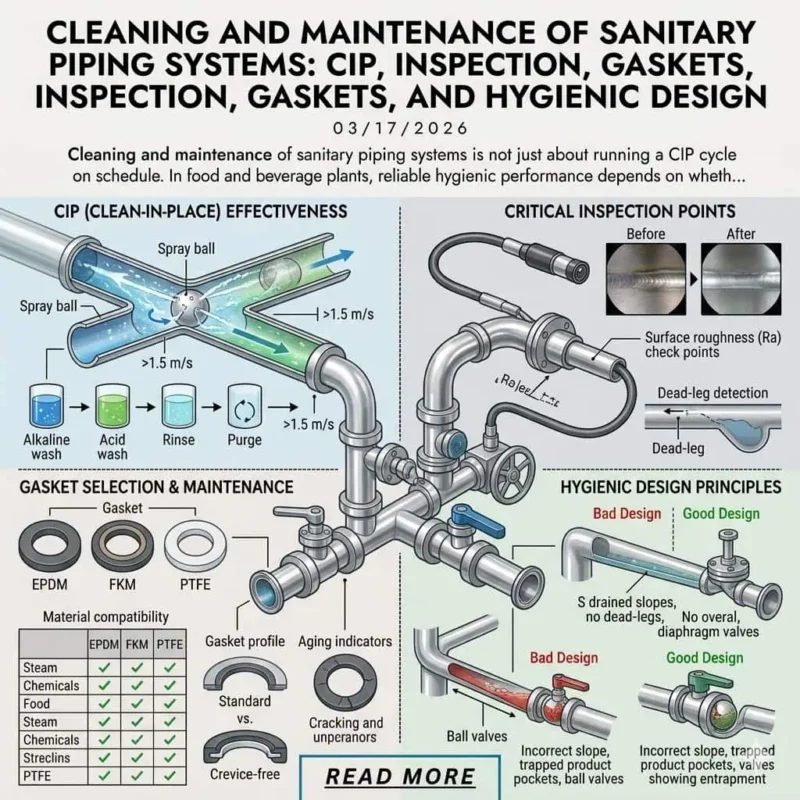
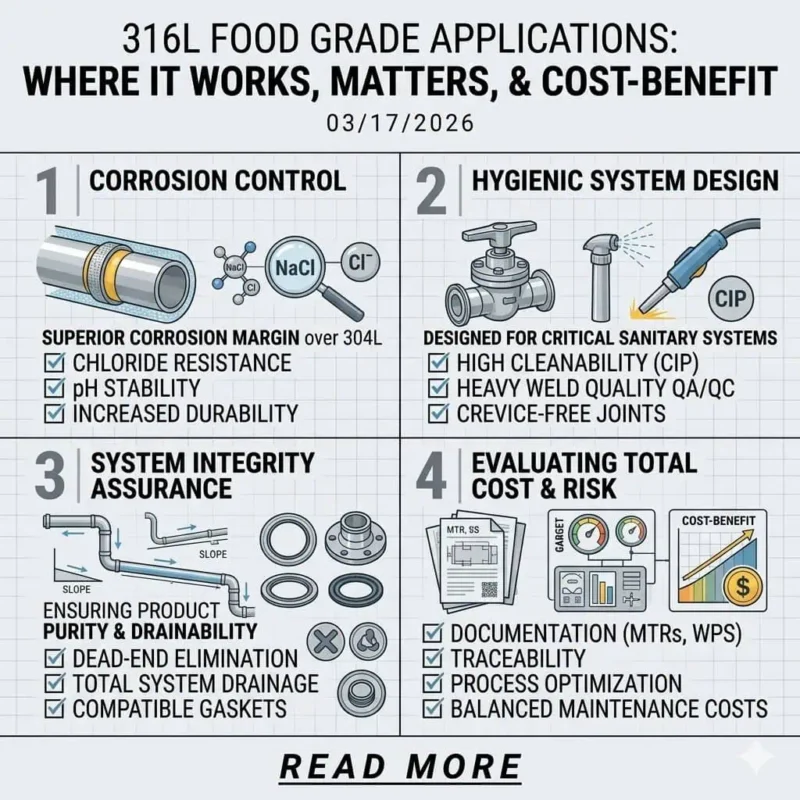
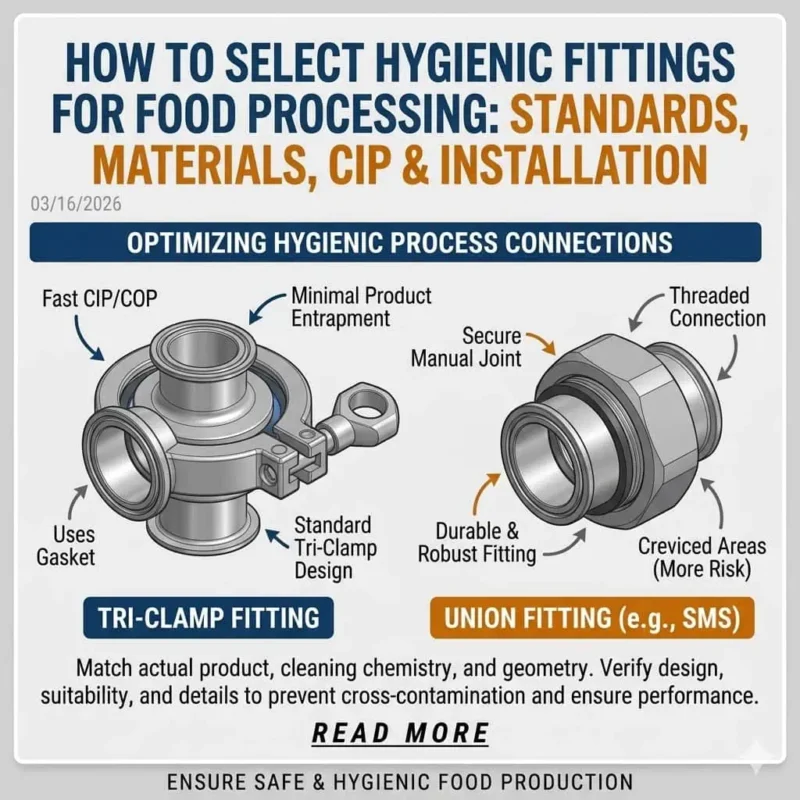
When you compare sanitary and industrial pipe fittings, the real difference is not just appearance or price. Sanitary fittings are engineered for hygienic product-contact service, validated cleanability, and audit-ready material control. Industrial fittings are engineered for pressure containment, mechanical duty, and broad utility service. Choosing the wrong category can create dead legs, cleaning failures, gasket compatibility problems, leakage, and non-conformance during customer or regulatory inspections. The table below shows the practical compliance split:
| نوع التركيبة | Typical Compliance Basis | لماذا يهم |
|---|---|---|
| صحي | معايير 3-A الصحية, ASME BPE, FDA CGMP equipment requirements, EHEDG hygienic design guidance | Supports cleanability, contamination control, traceability, and inspection readiness in food, beverage, biotech, and pharmaceutical systems. |
| صناعي | ASME B16.9, ASME B16.11, ASTM material specificationsو API standards where oilfield service applies | Controls dimensional compatibility, wall thickness selection, pressure class, and material performance in utility and process-duty piping. |
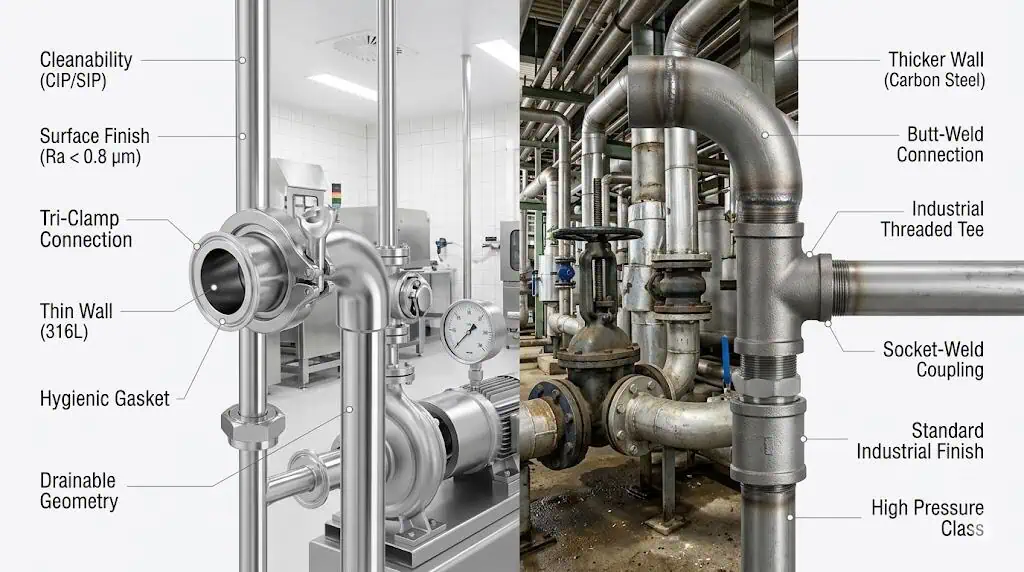
In real projects, wrong fitting selection rarely fails on day one. It usually appears later as repeated CIP complaints, trapped product at branches, clamp leakage after thermal cycling, thread seepage in hot service, or a rejected FAT/SAT package because the documentation does not match the stated hygienic duty. With over 30 years of engineering experience, SUNHY focuses on matching fitting design to actual service conditions instead of relying on generic catalog descriptions.
نظرة عامة على وصلات الأنابيب الغذائية
التعريف والميزات
You use sanitary pipe fittings when the piping system is part of the product-contact boundary or when the line must be cleaned repeatedly to a validated standard. In practice, that means the fitting must do more than resist corrosion. It must also support smooth internal flow, minimal crevice risk, full drainability where required, controlled weld quality, and elastomer compatibility with the cleaning regime. Most sanitary systems use stainless steel, often 304L or 316L, with 316L preferred when chloride exposure, acidic cleaners, or higher purity expectations make corrosion margin more important.
A good sanitary fitting is evaluated by what happens after installation: whether product drains out, whether CIP reaches the seat and branch intersection, whether the gasket stays compressed without extrusion, and whether the internal surface remains cleanable after repeated thermal and chemical cycles. Those details matter more than a polished outer appearance.
| الميزة | Why It Matters in Service |
|---|---|
| Smooth internal surface | Reduces product hold-up, lowers adhesion of residues, and improves repeatable cleaning results. |
| Crevice-conscious geometry | Helps prevent microbial harboring points at junctions, gasket grooves, and branch intersections. |
| Drainable layout support | Reduces stagnant product or rinse liquid, especially after shutdown, CIP, and changeover. |
| Controlled weld quality | Poor weld penetration or undercut can create hygiene defects even when the base material is correct. |
| Non-reactive materials | Protects product purity and avoids leaching, taint, or unwanted reaction with process media and cleaning chemicals. |
| مقاومة التآكل | Critical when the line sees caustic wash, acid rinse, chloride-bearing water, or aggressive product formulations. |
| أداء إحكام جيد | Prevents micro-leaks, product ingress behind the gasket, and loss of hygiene during pressure or thermal cycling. |
| إمكانية تتبع المواد | Supports FAT/SAT documentation, MTC review, and customer audit requirements in regulated industries. |
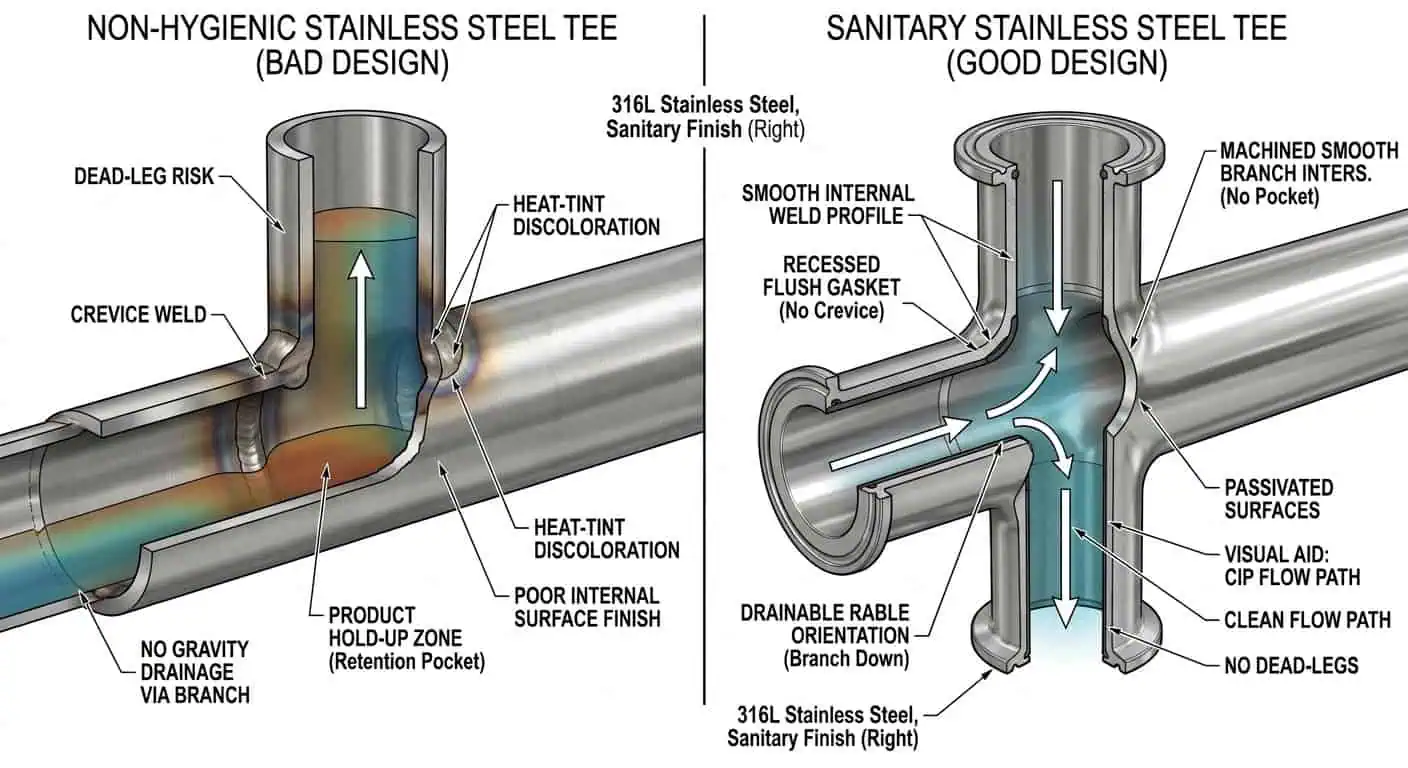
مثال هندسي: In one dairy transfer line, a polished external tee still failed hygiene review because the branch orientation and internal weld profile created a retention point after CIP. The corrective action was not “better polishing.” It required changing the branch arrangement, reworking the weld, and rechecking drainability under actual shutdown conditions.
Tip: Choose sanitary pipe fittings only when the system must be cleanable, inspectable, and compatible with your product-contact risk level—not just because the outside finish looks smoother.
تطبيقات في الغذاء والأدوية
You find sanitary pipe fittings in dairy lines, breweries, beverage batching skids, biotech process modules, cosmetics production, purified water loops, and pharmaceutical transfer systems. In these systems, the fitting is part of the contamination-control strategy. It must not trap product, interfere with cleaning validation, or introduce an unqualified material into the product path.
Food systems emphasize hygienic design and cleanability. Pharmaceutical and biotechnology systems add stricter expectations for documentation, material verification, weld control, and cleaning or sterilization discipline. That is why a fitting acceptable in a utility line may still be rejected in a product-contact pharmaceutical line.
| مجال التطبيق | What the Fitting Must Achieve |
|---|---|
| الأغذية والمشروبات | Maintain hygienic product contact, support repeatable CIP, resist flavor carryover, and simplify inspection after changeovers. |
| منتجات الألبان | Handle protein and fat residues without creating hold-up points that are difficult to clean. |
| Pharmaceutical and Biotechnology | Support high-purity service, documentation control, weld quality requirements, and validated cleaning or sterilization procedures. |
| Purified Water / High-Purity Water | Minimize rouging risk, dead legs, and contamination points that can destabilize water quality over time. |
| Cosmetics and Personal Care | Prevent residue build-up in viscous products and allow efficient line cleaning between product variants. |
You may also use sanitary relief valves, diaphragm valves, and mixproof valve arrangements in these systems. The fitting selection must still align with the same hygiene logic: cleanable geometry, chemical compatibility, and documented material control.
المواد والمعايير
You usually select sanitary fittings around stainless steel construction and hygienic tubing systems. ASTM A270 is commonly referenced for sanitary tubing in food and dairy service, while ASME BPE is widely used when the process requires a defined purity and bioburden control framework. For hygienic design evaluation, engineers also reference 3-A و EHEDG depending on project region and customer specification.
Material selection should follow the real cleaning chemistry and operating environment. 304L may be acceptable in less aggressive service, but many engineers move to 316L when chloride-bearing water, acidic rinse steps, or long-term corrosion margin become concerns. Gasket material is part of the same decision. A good stainless fitting paired with the wrong elastomer can still fail in service.
| قياسي | Engineering Relevance |
|---|---|
| معايير 3-A الصحية | Used widely in food, beverage, and dairy projects for hygienic equipment design and fabrication expectations on product-contact surfaces. |
| ASME BPE | Applies to equipment used in industries requiring defined purity and bioburden control, including materials, design, fabrication, and inspection expectations. |
| EHEDG hygienic design guidance | Useful for evaluating cleanability, geometry risk, and hygienic design logic, especially in European and multinational projects. |
| FDA CGMP equipment requirements | Important in pharmaceutical manufacturing because product-contact surfaces must be suitably designed and must not adversely affect product quality. |
| ASTM A270 | Common sanitary tubing specification for dairy and food service, with supplementary pharmaceutical quality requirements where specified. |
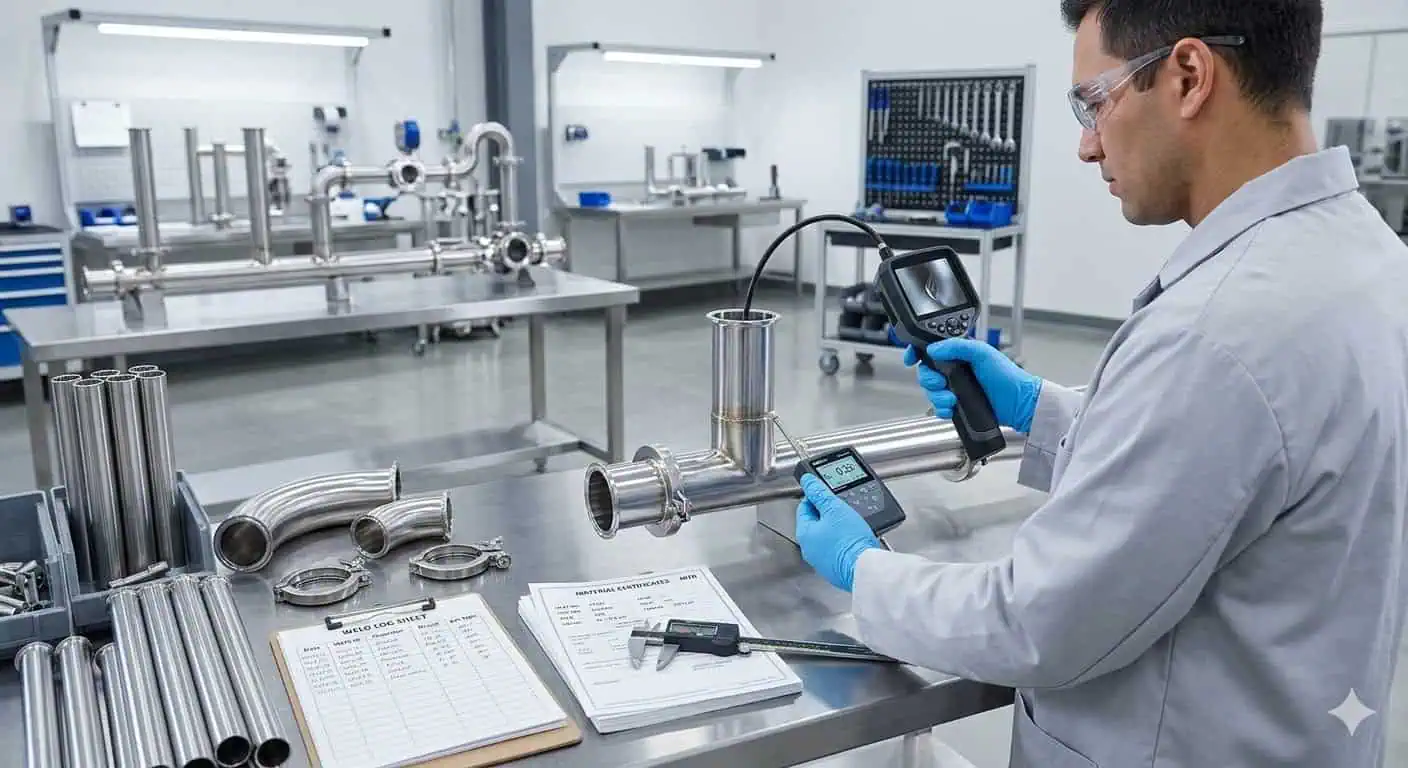
مثال هندسي: A plant reused 304 fittings in a line that later adopted a more aggressive cleaning program. The fittings did not fail immediately, but repeated exposure to the revised chemistry increased staining and local corrosion risk at heat-affected zones. The fix required reviewing not only the alloy but also weld finish, passivation practice, and the cleaning recipe itself.
You achieve reliable hygienic performance when the fitting, tube, gasket, weld procedure, and documentation package are treated as one system rather than separate purchase items.
نظرة عامة على تجهيزات الأنابيب الصناعية
التعريف والميزات
تستخدم مُقابِلَات الأنابيب الصناعية to connect, branch, reduce, cap, or redirect flow in systems designed primarily around pressure boundary integrity and mechanical service. These fittings are selected by size, wall thickness, end preparation, pressure class, material grade, corrosion allowance, and applicable code. They may be buttweld, socket-weld, threaded, grooved, or flanged depending on service needs and maintenance philosophy.
Industrial fittings are not a lower-quality version of sanitary fittings. They solve a different engineering problem. The design target is strength, interchangeability, and long-term service under duty conditions such as pressure cycling, vibration, erosion, high temperature, low temperature, or aggressive media.
That is why you often see thicker walls, forged construction, or more code-driven dimensional control in industrial systems than in sanitary product-contact lines.
التطبيقات في البيئات الصناعية
You see industrial pipe fittings across utilities, process plants, energy infrastructure, and heavy manufacturing. The right fitting depends on the medium, the governing code, and the consequence of failure. A utility water line, a steam header, a corrosive chemical line, and an oilfield manifold do not use the same selection logic even when the nominal pipe size is identical.
| الصناعات | التطبيقات النموذجية |
|---|---|
| النفط والغاز | Wellhead tie-ins, manifolds, gathering systems, production flow lines, and high-pressure utility services. |
| المعالجة الكيميائية | Corrosive liquid transfer, solvent handling, utility headers, and reactor support piping. |
| Water and Wastewater | Municipal distribution, treatment skids, chemical dosing, sludge handling, and maintenance-access piping. |
| HVAC and Building Services | Chilled water, heating water, condensate return, refrigerant piping, and mechanical room interconnections. |
| توليد الطاقة | Steam systems, feedwater support lines, cooling water, and auxiliary process services. |
| التعدين ومعالجة المعادن | Slurry transport, abrasion-prone transfer lines, and dewatering systems. |
| البحرية وبناء السفن | Fuel, ballast, cooling, and machinery support piping in vibration-prone conditions. |
| Semiconductor / Specialty Utilities | Utility and support services where industrial design rules apply, even if product-contact process lines use stricter clean piping standards. |
نصيحة: In industrial service, do not choose a fitting by shape alone. Check the governing code, material grade, corrosion mechanism, pressure-temperature envelope, and inspection requirement first.
المواد والمعايير
You select industrial fittings from materials such as carbon steel, stainless steel, low-alloy steel, duplex stainless, or nickel alloys depending on pressure, corrosion, and temperature demands. For buttweld fittings, engineers commonly reference ASME B16.9 للأبعاد و ASTM A234 أو ASTM A403 for material specifications. For threaded and socket-weld forged fittings, ASME B16.11 is a common basis. In oilfield wellhead and tree equipment, API 6A may govern the service class and design expectations.
| منظمة المعايير | المعايير الرئيسية | What Engineers Use Them For |
|---|---|---|
| ASME | B16.9, B16.11 | Dimensions, tolerances, ratings, markings, and end-connection rules for common industrial fitting categories. |
| ASTM | A234, A403, A182 | Material chemistry, heat treatment, and mechanical property basis for carbon steel, alloy steel, and stainless fittings. |
| API | 6A | Oilfield-specific requirements for wellhead and tree equipment where service severity and pressure class are critical. |
| ISO / Quality Systems | ISO 9001 and project-specific QMS requirements | Supports manufacturing quality assurance, documentation flow, and supplier qualification, but does not replace product design standards. |
مثال هندسي: A hot service branch connection that looked acceptable on paper kept seeping at a threaded joint after repeated thermal cycles. The root issue was not only assembly torque. The service was better suited to a welded arrangement with a more stable joint design for that duty.
Always verify the material standard, dimensional standard, and end-connection method together. A fitting can have the right shape and still be the wrong product if the grade, class, or code basis does not match your line class.
صحي مقابل صناعي: مقارنة
النظافة والنظافة
You must prioritize hygiene and cleanability when the pipeline is part of the product-contact or high-purity boundary. وصلات الأنابيب الصحي are designed to reduce contamination risk through geometry, surface control, weld quality, and cleaning access. Industrial pipe fittings are designed around service integrity, not validated cleanability. They may perform well mechanically and still be the wrong choice for hygiene-sensitive duty.
| الجانب | وصلات الأنابيب الصحي | وصلات الأنابيب الصناعية |
|---|---|---|
| Primary design goal | Cleanability, contamination control, audit-ready product contact | Pressure containment, durability, dimensional compatibility |
| الهندسة | Crevice-conscious, drainable where required, reduced hold-up risk | Optimized for service duty, not necessarily for hygienic cleaning validation |
| Surface expectations | Controlled internal finish and weld condition matter | Surface finish varies by service and is often secondary to strength and corrosion allowance |
| Gasket evaluation | Hygienic seal design and cleaning compatibility are critical | Seal selection focuses more on pressure, temperature, and chemical duty |
| Inspection priority | Drainability, weld quality, surface condition, traceability | Material grade, schedule/class, NDE requirements, mechanical integrity |
نصيحة: If the consequence of residue retention is contamination, spoilage, or failed cleaning validation, start from sanitary design logic—not from the lowest purchase price.
تصنيفات الضغط ودرجة الحرارة
You must evaluate pressure and temperature ratings as a system issue, not a fitting-only issue. In sanitary piping, the limit is often influenced by thin-wall tube geometry, clamp design, gasket material, and the actual assembly condition. In industrial piping, the rating is usually tied more directly to wall thickness, forged or wrought fitting class, code basis, and material grade.
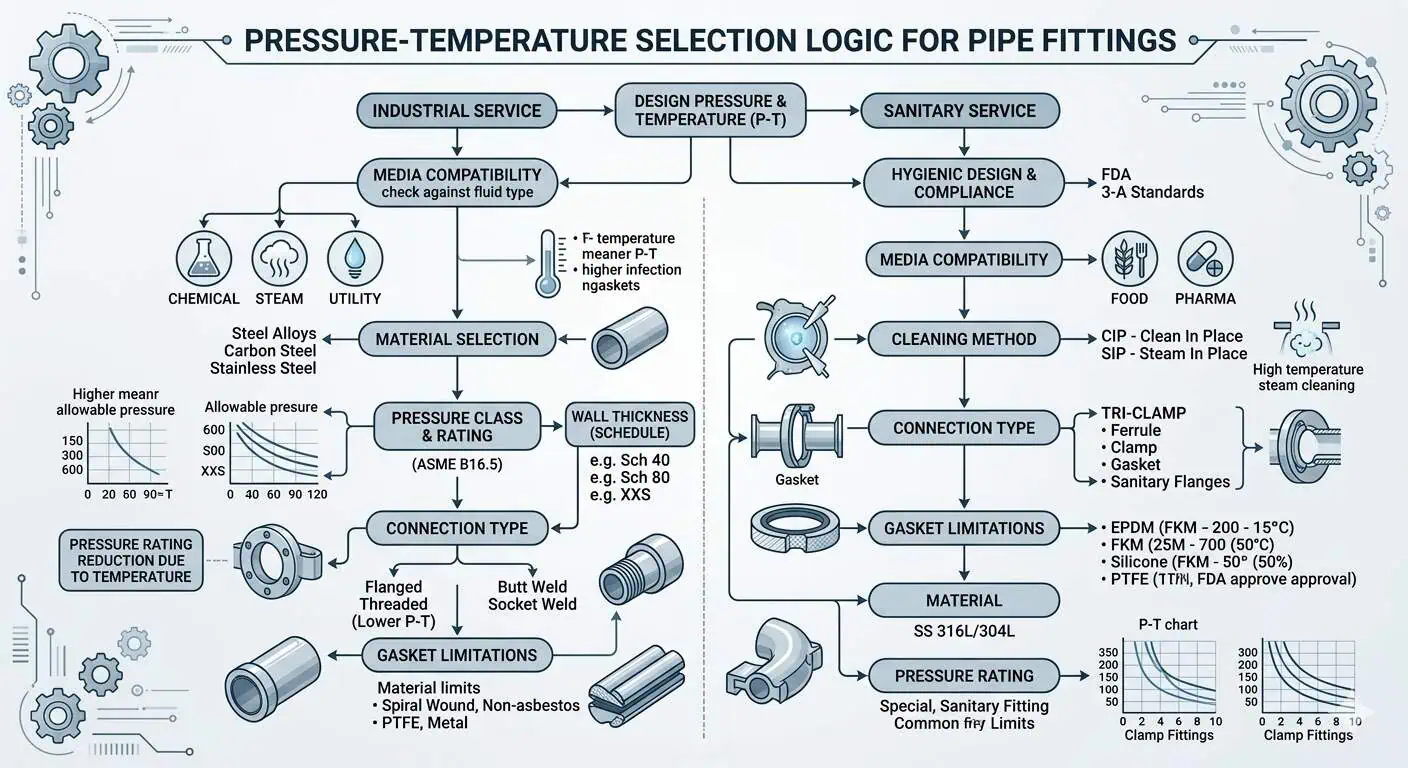
وصلات غذائية support safe operation in food, beverage, and pharmaceutical systems when the full assembly has been selected correctly. التركيبات الصناعية are generally preferred where higher mechanical load, thicker sections, or more severe pressure-temperature service is expected. Always verify the final allowable rating against the manufacturer’s data, the gasket compound, and the project code—not by material grade alone.
توافق المواد
You select materials based on product chemistry, cleaning chemistry, water quality, corrosion risk, and service temperature. Stainless steel 316L usually provides more corrosion margin than 304 in chloride-sensitive or higher-purity service. Carbon steel is common in general industrial systems but is not suitable for hygienic product-contact duty. Plastics such as UPVC or CPVC can perform well in selected chemical services, but temperature, solvent compatibility, impact resistance, and installation environment must be checked carefully.
Material compatibility is not just a metal choice. It also includes the gasket, lubricant policy, weld consumables, passivation method, and whether the assembled joint will stay stable after repeated cleaning cycles or temperature swings.
التثبيت والصيانة
You benefit from easier teardown and inspection with sanitary fittings, especially clamp systems used in equipment skids and product-contact branches. That does not mean they are maintenance-free. They require disciplined gasket handling, correct alignment, controlled tightening, and regular inspection for seal wear, surface damage, and assembly cleanliness.
- Sanitary fittings: Fast disassembly, easier visual inspection, frequent cleaning, tighter control of gasket condition, weld quality, and surface damage.
- Industrial fittings: Better suited for harsh utility and process duty, often lower intervention frequency, maintenance driven by pressure, corrosion, fatigue, and inspection intervals rather than hygiene checks.
مثال هندسي: A sanitary clamp joint that leaked repeatedly was traced to mixed ferrule geometry and reused gaskets, not poor stainless quality. Once the team standardized the ferrule interface and gasket replacement rule, the leak history stopped.
عوامل التكلفة
You must compare total lifecycle cost, not only purchase cost. Sanitary fittings often cost more because they require tighter fabrication control, better documentation, and more demanding surface or weld expectations. Industrial fittings may have lower unit cost for comparable sizes, but they are not interchangeable with sanitary fittings in regulated product-contact service.
| الميزة | وصلات الأنابيب الصحي | وصلات الأنابيب الصناعية |
|---|---|---|
| التكلفة الأولية | Usually higher due to hygienic design, documentation, and controlled fabrication expectations | Often lower for equivalent size because selection is driven more by duty and code class than hygiene finish |
| تكلفة الصيانة | Includes inspection, gasket management, cleaning verification, and potential downtime for hygiene-related checks | Driven more by corrosion, pressure duty, vibration, and inspection interval |
| قيمة دورة الحياة | Protects product quality, compliance, and line cleanability | Provides durability, availability, and broad service flexibility |
ملاحظة: In regulated service, a cheaper non-hygienic fitting can become the most expensive option once rework, downtime, rejected product, or failed inspection is included.
إيجابيات وسلبيات وصلات الأنابيب
مزايا وعيوب الوصلات الغذائية
Sanitary pipe fittings give you a clear advantage when hygiene is a hard requirement rather than a preference. Their stainless construction, geometry, and documentation practices support cleaner operation and easier compliance in food, beverage, pharmaceutical, and biotech systems.
| ميزة | الوصف |
|---|---|
| Better cleanability | Smoother internal surfaces and crevice-conscious geometry improve rinse-out and reduce residue retention risk. |
| مقاومة التآكل | Stainless materials, especially properly specified and finished grades, help protect product quality and line integrity. |
| Audit readiness | Traceability, standard alignment, and easier inspection support customer and regulatory review. |
| Faster teardown | Clamp-style assemblies simplify inspection and changeover in many sanitary skid applications. |
You also gain these practical benefits:
- Lower contamination risk when the full assembly is designed correctly
- Better visibility during inspection and maintenance
- Stronger fit with validated cleaning and changeover procedures
However, you should also consider the limitations:
- Higher purchase cost and tighter installation discipline than general industrial fittings.
- Not automatically suitable for very abrasive or extremely high-pressure service just because the fitting is stainless.
- Gasket selection errors can undermine performance even when the fitting body is correct.
- Poor field welding or poor branch layout can destroy hygienic performance despite using “sanitary” components.
نصيحة: A sanitary fitting only performs as intended when the tube, weld, gasket, slope, branch orientation, and cleaning method are engineered together.
Industrial Fittings Advantages and Disadvantages
Industrial pipe fittings excel where strength, availability, pressure class, and mechanical robustness control the design. They offer broad material options and strong compatibility with utility, process, and high-duty piping specifications.
| نوع المادة | المزايا |
|---|---|
| Carbon / Low-Alloy Steel | Strong, widely available, economical for many pressure services, and suitable for welded industrial piping systems. |
| الفولاذ المقاوم للصدأ | Improved corrosion resistance, strong temperature capability, and broad use across chemical, utility, and specialty services. |
| Duplex / Nickel Alloy | Selected when chloride stress, severe corrosion, or demanding chemical conditions exceed standard stainless capability. |
You will find these fittings essential in oil and gas, chemicals, power generation, water treatment, marine service, and general process plants. They help you build durable piping networks with strong code alignment and broad market availability.
Still, these drawbacks matter if you place industrial fittings in hygiene-sensitive systems:
| Typical Issue | Why It Becomes a Problem in Sanitary Duty |
|---|---|
| Threads and crevices | Can retain product, moisture, or cleaning residues and are difficult to validate hygienically. |
| Rougher internal profile | May increase residue hold-up and make repeatable cleaning harder. |
| Duty-first geometry | Optimized for pressure service, not necessarily for drainability or contamination control. |
| Material/document mismatch | May not satisfy product-contact audit expectations even if mechanically acceptable. |
ملاحظة: Industrial fittings offer durability and value in the right line class, but they should not be treated as a substitute for hygienic product-contact fittings.
Choosing the Right Pipe Fitting
Key Factors for Selection
You must evaluate several engineering factors before choosing between sanitary and industrial pipe fittings. The right decision protects product quality, limits leakage risk, and reduces costly rework during commissioning and operation.
- Process-contact risk: Is the line product-contact, high-purity, clean utility, or general utility service? This usually decides the first branch of the selection logic.
- Compatibility with process media and cleaners: Check the fitting body, gasket, and any weld or surface treatment against actual product chemistry and the full cleaning cycle.
- Pressure and temperature envelope: Review the full assembly rating, not only the alloy name or nominal size.
- Connection philosophy: Decide whether the line benefits more from hygienic clamp access, permanent welded construction, threaded convenience, or forged socket-weld strength.
- Inspection and maintenance method: If the line must be opened, inspected, and cleaned frequently, sanitary assemblies may reduce downtime and inspection effort.
- Documentation and customer specification: Food, biotech, and pharmaceutical projects often require a stronger document package than general utility projects.
- Lifecycle cost: Include cleaning time, gasket replacement, downtime, requalification, and possible audit exposure.
نصيحة: The first question is not “Which fitting is better?” It is “What service does the line actually perform, and what happens if the joint traps residue or fails under duty?”
الأخطاء الشائعة التي يجب تجنبها
You can avoid expensive commissioning and maintenance problems by preventing these common selection mistakes:
- Choosing by material name alone: “Stainless steel” does not guarantee hygienic suitability, correct pressure rating, or corrosion resistance for your actual cleaning cycle.
- Ignoring branch geometry and drainability: A fitting can be nominally sanitary and still create a dead zone if orientation and layout are wrong.
- Mixing incompatible connection standards: Similar-looking clamp parts, tube ODs, or gasket profiles can still misfit and leak.
- Using the wrong gasket compound: Seal failure often comes from cleaner, solvent, or temperature incompatibility rather than body material failure.
- Overlooking documentation requirements: Missing MTCs, weld records, or surface-finish evidence can delay acceptance even when the hardware is already installed.
مثال هندسي: One packaged skid passed hydrotest but failed customer acceptance because ferrules from different connection systems were mixed during final assembly. The leak appeared only after thermal cycling and repeated opening. The corrective action required replacing matched connection sets, retraining installers, and updating the spare-parts rule.
ملاحظة: Most field failures come from mismatch—mismatch between duty and design, between chemistry and gasket, or between dimensional standard and assembly practice.
Sanitary Valve vs Industrial Valve
Valve Types and Uses
You need to apply the same logic to valves as you do to fittings. A sanitary valve is designed for hygiene, cleanability, and contamination control. An industrial valve is designed primarily for flow isolation, throttling, pressure duty, or severe-service performance. The external material may look similar, but the internal design intent is different.
Sanitary systems commonly use butterfly valves, diaphragm valves, seat valves, and mixproof valves where cleanability and product segregation matter. Industrial systems rely more on ball, gate, globe, check, plug, and severe-service valve designs where pressure class, shutoff behavior, erosion, and maintainability are the main concerns.
| Type of Valve | التطبيقات الشائعة | الخصائص الرئيسية |
|---|---|---|
| Sanitary valves | Food and beverage processing, pharmaceutical and biotechnology lines, cosmetics, purified water and high-purity systems | مصممة لـ hygiene and contamination control, easier to clean, with geometry and seal design chosen to support hygienic service. |
| Industrial valves | Oil and gas, chemical and petrochemical plants, power generation, water treatment, building utilities, and general process industry | Built for duty, pressure class, durability, and shutoff performance under harsh mechanical and chemical conditions. |
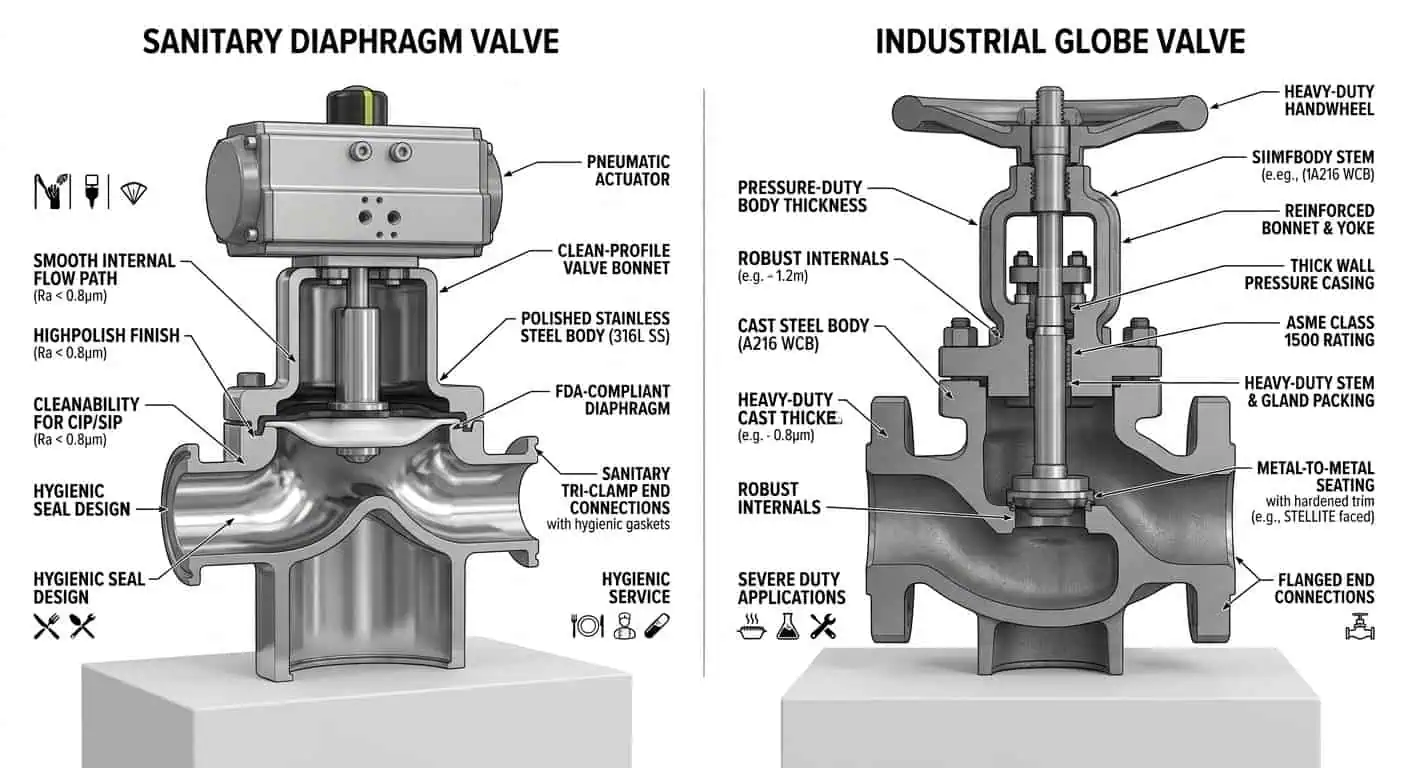
You select a hygienic valve when product quality can be affected by residue retention, seal design, or cleaning access. You rely on industrial valves when severe duty, isolation performance, and code-driven pressure service dominate the requirement.
المعايير والشهادات
You must confirm the valve standard and certification path before final selection. For sanitary valves, project documents often reference 3-A, FDA-related material expectations, EHEDG guidance, or ASME BPE depending on the industry and region. For industrial valves, engineers typically verify ASME, API, and project-specific pressure-temperature and material requirements.
- 3-A Sanitary Standards: Commonly required in food and beverage hygienic service.
- FDA-related CGMP expectations: Important in pharmaceutical and other regulated product-contact environments.
- EHEDG guidance: Useful for hygienic design and cleanability review.
- ASME BPE: Frequently used in bioprocessing and higher-purity systems.
- ASME / API standards: Typical basis for industrial pressure-duty valve selection.
Tip: Always verify whether the valve is being selected for product-contact hygiene or for pressure-duty performance. The wrong basis leads to the wrong valve even if the body material looks premium.
You prioritize hygiene, cleanability, and compliance with sanitary fittings, while industrial fittings focus on pressure duty, code alignment, and broad service capability. In real engineering work, geometry, flow behavior, material selection, branch layout, cleaning method, and document control matter more than catalog labels.
| وصف الأدلة | Key Focus Areas |
|---|---|
| Geometry, flow path, and seal arrangement determine whether a fitting or valve can actually be cleaned in service. | Hygiene, Cleanability, Compliance |
| Weld profile and branch orientation can create hidden retention points even when stainless steel is specified correctly. | Hygiene, Cleanability |
| Pressure class, wall thickness, and connection method dominate industrial fitting reliability under mechanical duty. | Strength, Code Compliance, Durability |
| Lifecycle cost depends on downtime, replacement frequency, cleaning burden, and acceptance documentation—not unit price alone. | Lifecycle Value, Reliability |
You should evaluate media, process risk, cleaning requirements, documentation expectations, and lifecycle cost before making a final selection. High-quality stainless steel fittings can improve corrosion resistance and maintenance stability, but only when the fitting type truly matches the service. SUNHY’s engineering approach emphasizes traceability, modularity, and service-based selection to support long-term reliability.
- Improved corrosion resistance when alloy and finish match the actual cleaning chemistry
- Modular piping solutions that simplify inspection and future maintenance planning
- Longer service life when geometry, material, and connection type are selected as a system
Evaluate real service conditions instead of choosing by appearance, polished finish, or initial price alone.
الأسئلة الشائعة
What is the main difference between sanitary and industrial pipe fittings?
Sanitary fittings are designed for cleanability, contamination control, and product-contact compliance. Industrial fittings are designed for pressure duty, dimensional compatibility, and mechanical service. If the line is part of the hygienic product path, sanitary design is usually the correct starting point.
Which materials are common for industrial pipe fittings?
Common industrial fitting materials include carbon steel, stainless steel, low-alloy steel, duplex stainless, and selected nickel alloys. The correct grade depends on pressure, temperature, corrosion mechanism, and the governing code.
Why does surface finish matter in sanitary fittings?
Surface finish matters because rough or damaged internal surfaces retain product and make cleaning less reliable. In hygienic service, finish must be considered together with weld quality, gasket design, and branch geometry.
How do I ensure my fittings meet regulatory certification?
Check the project specification, request the supporting documentation, and verify that the fitting standard matches the actual service. In sanitary projects, that may include material traceability, tubing or fitting standard references, weld documentation, and evidence aligned with 3-A, ASME BPE, FDA-related requirements, or customer hygienic specifications.
Can I use industrial fittings for food or pharma applications?
Not as a default. Standard industrial fittings may be mechanically adequate but still fail hygienic requirements because of geometry, finish, thread crevices, or missing documentation. Use them only where the line is clearly outside the hygienic product-contact boundary and the project specification allows it.